

Study Playlists GCSE Arabic Focus: Do They Help?
Study playlists GCSE Arabic focus advice: discover when music helps, why lyrics distract, and how to test silence against instrumentals before exams.

Revision can begin with a strangely demanding decision: what should you listen to? Ten minutes later, the playlist has a new title, the cover image looks perfect, and no Arabic has been revised.
The short answer on study playlists GCSE Arabic focus is this: a playlist may help you begin, settle into a routine or mask unpredictable background noise, but research does not show that instrumental music reliably improves learning compared with silence. Music with lyrics is riskier, particularly when you are reading, writing or memorising language.
That does not make every study playlist useless. It means the value often lies in the ritual around the music rather than in the music itself. The important question is not whether a playlist feels productive. It is whether you can remember more, understand more and perform better afterwards.
The quick verdict
Use this checklist before pressing play:
- Choose silence for Arabic reading, vocabulary recall and difficult writing.
- If silence is uncomfortable or your surroundings are noisy, try quiet instrumental music.
- Avoid familiar songs, prominent melodies and lyrics in any language during demanding verbal work.
- Turn all music off for Arabic listening practice.
- Complete some revision in exam-like silence so the real paper does not feel unfamiliar.
- Judge your playlist using quiz results and completed work, not mood alone.
- Keep the playlist ready in advance so selecting music does not become procrastination.
The same principle applies when you switch from Arabic to GCSE maths: match the sound to the task. Routine calculations may tolerate unobtrusive instrumentals, while a difficult proof, multi-step problem or timed paper usually deserves quiet.
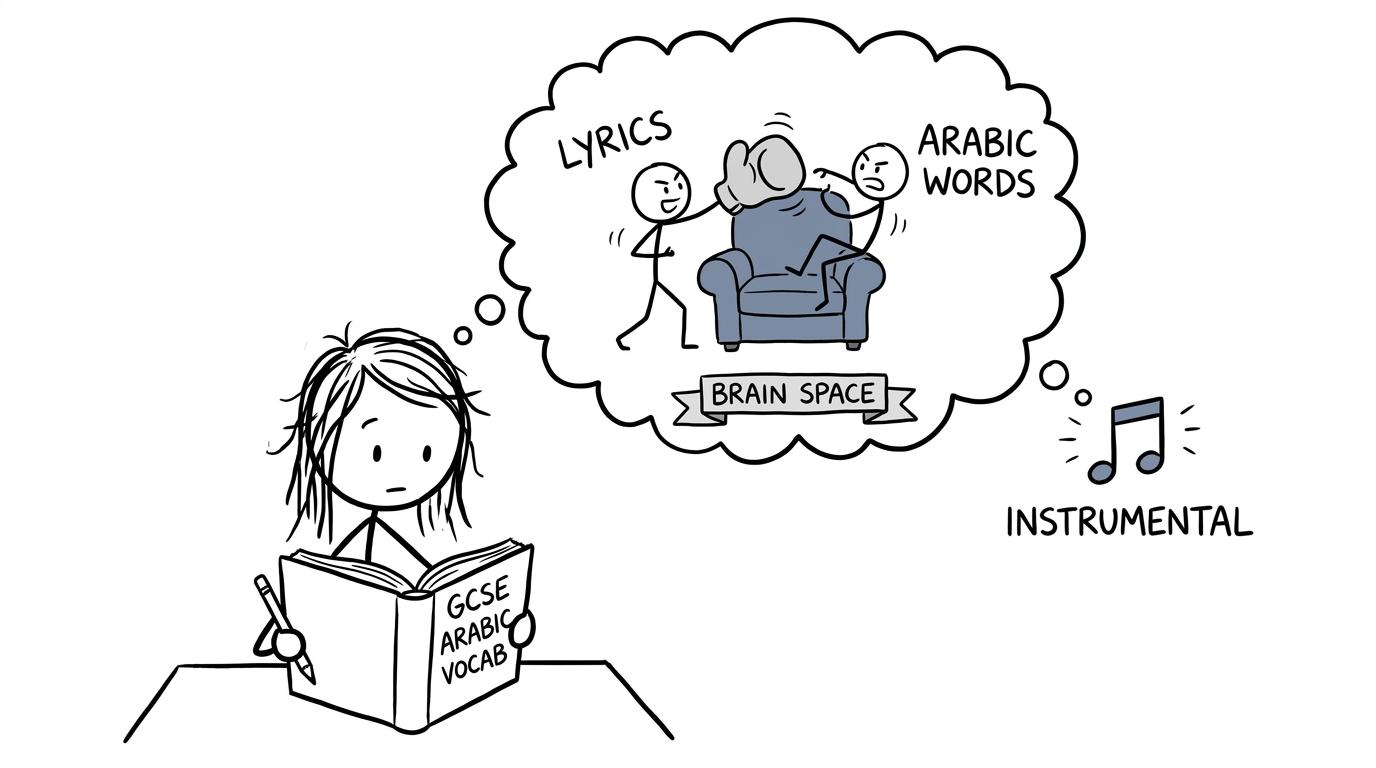 Two forms of language competing for one chair in a student's attention
What the research actually suggests
Research into background music is more cautious than playlist culture tends to be. A systematic review published in 202220222022 found that effects varied with the task, music and listener. It did not support the idea that background music produces a universal improvement in cognitive performance. Music containing lyrics was more likely to harm memory and language-related tasks than instrumental music.
A controlled study published in 202320232023 compared silence, instrumental lo-fi music and music with lyrics. The participants were university students rather than GCSE pupils, so its findings should not be treated as a direct prediction for every teenager. Still, the pattern is useful: lyrics harmed verbal and visual memory and reading comprehension, while instrumental lo-fi music produced no credible improvement over silence.
Research published in 202420242024 also found that pop music with lyrics reduced reading comprehension. Interference was stronger in some conditions when the lyrics and written text used the same language. Listening habits influenced the size of the distraction, but familiarity with studying to music did not turn lyrical music into a reliable learning advantage.
Together, these findings support a measured conclusion. Instrumental music may be neutral or personally useful in some settings. Lyrics create a clearer risk, especially when language processing is already doing most of the work. None of this proves that every student will respond identically, and much of the research involves adults rather than GCSE candidates. It does, however, challenge the confident claim that a curated playlist automatically improves concentration.
Why GCSE Arabic places unusual demands on attention
For Pearson Edexcel GCSE Arabic, the qualification assesses listening, speaking, reading and writing. Each skill contributes 25%25\%25% of the qualification, with foundation and higher tier papers. Those four skills do not place the same demands on your attention, so one sound environment will not suit every revision task.
Reading and vocabulary
Reading Arabic involves recognising vocabulary, following grammatical structures and extracting meaning. When a song adds another stream of words, your attention must process or suppress that stream while dealing with the text in front of you.
This is why a favourite lyrical playlist can feel pleasant while quietly making comprehension less efficient. You may remain at the desk for longer but reread more sentences or retain fewer words. Time spent is visible. Lost understanding is harder to notice.
Silence should therefore be your default for unfamiliar texts, translation and active vocabulary recall. Soft instrumental sound is a reasonable alternative if it helps block disruptive conversation, but it should remain genuinely unobtrusive.
Writing and speaking preparation
Arabic writing asks you to retrieve vocabulary, select structures, maintain accuracy and organise ideas. Speaking preparation requires similar retrieval, followed by pronunciation and fluent delivery. Lyrics compete with the verbal system involved in both tasks, even when the song is not in Arabic.
Music can still serve as a short starting cue. You might play one instrumental track while arranging materials, then turn it off before writing from memory or rehearsing aloud. In that role, music supports the transition into work rather than pretending to do the work for you.
Listening practice
Background music should be switched off during Arabic listening exercises. The recording itself is the material you must process, and extra audio makes the task less faithful to the examination.
Listen in quiet conditions, answer without pausing when practising exam technique, then review the transcript or audio again if your resources allow it. The most useful difficulty is the difficulty that resembles the assessment. Two audio streams merely create noise.
Focus aid or attractive ritual?
Rituals matter because starting is often the hardest part of revision. A familiar instrumental track can become a cue: headphones on, phone away, one defined task open. That may reduce the friction between intending to revise and actually beginning.
But rituals have a weakness. They can look almost identical to progress.
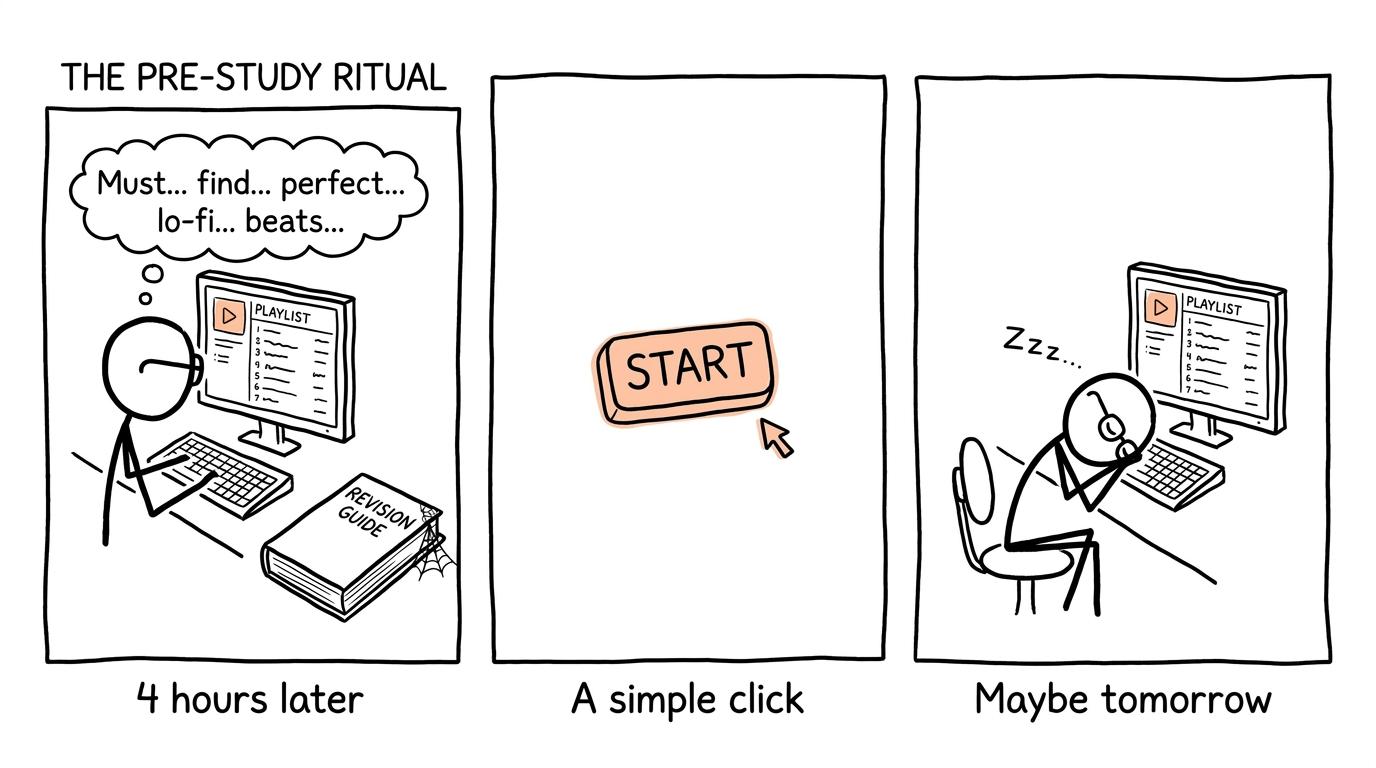 A student perfecting a playlist while the revision book waits
A playlist is helping when it gets you into active practice quickly. It is mostly theatre when you repeatedly edit it, skip songs, check notifications or use the music to make passive rereading feel substantial.
The distinction is simple:
- Useful ritual: choose a prepared playlist, start promptly and complete a measurable task.
- Empty ritual: spend more energy designing the atmosphere than retrieving knowledge.
For maths, measurable work might mean completing a focused set from the GCSE maths revision hub and checking the solutions. For Arabic, it might mean recalling a vocabulary set, completing a reading task or recording a speaking response without notes.
Match the sound to the revision task
The best listening policy is task-dependent rather than based on a fashionable genre.
Use silence for high-load work
Choose quiet when you are:
- learning unfamiliar Arabic vocabulary;
- translating into or from Arabic;
- reading a demanding passage;
- planning or producing extended writing;
- completing Arabic listening practice;
- sitting a timed maths paper;
- learning a new mathematical method; or
- checking a complicated chain of reasoning.
When practising maths under realistic conditions, choose the correct board and tier through MathsGenie's GCSE revision resources. Edexcel students can use the dedicated Edexcel GCSE maths revision hub, while students following AQA, OCR or Eduqas can select their board from the main GCSE page.
Consider instrumentals for lower-load work
Quiet, predictable instrumental music may be acceptable when you are organising notes, reviewing familiar material or completing routine practice. It can also mask intermittent household noise, which may otherwise be more distracting than the music.
Keep the volume low. Avoid tracks with dramatic changes, speech samples or melodies that repeatedly capture your attention. If you notice yourself anticipating the chorus or changing tracks, the sound is no longer in the background.
For shorter maths practice, Edexcel GCSE maths mini tests provide a clear task that makes it easier to notice whether the music supports work or encourages drifting.
Run a fair focus experiment
Personal preference matters, but preference is not the same as performance. You can test your study environment without turning revision into a laboratory project.
Choose several similar sessions. Complete half in silence and half with one quiet instrumental playlist. Keep the duration, difficulty, time of day and phone rules as consistent as reasonably possible. Do not compare an easy vocabulary review in the afternoon with a difficult translation when exhausted.
After each session, record:
- the number of tasks completed;
- your score on a short closed-book check;
- how often you changed tracks or touched your phone;
- whether you can recall the material the following day; and
- how mentally tired you felt.
A simple accuracy measure is:
Accuracy=correct responsestotal responses×100%\text{Accuracy} = \frac{\text{correct responses}}{\text{total responses}} \times 100\%Accuracy=total responsescorrect responses×100%Compare average accuracy rather than judging one unusually good session. If instrumental music helps you start but produces no improvement in recall, use it only for the opening few minutes. If silence gives you better scores, believe the evidence even if the playlist feels more enjoyable.
MathsGenie's guidance on finding your weakest GCSE topics follows the same philosophy: decisions should come from marked performance, not impressions. You can also use the structure in this realistic GCSE revision timetable to schedule quiet and instrumental test sessions fairly.
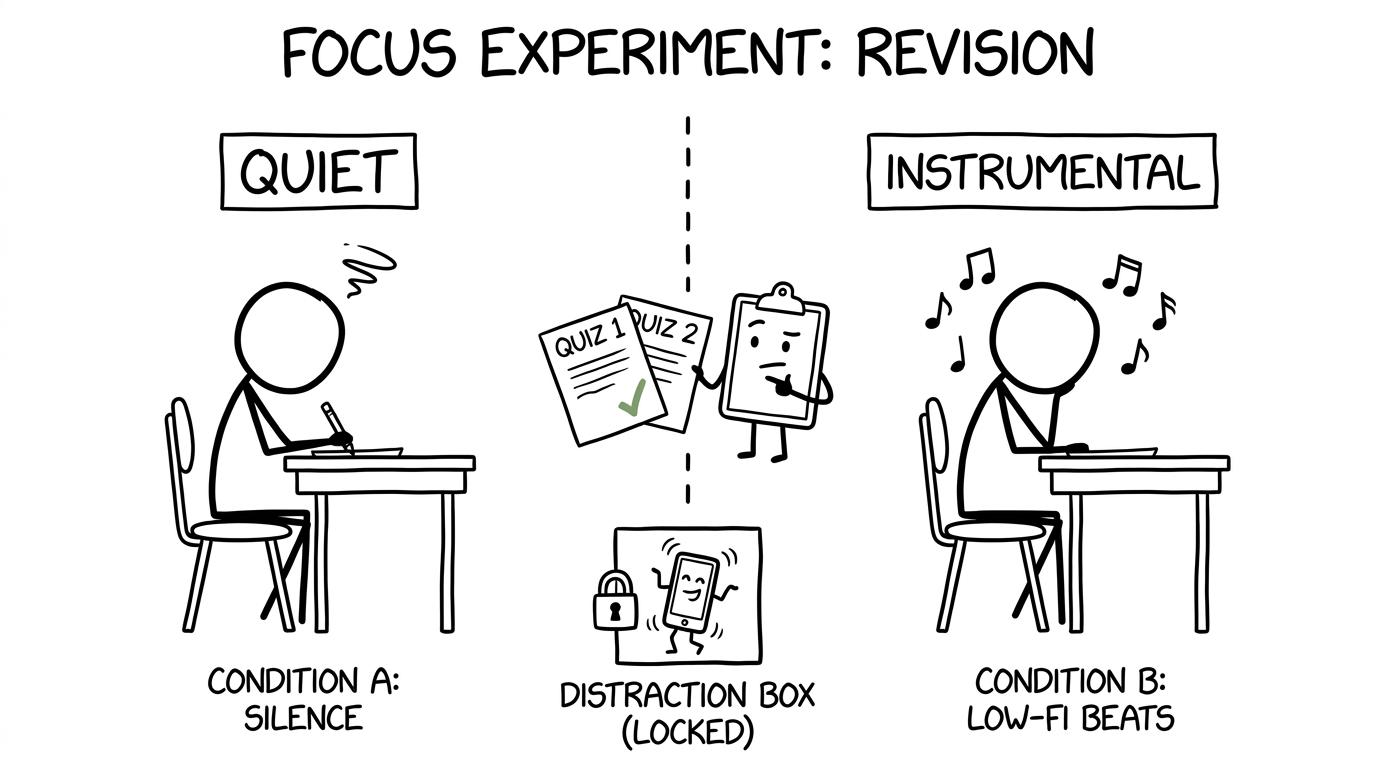 A student comparing quiet and instrumental revision sessions
Build an exam-ready routine
Your final routine should work without requiring ideal conditions. Begin with one specific task, put the phone beyond reach and decide in advance whether the session needs silence. If you use music, start a saved instrumental playlist and leave it alone.
Then make the revision active. Retrieve vocabulary, write, speak, answer questions or mark completed work. For maths, the repeatable cycle is learn, practise, mark, fix and retest. MathsGenie's guide to efficient GCSE maths revision explains how to build that loop.
At least some sessions should reproduce exam conditions. Complete Arabic listening without background audio and attempt reading or writing in silence. For maths, use timed GCSE predicted papers, mini tests and past papers with the correct calculator rules. The guidance on when to start GCSE past papers can help you introduce timed practice gradually.
A playlist should never become equipment you believe you cannot work without. You are preparing for an exam room, not a personalised café.
Common mistakes with study playlists
Choosing songs because they are familiar
Familiar music can be especially attention-grabbing because you anticipate lyrics and changes. Enjoyment does not guarantee concentration.
Using lyrics during verbal tasks
Arabic reading, writing, vocabulary and speaking preparation already require language processing. Adding another verbal stream creates unnecessary competition.
Mistaking endurance for learning
Music may make a session feel easier or help you remain seated. That matters, but the session only succeeds if your recall, accuracy or exam performance improves.
Constantly changing the playlist
Every skip creates a fresh decision and often puts your phone back in your hand. Use one prepared playlist or choose silence.
Never practising in exam conditions
A student who always revises with sound may find the exam room unusually stark. Quiet timed practice makes silence ordinary rather than unsettling.
Optimising atmosphere instead of technique
No playlist can replace retrieval, practice questions, feedback and correction. In maths, use mark schemes and video solutions to understand lost marks. In Arabic, check vocabulary, grammar, comprehension and whether your response answers the task.
The quieter route to better focus
Study playlists can be useful, but their strongest benefit may be behavioural: they signal that revision has begun. The evidence does not support treating instrumental music as a dependable learning enhancer, while lyrics present a meaningful risk for the verbal work at the heart of GCSE Arabic.
Start with silence for demanding tasks. Use quiet instrumentals only when they solve a real problem, such as unpredictable environmental noise or difficulty settling down. Then test the result through recall and marked work.
When it is time to revise maths, let MathsGenie provide the structure rather than asking a playlist to provide the progress. Choose a free revision lesson, answer practice questions, check the mark scheme, use video solutions to repair mistakes, and build towards mini tests, past papers and predicted papers. Pressing play may begin the session. Purposeful practice is what moves the grade.










