How to Stop Procrastinating GCSE Astronomy
Stop procrastinating GCSE Astronomy with a practical revision system that makes observations, maths practice and exam questions easier to begin and finish.
There is a peculiar kind of procrastination that begins with good intentions. You decide to revise stellar evolution, open a new tab to check one fact about black holes, and somehow end up watching videos that have nothing to do with your exam.
If you want to stop procrastinating GCSE Astronomy, the answer is not to wait for more motivation. Make the starting point smaller, decide the exact task in advance and produce something you can check, an answered question, a labelled diagram from memory or a corrected calculation. A useful first target is just 101010 minutes.
That matters because GCSE Astronomy can feel unusually difficult to begin. It combines a wide specification, unfamiliar vocabulary, observational work and mathematical skills. Some revision also appears to depend on darkness, equipment or clear weather. The solution is to separate these demands and give every session one visible finish line.
The quick anti-procrastination checklist
Use this whenever you notice yourself avoiding Astronomy:
- Choose one specification point, not an entire topic.
- Define a task that can be finished in 101010 to 252525 minutes.
- Put your phone outside arm's reach.
- Begin with retrieval or questions rather than decorating notes.
- Mark the work immediately when answers are available.
- Record one error and one next action.
- Keep observation planning separate from weather-dependent observing.
- Use a regular time and place so that starting requires fewer decisions.
The goal is not an impressive evening of revision. It is a repeatable beginning.
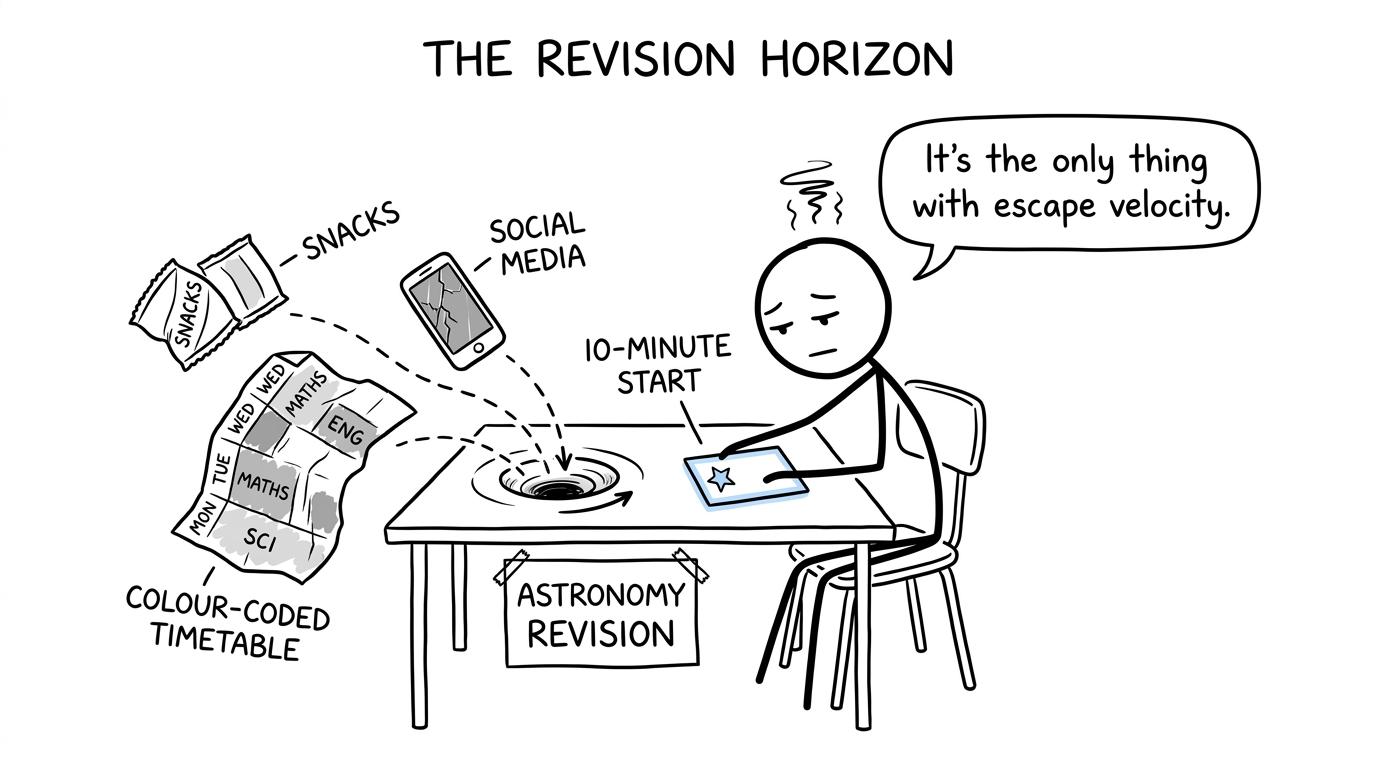 A tiny ten-minute revision card escapes an astronomy procrastination black hole
Why GCSE Astronomy gets procrastinated on
Procrastination is usually understood as voluntarily delaying an intended task despite expecting that the delay will make things worse. That is different from choosing to rest, changing a plan because you are unwell or asking for help because a task is inaccessible.
Astronomy creates several sources of friction at once.
The subject feels vast
The current Pearson Edexcel GCSE Astronomy specification contains 161616 topics, ranging from the Earth-Moon-Sun system and planetary motion to stellar evolution and cosmology. Looking at the whole course can produce a vague instruction such as “revise space”. Vague tasks are difficult to start because there is no obvious first action or stopping point.
Replace the subject-sized task with a micro-task:
- recall the stages in one stellar life cycle;
- answer three questions about lunar features;
- interpret one graph;
- plan the variables and controls for one observation;
- practise one set of standard-form calculations.
A small task is not an easier version of revision. It is a clearer version.
Observation feels dependent on perfect conditions
GCSE Astronomy includes mandatory observational experience. The specification requires students to complete unaided and aided observational tasks, while the written examinations assess knowledge and understanding developed through observation. Your school is responsible for organising and certifying the required work, so follow your teacher's instructions and the current specification.
The practical difficulty is obvious: clouds do not respect revision timetables. If “revise Astronomy” means “go outside with a telescope”, poor weather can become a permanent excuse.
Split the work into two lists:
- Weather-dependent: making the actual observation safely under suitable conditions.
- Weather-independent: planning, equipment knowledge, risk awareness, data presentation, analysis, evaluation and improvement.
A cloudy evening can still become a useful session on graph interpretation or evaluating observational methods.
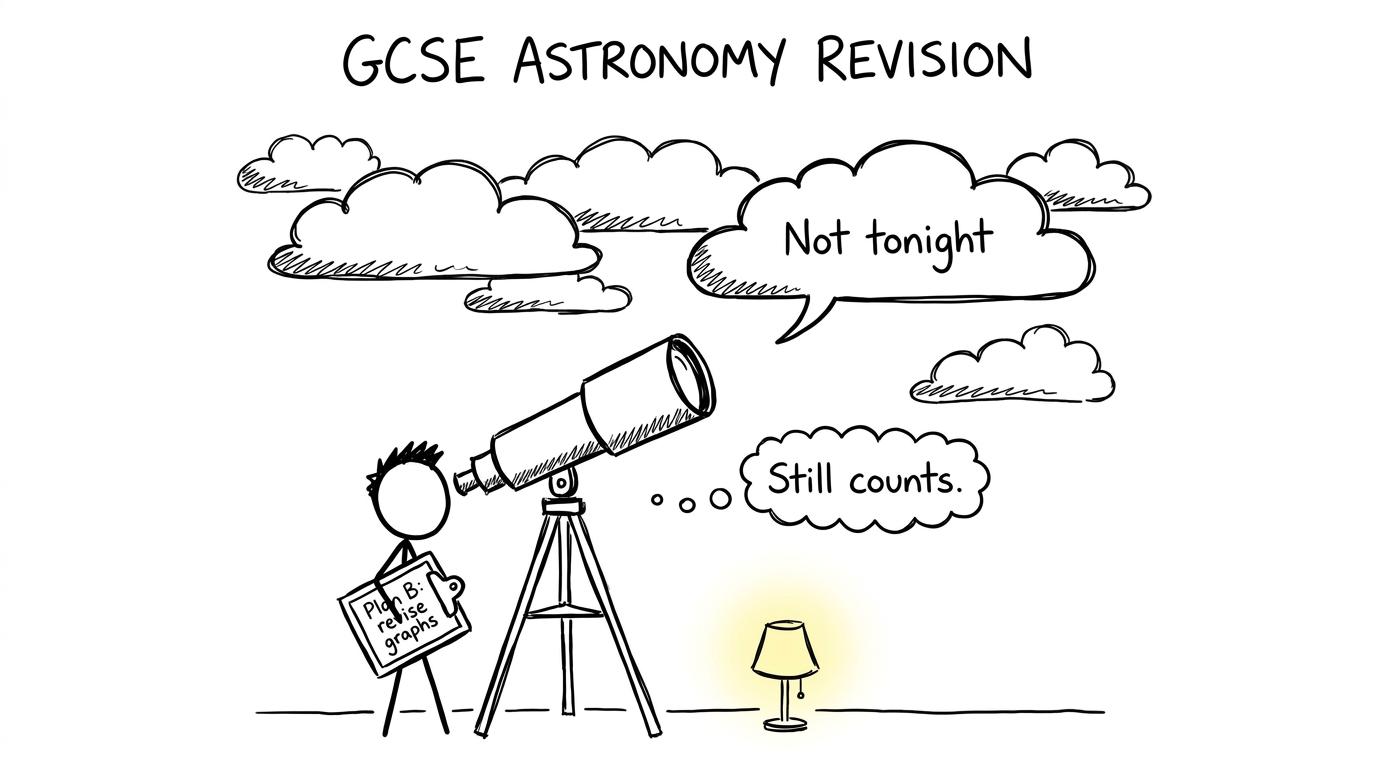 A student calmly switches from a cloudy telescope session to graph revision
Astronomy switches between different kinds of thinking
One question may test factual recall. The next may require a calculation, graph, explanation or evaluation of data. That switching can make the subject feel less predictable than a chapter with one repeated method.
Do not try to remove the variety. Organise it. Label each task as one of four types:
- knowledge and recall;
- mathematical application;
- observational skills;
- extended explanation or evaluation.
You can then see what you are avoiding. “I am bad at Astronomy” is hard to act upon. “I avoid evaluating reliability” gives you somewhere to begin.
What actually breaks the pattern
Write an if-then starting plan
Research on implementation intentions suggests that specifying when, where and how you will act can support goal initiation, although evidence for procrastination interventions is not uniformly positive. Treat an if-then plan as a practical prompt, not a magic cure.
For example:
If I finish dinner at 6:306{:}306:30 pm, then I will sit at the kitchen table, put my phone in another room and answer three questions on planetary motion.
This works better than “do Astronomy later” because the cue, place and first action have already been decided. Make the action small enough to complete even on a low-energy day.
Use a minimum session
Set a minimum of 101010 focused minutes. You may continue, but continuation is optional. The minimum should include active work, such as retrieval, a question or a correction.
This avoids a common trap: believing revision only counts if it lasts for hours. Long sessions can be valuable, but making them the entry price encourages delay. Consistency is built from sessions that survive ordinary days, not just highly motivated ones.
Build a visible feedback loop
Use this sequence:
Retrieve, attempt, check, fix, and revisit.
First write or say what you know without notes. Then attempt a relevant question. Check it against reliable course material or a mark scheme, write one precise correction and revisit the same weakness later.
The final product might be tiny: one corrected graph scale or one sentence explaining why repeated observations improve reliability. It still gives your next session a starting point.
For a wider approach to revision cycles, see how to revise GCSE maths efficiently. The same principle applies here: feedback changes performance; rereading alone often hides gaps.
Use maths to make Astronomy revision more concrete
The Department for Education requires mathematical skills to account for at least 20%20\%20% of GCSE Astronomy marks. These skills include standard form, ratios, percentages, inverse-square relationships, logarithmic scales, significant figures, unit conversions, algebra, graphs, angles and coordinates.
That makes maths a useful anti-procrastination entry point. A calculation has a clear beginning, an answer and a method to check.
Start with the MathsGenie GCSE maths revision hub and prioritise the skills that overlap with Astronomy. Standard-form revision supports work with very large and very small values. Formula questions benefit from confident substitution and rearranging; if that is a recurring barrier, use the rearranging harder formulae resources.
Graphs deserve separate attention. You may need to translate between graphical and numerical information, plot data or determine a gradient and intercept. Do not simply look at a graph and decide it “makes sense”. Practise reading scales, units and trends precisely.
GCSE Astronomy is currently an untiered Pearson Edexcel qualification, unlike GCSE Maths, where Edexcel, AQA, OCR and Eduqas offer foundation and higher tiers. Your MathsGenie practice should therefore match your own Maths board and tier, while your Astronomy revision should follow the current Pearson specification and your teacher's guidance.
A weekly system that is easier to start
Keep the plan light enough to repeat:
- Session A, recall: 151515 minutes retrieving one Astronomy micro-topic.
- Session B on maths: 202020 minutes on standard form, ratio, graphs or formulae.
- Session C on exam practice: 252525 minutes answering and checking questions.
- Session D on observation: 202020 minutes planning, analysing or evaluating observational work.
- Review: 101010 minutes revisiting errors from the week.
Put each session in your calendar with a precise task. If you also have GCSE Maths revision to manage, the MathsGenie one-month revision plan shows how to balance topic repair, timed work and review.
When full papers feel too large, use shorter tests or selected questions. MathsGenie's free revision resources include mini tests, practice papers and solutions for strengthening the mathematical foundation beneath Astronomy. Later, use GCSE past-paper guidance to introduce timed Maths practice without abandoning careful review.
Common mistakes when trying to stop procrastinating
Planning revision instead of doing it
A polished timetable can feel productive while protecting you from difficult questions. Limit planning to a few minutes, then begin the first task immediately.
Choosing tasks that are too broad
“Revise cosmology” offers no definition of done. “Recall three pieces of evidence associated with the Big Bang model, then check them” does.
Waiting for motivation
Motivation often changes after starting. Use a fixed cue and minimum session rather than asking whether you feel ready.
Making every Astronomy session weather-dependent
Observation matters, but planning, analysis and evaluation can happen indoors. Keep a prepared cloudy-night task list.
Revising only the fascinating parts
It is natural to prefer black holes or exoplanets. Exams also reward accurate work on coordinates, data, observational methods and calculations. Use errors from questions to choose what comes next.
Ignoring the maths because it belongs to another subject
Astronomy calculations still depend on secure numerical skills. Find the exact leak, perhaps standard form, significant figures or rearranging, and repair it through focused practice. The guide to finding weak GCSE topics offers a useful diagnostic approach.
Start before the task feels comfortable
To stop procrastinating GCSE Astronomy, reduce the distance between intention and action. Choose one specification point. Set a 101010-minute minimum. Produce an answer you can check. Then leave yourself a precise next step.
You do not need to feel fascinated by every topic or confident before every calculation. You need a system that works on ordinary evenings, including the cloudy ones.
Use MathsGenie as your free maths revision base: strengthen the numerical skills behind Astronomy with revision lessons and practice questions, diagnose gaps with mini tests, and build exam confidence using past papers, predicted papers, mark schemes and video solutions. Open the GCSE maths revision hub, choose one relevant skill and begin the smallest useful session now.