

Staying Consistent GCSE Design and Technology Revision
Staying consistent GCSE Design and Technology revision gets easier with a low-motivation routine, active recall, exam practice and weekly review.
Motivation is unreliable. It can arrive on a quiet Sunday afternoon and disappear completely by Tuesday evening, just when materials, manufacturing processes and your unfinished revision cards are waiting.
The practical answer to staying consistent GCSE Design and Technology revision is not to force yourself to feel motivated. It is to build a routine that still works when you do not. Make the first task small, decide it in advance, practise retrieving knowledge rather than repeatedly reading it, and record the next action before you stop.
This matters because GCSE Design and Technology is broad. Across current specifications, students must connect technical knowledge with designing, making, analysing and evaluating. The qualification is not tiered, and current specifications from AQA, Edexcel, OCR and Eduqas combine a written examination with non-exam assessment. A sustainable routine must therefore deal with several different kinds of work rather than treating revision as one enormous task.
Your low-motivation revision checklist
When enthusiasm is missing, use this shorter checklist:
- Choose one precise topic, such as polymers, tolerances or sustainability.
- Set a minimum session of ten minutes.
- Start with a closed-book recall task.
- Check your answer against trusted notes or a mark scheme.
- Record one gap and one next action.
- Revisit the topic later in the week.
- Stop at the planned time unless you genuinely want to continue.
The aim is not to have a perfect evening. It is to keep contact with the subject. Ten focused minutes preserve the habit and make tomorrow's return less intimidating.
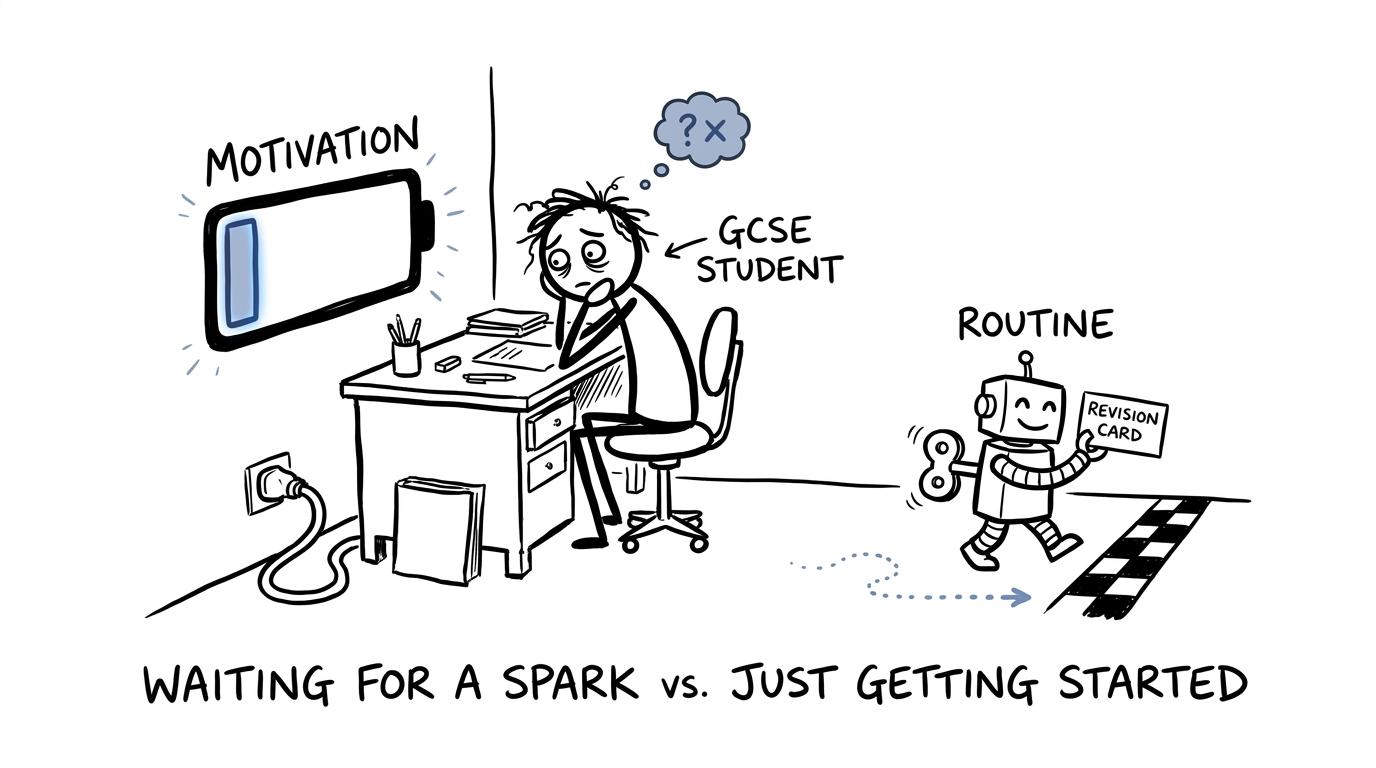 A revision routine quietly overtakes motivation
Build a system that does not depend on mood
A weak revision plan says, “Revise D&T tonight.” That instruction creates too many decisions. Which topic? Which resource? For how long? What does finished mean?
A stronger plan names the action: “At 6.30 pm, answer five questions on timbers, mark them, then write two corrections.” The task has a start, a finish and visible evidence of completion.
This follows the principles of self-regulated learning: plan the task, monitor your understanding and evaluate what worked. Educational evidence reviewed by the Education Endowment Foundation supports teaching these processes within specific subject content. In other words, do not merely create a generic productivity system. Apply it directly to the D&T knowledge and questions you need to master.
Set a minimum that feels almost too easy
Your minimum is the version of revision you can complete on a difficult school day. It might be:
- recalling five material properties;
- labelling one manufacturing process from memory;
- planning one extended response;
- correcting one previous exam question;
- testing yourself on key terminology for ten minutes.
The minimum is not your ideal target. It is your safety net. On better days, you can continue. On difficult days, completing it keeps the routine alive.
The same idea works for maths revision. MathsGenie's guide to building a GCSE maths revision timetable shows how short topic sessions and timed practice can sit inside a realistic week without crowding out rest or other subjects.
Reduce the number of decisions
Before each session ends, write the first task for the next one. Leave the relevant question, flashcard set or specification section ready. Starting then requires one decision rather than five.
A regular cue helps too. You might revise after dinner at the same desk, or complete a recall card before opening another app. The cue should fit your life rather than imitate somebody else's elaborate timetable.
Divide D&T revision into manageable strands
Consistency improves when “Design and Technology” becomes a set of visible categories. Use your own exam board's specification because wording and paper structures differ between AQA, Edexcel, OCR and Eduqas.
A useful weekly rotation could include:
| Revision strand | Suitable low-motivation task |
|---|---|
| Core technical principles | Recall definitions, applications and examples |
| Specialist material knowledge | Compare properties, processes and suitable uses |
| Designing and making principles | Plan responses about users, briefs and iteration |
| Analysis and evaluation | Apply criteria to a product or design decision |
| Quantitative skills | Practise units, ratio, area, percentages and scale |
| Extended writing | Create a brief paragraph plan, then check its balance |
Official subject content places substantial emphasis on applying knowledge, not simply recognising facts. Ofqual's assessment objectives allocate 40%40\%40% to demonstrating and applying knowledge and understanding, while analysis and evaluation account for another 20%20\%20%. This is why active questions deserve more time than decorative notes.
For many specifications, the written examination and non-exam assessment each contribute 50%50\%50% of the qualification. Follow your teacher's instructions carefully for NEA work: controlled conditions, permitted guidance and deadlines are not the same as ordinary home revision.
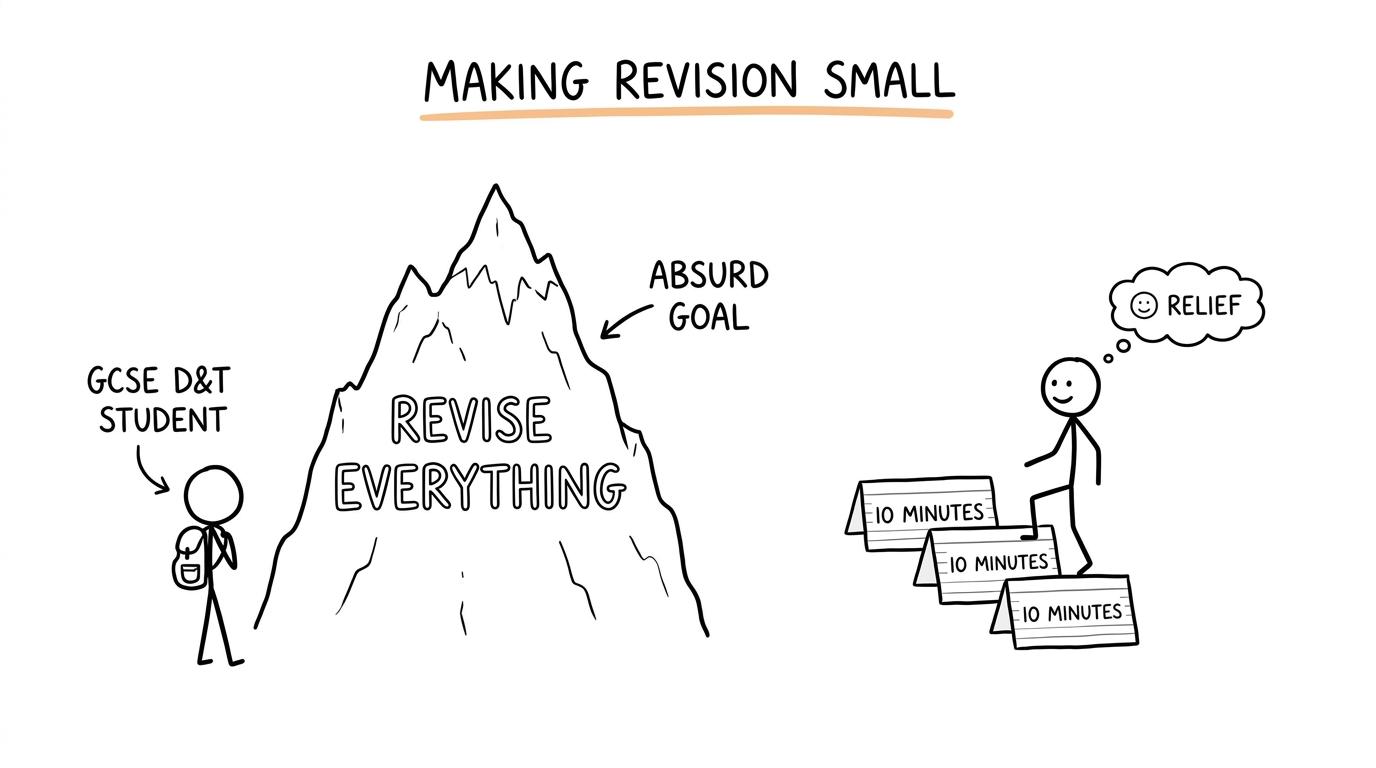 A small revision staircase beside the mountain called revise everything
Use active recall before your notes
Reading feels comfortable because the page supplies the answer. Unfortunately, that comfort can disguise weak recall. Start by closing the book and trying to produce something.
You could:
- list the properties of a material;
- explain why a process suits a production scale;
- sketch the stages of an iterative design process;
- compare two energy sources;
- outline an answer about social or environmental impact;
- define a technical term and give an appropriate context.
Then check your response. Add only what was missing. This turns every session into feedback rather than a vague impression that the topic looks familiar.
Spacing those attempts across several days is more useful than exhausting one topic in a single sitting. Mix strands as confidence grows so that you must identify the required knowledge rather than being told what kind of answer to give.
This is also the logic behind MathsGenie's scheme of learning and topic tests: learn a focused skill, answer questions, assess it and return where necessary.
Protect the maths marks inside D&T
Design and Technology contains genuine quantitative work. The national subject content includes mathematical knowledge and skills, while AQA and OCR specify that at least 15%15\%15% of their written examination assesses maths in a D&T context. Check your board's current specification for its precise requirements.
Relevant skills can include:
- ratios and proportions;
- percentages and percentage change;
- unit conversions;
- area, surface area and volume;
- scale drawings;
- interpreting tables, charts and graphs;
- calculating material quantities and cost;
- using tolerances and understanding accuracy.
These are valuable revision targets because practice can support both D&T and GCSE maths. If ratio is a weak point, use MathsGenie's GCSE ratio lesson and questions. For scale factors and three-dimensional contexts, revisit similar shapes involving area and volume.
Do not assume that recognising a formula is enough. Practise selecting the right quantities, using consistent units, showing the calculation and checking whether the result is sensible in the design context.
Create a weekly rhythm rather than a perfect streak
Daily revision is not compulsory. A repeatable week is more useful than a heroic three-day burst followed by silence.
A balanced pattern might contain:
- one technical-knowledge session;
- one specialist-material session;
- one exam-question session;
- one short quantitative-skills session;
- one weekly review.
At the review, ask three questions:
- What can I now recall without help?
- Which mistake appeared more than once?
- What is the first task for next week?
If a session is missed, do not double the next one as punishment. Return at the next planned opportunity. Consistency is the ability to restart quickly, not the ability to produce an unbroken chain forever.
When several GCSE subjects compete for attention, the MathsGenie GCSE revision hub can reduce planning for maths by keeping lessons, questions, papers and solutions together. That leaves more mental space for D&T rather than forcing you to search for every maths resource separately.
Make progress visible without obsessing over hours
Hours recorded are a poor measure if most of the time was spent highlighting. Track outputs instead:
- questions attempted;
- answers marked;
- topics retrieved without notes;
- recurring errors corrected;
- extended responses planned;
- weak quantitative skills retested.
Use a simple traffic-light list, but base the colour on evidence. A topic is not green because you read it yesterday. It is green because you can answer an unfamiliar question accurately without support.
For maths topics that overlap with D&T, MathsGenie's GCSE topics by exam board and tier can help you locate the relevant number, ratio and geometry skills. Remember that GCSE D&T itself is untiered, even though your GCSE maths course may be foundation or higher tier.
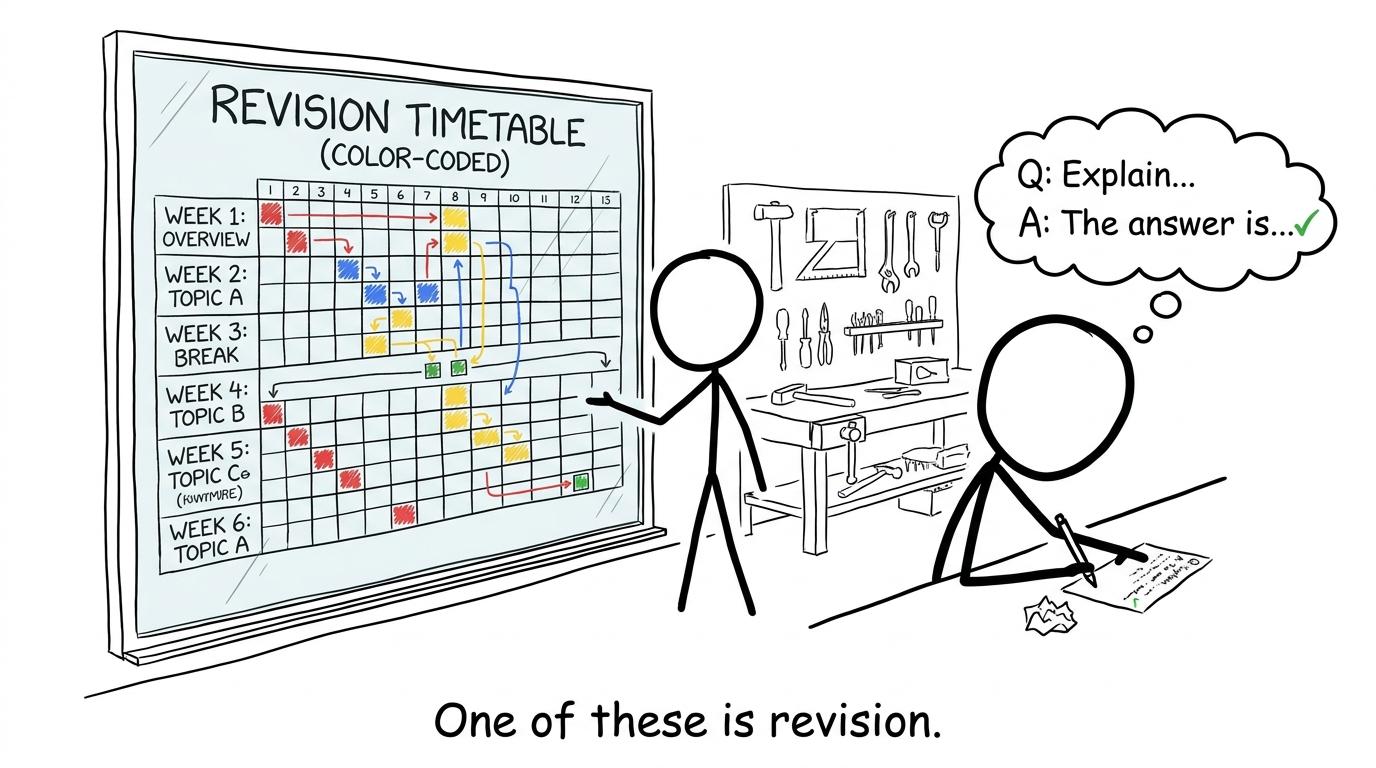 A beautiful timetable competes with an actual practice question
Common mistakes that break revision consistency
Waiting to feel ready
Motivation often follows starting rather than preceding it. Use your minimum session and allow yourself to stop when it is complete.
Writing “revise D&T” on the timetable
That is a subject, not a task. Name one topic, one activity and one finishing point.
Rewriting notes without testing recall
Neat pages can feel productive while leaving knowledge dependent on prompts. Retrieve first, check second and rewrite only the missing detail.
Ignoring mark schemes and command words
Knowing content does not automatically produce an effective answer. Notice whether the question asks you to identify, explain, analyse, evaluate or justify, then study how the available marks are awarded.
Avoiding quantitative questions
Calculations may feel like a separate subject, but they are part of D&T assessment. Strengthen the underlying skills through focused GCSE maths revision, then apply them in design contexts.
Making one missed session mean the week has failed
A missed session is one event, not a verdict. Shrink the next task, restart and continue with the plan.
Consistency is a design problem
A good product does not depend on ideal conditions. Neither should your revision routine.
Define the user's needs, including tiredness, homework and limited time. Build a small system. Test it for a week. Notice where it fails. Refine it. That is not only a sensible approach to staying consistent with GCSE Design and Technology revision; it is the iterative thinking the subject itself values.
Start today with ten minutes and one specific D&T question. Then protect your linked maths skills through MathsGenie's free revision lessons and practice questions. As your maths exams approach, use Edexcel GCSE maths past papers, or choose your board through the main GCSE hub, before adding mini tests, predicted papers, mark schemes and video solutions.
You do not need motivation to rescue every evening. You need a next action small enough to begin, and a reliable place such as MathsGenie to make the maths part of that action clear.










