Standard Form GCSE Foundation: Indices Made Clear
Standard form GCSE foundation revision for resit students: learn conversions, calculations and index laws with clear calculator and non-calculator examples.
Standard form GCSE foundation: start with the meaning
A small raised number can make an ordinary calculation feel unfamiliar. If you are resitting GCSE Maths, that feeling may arrive before you have even read the question. Standard form GCSE foundation questions become more manageable when you connect those powers to something familiar: multiplying and dividing by ten.
Standard form writes a positive number as a×10na \times 10^na×10n, where 1≤a<101 \leq a < 101≤a<10 and nnn is an integer. Indices are powers, and index laws help you calculate with them. Together, these ideas let you handle very large and very small numbers without writing every zero.
You can begin with MathsGenie's standard form revision lessons, then use the examples here to practise each decision.
Your revision checklist
Aim to recognise and complete these tasks:
- Explain what a power means.
- Convert ordinary numbers into standard form and back.
- Multiply and divide numbers in standard form.
- Add and subtract by expressing quantities consistently.
- Apply index laws when the bases match.
- Use a calculator and check whether its answer is sensible.
These topics belong in foundation revision. You do not need to master every possible indices question before practising the foundation skills.
Understand powers before learning the rules
An index tells you how many times a base appears as a factor. For example:
34=3×3×3×3=813^4 = 3 \times 3 \times 3 \times 3 = 8134=3×3×3×3=81The base is 333 and the index is 444. It does not mean 3×43 \times 43×4.
Powers of ten connect indices to place value:
103=1000,100=1,10−3=0.00110^3 = 1000, \qquad 10^0 = 1, \qquad 10^{-3} = 0.001103=1000,100=1,10−3=0.001A negative power of ten represents a reciprocal. It does not make the number negative. In particular, 10−3=1100010^{-3} = \frac{1}{1000}10−3=10001.
If powers GCSE questions still feel uncertain, work through MathsGenie's indices revision resources before combining them with standard form.
Convert numbers into standard form
Standard form has two parts: a coefficient between 111 and 101010, excluding 101010, and a power of ten that preserves the original value.
A large number without a calculator
Write 630000630000630000 in standard form.
First choose 6.36.36.3 as the coefficient. Then ask what multiplies it back to the original number:
6.3×100000=6300006.3 \times 100000 = 6300006.3×100000=630000Therefore:
630000=6.3×105630000 = 6.3 \times 10^5630000=6.3×10⁵Thinking about the multiplier makes the sign of the power easier to justify than memorising a direction rule.
A small number without a calculator
Write 0.000720.000720.00072 in standard form.
The coefficient is 7.27.27.2. To recover the original value, divide it by 100001000010000:
0.00072=7.2×10−40.00072 = 7.2 \times 10^{-4}0.00072=7.2×10⁻⁴For positive numbers smaller than 111, the standard form exponent is negative.
Convert back and check
To turn standard form into an ordinary number, apply the power of ten:
4.8×103=48004.8 \times 10^3 = 48004.8×103=4800 4.8×10−3=0.00484.8 \times 10^{-3} = 0.00484.8×10−3=0.0048On a calculator, enter the coefficient, multiplication sign, and the power using brackets where needed. For the second example, enter 4.8×10(−3)4.8 \times 10^{(-3)}4.8×10(−3). The display gives a useful check, but you should still predict whether the answer will be large or small.
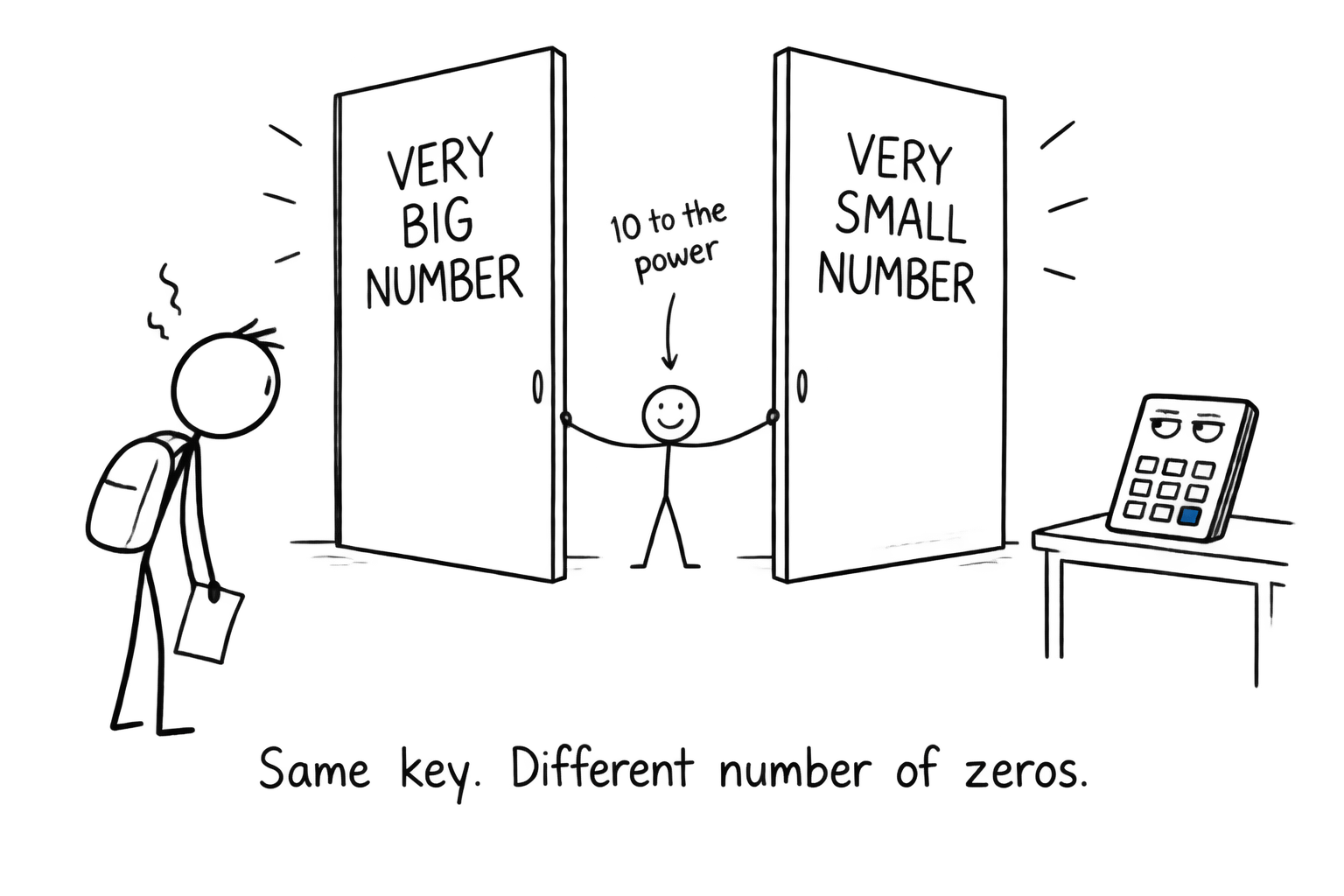 A hand-drawn stick-figure comic about very large and very small numbers sharing the same helpful power-of-ten key
Use index laws GCSE questions rely on
Index laws describe patterns in repeated multiplication. The matching base is essential.
Multiply powers with the same base
Add the indices:
am×an=am+na^m \times a^n = a^{m+n}am×an=am+nFor example:
23×24=27=1282^3 \times 2^4 = 2^7 = 12823×24=27=128Without a calculator, expanding the factors explains why there are seven copies of 222. With a calculator, check that 8×16=1288 \times 16 = 1288×16=128.
Divide powers with the same base
Subtract the indices, provided the base is non-zero:
am÷an=am−na^m \div a^n = a^{m-n}am÷an=am−nFor example:
56÷52=54=6255^6 \div 5^2 = 5^4 = 62556÷52=54=625You can simplify first without a calculator, then evaluate the remaining power if needed.
Raise a power to another power
Multiply the indices:
(am)n=amn(a^m)^n = a^{mn}(am)n=amnFor example:
(32)3=36=729(3^2)^3 = 3^6 = 729(32)3=36=729Also remember that a0=1a^0 = 1a0=1 for a≠0a \neq 0a=0. MathsGenie's indices revision guide provides another place to revisit these relationships.
Calculate with standard form
The useful habit is to handle the coefficients and powers separately, then check that the result satisfies the standard form definition.
Non-calculator multiplication
Calculate:
(3×10⁴)(4×10²)(3 \times 10^4)(4 \times 10^2)(3×10⁴)(4×10²)Multiply the coefficients and add the powers:
(3×4)×104+2=12×106(3 \times 4) \times 10^{4+2} = 12 \times 10^6(3×4)×104+2=12×106The value is correct, but the coefficient is too large. Rewrite it:
12×106=1.2×10712 \times 10^6 = 1.2 \times 10^712×106=1.2×10⁷Calculator division
Calculate:
7.2×1083×103\frac{7.2 \times 10^8}{3 \times 10^3}3×1037.2×108Enter the numerator and denominator separately in a fraction template, or put brackets around each complete number. The calculation is:
7.23×10⁸−3=2.4×10⁵\frac{7.2}{3} \times 10^{8-3} = 2.4 \times 10^537.2×10⁸−3=2.4×10⁵A calculator may display 240000240000240000 or use scientific notation, depending on its settings. Both represent the same value, but give standard form when requested.
Addition and subtraction
You cannot use the multiplication rule to add powers. First express both quantities using the same power of ten:
3.2×10⁵+4×104=3.2×10⁵+0.4×105=3.6×1053.2 \times 10^5 + 4 \times 10^4 = 3.2 \times 10^5 + 0.4 \times 10^5 = 3.6 \times 10^53.2×10⁵+4×104=3.2×10⁵+0.4×105=3.6×10⁵For subtraction:
6.5×10⁴−2×104=4.5×1046.5 \times 10^4 - 2 \times 10^4 = 4.5 \times 10^46.5×10⁴−2×104=4.5×10⁴With a calculator, entering the complete quantities also works. Without one, matching powers keeps the arithmetic small. Practise both approaches using the standard form question booklet.
Common mistakes and how to catch them
Leaving the coefficient outside the allowed range. An answer such as 25×10325 \times 10^325×103 needs rewriting as 2.5×1042.5 \times 10^42.5×10⁴.
Treating a negative exponent as a negative number. The value 10−210^{-2}10−2 is 0.010.010.01, not −100-100−100.
Applying index laws to different bases. You cannot combine 23×542^3 \times 5^423×54 by simply adding the indices.
Using multiplication rules for addition. The expression 102+10310^2 + 10^3102+103 equals 110011001100, not 10510^5105.
Losing brackets on the calculator. Keep each standard form quantity together, especially when dividing. Estimate the size of the answer before accepting the display.
Turn revision into a repeatable routine
For a resit, a useful session has a clear purpose: identify one mistake, correct the reasoning, then answer a fresh question independently.
Start with conversions. Next practise index laws, followed by mixed calculations. Use MathsGenie's mini tests for a short check, then select your exam board through the GCSE Maths revision hub for past papers and mark schemes. Review video solutions where available, and attempt the question again without looking.
Predicted papers can provide additional practice, but they cannot guarantee exam content. Use them alongside topic questions and past papers. Put your next practice session into the revision planner.
Confidence grows when the notation starts to mean something. Open MathsGenie's free revision resources, complete a short set, and check every answer. Your next step is simply to understand one more question than you did yesterday.