Spoken Language Endorsement GCSE Resit Guide
Spoken language endorsement GCSE resit rules explained: carrying grades forward, retaking the assessment and November 2026 deadlines for centres.
A GCSE English Language resit already brings enough questions. Which papers must you take? Does your previous work still count? And must you stand up and deliver another speech?
The short answer is reassuring: the spoken language endorsement GCSE result can normally be carried forward when you resit, including when you change between JCQ awarding bodies. If you already achieved a Pass, Merit or Distinction, you will usually not need a new assessment. Your new centre must still enter or report the carried-forward result correctly.
The endorsement is separate from your numerical GCSE English Language grade. It is reported as Pass, Merit, Distinction or Not Classified, but it does not contribute to your grade from 9-1.
Your resit checklist
Before concentrating entirely on the written papers, confirm these points with your exams officer or English teacher:
- Find your previous spoken language result.
- Tell your new centre if you are changing school, college or exam board.
- Ask whether the centre will use the correct carry-forward entry.
- Arrange a new assessment if you have no positive endorsement or want to improve it.
- Complete any assessment well before the centre's submission deadline.
- Keep written confirmation of what the centre has agreed to enter.
The administrative detail matters. A valid result does not always transfer automatically, particularly when a candidate moves to a different centre.
Do resit candidates need a new endorsement?
Usually, no. A candidate who already has a Pass, Merit or Distinction can generally carry that outcome forward when resitting GCSE English Language. JCQ awarding bodies allow an endorsement achieved with another JCQ board to be reused, so changing from AQA to Pearson Edexcel, for example, does not automatically mean giving another presentation.
The centre handling your resit must know about the previous result and use the board's carry-forward process. OCR, for example, identifies a specific carry-forward entry option. Other boards have their own administrative procedures.
You are more likely to need a spoken language resit if:
- you have never completed the assessment;
- your previous outcome was Not Classified;
- the former result cannot be confirmed;
- you want the opportunity to improve your endorsement;
- your centre cannot make a valid carry-forward entry from the information supplied.
Do not assume that booking the written resit settles this automatically. Ask one direct question: “Are you carrying forward my spoken language endorsement, or do I need to complete it again?”
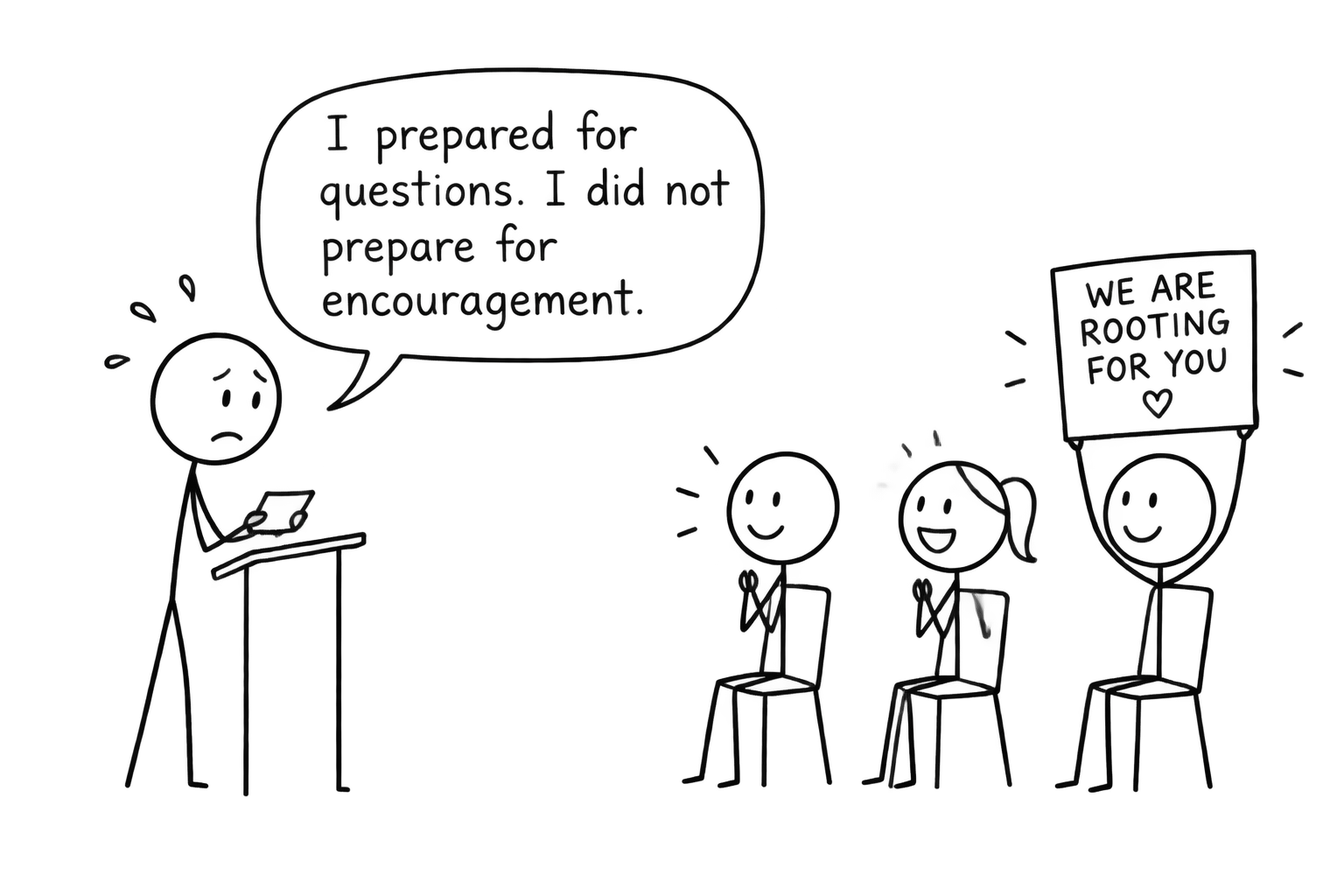 A nervous GCSE student discovers that the audience is encouraging
What the GCSE English speaking assessment involves
If you do need a new assessment, it is not another written examination. The GCSE English speaking assessment requires you to give a prepared presentation in a formal setting, listen and respond appropriately to questions and feedback, and communicate clearly using spoken Standard English.
The result is awarded using competency criteria. Broadly, stronger performances show greater control over organisation, vocabulary, delivery and responses to questions. A complicated topic is not automatically better. A clear argument that you understand is usually safer than an ambitious script that you cannot explain without reading every line.
A sensible preparation process is:
- choose a focused subject with a clear viewpoint;
- organise an opening, developed main points and conclusion;
- use brief cue cards rather than a complete script where possible;
- practise aloud and time the presentation;
- predict likely questions and prepare flexible answers;
- speak slowly enough for every idea to be understood.
The assessment is internally conducted and graded by your centre, with awarding-board monitoring arrangements. Your teacher or exams officer should explain the local recording, audience and scheduling requirements.
November 2026 submission deadlines
For the November 2026 series, the published deadline is 5 November 2026 across the four main GCSE English Language awarding bodies listed below.
| Exam board | November 2026 spoken language deadline |
|---|---|
| AQA | 5 November 2026 |
| Pearson Edexcel | 5 November 2026 |
| OCR | 5 November 2026 |
| WJEC Eduqas | 5 November 2026 |
For AQA, this is the deadline for centres to submit internally assessed grades for the November 2026 series. OCR states that endorsement grades for a November series must be submitted by 5 November. Pearson's published English information gives 5 November 2026 for coursework and spoken language endorsement submission. Eduqas gives the same date for Component 3 outcomes and required recorded samples.
This is a centre submission deadline, not a safe date for a candidate to give the presentation. Schools, colleges and private exam centres will normally set earlier internal deadlines so that staff can assess work, complete records and resolve missing information. Candidates should follow the date given by their centre.
If you have not yet secured an entry, read the guidance on late GCSE English Language resit options and contact an approved centre immediately. A centre may accept written-paper entries but decline to provide internally assessed components, so private candidates must ask specifically about the endorsement.
Common mistakes to avoid
Assuming the endorsement changes the numerical grade
A Distinction does not raise a GCSE English Language grade, and a Pass does not add marks to a written paper. The endorsement is reported separately.
Forgetting to tell a new centre about the old result
A college cannot reliably carry forward information it does not have. Give the exams officer your previous centre, candidate details, exam board, series and result where available.
Treating 5 November as the day to start
The board deadline is when centres submit information. Your presentation, grading and paperwork need to happen before then.
Memorising every sentence
Over-rehearsing a script can make questions feel frightening because they interrupt the sequence you memorised. Learn the structure and ideas instead. That creates room to think.
Neglecting the written papers
The endorsement is important, but the written examinations determine the 9-1 GCSE grade. Build a balanced timetable rather than allowing a short speaking task to consume your whole resit plan. MathsGenie's free revision planner can help you organise work across subjects, while the GCSE papers library makes it easier to schedule timed practice.
Build a calmer resit plan
Resits often feel difficult because several small uncertainties arrive together. The answer is not endless revision. It is removing uncertainty one decision at a time.
Confirm the endorsement first. Record the centre's deadline. Then return your attention to the written English papers and any other GCSE resits. If maths is also part of your programme, MathsGenie provides free GCSE maths revision lessons, topic-based mini tests, past papers, predicted papers, mark schemes and video solutions.
A carried-forward endorsement is one less task. A required reassessment is a manageable task with a clear finish line. Either way, speak to your centre now, settle the administration and give the written resit the focused preparation it deserves.