Spaced Repetition GCSE Food and Nutrition: Start Simple
Spaced repetition GCSE food and nutrition made simple: build a paper-based recall routine, remember key facts and balance it with GCSE maths revision.
Revision often goes wrong before the first question is answered. A student sits down with an entire textbook, sees nutrition, food science, safety, provenance and practical skills competing for attention, then decides that rereading everything is the safest option.
It feels productive. But recognition is not the same as recall.
A spaced repetition GCSE Food and Nutrition routine offers a simpler approach: test yourself on a small amount of knowledge, check your answers, then return to it after increasingly long gaps. You do not need an app, a complicated algorithm or hundreds of perfect flashcards. You need questions, a calendar and an honest way to record what you forget.
This guide explains how to build that routine while protecting enough time for GCSE maths revision.
Your simple spaced repetition checklist
Start with this paper-based system:
- Check the specification used by your school: AQA, OCR or Eduqas.
- Divide the course into small, examinable topics.
- Write short question-and-answer cards.
- Test yourself without looking at your notes.
- Check every response and correct mistakes immediately.
- Review a new card after approximately 111, 333, 777 and 141414 days.
- Bring difficult cards back sooner and retire secure cards temporarily.
- Use exam questions once the underlying knowledge is reliable.
- Keep separate time for practical preparation, NEA work and GCSE maths.
The intervals are a starting structure, not a scientific rule for every student. If something is forgotten, shorten the gap. If it is recalled accurately several times, lengthen it.
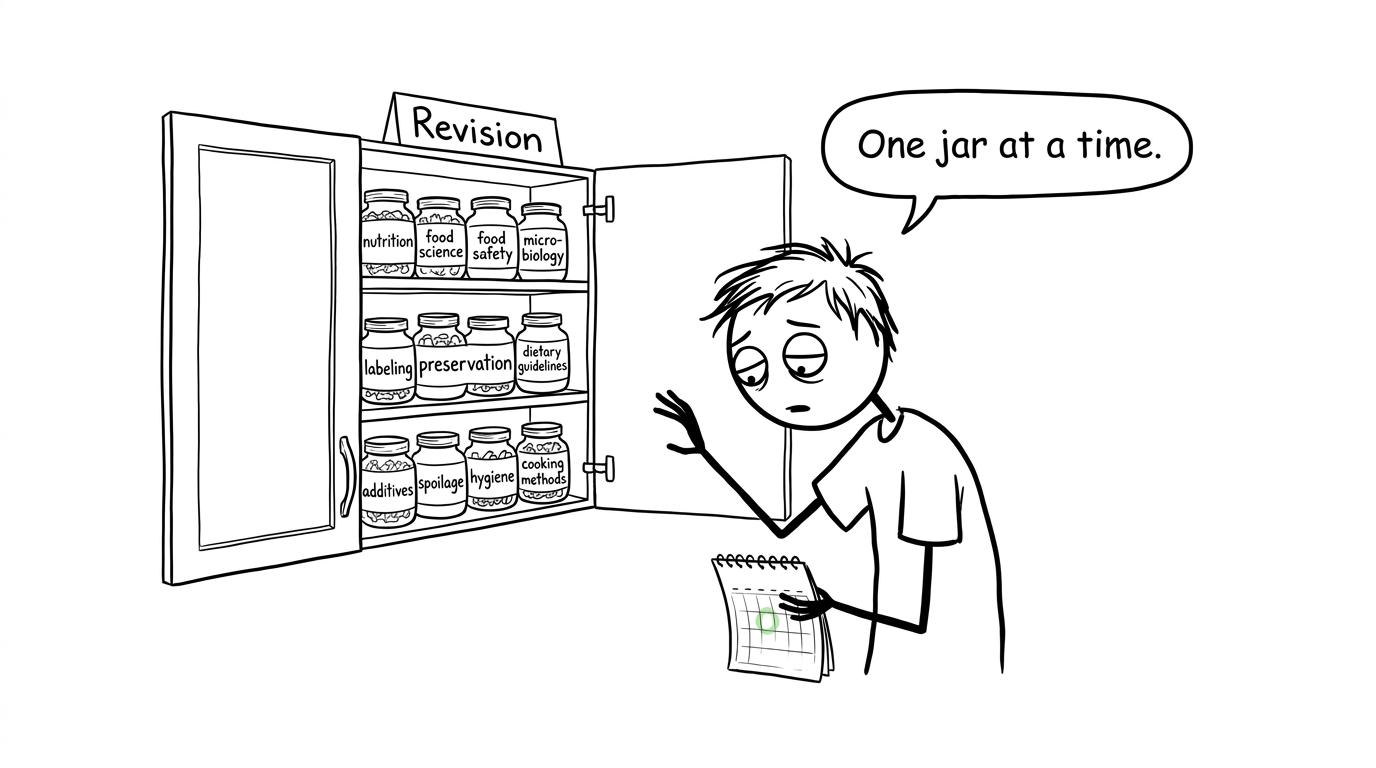 A student choosing one revision jar at a time
What spaced repetition actually means
Spaced practice means returning to previously learned material after a gap. Retrieval practice means trying to bring that material to mind without first seeing the answer. The two ideas work particularly well together.
Instead of reading the same nutrition page repeatedly, you close the book and answer a focused question. You then compare your response with an accurate source. That feedback matters: an incorrect answer left uncorrected can become familiar for the wrong reason.
Official educational guidance on retrieval practice emphasises repeated recall over extended periods, followed by feedback. It also distinguishes spaced practice from interleaving. Spacing revisits old content after a delay; interleaving mixes different topics or question types within a session.
Both can help, but begin with spacing. A system that is simple enough to repeat is more useful than an impressive one abandoned after three days.
Build a Food and Nutrition revision system without an app
Make a topic map from your specification
Do not make cards directly from the textbook contents page. Start with your exam board's current specification and your teacher's guidance.
The precise organisation differs between AQA, OCR and Eduqas, but GCSE Food Preparation and Nutrition commonly includes areas such as:
- nutrition and health;
- food science;
- food safety;
- food choice;
- food provenance;
- preparation and cooking techniques.
Specifications also combine theoretical knowledge with practical and non-exam assessment requirements. Flashcards can strengthen recall, but they cannot replace cooking practice, investigation, analysis or evaluation.
Break each broad area into smaller units. “Nutrition” is too large for one revision session. Macronutrients, micronutrients, dietary needs and sources are more manageable categories.
Create questions rather than miniature notes
A weak card says “Vitamin C” on one side and contains a paragraph on the other. That card encourages recognition and vague self-marking.
A stronger card asks for one precise response, such as:
- What is the main function of this nutrient?
- Which food sources provide it?
- What can deficiency cause?
- How does heat affect it?
- Why does this process change a food's texture?
- Which conditions encourage bacterial growth?
- Which preparation method is appropriate, and why?
Keep the expected answer short enough to check reliably. When a topic requires explanation, use a prompt with two or three explicit elements rather than hiding an essay behind one flashcard.
Use four review piles
Label four envelopes or sections of a card box:
- New: not yet tested
- Soon: review tomorrow
- Later: review within the next week
- Secure: recalled correctly several times
During a session, answer aloud or on scrap paper before turning the card over. Saying “I knew that” after seeing the answer does not count as retrieval.
Move an accurate card forwards. Move an incomplete or incorrect card back to Soon. Add the next date in pencil so that your system remains visible and adjustable.
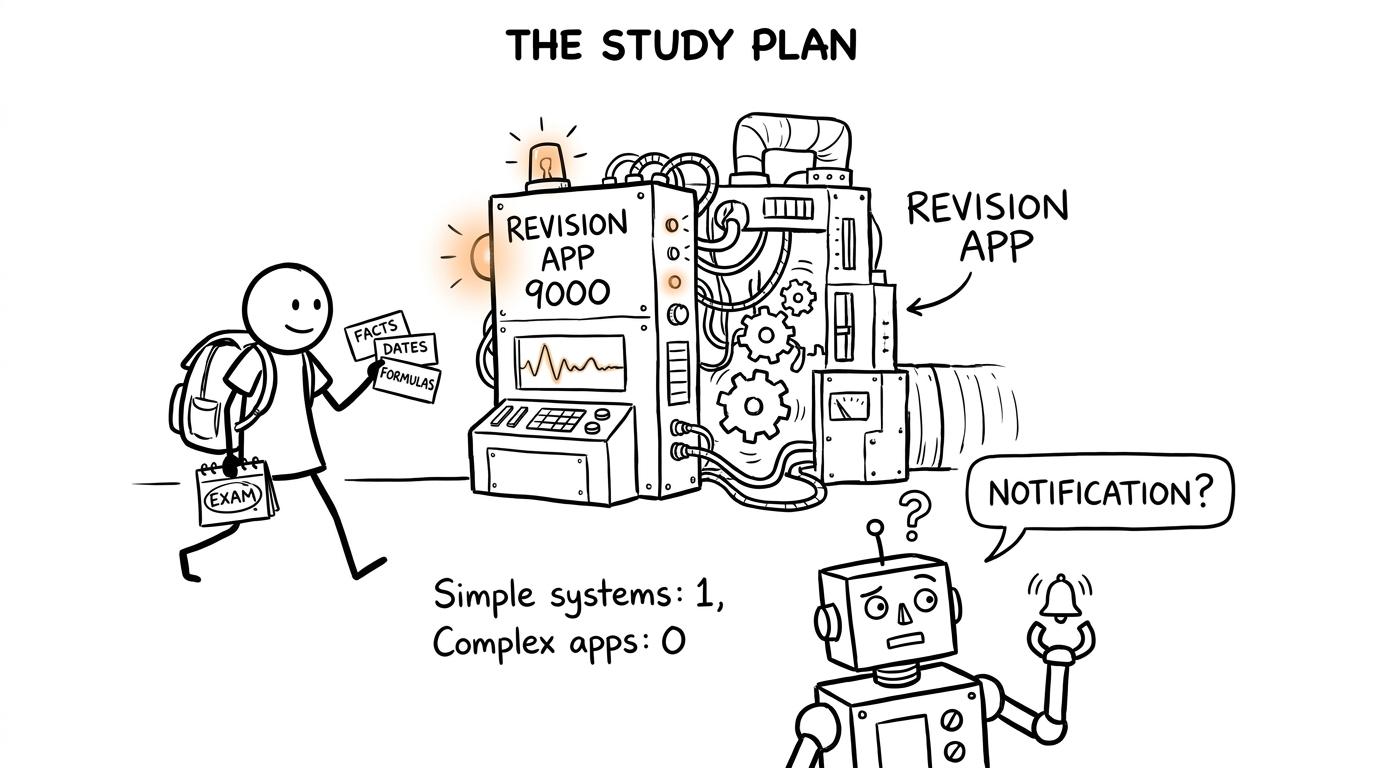 A student walking past an overcomplicated revision app
A realistic weekly routine
A useful session can last fifteen to twenty minutes. Short sessions reduce the temptation to postpone revision until an imaginary free afternoon appears.
Try this rhythm:
Monday to Thursday
- Retrieve five older cards.
- Test three newer cards.
- Check and correct every answer.
- Record one topic that needs fuller revision.
Friday
Mix questions from different areas. For example, combine nutrition, food safety and food science rather than completing a large block from only one chapter. This begins to build the flexibility required when an exam moves quickly between topics.
Weekend
Complete a short set of exam-board questions and use the mark scheme carefully. Cards build accessible knowledge; exam questions reveal whether you can select, apply and explain that knowledge under pressure.
This is similar to effective maths revision. MathsGenie's GCSE maths revision hub combines topic learning, practice questions, flashcards, mini tests and papers so that recall leads into application. The same principle applies here: remembering a fact is the beginning, not the finished performance.
If your exams are close, adapt the structure rather than attempting to compress months of revision into one evening. The GCSE one-week revision plan shows how short diagnostic and correction cycles can organise maths revision, while the one-month GCSE revision plan provides more room for spaced returns.
Connect Food and Nutrition revision with GCSE maths
The subjects should have separate revision goals, but some mathematical skills support Food and Nutrition work. These may include quantities, units, proportional changes, percentages, charts and interpreting numerical information.
A recipe adjustment may rely on proportional reasoning. Nutritional information may involve quantities per serving or per 100 g100\text{ g}100 g. Investigation results may need clear tables, averages or graphs. The calculations are not a substitute for food knowledge, yet weak numerical fluency can make an otherwise familiar question harder.
Use the same spaced system for these skills:
- revisit unit conversions;
- practise ratio and proportion;
- retrieve percentage methods;
- interpret tables and graphs;
- check that every numerical answer has an appropriate unit.
MathsGenie's conversions and units revision guide is useful when grams, kilograms, millilitres and litres feel uncertain. The GCSE ratio revision resources support proportional reasoning, while the Stage 4 revision pathway includes percentages, fractions and ratio alongside exam-style questions.
Keep the transfer disciplined. A Food and Nutrition card should test food knowledge. A maths session should teach and practise the mathematical method properly.
Know when to move beyond flashcards
Flashcards are strongest for definitions, functions, sources, conditions, stages and concise cause-and-effect relationships. They are less suitable for extended analysis, unfamiliar applications and evaluation.
Once recall is reasonably secure, move through three layers:
- Recall: Can you produce the knowledge without notes?
- Application: Can you use it in a new food, diet or practical context?
- Exam response: Can you give enough relevant development for the available marks?
Do not wait until every card feels perfect before attempting questions. Exam practice itself provides retrieval and exposes gaps. Marking then tells you which cards should return to the Soon pile.
The same progression matters in maths. The article on when to start GCSE past papers explains why shorter topic practice can come before regular full papers. MathsGenie's GCSE revision topic resources also demonstrate how questions and solutions can sit alongside focused revision.
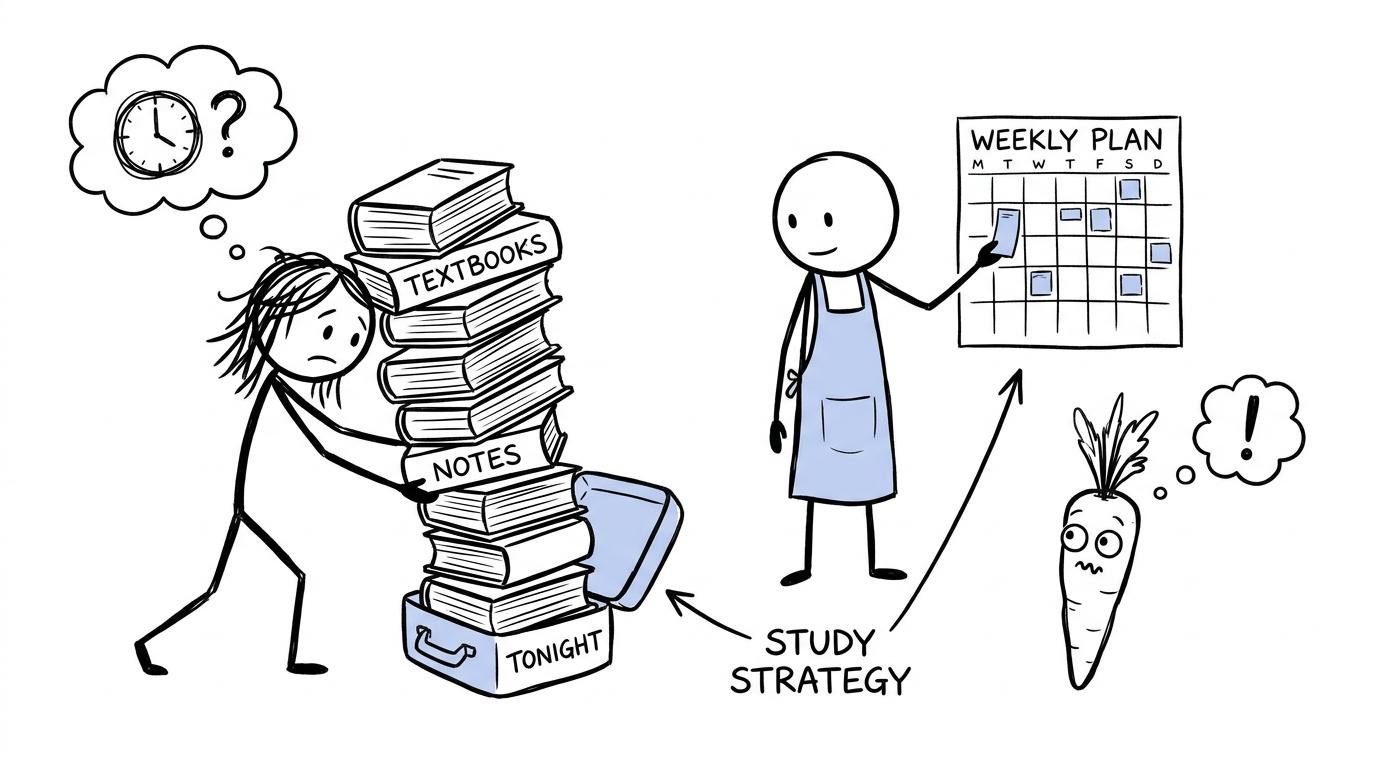 One student cramming while another spaces revision across a calendar
Common mistakes with spaced repetition
Copying too much onto each card
A card containing half a page becomes a reading task. Split it into precise questions that can be marked clearly.
Looking before attempting an answer
Even a quick glance removes the retrieval challenge. Commit to a response first, then check it.
Treating the schedule as unbreakable
The intervals are there to support memory, not control your life. Move weak material closer and secure material further away.
Reviewing only comfortable topics
Easy cards provide reassurance but little diagnostic value. Give more attention to repeated errors while continuing occasional reviews of secure knowledge.
Making cards without checking the specification
A beautiful set of irrelevant cards is still irrelevant. Match content to your board and ask your teacher if you are uncertain.
Replacing exam questions with flashcards
GCSE assessments require knowledge to be applied, analysed and communicated. Use cards to make knowledge available, then practise using it.
Allowing one subject to consume the timetable
Food and Nutrition revision should not quietly replace maths, English or science. A balanced plan assigns each subject a realistic slot. MathsGenie's guide to the best order for learning GCSE maths topics can help you sequence maths work rather than revising whichever topic happens to feel easiest.
Start small and let the system grow
The best first step is not to produce every flashcard you might need. Choose one specification topic, create ten clear questions and schedule the first four reviews. That is enough to discover whether your prompts are precise and whether your timetable is realistic.
Then repeat the cycle: retrieve, check, correct and return later.
For the maths side of your revision, make MathsGenie GCSE revision your free home base. Use revision lessons to rebuild understanding, practice questions and mini tests to retrieve methods, mark schemes and video solutions to correct errors, and past papers or predicted papers to prepare for exam conditions. Spaced repetition keeps knowledge within reach. Careful practice teaches you what to do with it.