Sleep Before a GCSE Statistics Exam: How Much?
Sleep before GCSE Statistics exam: discover why teenagers need eight to ten hours, plus a practical night-before plan for memory, focus and exam-day calm.
The temptation usually arrives late. There is one more sampling method to review, one more cumulative frequency question to try, one more mark scheme to inspect. Sleep can feel like time taken away from revision.
But if you are deciding how much sleep before a GCSE Statistics exam you need, the clearest answer is this: most teenagers aged 131313 to 181818 should aim for 888 to 101010 hours each night. That includes the night before the exam. Sleep supports memory consolidation, working memory and attention, so sacrificing several hours to continue revising may leave you less able to use what you have learnt.
Sleep is not a substitute for preparation. It is part of preparation.
The night-before checklist
If your exam is tomorrow, keep the plan simple:
- Work backwards from your morning alarm and allow an opportunity for 888 to 101010 hours of sleep.
- Finish demanding revision about an hour before bed.
- Use one short, focused session rather than beginning a complete paper late at night.
- Review familiar material instead of trying to master a large new topic.
- Pack your calculator, pens, ruler and exam information.
- Avoid caffeine during the final several hours before bedtime.
- Put your phone away and follow a calm wind-down routine.
- If one night goes badly, do not assume the exam is ruined.
MathsGenie's GCSE Statistics revision hub can help you choose a small, relevant task without opening five different resources and wondering where to begin.
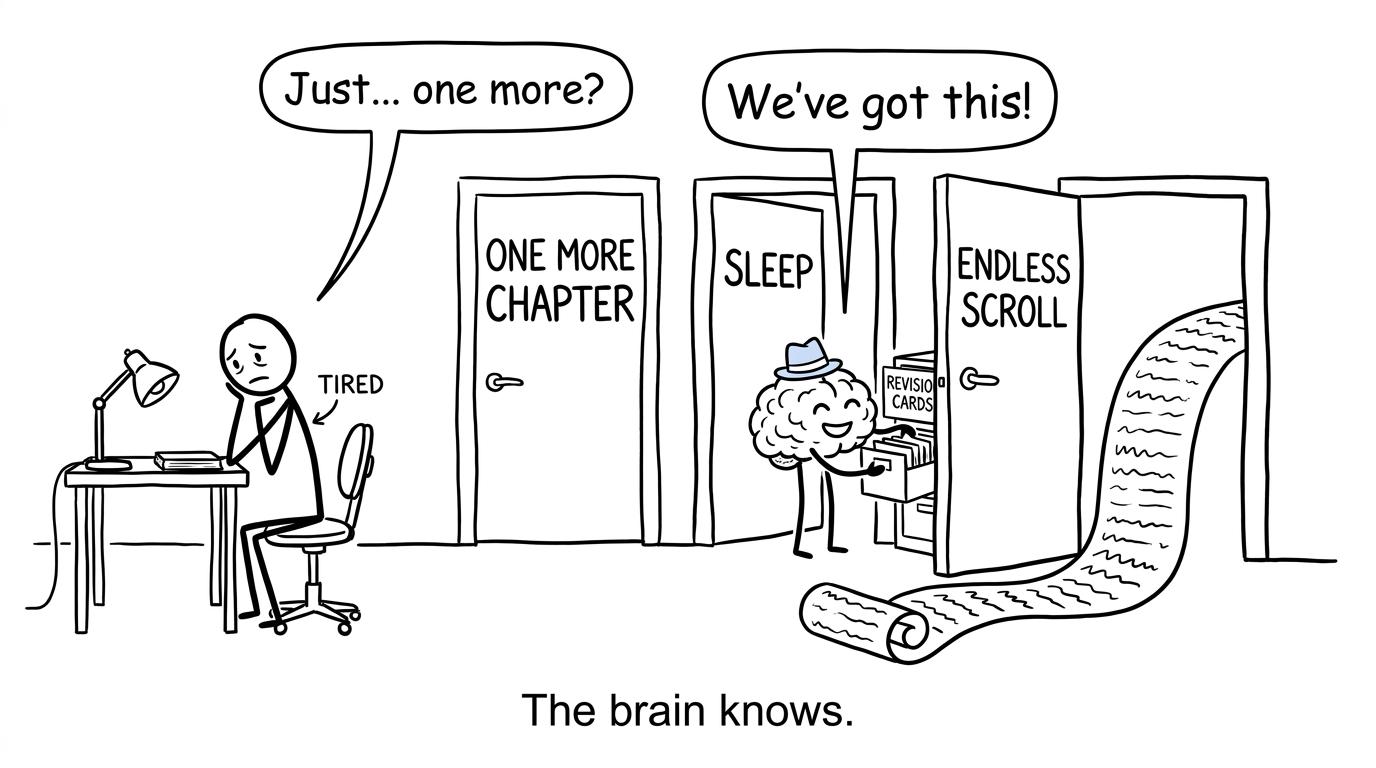 A student chooses between endless revision and letting the brain file away what has been learnt
How much sleep do GCSE students actually need?
Authoritative sleep guidance generally recommends 888 to 101010 hours in each 242424-hour period for teenagers aged 131313 to 181818. Individual needs differ, so the target is a range rather than one perfect number.
The important phrase is sleep opportunity. Going to bed eight hours before your alarm does not mean you will sleep for eight hours. You need time to settle, fall asleep and deal with ordinary interruptions.
A useful calculation is:
bedtime=wake-up time−sleep target−settling time\text{bedtime}=\text{wake-up time}-\text{sleep target}-\text{settling time}bedtime=wake-up time−sleep target−settling timeFor instance, someone who needs to wake at 7:00 am7\text{:}00\,\text{am}7:00am and wants around nine hours asleep should begin winding down well before 10:00 pm10\text{:}00\,\text{pm}10:00pm. This is not a universal bedtime. Your travel arrangements, usual routine and personal sleep needs matter.
One long night also cannot reliably cancel a week of short nights. Regular sleep across the revision period is more useful than treating the night before as an emergency repair job. If exam season has already become a cycle of late revision and tired mornings, make the next night calmer rather than trying to achieve a mathematically perfect reset.
What sleep does for statistics memory
Revision begins with encoding: taking in information such as definitions, methods and the meaning of different representations. Later, you need to retrieve that information under timed conditions. Sleep helps between those two moments.
Research reviews indicate that sleep plays an active role in memory consolidation, the process through which recently learnt information becomes more stable. Evidence in children and adolescents supports benefits for working memory and the consolidation of complex information, although the size of the effect varies between tasks and individuals.
That qualification matters. Sleep is not a button that permanently stores everything you read before bed. If you never understood stratified sampling, sleeping for nine hours will not teach it to you. But after purposeful revision, sleep gives the brain a better setting in which to preserve and organise the learning.
This is why a brief review followed by sleep can be more sensible than continuing until the words stop carrying meaning. If frequency tables are a weak area, use the averages from frequency tables revision guide, answer a few appropriate questions, check the method and stop.
Why sleep matters for focus in a Statistics exam
A GCSE Statistics paper does not test recall alone. It asks you to read carefully, select information, evaluate conclusions and keep several pieces of data in mind.
Working memory
Working memory is the limited mental workspace used while completing a task. You rely on it when you hold a frequency in mind while calculating a total, compare two distributions or connect a graph with a written conclusion.
Reviews of adolescent sleep research find that restricted sleep can impair working memory, while sleep extension or improved sleep quality has sometimes been associated with better performance. Findings are not identical across every study, but the overall message is practical: tiredness does not create a good environment for multi-step reasoning.
Vigilance and attention
Sleep deprivation has a particularly consistent effect on vigilance: the ability to remain alert and respond reliably. In an exam, reduced vigilance may look ordinary rather than dramatic: overlooking a word such as “estimate”, copying the wrong value, missing the scale on an axis or answering a different question from the one asked.
These errors are frustrating because they may not reflect a gap in statistical knowledge. They reflect a moment in which attention slipped.
Judgement and interpretation
Statistics involves judgement. You may need to discuss bias, decide whether a sample is representative or explain what a result does and does not prove. A rested student is not guaranteed to make the right judgement, but adequate sleep supports the attention and mental control needed to consider the evidence before writing.
The goal is not simply to feel less sleepy. It is to make your knowledge more available when the paper demands it.
What to revise on the final evening
The last evening should reduce uncertainty, not expand the syllabus.
Begin with your exam board. GCSE Statistics resources and paper structures are not interchangeable, so confirm whether you are following AQA, Edexcel or CCEA and use material matching your specification. Edexcel students can start with the Edexcel GCSE Statistics revision page, which brings together topic resources, questions and papers.
Choose no more than two priorities:
- retrieve important definitions or methods from memory;
- correct a familiar mistake using a small set of practice questions;
- inspect a previously completed paper and its mark scheme;
- read your own brief list of reminders.
Avoid starting a full unseen paper if completing and marking it will push bedtime significantly later. A paper is valuable when it produces feedback you have time to use. Late at night, an unfinished paper can simply produce anxiety.
The MathsGenie night-before revision plan offers a broader structure for choosing a short task, fixing recurring mistakes and stopping at a planned time. If you are preparing earlier in the season, the one-month GCSE revision plan helps spread practice across several weeks so the final night carries less pressure.
How to build an exam-friendly sleep routine
A good night usually starts before you enter the bedroom.
Set a firm revision cut-off
Decide when revision ends before you begin. During the final session, use the MathsGenie resources collection to select one mini test, worksheet or focused activity. When the time is up, mark what you completed and write down the next action. This tells your brain that the unfinished work has a place tomorrow.
Reduce stimulation
NHS sleep guidance recommends a regular routine, time to relax before bed, a comfortable bedroom and putting phones away. Screens can be stimulating through their light, content and notifications, so moving the phone out of reach is often more effective than promising not to touch it.
Caffeine is also a stimulant and can remain disruptive for hours. Coffee is not the only source: tea, cola, chocolate and energy drinks may contain caffeine too. Avoid using caffeine late in the day to manufacture extra revision time.
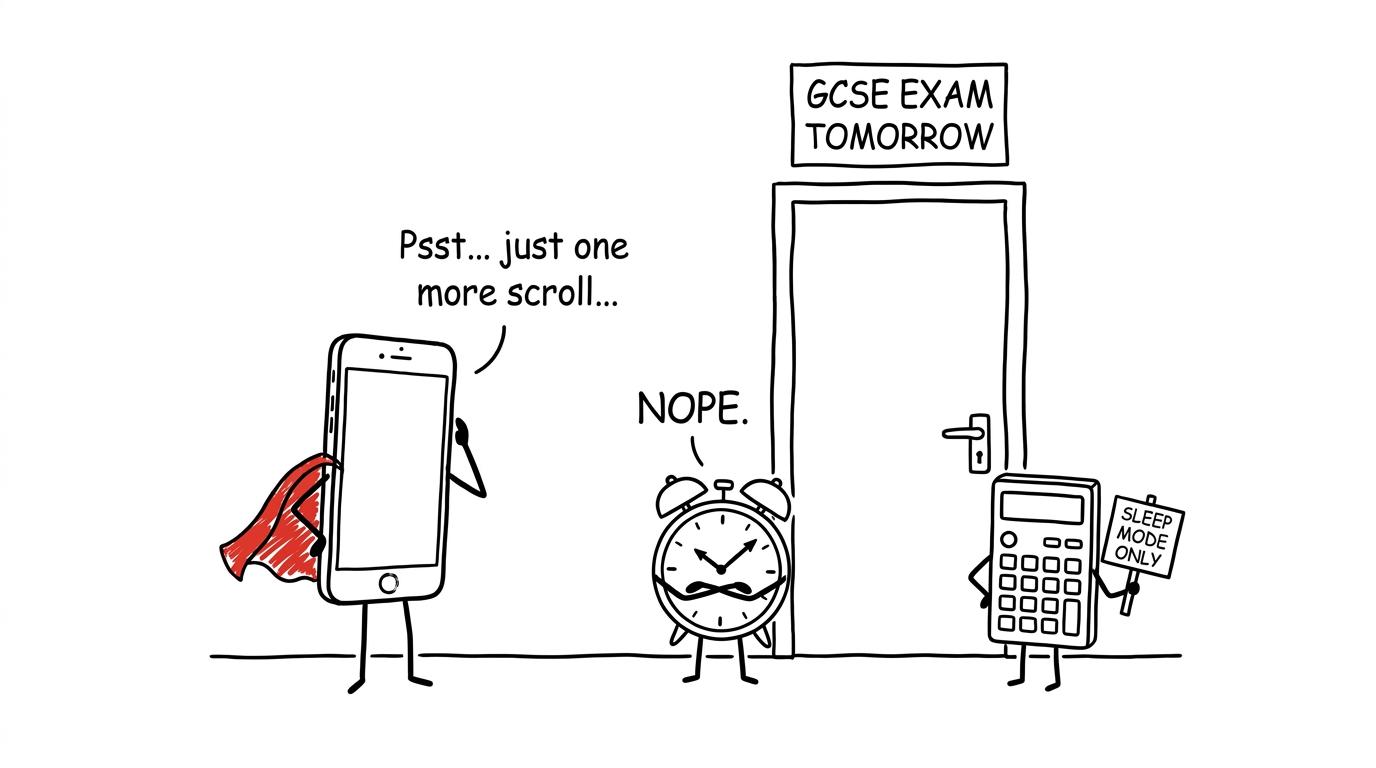 A calculator and alarm clock protect bedtime from the phone's promise of one more scroll
Make tomorrow feel organised
Pack what you need, check your journey and set an alarm. Write down any final concern rather than carrying it into bed. Small practical decisions matter because uncertainty can keep the mind active long after revision has ended.
If you are still awake after a while and becoming frustrated, avoid repeatedly checking the clock. Authoritative NHS guidance commonly suggests getting up, sitting somewhere quiet in dim light and returning to bed when sleepy. Do something calm rather than restarting revision or scrolling through social media.
What if you slept badly?
One poor night does not erase months of preparation. The worst response is often to turn tiredness into a prediction: “I slept badly, therefore I will fail.” That conclusion is not supported by the information available.
Get up at the planned time, eat and drink as you normally would, and give yourself enough time to reach the exam. Avoid a frantic attempt to relearn the course. A short look at your own reminders is enough.
During the paper:
- read each instruction carefully;
- underline key statistical terms;
- show the stages of calculations;
- check graph scales and units;
- return to skipped questions calmly;
- use the final minutes to inspect avoidable errors.
These actions provide external structure when attention feels less reliable. They cannot replace sleep, but they can help you work steadily with the energy you have.
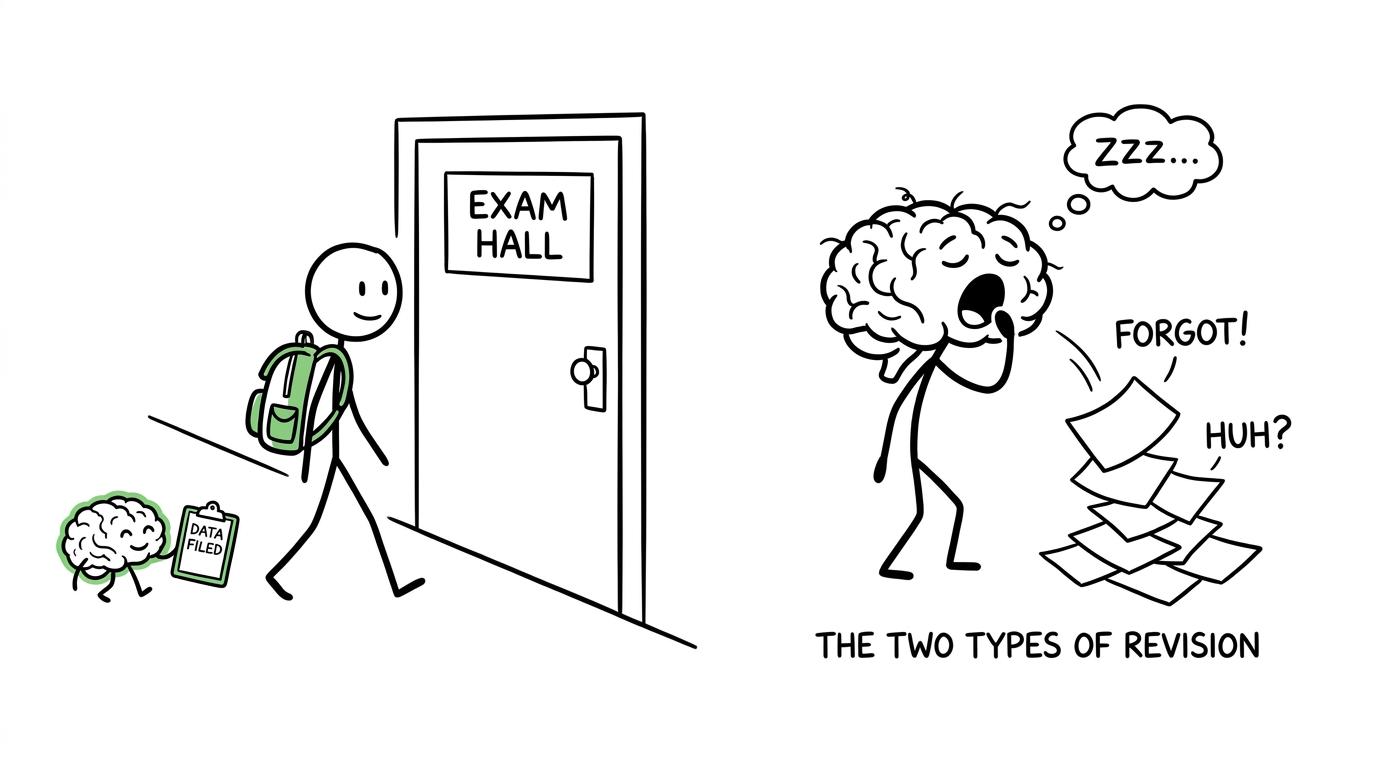 A rested brain arrives with the revision neatly filed while a tired brain chases loose notes
Common mistakes before a GCSE Statistics exam
Trading several hours of sleep for passive rereading
Reading notes repeatedly can feel productive because it is familiar. Retrieval is a better test of what you know. Close the notes, recall the method, answer a few questions and then stop. The guide to remembering GCSE maths content explains how active recall and spaced practice reduce dependence on last-minute sessions.
Revising every weak topic at once
A long weakness list creates movement without progress. Use previous questions and mark schemes to identify the errors most likely to cost you marks. MathsGenie's guide to finding weak GCSE topics shows how to turn lost marks into a focused practice plan.
Going to bed unusually early and trying to force sleep
Sleep is not an exam question that yields to greater effort. Keep reasonably close to your normal routine, allow enough time and focus on resting rather than monitoring every minute.
Using energy drinks as a backup plan
Caffeine may make you feel more awake temporarily, but taking it late can make sleep harder. It is not a substitute for a sustainable revision timetable.
Assuming a bad night guarantees a bad result
Sleep supports performance, but your result depends on many things: preparation, question selection, method, accuracy and how you respond during the paper. Treat tiredness as something to manage, not as a verdict.
Make sleep part of the revision plan
The night before a Statistics exam is a test of judgement before the official test begins. Another hour of revision has an obvious benefit because you can see the page in front of you. Sleep works quietly, supporting memory, working attention and the ability to retrieve what you already know.
Aim for 888 to 101010 hours, protect a calm wind-down period and let the final session be short enough to finish with confidence. Then use MathsGenie to make the revision itself count: choose your board through the GCSE Statistics revision hub, learn through revision lessons, practise with focused questions, and test yourself using past papers, predicted papers, mini tests, mark schemes and video solutions.
Do the useful work. Stop at the planned time. Give your brain the night to keep it.