

Sleep Before a GCSE Economics Exam: What You Need
Sleep before GCSE Economics exam: learn how many hours teenagers need, how rest supports memory and focus, plus a calm plan for exam day and avoid panic.
The night before an Economics paper creates a difficult bargain. Another hour of revision feels productive, yet the cost may arrive the next morning as slower thinking, weaker concentration and muddled recall. If you are deciding how much sleep before a GCSE Economics exam you need, the short answer is this: most teenagers should aim for roughly 888 to 101010 hours, while keeping as close as possible to their normal sleep routine.
Sleep is not time stolen from revision. It is part of revision. It helps your brain stabilise what you have learnt, supports attention and makes it easier to organise an answer under pressure. One excellent night cannot replace weeks of preparation, but sacrificing sleep for last-minute cramming is rarely a good trade.
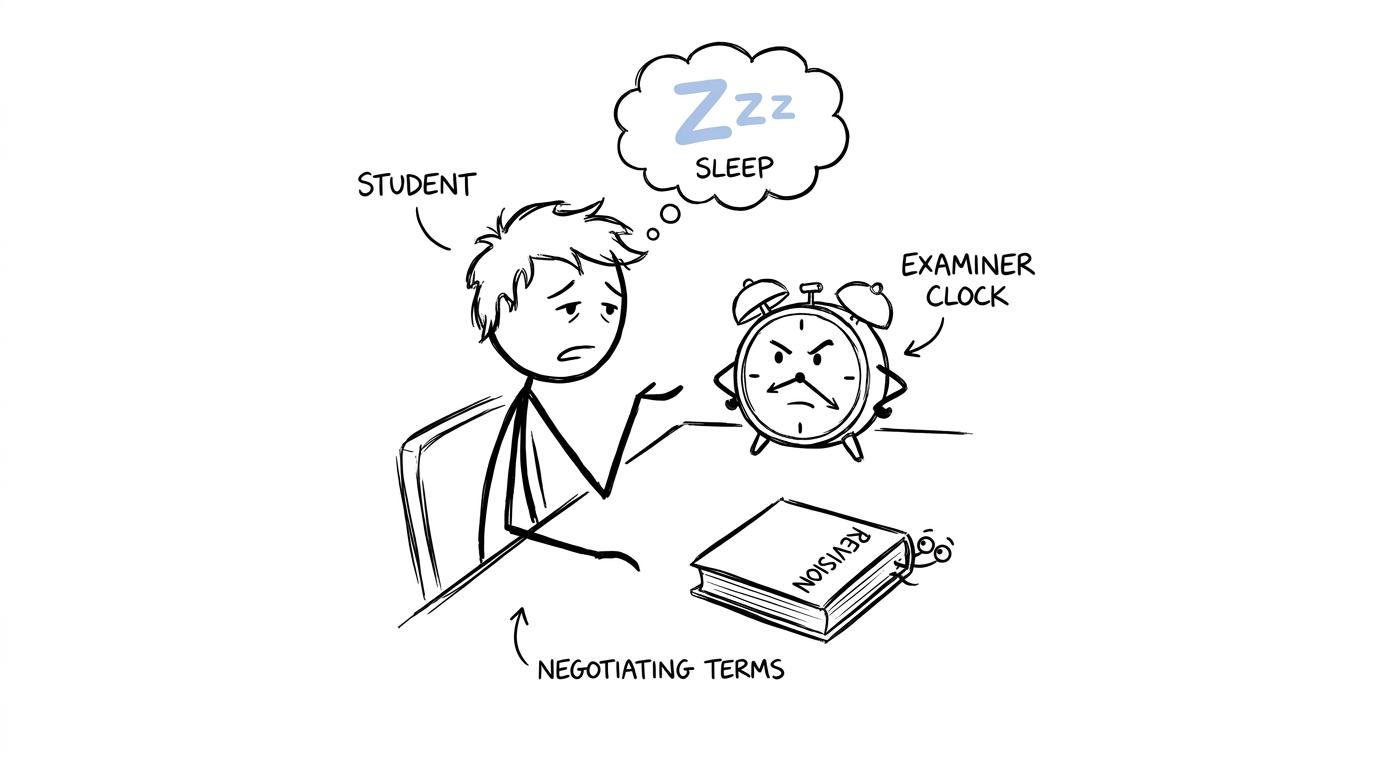 A tired student negotiating with an alarm clock over one more hour of revision
Your night-before checklist
A sensible plan is deliberately uncomplicated:
- Aim for about 888 to 101010 hours of sleep.
- Work backwards from the time you must wake up.
- Finish demanding revision at least an hour before bed where possible.
- Review a short list of definitions, diagrams and weak areas rather than an entire specification.
- Pack your approved equipment and check the exam time and location.
- Avoid relying on caffeine or energy drinks late in the day.
- Put your phone away and give your mind time to slow down.
- If sleep does not come immediately, rest calmly rather than repeatedly checking the clock.
The goal is not a perfect evening. It is to remove avoidable decisions so that your brain has less to manage.
How much sleep do GCSE students actually need?
Widely accepted health guidance places most teenagers' usual sleep requirement at around 888 to 101010 hours per night. Individual needs vary, so your best target is normally the amount that leaves you alert during an ordinary school day.
That does not mean every student will fall asleep at exactly the planned time. Nor does it mean that getting slightly less than your target guarantees a poor result. Sleep recommendations describe a healthy pattern, not a mark-scheme boundary.
The broader pattern matters too. If possible, protect your sleep throughout the revision period rather than treating the final night as a rescue operation. A long lie-in or one early night cannot completely cancel a sustained sleep shortage. Regular sleep also makes it easier to become sleepy at a predictable time.
Work backwards from your morning alarm and allow extra time to settle. If you need to wake at seven in the morning and generally need around 999 hours, you should be trying to sleep at approximately ten in the evening, not only beginning your revision shutdown then.
What sleep does for Economics memory
A GCSE Economics paper does not simply ask whether you have seen a term before. You may need to recall a definition, interpret information, apply it to a context, develop a chain of reasoning and reach a supported judgement. AQA and OCR papers may structure questions differently, but both demand more than recognition.
Sleep contributes to three processes that matter here.
It supports memory consolidation
Learning creates memories that are initially vulnerable. During sleep, the brain continues processing recently encountered information and helps stabilise useful memories. This is often described as memory consolidation.
That matters when you have revised ideas such as opportunity cost, price elasticity, market failure or fiscal policy. Sleep does not magically correct an inaccurate definition, but it can support retention of material that was properly understood and practised while awake.
A short, focused review followed by adequate sleep is therefore usually more useful than repeatedly reading pages while exhausted. The active learning happens during revision; sleep helps preserve and organise its results.
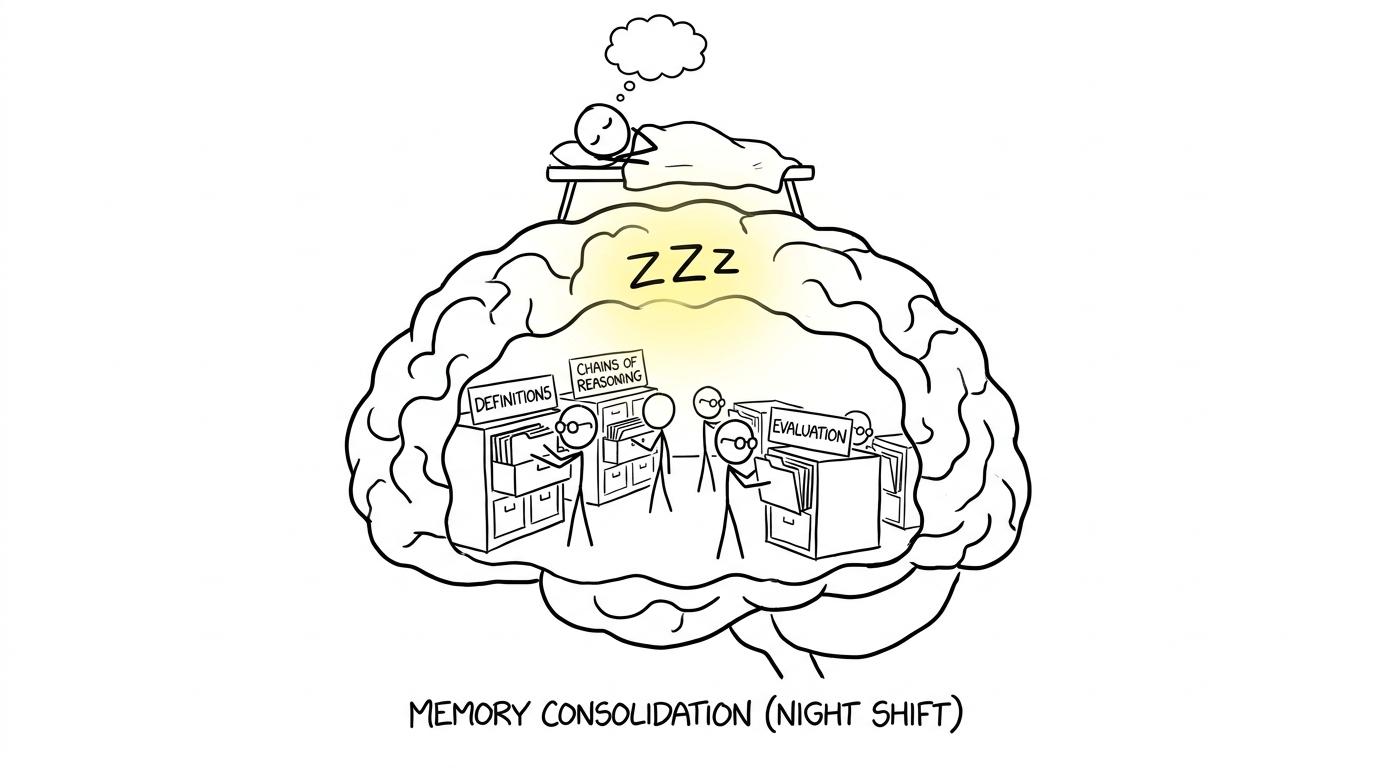 Tiny brain librarians filing Economics ideas while a student sleeps
It protects working memory
Working memory is the limited mental space used to hold and manipulate information. In an Economics exam, you use it when connecting several steps in an argument:
change⟶effect⟶secondary effect⟶judgement\text{change} \longrightarrow \text{effect} \longrightarrow \text{secondary effect} \longrightarrow \text{judgement}change⟶effect⟶secondary effect⟶judgementFor example, you may need to keep the question's context in mind while selecting evidence, developing analysis and remembering the command word. Tiredness can make this mental juggling harder. Students may know each individual idea but lose the thread connecting them.
The same principle transfers directly to GCSE maths. Multi-step problems become more demanding when concentration and working memory are weakened. MathsGenie's GCSE revision resources can help you build fluency earlier, reducing how much unfamiliar processing is left for exam day.
It supports attention and self-control
Exams contain small traps: a changed unit, a negative sign, a command word such as “evaluate”, or a piece of context that must appear in your answer. Adequate sleep supports sustained attention, while insufficient sleep commonly leaves people less alert and more prone to lapses.
Self-control matters as well. When tired, it can be harder to pause, reread a question and choose a proportionate answer. You may rush the opening section, spend too long on one problem or abandon a sensible plan after meeting a difficult question.
Sleep will not supply missing knowledge. It helps you access and manage the knowledge you already have.
Why late-night cramming feels more useful than it is
Cramming has one persuasive feature: it is visible. You can count pages, highlight definitions and watch the clock move. Sleep produces no equally satisfying pile of evidence.
But activity and progress are not identical. Once you are struggling to follow a paragraph or repeatedly forgetting what you have just read, the value of another hour may be low. You are exchanging tomorrow's alertness for revision of declining quality tonight.
A better final session has boundaries. Choose a few high-value tasks:
- retrieve essential definitions without looking;
- check the structure of longer responses;
- revisit a small number of weak areas;
- inspect common diagram labels;
- confirm exam arrangements and permitted equipment.
Then stop. If maths is also part of your exam week, use a GCSE revision planner to spread practice across several days rather than creating another last-night emergency.
A calmer routine before bed
Your body cannot always move instantly from exam anxiety to sleep. Build a short transition between revision and bed.
Finish with retrieval, not new content
Close your notes and recall a brief checklist of ideas. Then verify what you remembered. This gives you useful feedback without opening an entirely new topic late at night.
Avoid sitting a full paper immediately before bed. Timed practice is valuable earlier in your preparation, using resources such as GCSE maths past papers and MathsGenie predicted papers, but a demanding paper late at night may leave you alert, frustrated or tempted into hours of marking.
Prepare the morning in advance
Pack your pens, pencils, ruler and any other approved equipment. Check your candidate details, travel plan and start time using information supplied by your school.
This is not merely organisation. It removes small worries that otherwise tend to reappear when the room becomes quiet.
Reduce stimulation
Dim the lights, leave your phone away from the bed and choose a calm activity. Screens are not the only cause of sleep difficulties, but messages, videos and revision notifications can keep your attention active long after you intended to stop.
Caffeine can remain disruptive for hours, and sensitivity differs between people. Do not use the night before an exam to experiment with energy drinks, supplements or unfamiliar sleep products. If sleep difficulties are persistent, speak to a parent, carer, GP or another appropriate health professional.
What if you cannot fall asleep?
Trying to force sleep often creates a second problem: anxiety about being awake. One imperfect night does not erase your preparation. Your knowledge has been built over time, not stored in a single fragile evening.
Keep the room quiet and dark, avoid repeatedly checking the time, and use slow breathing or another familiar relaxation routine. If you remain awake for a long period, a calm activity in low light may be more helpful than scrolling through exam predictions.
The next morning, follow your normal routine. Eat and drink as you ordinarily would, arrive with time to spare and begin the paper methodically. Avoid deciding in advance that tiredness has ruined the exam. That belief can consume more attention than the tiredness itself.
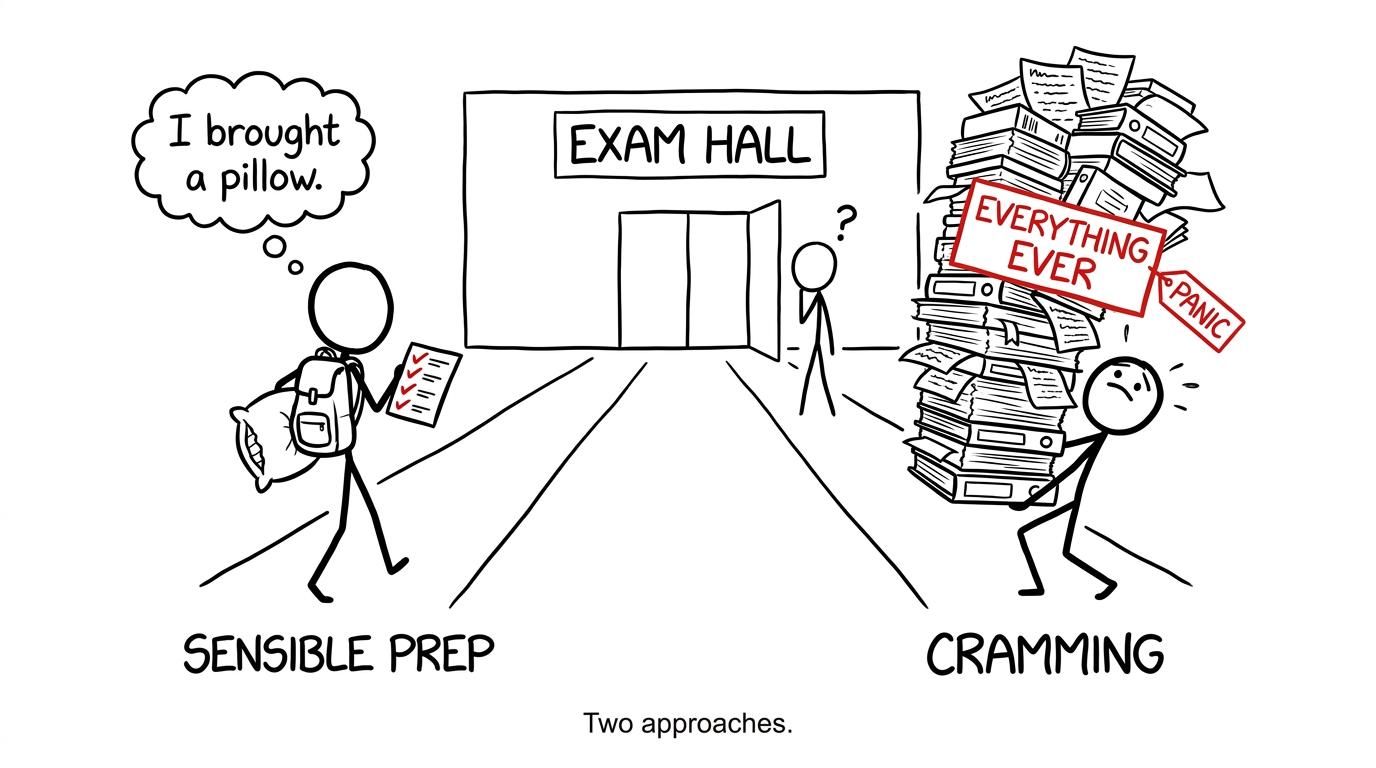 One calm student and one student pushing an impossible tower of revision notes
Common mistakes before an Economics exam
Trading several hours of sleep for passive rereading
Reading familiar notes can feel reassuring without testing whether you can retrieve or apply the content. Set a stopping time and use the final session for concise recall.
Trying to learn the whole specification overnight
This creates panic and encourages shallow coverage. Prioritise familiar material, major weak spots and answer structure. Accept that not every gap can be closed in one evening.
Changing your sleep schedule dramatically
Going to bed several hours earlier than usual does not guarantee sleep. Move towards a sensible routine across the revision period where possible.
Using caffeine as a substitute for rest
Caffeine may temporarily increase alertness, but it does not reproduce sleep's role in memory and recovery. Taking it late can also make falling asleep harder.
Doing nothing because the exam is not maths
Economics still involves careful reasoning, quantitative information, graphs and proportional thinking. Regular maths practice supports those underlying skills. MathsGenie's GCSE mini tests provide focused practice, while AQA maths papers and OCR maths papers help students prepare for the format used by their own maths exam board.
Assuming one poor night guarantees failure
Sleep matters, but exam performance has many influences. Do not turn tiredness into a prediction. Read carefully, plan longer answers and collect the marks available to you.
Make sleep part of the revision plan
The best answer to late-night panic usually begins several days earlier. Short, repeated sessions give you time to identify weak knowledge, practise retrieval and recover between demanding tasks. They also stop every subject competing for the same final evening.
Maths revision benefits from the same approach. Use MathsGenie's free revision lessons and video solutions to understand a topic, complete practice questions without support, and check your work against the answers or mark scheme. Follow that with mini tests, GCSE past papers and predicted papers when timed practice becomes appropriate.
If you are moving towards sixth-form study, the A Level maths revision hub continues the same pattern: learn, practise, check, revisit and rest.
Protect the knowledge you have built
Before a GCSE Economics exam, aim for roughly 888 to 101010 hours of sleep and stay close to your established routine. Finish revision early enough to unwind, prepare everything needed for the morning and remember that rest supports memory, working attention and controlled decision-making.
The final night is not the moment to prove how long you can work. It is the moment to protect the work already done.
Use MathsGenie to make that possible. Start with free revision lessons, practise with topic questions and mini tests, then build confidence through past papers, predicted papers, mark schemes and video solutions. Plan the work earlier, close the books at a sensible time and walk into the exam ready to use what you know.











