

A Six-Week A-Level Maths Revision Plan That Works
A six-week A-Level maths revision plan with topic triage, past papers, rest days and catch-up time. Build a realistic timetable for your final maths exams.
Start with the time you actually have
Six weeks before your exams, deciding what deserves attention can feel difficult. Integration feels urgent, mechanics keeps slipping, and other subjects need time too. A six-week A-Level maths revision plan makes those decisions manageable: identify weak topics, practise them alongside mixed questions, then gradually increase timed paper work.
Start with lessons, travel, other subjects and rest. The space left is your revision budget. Planning within it gives you something you can follow when life becomes busy.
The structure is simple: diagnose and repair, connect topics, then rehearse exam conditions.
Check your starting point
Before allocating sessions, gather:
- Your exam board, specification and confirmed paper dates.
- Recent marked work, including mock papers.
- A checklist covering pure mathematics, statistics and mechanics.
- Your realistic availability across subjects.
- A place to record mistakes and questions to revisit.
Paper structures differ between boards. AQA combines pure mathematics with mechanics in one paper and statistics in another; Edexcel has two pure papers and one statistics and mechanics paper. Start with MathsGenie’s A Level Maths revision hub, and check your specification before dividing your time.
The revision timetable guide targets GCSE students, but its starting principle transfers: fit revision around actual commitments.
Triage topics using evidence
Sort topics into three groups:
- Secure: you complete unfamiliar exam questions independently.
- Developing: you understand the method but need prompts or make repeated errors.
- Priority: you cannot reliably choose or complete a method.
Use short question sets and recent scripts as evidence. Recognising a method in a video does not demonstrate that you can use it independently.
Look beneath the topic label. Integration difficulties might begin with algebraic manipulation. Mechanics errors might involve resolving forces or choosing signs. Repairing an underlying skill can help several topics.
Give most early sessions to priority and developing topics, while retaining secure material in mixed practice. The specification defines what you must prepare.
Your six-week A-Level revision plan
Adapt this structure to your diagnostic results, reserving time to mark every substantial task.
| Week | Main focus | Practical outcome |
|---|---|---|
| One | Diagnose gaps and repair essential skills | A prioritised topic list |
| Two | Rebuild weak pure and applied methods | Independent solutions to difficult question types |
| Three | Mix topics and revisit repairs | Method selection without topic labels |
| Four | Introduce full timed papers | A record of timing problems and errors |
| Five | Alternate papers with targeted repairs | Fewer repeated mistakes |
| Six | Consolidate around paper dates | A manageable final review list |
Build your schedule in the Revision Planner, fitting these priorities around your commitments.
Weeks one and two: repair before rushing
Use marked work or a diagnostic paper to identify gaps. If a full paper would consume your available time, begin with shorter selections covering all three strands.
For each priority topic, attempt questions, identify the missing method, use a revision lesson, then try fresh questions independently. MathsGenie’s Edexcel A Level Maths resources provide a starting point for that specification.
During week two, revisit earlier repairs after a gap. Include statistics and mechanics from the beginning to avoid creating another backlog.
Week three: practise choosing the method
Topic practice tells you which technique to use. Exams often leave that decision to you.
Mix questions from different areas and briefly explain why your approach fits. Retain a repair session for persistent difficulties. A mini test assembled from your error log can check whether earlier corrections have lasted.
Weeks four and five: papers, marking and repair
Begin full timed papers when you can accommodate both the attempt and review. Use the printed duration, your permitted calculator and formula booklet.
Choose resources for your board, such as Edexcel A Level Maths past papers and mark schemes. Record whether lost marks reflect knowledge, method selection, execution or timing.
Schedule repairs before the next paper. Redo missed questions without solutions visible, then attempt a different question testing the same skill. Video solutions can clarify difficult steps; independent retries check your understanding.
Keep an official past paper for a later progress check. Treat predicted papers as additional practice, never a forecast of the examination.
Week six: narrow the workload
Use your error log to select final tasks: recurring algebra errors, calculator procedures, statistical interpretation or mechanics assumptions.
Follow your actual paper order. Between examinations, focus on content still to come. Keep the day before each paper lighter, with familiar questions, equipment checks and a sensible bedtime.
Give each week a sustainable rhythm
One possible timetable includes four focused weekday sessions, a longer weekend block and one maths-free day. Adjust this starting point to your circumstances.
For a forty-five-minute session, allow roughly five minutes for recall, twenty-five for questions and fifteen for corrections. Paper sessions need separate review time.
Protect a flexible weekly slot for missed work or unfinished corrections. The short maths revision routine offers a GCSE structure you can adapt using A Level questions.
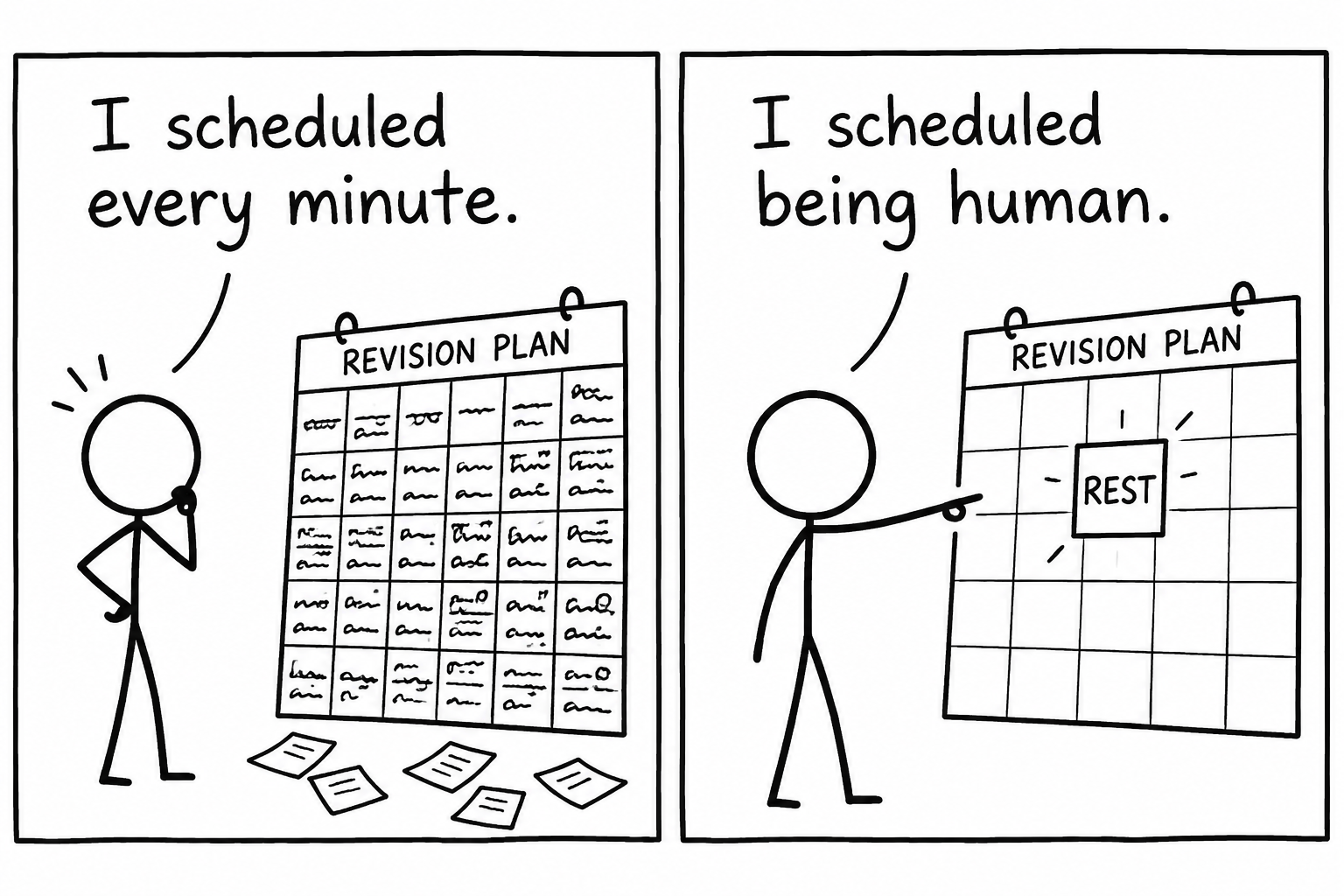 Stick figures compare an overloaded revision calendar with one that leaves room for rest.
Adjust when you fall behind
If another deadline displaces a session, move its most useful task into your flexible slot. Avoid automatically doubling tomorrow’s workload.
Keep tasks addressing repeated errors or essential prerequisites. Shorten work on secure topics. Replace “revise calculus” with a specific question set and correction task. Repeatedly missed sessions suggest your planned workload needs reducing.
Common mistakes to avoid
Counting papers without reviewing them. Uncorrected weaknesses remain for the next attempt.
Only watching explanations. Follow lessons with independent questions.
Dropping secure topics. Brief mixed practice checks that they remain secure.
Sacrificing rest every week. Persistent catch-up pressure signals an overloaded timetable.
Build the next six weeks
Diagnose, repair, mix, rehearse and consolidate. Turn those priorities into manageable tasks with MathsGenie’s free revision resources. Build your six-week schedule in the Revision Planner, then review it weekly using evidence from your questions and corrections.















