

Should You Drop GCSE Business Mid-Year?
Drop GCSE Business? Learn how to assess overload, check the consequences and protect your maths revision before making a mid-year decision.

The thought often arrives after a disappointing assessment or an evening when every subject seems to need attention at once: should you drop GCSE Business and use the time elsewhere?
The short answer is: perhaps, but not because of one poor mark or one difficult week. Dropping may be sensible when the subject is creating persistent, evidenced overload and your school agrees that leaving it will improve your wider GCSE programme. Before deciding, check your school’s policy, examination-entry position, timetable and sixth-form plans. Do not simply stop attending lessons.
This is less a question about whether Business is “easy” or “hard” than whether your overall workload is sustainable. A subject can be manageable in isolation yet become too much when placed beside compulsory GCSEs, health concerns and responsibilities outside school.
Your decision checklist
Before asking to leave the course, establish:
- whether Business is an optional subject in your school;
- whether your school permits mid-year subject changes;
- whether you have already been entered for the examination;
- whether support has been tried consistently;
- whether the problem is Business specifically or revision overload generally;
- how leaving would affect your timetable and supervised learning;
- whether a sixth form, college or apprenticeship has relevant entry requirements;
- what you would do with any genuinely released time.
The final question matters. Dropping a subject does not automatically improve another grade. It creates capacity; you still need a plan for using it.
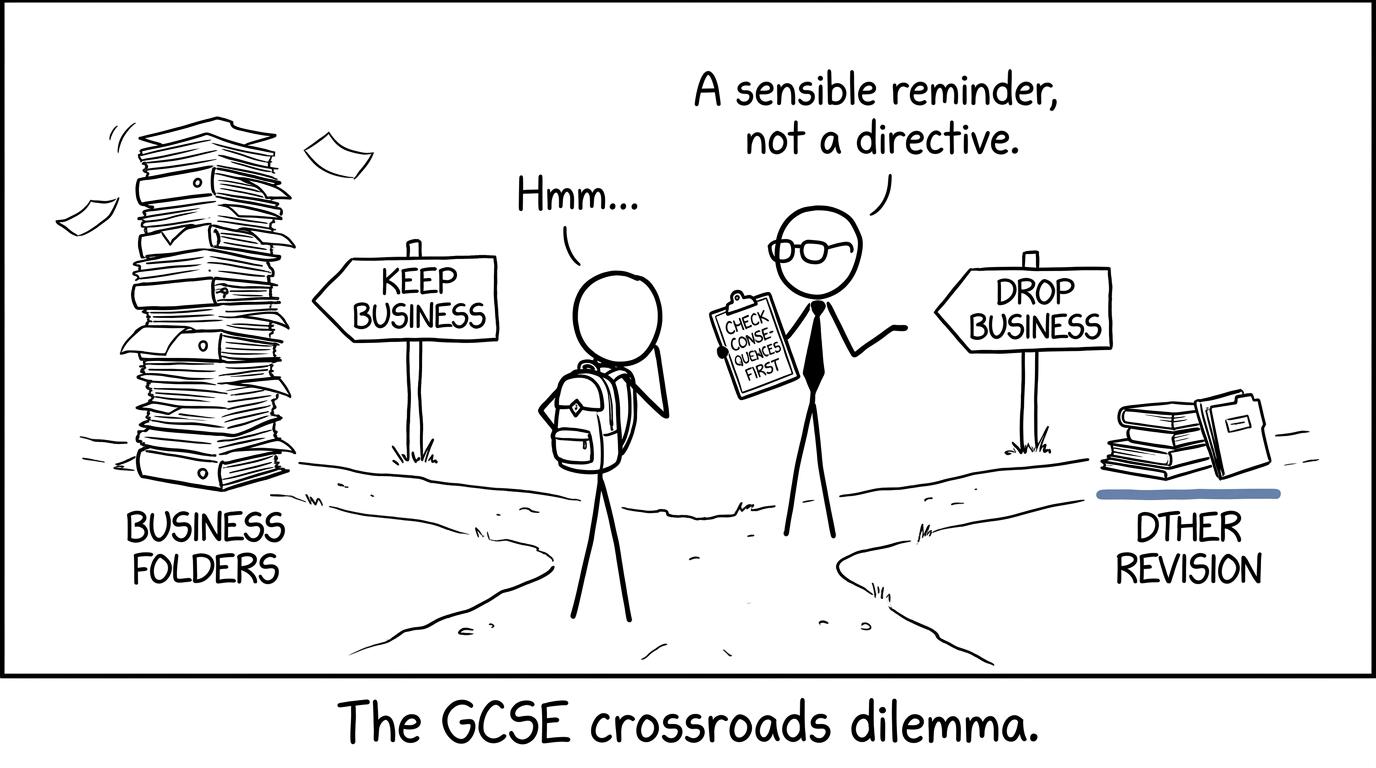 A student considers two GCSE paths while a teacher reminds them to check the consequences
How to tell if you are actually in over your head
A low mark is evidence, but it is not a verdict. Marks can fall because you misunderstood one topic, used an ineffective revision method or had several deadlines in the same week.
Being genuinely overextended looks more persistent. Consider the evidence from the last few weeks rather than the emotion of the last few hours.
The difficulty continues despite appropriate support
You may have a substantial problem if you regularly attend, complete practice, act on feedback and ask for help, yet remain unable to explain core ideas or structure examination responses.
That does not automatically mean you should leave. It means the difficulty deserves a specific conversation with your Business teacher. Ask which knowledge or examination skills are holding you back and whether the gap can realistically be closed within the remaining time.
Business is displacing essential work
GCSE mathematics is compulsory, whereas Business is normally an optional qualification. If Business tasks repeatedly prevent you from completing essential maths, English or science preparation, your priorities may need reconsidering.
Start by reviewing your maths position using the free GCSE maths revision resources. A topic-by-topic check is more informative than saying, “I am bad at maths”. You might discover that only a few areas require urgent attention.
Students working towards a secure pass can focus their diagnosis with Grade 4 GCSE maths topics, while those aiming higher can review the skills on the Grade 7 GCSE maths page. The purpose is not to predict your final grade from a webpage. It is to identify whether another subject is being neglected in a measurable way.
Your health and attendance are being affected
Persistent loss of sleep, anxiety, illness or non-attendance should not be treated as an ordinary productivity problem. Speak to a parent or carer, your form tutor, pastoral team or another trusted adult. If your health is involved, subject choices should form part of a wider support plan rather than becoming a decision you make alone.
The problem survives a fair trial period
Before dropping, try a defined recovery plan. This might include attending intervention, completing shorter and more frequent practice, using teacher feedback and protecting fixed revision periods.
If the situation improves, the subject may not have been the real problem. If it remains unmanageable despite sustained support, you have stronger evidence for discussing withdrawal.
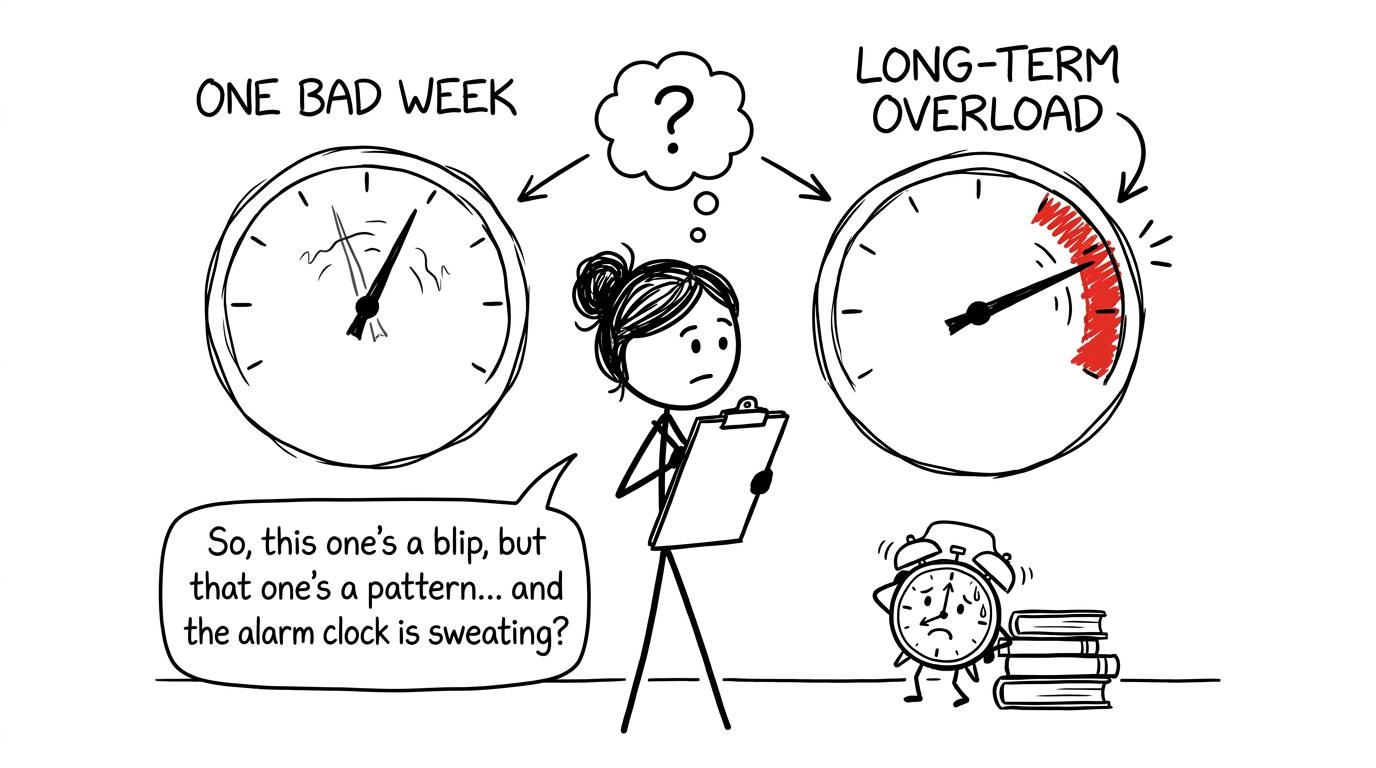 A student compares one bad week with persistent long-term overload
What dropping GCSE Business may affect
The practical consequences depend on your school, country within the UK, examination board and stage of the course. Policies are not identical, so a teacher or examinations officer must confirm what applies to you.
Your qualifications and school timetable
If you withdraw successfully, you will not receive a GCSE grade for Business. Your school must also decide where you go during the lessons. You may receive supervised revision, join another appropriate activity or follow a school-specific arrangement. You cannot assume that every timetabled Business lesson will become free time at home.
Exam-entry deadlines and administrative arrangements also matter. Schools enter candidates through examination boards such as Edexcel, AQA, OCR and Eduqas. If an entry has already been made, the school’s examinations officer will need to explain whether it can be withdrawn and whether any internal deadline or cost affects the decision.
Progress measures
In England, Business is not an English Baccalaureate subject. An approved Business qualification may, however, contribute within the open group of subjects used in Attainment 888 and Progress 888 calculations. These are primarily school accountability measures, and your school may therefore want to discuss how withdrawing affects your programme.
This does not mean that every student must take Business. Nor does it mean that Progress 888 works in exactly the same way in Wales or elsewhere in the UK. Ask your school to explain the consequence for your particular set of qualifications rather than relying on a general rule found online.
Sixth form, college and apprenticeship applications
Dropping one optional GCSE does not automatically prevent progression. Providers set their own entry requirements, often including minimum grades in English and maths alongside requirements for particular courses.
Do not assume, however, that GCSE Business is either essential or irrelevant. If you are considering A Level Business, economics, accounting or a related vocational course, check the published requirements of the institutions you may apply to. Some providers may not require GCSE Business at all; others may consider your wider GCSE profile or set additional conditions.
Your remaining workload
Leaving a subject can reduce lessons, homework and examination preparation, but the benefit depends on what replaces them. If the released capacity disappears into unplanned scrolling or general worry, the decision will not solve much.
A better approach is to assign the time in advance. Use a maths revision planner to connect each session to a topic, question set or paper. Revision becomes calmer when the next action has already been chosen.
What dropping the subject does not affect automatically
Dropping GCSE Business does not automatically:
- lower your grades in the subjects you continue;
- raise your maths grade;
- prevent you from applying to sixth form or college;
- stop you pursuing a business-related career;
- remove the need to meet your school’s curriculum expectations;
- solve poor organisation across every subject.
It also does not erase the useful knowledge you have already gained. Understanding revenue, costs, finance, marketing and decision-making can remain valuable even without a final qualification.
The central distinction is between removing one source of overload and expecting one decision to repair everything. The first can be realistic. The second usually is not.
Make the decision with evidence, not panic
Arrange a meeting involving your Business teacher and, where appropriate, your form tutor, head of year, examinations officer and parent or carer. Take evidence rather than arriving with only a conclusion.
Useful information includes recent assessments, homework completion, attendance, teacher feedback, your weekly timetable and the grades required for your next step. Ask direct questions:
- Is my current grade mainly a knowledge problem or an examination-technique problem?
- What support can I try before withdrawing?
- Has the school entered me for the examination?
- What would replace my Business lessons?
- Would leaving alter my eligibility for any school pathway?
- When must a final decision be made?
You are not asking other people to choose your life for you. You are gathering facts that you cannot obtain alone.
Protecting maths revision if you continue with Business
Keeping the subject may still be the right choice. If so, reduce friction in your maths preparation rather than waiting for a completely free evening.
Use short topic sessions followed by examination questions. MathsGenie’s Grade 5 GCSE maths resources and Grade 6 GCSE maths resources let you target the level currently most relevant to you. The revision lessons combine explanations, practice questions and solutions, so you can identify errors without searching across several resources.
Once individual topics feel secure, move to GCSE maths past papers. Past papers help reveal whether knowledge survives under timed conditions. Closer to the examination, GCSE predicted papers can provide additional practice, but they should supplement broad revision rather than encourage guessing about exact questions.
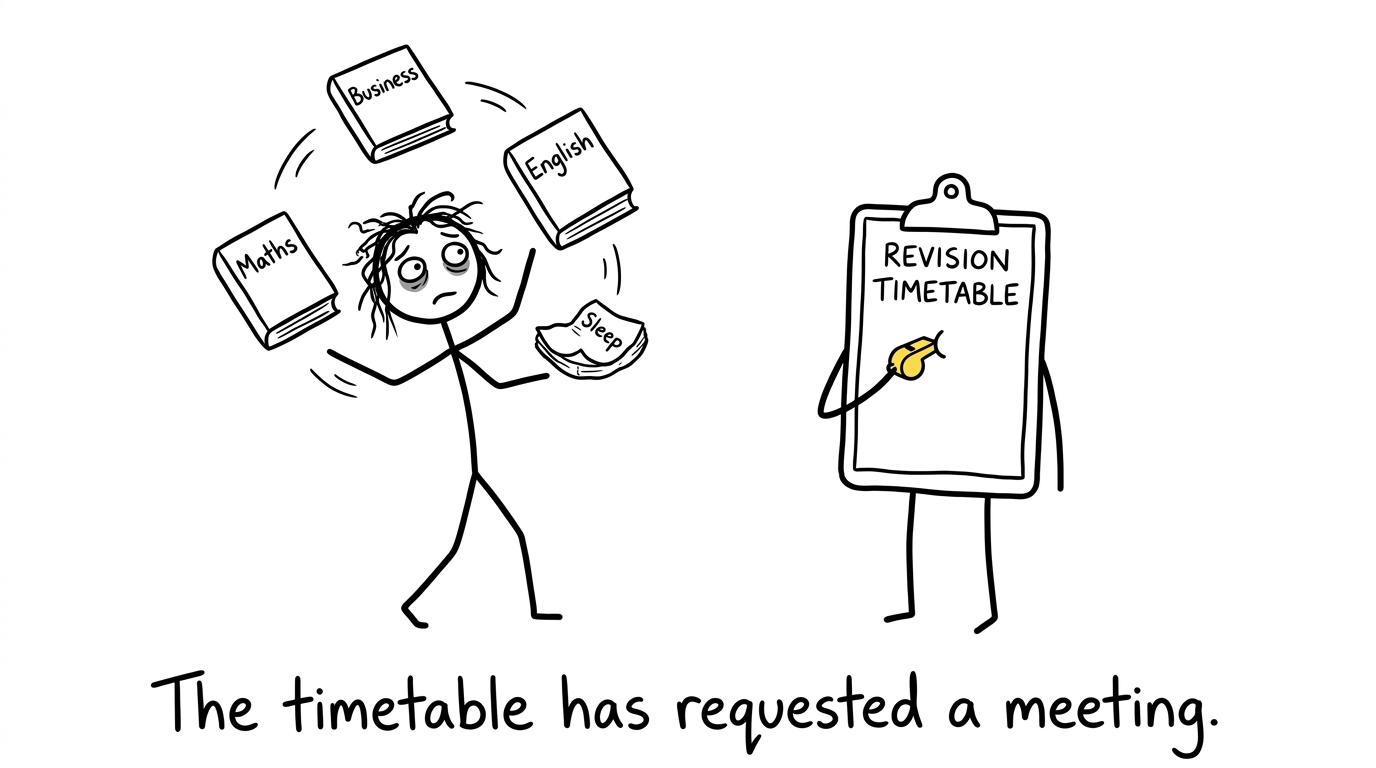 A GCSE student juggles subjects while the revision timetable requests a meeting
Common mistakes when considering withdrawal
Deciding immediately after one bad result
One assessment may expose a repairable gap. Review the paper, read the mark scheme and ask your teacher what caused the lost marks before treating the result as proof that you cannot succeed.
Comparing your workload with someone else’s
Another student may have different subjects, targets, support and responsibilities. The useful comparison is between your required workload and your available capacity.
Assuming fewer GCSEs always look worse
Entry decisions are more nuanced than simply counting qualifications. Grades, compulsory subjects and course-specific requirements all matter. Obtain advice from the institutions relevant to your plans.
Quietly stopping lessons or homework
Withdrawal is a formal school decision, not an individual act of disengagement. Until your school confirms a change, continue attending and completing required work.
Dropping without a replacement plan
Write down exactly how any released time will be used. For maths, that could mean one revision lesson, one set of practice questions and regular paper practice, followed by careful use of mark schemes and video solutions.
Make a smaller decision before a permanent one
When everything feels urgent, dropping a subject can look like the only lever available. Sometimes it is the correct lever. Often, the first useful step is smaller: diagnose the gaps, test a recovery plan and ask the people who understand your school’s rules.
If the evidence shows persistent overload, your school permits withdrawal and the change protects your health or essential GCSE preparation, leaving Business may be reasonable. If the problem is temporary or caused by an unfocused timetable, better support may preserve the qualification without sacrificing maths.
Whichever route you take, turn the decision into a practical revision plan. Start with MathsGenie’s free revision lessons and practice questions, then build towards past papers, predicted papers, mark schemes and video solutions. A difficult term becomes more manageable when the next task is clear and when every task has a reason for being there.










