Should I Take GCSE Further Maths? Honest Questions
Should I take GCSE Further Maths? Ask these honest questions about ability, workload, A Level plans and enjoyment before committing to the course.
There is a particular kind of regret that arrives when a subject you chose because you were “good at it” quietly takes over your timetable. More homework. Another examination. Less time for everything else.
So, should I take GCSE Further Maths? The short answer is: consider it if you are secure with Higher tier GCSE Maths, enjoy difficult algebra and have enough time to study an additional qualification without weakening your other subjects. It can be excellent preparation for A Level Maths, but it is not essential, and declining it does not close the door to future mathematical study.
The right decision depends less on whether you can take it and more on whether the course fits your interests, foundations and available time.
A quick decision checklist
GCSE Further Maths may suit you if:
- you are consistently working around grades 777 to 999 in GCSE Maths;
- Higher tier algebra feels manageable rather than mysterious;
- you enjoy solving unfamiliar problems, not only getting quick answers;
- you may take A Level Maths or Further Maths;
- your GCSE Maths knowledge is already secure;
- the additional lessons and revision fit your timetable.
Think more carefully if:
- ordinary GCSE Maths still needs substantial attention;
- your other subjects are already competing for limited revision time;
- you are choosing it mainly because someone called you “a maths person”;
- you dislike extended algebraic reasoning;
- you do not know which qualification your school actually offers.
That final point matters. “GCSE Further Maths” is often used informally for several different qualifications.
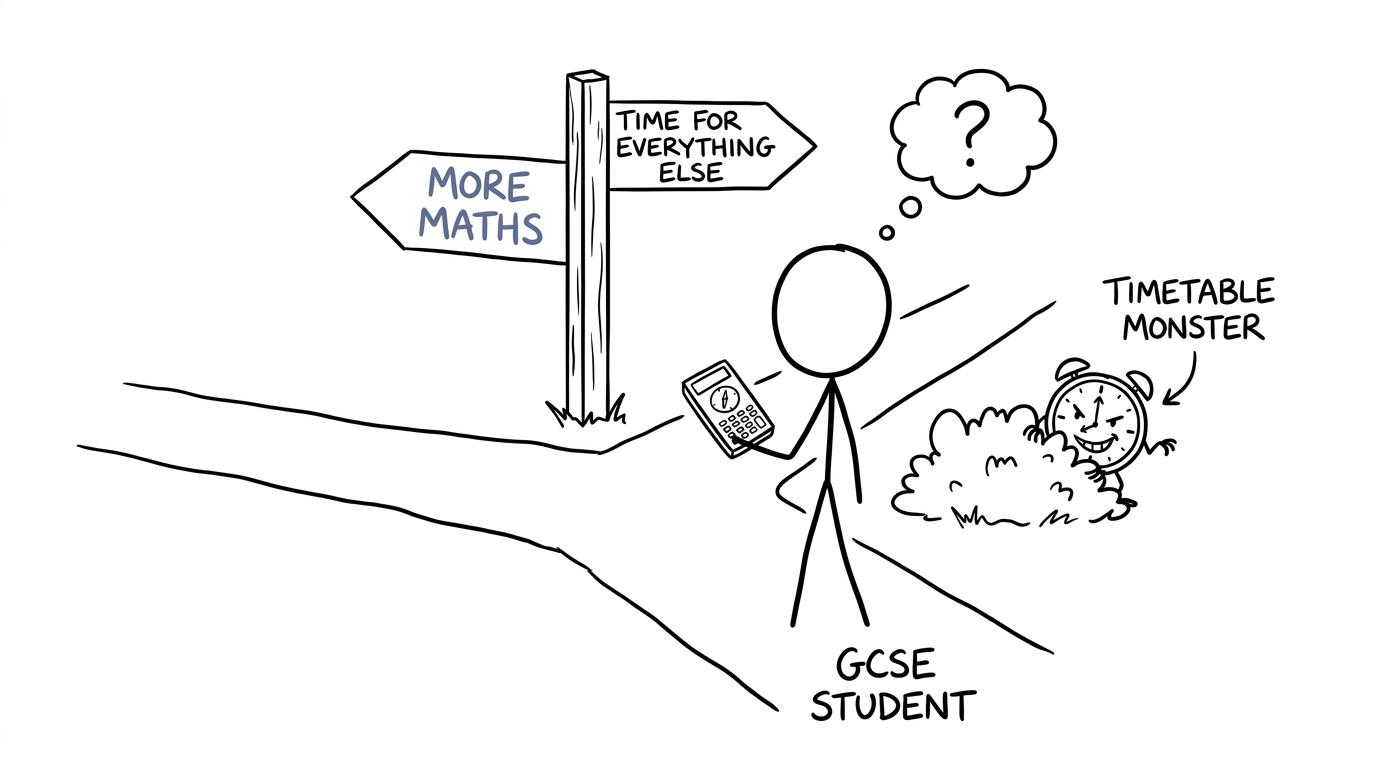 A student choosing between more maths and time for other subjects
What does GCSE Further Maths actually involve?
A common option is the AQA Level 2 Certificate in Further Mathematics. AQA describes it as an additional qualification for students expected to achieve grades 777, 888 or 999 in GCSE Maths and who may continue to A Level. It does not replace GCSE Maths.
The AQA course is untiered and extends Key Stage Four work through deeper algebra, functions, coordinate geometry, trigonometry and geometric reasoning. It also introduces ideas such as matrices and calculus. Its current assessment consists of two equally weighted written papers, each lasting one hour and forty-five minutes and carrying 808080 marks.
Your school may offer something different. Pearson Edexcel has a Level 2 Extended Mathematics Certificate, first assessed in 202520252025, while OCR offers the Level 3 FSMQ in Additional Mathematics. These qualifications have different content, grading systems and assessment structures.
Ask your teacher for:
- the full qualification title and exam board;
- the specification code;
- the examination format;
- when lessons take place;
- whether it appears as a separate qualification on your results;
- what support is available if you fall behind.
Do not make the decision from the course nickname alone.
Are your GCSE Maths foundations genuinely secure?
Further Maths extends Higher tier content. It does not pause to rebuild every earlier skill.
Confidence with arithmetic is useful, but algebra is usually the better signal. You should be increasingly comfortable with quadratics, surds, functions, equations, graphs and algebraic proof. If factorising is still unreliable, every advanced topic built on factorisation becomes harder than it needs to be.
A sensible test is to use the GCSE Maths revision hub and attempt challenging Higher tier questions without notes. Then mark them honestly. One strong classroom test is not enough evidence; look for consistency across topics and over time.
The GCSE Maths topics by exam board and tier guide can help you check the Higher content expected by Edexcel, AQA, OCR and Eduqas. Pay particular attention to topics such as:
- quadratic equations and graphs;
- simultaneous equations;
- surds and indices;
- functions and graph transformations;
- algebraic fractions;
- exact trigonometric values;
- proof and multi-step reasoning.
You do not need to be flawless. You do need foundations strong enough that the extra course becomes extension rather than emergency repair.
Do you enjoy being stuck for a while?
This may be the most revealing question.
Further Maths is not simply ordinary GCSE Maths with larger numbers. The interesting part is often the reasoning between the first line and the answer. You may have to connect several ideas, choose a method without being prompted, or keep working after an obvious approach fails.
Ask yourself what happens when a problem resists you. Do you become curious? Do you try a diagram, rearrange the information or revisit an assumption? Or does the uncertainty make every minute feel wasted?
Neither response makes you more intelligent. It tells you something about fit.
Enjoying routine questions because you complete them quickly is different from enjoying mathematics when it becomes slow. Further Maths rewards the second kind of enjoyment.
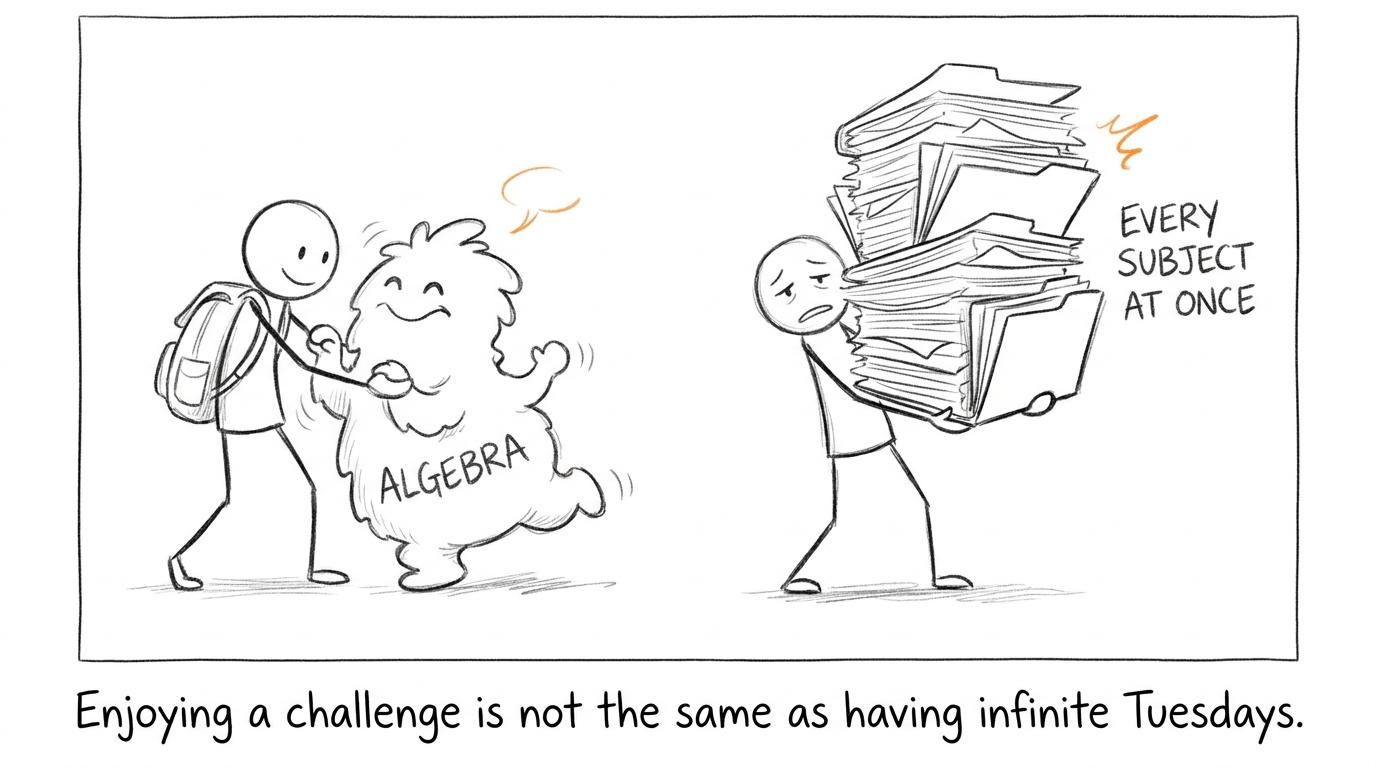 A student wrestling algebra while revision folders approach
Can your timetable absorb another demanding subject?
Ability is only one resource. Time and attention matter too.
Find out whether the course is taught in normal lessons, after school, at lunchtime or mainly through independent work. A qualification that fits neatly into the school day is a different commitment from one squeezed into a weekly club with substantial homework.
Then look at the opportunity cost. An extra hour spent on Further Maths is an hour unavailable for English, science, humanities, languages, sleep or rest. That does not make the hour a bad investment. It simply means the cost is real.
Use the MathsGenie revision planner to map a normal week rather than an imaginary perfect week. Include homework, travel, activities and breaks. If the plan only works when nothing goes wrong, it is not a robust plan.
A healthy commitment should still leave room to protect your core GCSE Maths grade. The additional qualification should not become the reason your main qualification receives less attention.
Are you considering A Level Maths?
Further Maths can make the transition to A Level Maths feel more familiar. Topics such as functions, advanced algebra and introductory calculus develop habits that later become important, while the greater emphasis on reasoning can make the pace of Level Three study less surprising.
But the qualification is not a universal entry requirement for A Level Maths. National A Level Maths content builds from the full GCSE Maths curriculum, and individual sixth forms set their own entry requirements. Check the published rules for the schools or colleges you may apply to.
If you already expect to continue with maths, the course can offer a useful preview. You can also look through the A Level Maths revision hub to see the direction in which the subject develops. You are not expected to understand it all now. The question is whether that style of mathematics looks interesting enough to explore.
If you decide against Further Maths, strong Higher tier GCSE preparation remains the priority. You can still begin A Level Maths successfully, provided you meet your chosen provider's requirements and arrive with secure algebraic skills.
Would the challenge help you or merely impress other people?
Some choices are made for the imagined future sentence: “I took Further Maths.” That sentence sounds impressive. It is also a weak reason to spend months on a course.
A better reason is that you want the challenge, value the preparation or enjoy the subject enough to give it regular attention. External approval fades quickly when homework appears on a tired Wednesday evening.
Equally, do not reject the course because you fear not being the best student in the room. A challenging class may be valuable precisely because answers no longer arrive instantly. Difficulty is not evidence that you do not belong. Persistent confusion without enough support is different, which is why the teaching arrangements matter.
Try the decision before making the decision
You can collect evidence rather than relying on a label.
First, complete some demanding GCSE Higher work. The algebraic fractions revision resources and quadratic formula revision guide provide useful tests of algebraic fluency. Use resources matching your own exam board where possible.
Next, attempt a timed Higher paper. Students following Edexcel can use the Edexcel GCSE Maths past papers, with mark schemes and solutions available for review. The purpose is not to prove that you already know everything. It is to discover whether gaps are occasional or structural.
Finally, speak to the teacher who runs the course. Ask what a normal week looks like, how students are selected and what happens if the workload becomes unmanageable. Concrete answers are more useful than reassurance.
Common mistakes when choosing Further Maths
Choosing it because of one high mark
One test may favour your strongest topics. Look across several assessments, especially algebra and unfamiliar problem solving.
Assuming it guarantees A Level success
It can provide helpful preparation, but no qualification replaces consistent work. A Level Maths still requires regular practice, accurate algebra and careful correction of mistakes.
Ignoring the exact qualification
AQA Level 2 Further Mathematics, Pearson Edexcel Level 2 Extended Mathematics and OCR's Level 3 FSMQ are not interchangeable names for one identical course. Check the specification your school teaches.
Protecting Further Maths at the expense of GCSE Maths
Your main GCSE Maths result is normally more important for sixth-form entry. Secure that foundation first.
Underestimating non-calculator fluency
Some advanced qualifications include non-calculator assessment. Weaknesses with fractions, surds and algebraic manipulation can therefore become expensive.
Treating every mistake as a verdict
Mistakes are useful only when they change the next practice session. Mark carefully, identify the exact gap, then return to a focused revision lesson or question set.
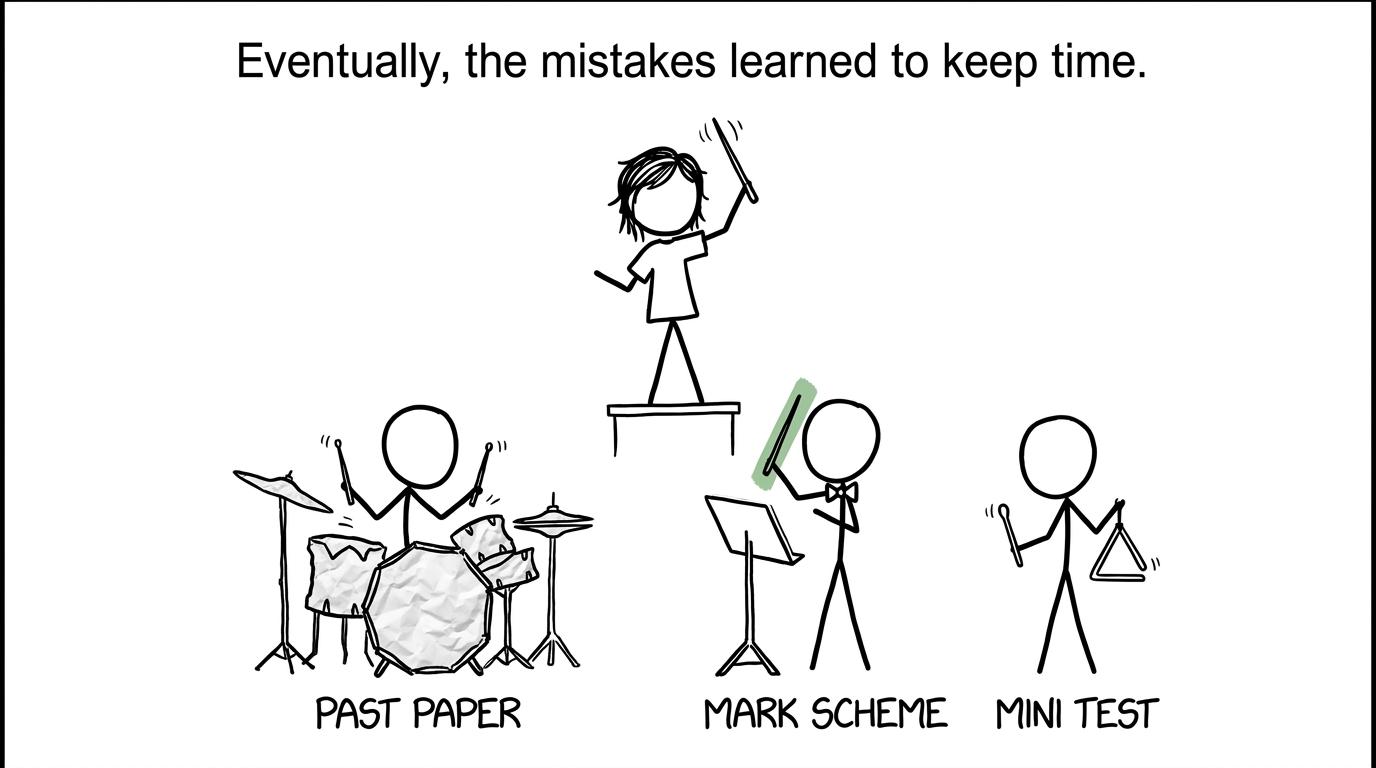 Past papers, mark schemes and mini tests forming a revision orchestra
Make the choice from evidence, not pressure
The best answer to “should I take GCSE Further Maths?” is not automatically yes, even for a high-attaining student. It is yes when your Higher tier foundations are secure, you enjoy sustained mathematical reasoning, the course supports your future plans and the timetable cost is manageable.
It is perfectly reasonable to say no when another qualification would overload your week or when your main GCSE subjects need the time. A thoughtful no is better than a prestigious yes followed by months of resentment.
Whichever route you choose, build the evidence on MathsGenie. Start with free revision lessons and practice questions, check your understanding with mini tests, then use mark schemes and video solutions to correct errors. As examinations approach, add GCSE predicted papers and past papers for realistic timed practice.
Choose the course honestly. Then revise the course you chose properly.