

Should I Take GCSE Biology? Honest Questions
Should I take GCSE Biology? Ask honest questions about interest, workload, maths skills and future plans before choosing separate sciences at school.
Choosing GCSE options can feel strangely permanent. A timetable box looks small, yet it seems to contain your future career, your exam results and every Wednesday afternoon for the next two years.
So, should I take GCSE Biology? The short answer is yes if you are genuinely interested in living systems, prepared for detailed content and comfortable applying knowledge to unfamiliar evidence. But first check what “taking Biology” means at your school. In many schools, the real choice is between separate sciences, Biology, Chemistry and Physics as three GCSEs, and Combined Science, which is worth two GCSEs.
Separate Biology can offer greater depth, but it is not automatically the better route for every student. The right choice is the course that fits your curiosity, workload and future plans without making the rest of your timetable unmanageable.
A quick decision checklist
Before choosing, ask yourself:
- Does my school offer Biology separately, or only as part of a separate-sciences package?
- Do I enjoy explaining biological processes, not merely learning definitions?
- Am I willing to revise regularly rather than depend on last-minute memorisation?
- Can I interpret graphs, percentages, ratios and experimental data?
- Would the additional science content displace another subject I value more?
- Have I checked the entry requirements for any sixth forms or careers I am considering?
- Do my current science results reflect my understanding, effort or both?
One weak test should not decide your future. Neither should one enjoyable lesson. Look for the pattern across a term.
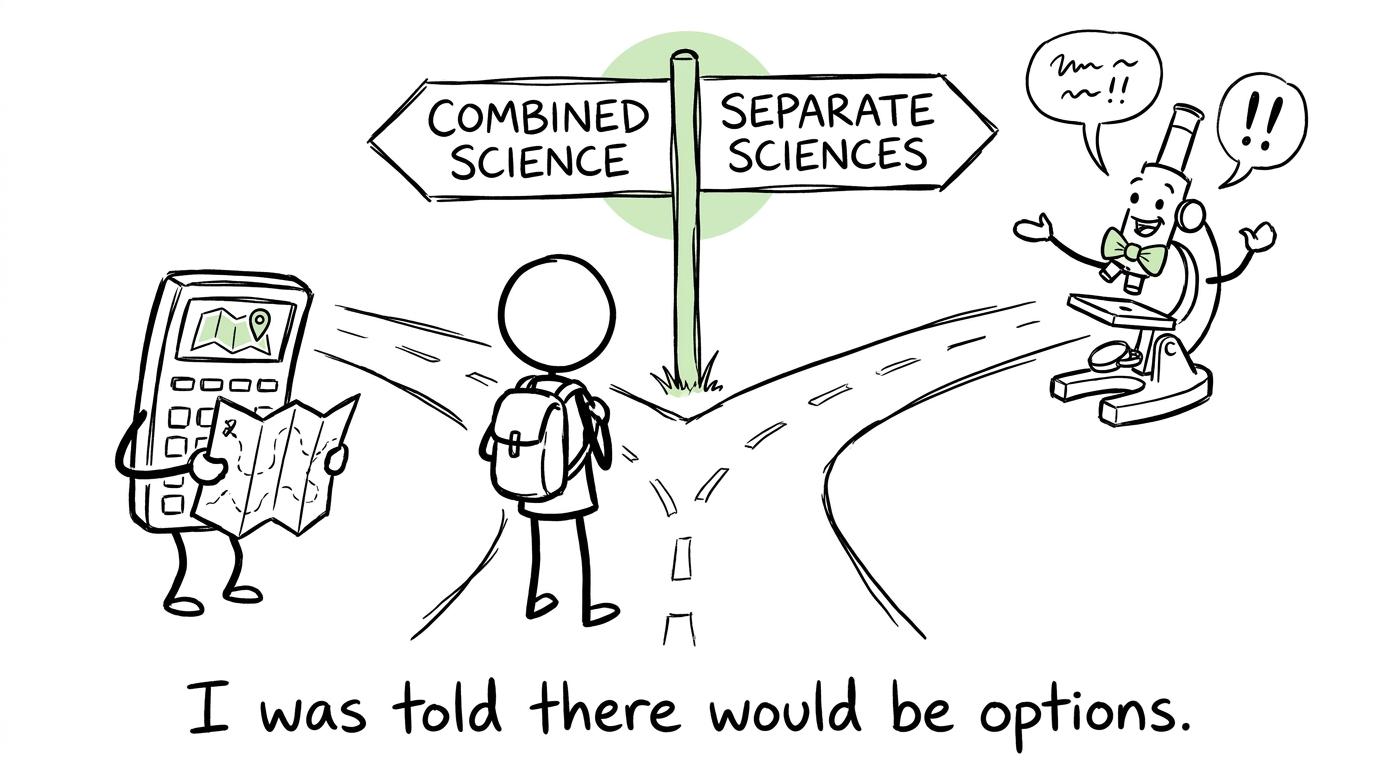 A student meets an overenthusiastic microscope at the science-options crossroads
What does choosing GCSE Biology actually mean?
GCSE Biology is available as a single science qualification on the grades 999 to 111 scale. However, schools commonly organise science through one of two routes:
- Separate sciences: individual GCSEs in Biology, Chemistry and Physics.
- Combined Science: biology, chemistry and physics are studied together for an award worth two GCSEs, reported using paired grades such as 777 to 666.
The exact option structure is controlled by your school. You may not be able to select Biology without also taking separate Chemistry and Physics. Ask your science teacher or options lead precisely what would appear on your timetable and certificates.
Separate Biology contains more biological content than the biology component of Combined Science. It is not simply the same material with an extra exam. Both routes still involve substantial science, practical work, data analysis and preparation for external assessment.
For current board-specific material, start with the GCSE Biology revision hub, where you can select resources for AQA, Edexcel, OCR and other specifications.
Do you enjoy how Biology makes you think?
Enjoying documentaries about animals is not quite the same as enjoying GCSE Biology. The course asks you to move between scales: molecules, cells, organs, organisms, populations and ecosystems. You must remember precise vocabulary, but you must also use it to explain causes, consequences and patterns.
Ask yourself what happens when a lesson becomes difficult. Do you still want to understand why a result occurred? Are you curious about cells, inheritance, disease, homeostasis, ecology and the interactions between organisms and their environment?
Interest matters because motivation is easier to sustain when the questions themselves feel worthwhile. Yet interest does not mean every topic will be fascinating. A sensible choice is based on whether you value the subject overall, including its less glamorous sections.
Try a small reality check before submitting your form. Explore your board’s topic list, read several exam questions and inspect a mark scheme. The aim is not to score highly before taking the course. It is to see whether the work feels demanding in a way you are willing to meet.
Are you ready for depth as well as memory?
Biology has a reputation for being the science with the most words. There is some truth behind that impression: terminology matters, and explanations often depend on linked sequences of events. But memorising isolated sentences is not enough.
Exams may ask you to apply familiar knowledge to an unfamiliar organism, interpret an investigation or evaluate whether evidence supports a conclusion. That means successful revision needs three layers:
- accurate recall of facts and processes;
- understanding of how ideas connect;
- practice applying those ideas to exam-style contexts.
If you currently revise by rereading notes, do not assume that Biology is unsuitable. Revision methods can change. A stronger routine uses retrieval, practice questions, mark schemes and corrections. The guide to revising GCSE Biology without wasting time explains how to build that feedback loop.
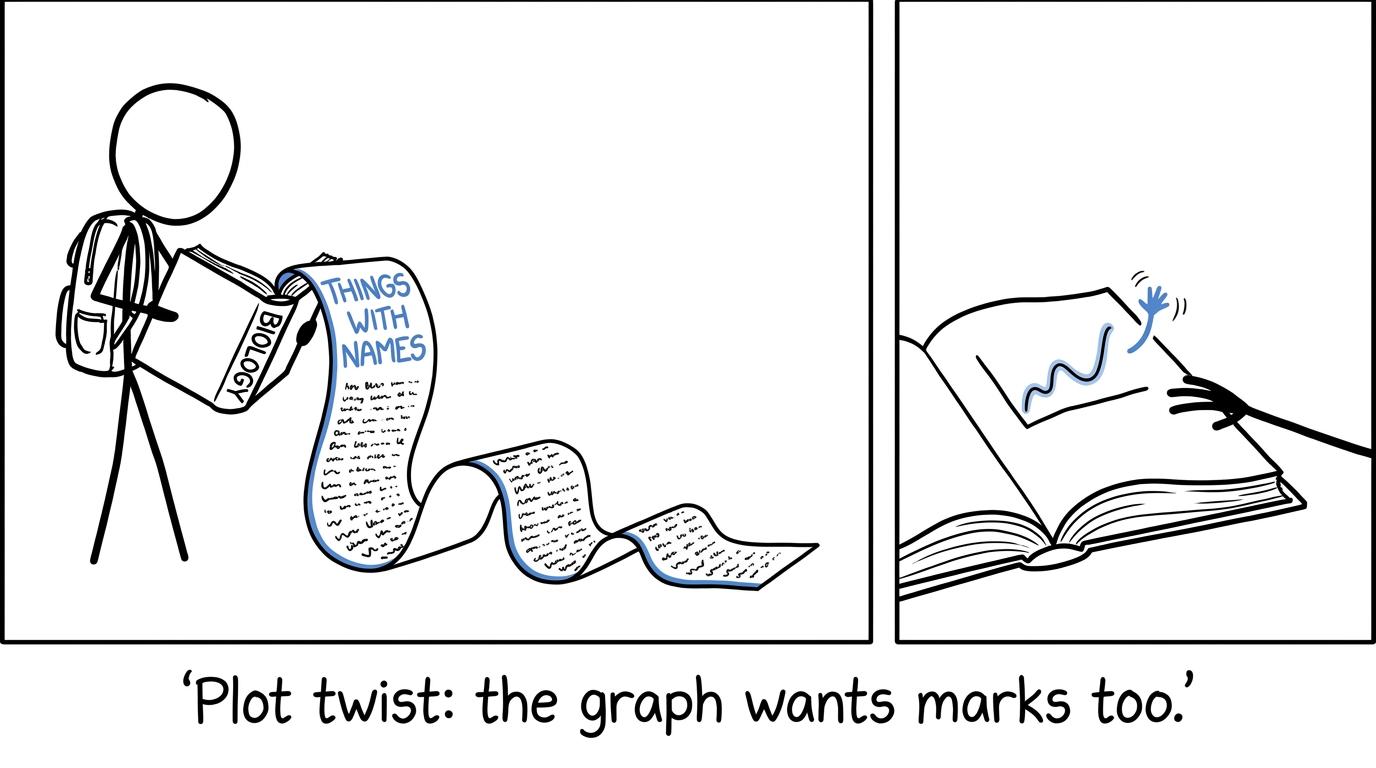 A very long list of biological names is interrupted by a graph looking for marks
How comfortable are you with maths in Biology?
GCSE Biology is not a maths-free subject. Under the current rules for single-science GCSEs in England, at least 10%10\%10% of the marks assess mathematical skills. At least 15%15\%15% of the qualification’s marks also relate to practical work, where measurements, tables and data interpretation often matter.
The maths can include:
- ratios, fractions and percentages;
- arithmetic means and sampling;
- probability in inheritance;
- standard form and orders of magnitude;
- unit conversions and magnification;
- rates of change;
- areas, volumes and surface-area-to-volume relationships;
- plotting, reading and interpreting graphs.
This should encourage maths students rather than frighten them. Your numerical skills can become a quiet advantage. Biology gives those skills a purpose: a graph represents an experiment, a ratio describes a relationship and a percentage measures change.
If these areas feel uncertain, strengthen them alongside your science. MathsGenie’s ratio revision guide and standard form revision resources provide focused lessons and questions. The board organisation may differ, but the underlying mathematical skills transfer across GCSE science specifications.
Accuracy matters too. Units, sensible rounding and clearly shown working can separate a nearly correct response from one that earns all available marks.
Will the wider separate-science workload fit your timetable?
The honest question is not only, “Can I do Biology?” It is, “Can I do this complete timetable well?”
If your school offers Biology through separate sciences, choosing it may also mean additional Chemistry and Physics content. That can be an excellent option for someone who enjoys science broadly. It can feel much less attractive if Biology is the only science you want to study and another valued option must be dropped.
Think about the whole week:
- How many subjects already require substantial factual recall?
- Are you balancing coursework, performance subjects or practical commitments?
- Do you have time for short, regular science revision?
- Would another option better support your interests or wellbeing?
This is not an argument for choosing the easiest timetable. Easy is hard to predict anyway. It is an argument for opportunity cost: every option occupies time that cannot be spent twice.
A simple GCSE revision timetable that actually works can help you picture the commitment. Build a hypothetical week containing maths, English, science and your other options. If the plan only works when every evening is perfect, it is not yet a realistic plan.
Do your future plans require separate Biology?
GCSE Biology can be valuable preparation for A Level Biology and science-related routes. Separate science offers extra depth, so the transition may feel more familiar. However, taking Combined Science does not automatically prevent progression to A Level Biology.
Sixth forms and colleges set their own entry requirements. They may consider your Biology grade, Combined Science grades, GCSE Maths grade or a combination of these. Requirements can change, so check the published criteria of institutions you might realistically attend and ask them directly if anything is unclear.
Avoid two opposite mistakes. Do not select separate sciences solely because you think every respected career demands them. But do not dismiss the route if you are seriously considering medicine, biological sciences, healthcare, environmental science or another science-heavy pathway.
You do not need a finished career plan at fourteen. You need enough information to avoid closing a door accidentally, and enough perspective to remember that one GCSE option rarely determines an entire life.
What do your current results really tell you?
Grades are useful evidence, but they need interpretation. A strong result achieved through consistent work suggests you may be ready for greater depth. A disappointing result after limited revision says something different from a disappointing result after sustained, effective practice.
Ask your teacher for a specific judgement. Instead of “Am I good enough?”, try:
- Which skills would I need to improve for separate science?
- Is recall, application, practical analysis or maths costing me marks?
- How does my current performance compare with the demands of the course?
- What support is available if I struggle?
Then test the advice. Complete a short set of questions, mark it carefully and classify each error. MathsGenie’s guide to using GCSE mark schemes effectively can help you distinguish a knowledge gap from a method, communication or accuracy gap.
Common mistakes when choosing GCSE Biology
Choosing it only because friends are taking it
Friends can make a class enjoyable, but sets and timetables change. You will sit your own exams and complete your own revision. Choose the subject, not the seating plan.
Assuming Biology is just memorisation
Recall is important, but application, mathematical reasoning, practical understanding and evaluation also earn marks. Look at real question styles before deciding.
Ignoring Chemistry and Physics
If Biology is part of a separate-sciences option, assess the whole package. Finding Biology interesting does not remove the additional content in the other sciences.
Believing Combined Science is an inferior qualification
Combined Science is a substantial double-award route covering all three sciences. The better route depends on your school, attainment, interests and future entry requirements.
Making the decision from one grade
A single assessment can be distorted by one topic, poor preparation or an unusually difficult day. Use several pieces of evidence and your teacher’s detailed feedback.
Forgetting to check the specification
AQA, Edexcel, OCR and Eduqas organise and assess content differently. Use resources matched to your actual board. OCR students, for example, can begin with the OCR GCSE Biology revision area.
Make the choice you can support with action
The best answer to “should I take GCSE Biology?” is not based on prestige or fear. Choose it if the subject holds your attention, its wider science package fits your timetable and you are willing to practise recall, application, calculations and practical analysis. Choose another route if the cost to subjects you value more is too high.
Once you decide, turn the decision into a routine. Use MathsGenie as your free revision base: begin with GCSE Biology lessons and resources, repair mathematical gaps with topic practice, and build exam confidence through practice questions, mini tests, past papers, predicted papers, mark schemes and video solutions.
A good option choice does not guarantee an easy two years. It gives you a challenge you have considered honestly, and one you are prepared to meet.










