Short Breaks vs Long Break for GCSE Polish
Short breaks vs long break GCSE Polish revision: discover what research suggests, how to plan focused sessions and when a longer rest is worthwhile.
Revision often goes wrong quietly. You begin a Polish vocabulary list with good intentions, but forty minutes later you are reading the same word without taking it in. The question behind short breaks vs long break GCSE Polish revision is simple: should you pause regularly, or work for a long stretch and earn one substantial rest?
The evidence points towards a hybrid approach. Several short breaks can reduce fatigue and help you sustain attention, while a longer break becomes valuable after several demanding blocks. There is no scientifically proven perfect timetable for every GCSE student, and research specifically comparing break patterns during GCSE Polish revision is limited. Still, the broader evidence on micro-breaks, mental fatigue, spacing and retrieval gives us a sensible way to plan.
The quick answer and revision checklist
For most students, a useful starting structure is:
- revise actively for around 252525 to 353535 minutes;
- take a genuine break of 555 to 101010 minutes;
- complete another focused block with a different Polish skill;
- repeat for 222 or 333 blocks;
- then take a longer break of roughly 151515 to 252525 minutes;
- adjust the timings when your accuracy or attention starts falling.
This is a practical starting point, not a universal scientific formula. A speaking task, a difficult translation and a short vocabulary test place different demands on you. The important feature is not whether your timer looks perfect. It is whether you return from each break able to retrieve, apply and check what you have learnt.
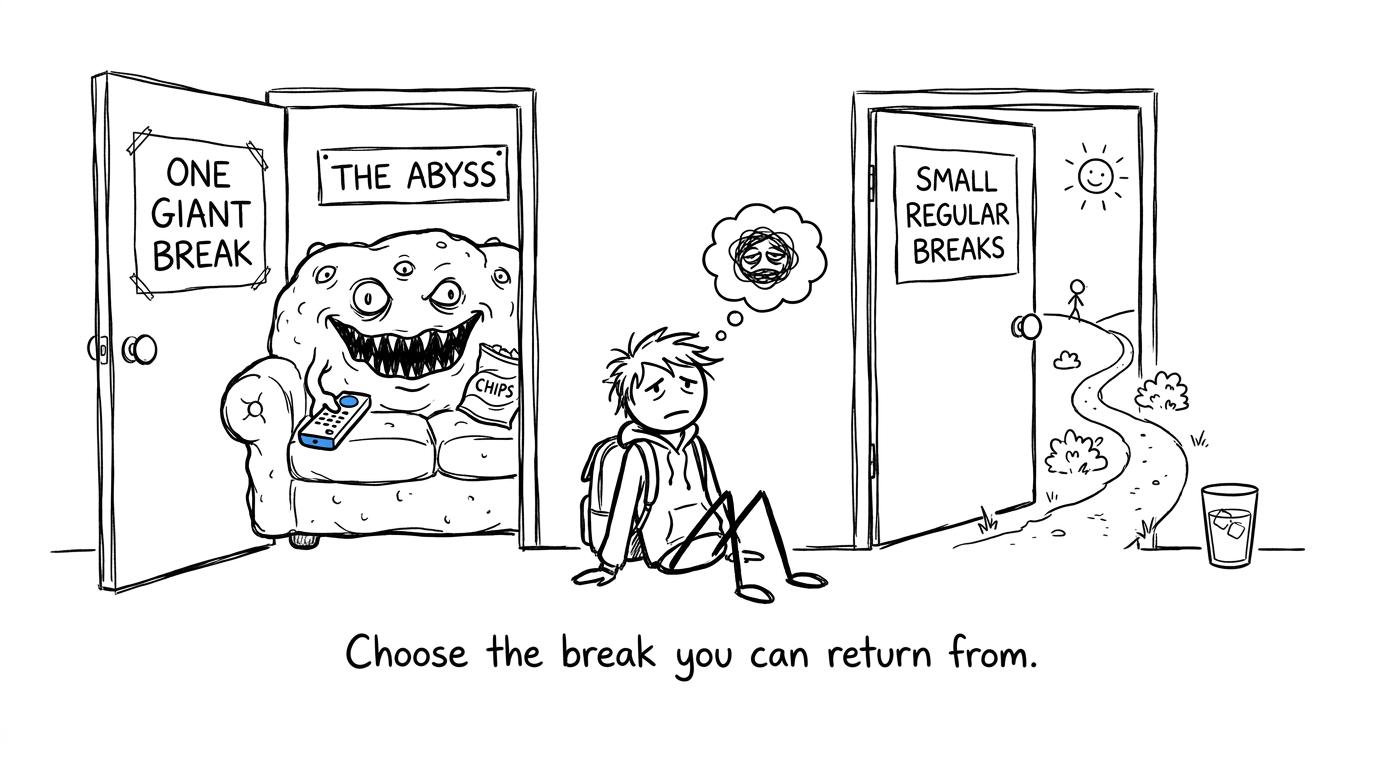 A student choosing between one giant break and small regular breaks
What the research actually suggests about breaks
A systematic review and meta-analysis of experimental micro-break research defined micro-breaks as pauses lasting no more than 101010 minutes. Across the included studies, these breaks produced small but statistically significant improvements in vigour and reductions in fatigue. However, the overall improvement in task performance was not statistically significant.
That distinction matters. Feeling fresher is useful, but it is not identical to remembering more Polish vocabulary or producing more accurate grammar. The review also found that longer breaks tended to be more helpful for performance, particularly after highly demanding work. Much of this evidence came from workplace tasks rather than GCSE pupils, so it should guide revision rather than dictate it.
Research involving university teaching has also reported that frequent micro-breaks can support concentration and quiz performance. Again, university seminars are not GCSE Polish revision, and a single study should not become a rigid rule. The reasonable conclusion is narrower: interrupting long periods of sustained attention can help, especially when the alternative is continuing while mentally fatigued.
Break frequency is not the same as spaced practice
Two ideas are often mixed together:
- Rest breaks interrupt one revision period so that you can recover.
- Spaced practice revisits learning across separate periods, often over days or weeks.
The evidence for spaced practice is especially strong. Reviews of learning research consistently find that distributing practice over time supports longer-term retention better than massing the same practice together. Retrieval practice, trying to recall an answer before checking it, also produces more durable learning than passive rereading.
For Polish, that means a short break may help you complete tonight's session well, but returning to the vocabulary tomorrow and next week is what helps protect it from being forgotten. Maths revision follows the same principle. MathsGenie's one-month GCSE maths revision plan builds repeated retrieval and marking into a wider schedule rather than relying on one heroic evening.
Why GCSE Polish feels unusually dense
GCSE Polish is not one kind of memory task. Depending on the specification and tier, students need to develop listening, speaking, reading and writing while applying vocabulary and grammar accurately. Translation and extended responses also require several processes at once: understanding meaning, selecting language, controlling structure and checking accuracy.
The current AQA specification sets grammar requirements for Foundation and Higher tier and includes core vocabulary, while warning that assessment can require students to respond appropriately within unfamiliar contexts. That makes endless rereading particularly weak preparation. Recognition can feel fluent even when independent recall remains fragile.
A better session changes the mental demand from block to block. You might move between:
- recalling vocabulary without seeing the English;
- listening and noting the essential message;
- planning a spoken response aloud;
- checking one grammar category;
- translating a short passage;
- reviewing errors from previous practice.
These are not worked examples or a fixed order. They are ways of preventing one overloaded skill from consuming the entire session.
Short breaks vs long break GCSE Polish strategy
Several short breaks will usually beat waiting for one long break when the long work period causes your concentration and accuracy to deteriorate. But one long break can beat repeated tiny pauses if the pauses are so frequent that you never settle into demanding work.
The best arrangement therefore protects both focus and recovery.
Use short breaks to preserve attention
A short pause is most useful before tiredness has turned into careless repetition. Stop at a planned point, record what you will do next, and leave the desk briefly. Stand up, stretch, drink water or look away from the screen.
Your break should reduce the demand placed on the same attention system. Switching from a vocabulary document to a stream of messages may feel different, but it still asks you to process language and make rapid decisions. It can also make returning harder.
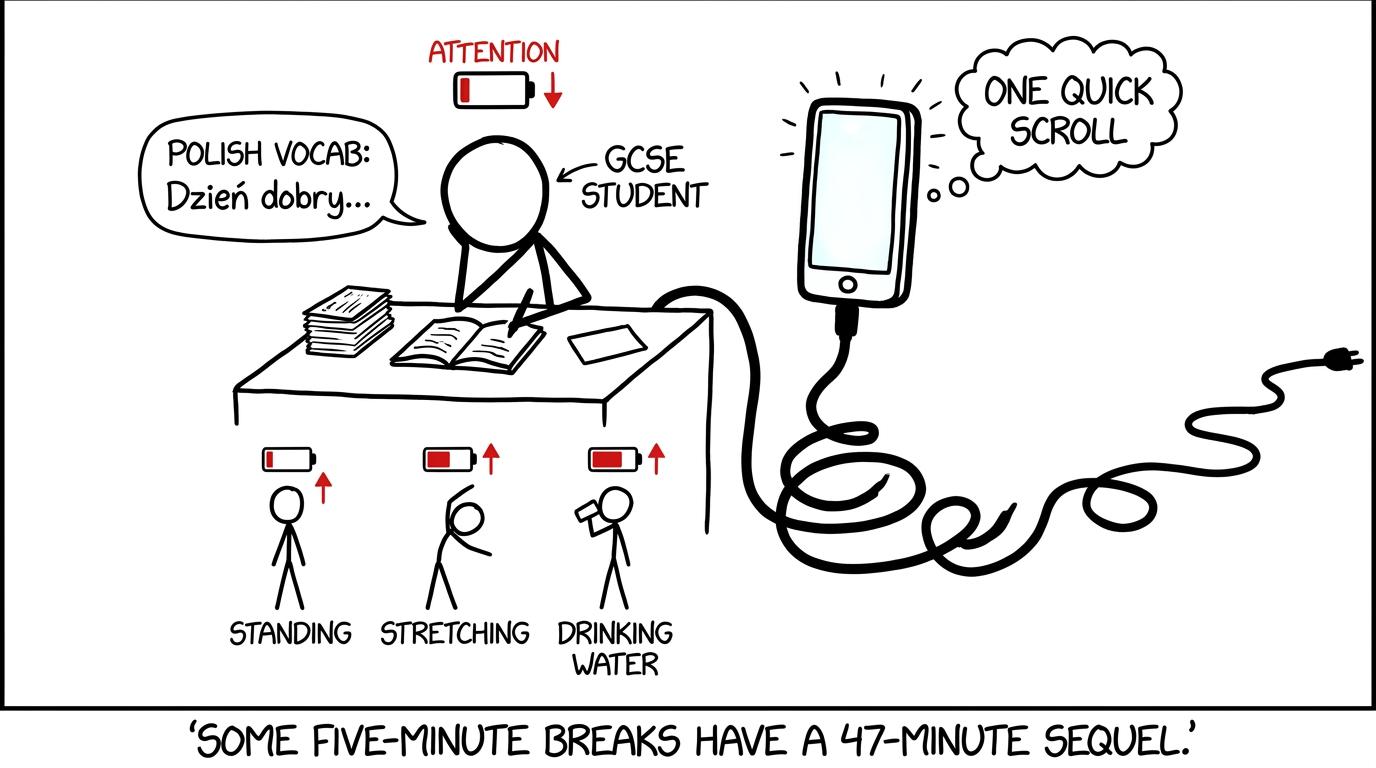 A revision attention battery and a suspiciously long phone break
Use a longer break after demanding cycles
A longer pause makes sense after several blocks, after a full listening or writing task, or when a short break does not restore useful concentration. It is also sensible between subjects. Polish translation followed immediately by a difficult Higher tier maths paper may preserve desk time without preserving performance.
Long breaks should have a return point. Decide when the next block begins and what its first task will be. Otherwise, a recovery period can become the end of the session without you consciously choosing to stop.
For maths, shorter resources make this structure easier. A focused Edexcel GCSE maths mini test can occupy one work block, followed by marking after a short break. When you are ready for sustained practice, the main GCSE maths revision hub provides revision lessons, questions and board-specific papers.
Build breaks around active revision
Break timing cannot rescue a passive method. Twenty minutes of highlighting followed by an excellent rest is still mostly highlighting.
Before each block, give yourself an observable goal. Instead of writing “revise Polish”, choose a task such as retrieving a defined vocabulary set, recording a spoken answer or correcting errors from a translation. At the end, leave evidence: a score, an error list, a recording or a short set of corrections.
Use this cycle:
- Retrieve: answer without notes where possible.
- Check: compare your response with reliable course materials or feedback.
- Correct: write the precise change needed.
- Break: detach briefly from the task.
- Return: test the correction without copying it.
This closely resembles effective maths revision. A student uses a revision lesson, attempts practice questions, checks a mark scheme and later retests the weak skill. The MathsGenie GCSE revision timetable guide explains how to combine focused sessions with spaced practice and timed work.
Match the break to the type of work
Not every task needs the same interval.
Vocabulary and grammar recall
Short, active rounds suit material that can be tested repeatedly. Stop before guessing becomes automatic, take a brief break, then test the missed items again. Revisit them on another day rather than trying to force permanent memory in one sitting.
Listening and speaking
Avoid interrupting an individual recording or timed speaking task. Finish the complete attempt, note the difficulty, and break afterwards. This preserves the flow and gives the break a clear boundary.
Extended writing and translation
Longer tasks need enough uninterrupted time for planning, production and checking. Use fewer interruptions within the attempt, followed by a more substantial recovery period. If quality falls sharply, shorten the next work block rather than pushing through simply to satisfy the timer.
Maths alongside Polish
Students preparing for several GCSE exams need to budget attention across subjects. After dense language work, a short maths topic session may provide variety, but a timed paper requires fresh concentration. Use the guide to starting GCSE past papers to decide when full-paper practice belongs in your wider plan.
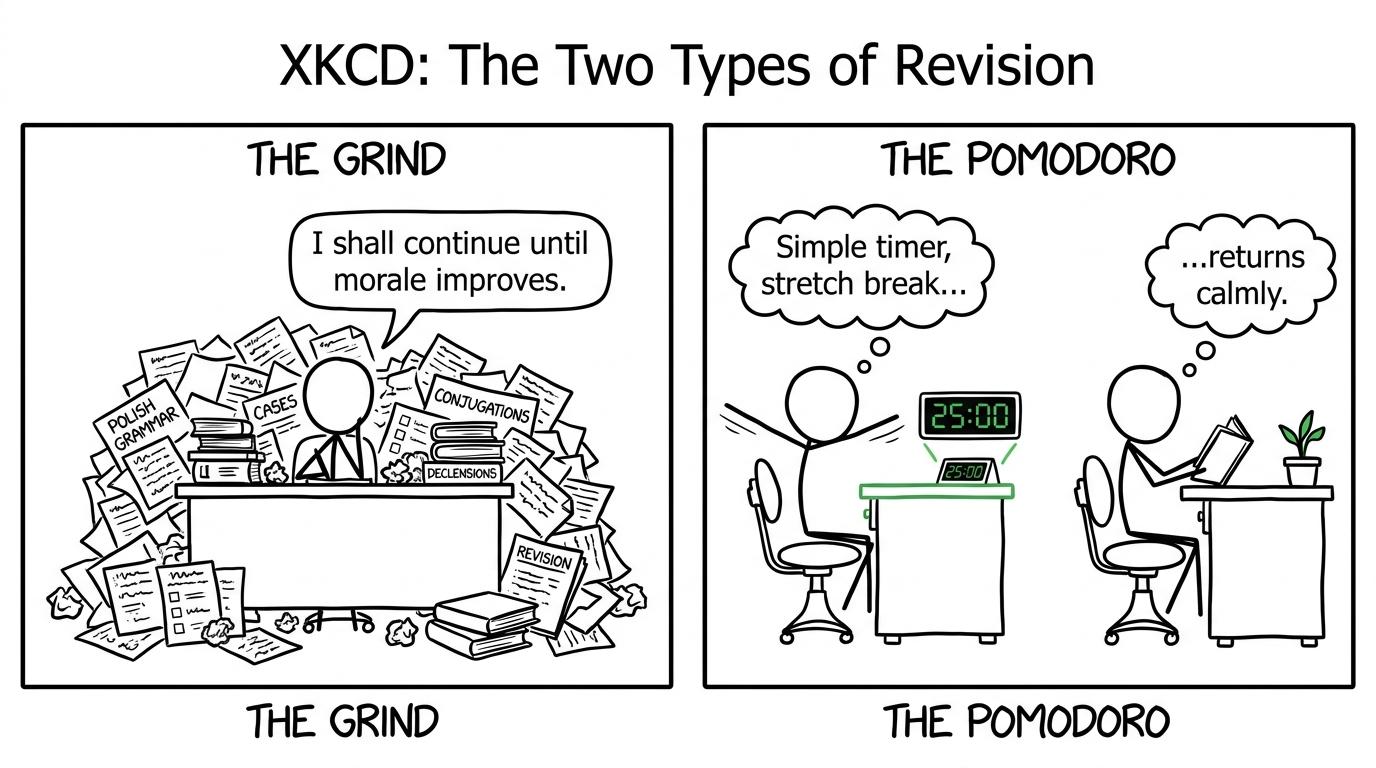 Two revision desks taking very different approaches to fatigue
How to personalise your break schedule
Treat your timetable as a small experiment rather than a personality test. For several sessions, record:
- the length and type of each task;
- when your attention first drifted;
- whether you returned on time;
- your recall or practice score;
- the errors that appeared late in the block;
- how much you remembered the following day.
If late-block errors increase, shorten the work interval or change activity sooner. If you are focused when every timer rings, extend the block slightly. If a 555-minute pause regularly becomes 303030 minutes, change the break activity or leave your phone elsewhere.
On low-motivation days, reduce the size of the task rather than abandoning the routine. MathsGenie's GCSE catch-up revision guide shows how small, targeted sessions can restart progress without pretending that panic is a plan.
Common mistakes with revision breaks
Copying a fashionable timer exactly
A fixed pattern can provide structure, but it is not a law of learning. Adjust it for task difficulty, your current fatigue and the need to complete uninterrupted exam practice.
Taking breaks without planning the return
Write the next action before standing up. A clear restart removes the decision that often extends a break.
Using every break for scrolling
Phones do not automatically ruin a break, but unplanned feeds are designed to keep attention. Choose an activity with a natural endpoint.
Confusing comfort with learning
A pleasant session may produce weak recall. Test yourself after the break and again on another day. Performance, not the feeling of familiarity, is the better signal.
Breaking up timed exam practice
Regular pauses are useful during learning, but an exam paper also requires stamina. Build towards uninterrupted conditions. MathsGenie's night-before GCSE maths plan sensibly prioritises focused practice and rest rather than a final exhausting marathon.
Make the next session easier to begin
The evidence does not prove that several short breaks always defeat one long break for every student or every Polish task. It suggests something more useful: short breaks can protect energy and reduce fatigue, while difficult, sustained work may require longer recovery. Spaced retrieval across days matters more for long-term memory than finding a supposedly perfect minute-by-minute formula.
Start with a repeatable hybrid plan. Work actively, pause briefly, complete several cycles, then recover properly. Measure what you remember and adjust.
For your maths exams, make MathsGenie the other half of that routine. Open the free GCSE maths revision hub, choose a revision lesson or practice set for your Foundation or Higher tier, mark your work, and return after a break to correct it. Then build towards mini tests, past papers and predicted papers, using mark schemes and video solutions to turn each mistake into a clear next step.