Send GCSE English Literature Result to Sixth Form
Send GCSE English Literature result to sixth form or college correctly. Learn what evidence to share and what to do when a result is delayed.

Results day can feel like the moment when months of work are compressed into a few lines on a page. Then, almost immediately, someone asks for proof. If you need to send GCSE English Literature result to sixth form or college, the short answer is this: follow the provider's enrolment instructions and share the school-issued Candidate Statement of Provisional Results, ideally printed on school letterheaded paper or endorsed by your exam centre. In England, you may also be invited to share a digital DfE education record.
Your exam board does not usually require you to post an English Literature grade directly to your new provider. Results first reach the school or examination centre where you were entered. You receive the result, then provide the evidence requested by your sixth form or college unless the institutions have arranged another secure process.
The important thing is not to guess. Check the provider's instructions, keep your results slip safe and contact its admissions team promptly if anything is missing or delayed.
Your results-sharing checklist
Before results day, prepare the following:
- Your sixth form or college offer and its subject entry requirements.
- The provider's enrolment email, portal link or appointment details.
- Your school-issued results slip, showing GCSE English Literature separately from English Language.
- Your candidate details, including your full name and candidate number.
- Photographic identification, if either institution asks for it.
- Contact details for your school's examinations officer and the provider's admissions team.
- A secure digital copy of your results slip as a backup, while remembering that a screenshot may not be accepted as final evidence.
- Details of any review of marking or missing-result enquiry already in progress.
For a broader view of what happens after results are released, read the GCSE results day timeline.
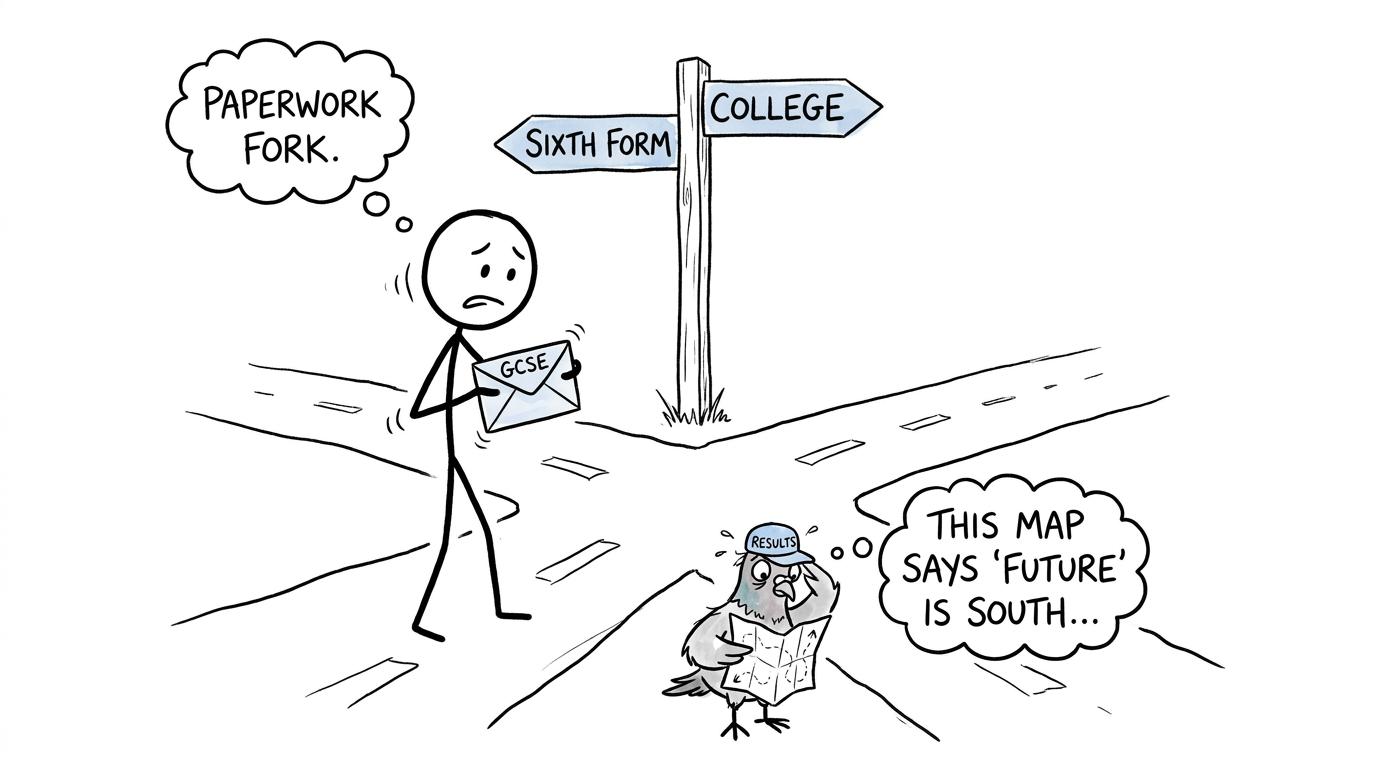 A student waits while a results pigeon studies a map to sixth form and college
How GCSE English Literature results reach you
The route is more orderly than it may appear from the outside.
Your exam board, such as AQA, Pearson Edexcel, OCR or Eduqas, provides results securely to the school, college or examination centre that entered you. The centre receives the information before candidates so that authorised staff can check and prepare it, but the grades remain confidential until the official release time.
For the June 2026 examination series, GCSE results can be released to candidates from 8.00 am on Thursday 20 August 2026. Your school may choose a later collection time, so its own instructions still matter.
On results day, you normally receive a Candidate Statement of Provisional Results. This lists your subjects and grades, often across several exam boards. GCSE English Literature should appear as its own qualification. It is not interchangeable with GCSE English Language, so check that the correct subject is visible before sharing the document.
The word provisional matters. A grade can still change following a successful post-results review or the resolution of an incomplete result. The certificate issued later is the final record of the qualification.
How to send your result to a sixth form or college
There is no single national upload process used by every provider. A school sixth form may already hold the results of its own pupils, while an external sixth form or further education college may ask candidates to upload evidence, bring it to enrolment or share a secure digital record.
Follow the provider's stated method
Read the enrolment message rather than relying on what a friend at another college has been told. You may be asked to:
- bring the original school-issued results slip to an appointment;
- upload a clear scan through an admissions portal;
- email a copy to an official admissions address;
- ask your school to provide an endorsed statement;
- share a DfE education record through the official app in England; or
- present your certificate later when it becomes available.
Do not send personal information through social media or to an address you cannot verify. If the instructions are unclear, telephone the provider using the contact details in your offer correspondence or on its official website.
Use centre-endorsed evidence where requested
JCQ advises that provisional results supplied to sixth forms or further education colleges should be printed on school letterheaded paper and/or carry the school's name and logo. The statement should include your Unique Candidate Identifier, which can support future examination entries and enrolment.
A phone photograph is useful as a backup, but it may not provide enough assurance on its own. If your only copy is an online screenshot, ask your examinations officer whether the school can issue an endorsed printout.
Share your education record if offered
From summer 2026, the DfE education record app is being rolled out for Year 11 pupils in England. A participating school issues the record after verifying the pupil's identity. Official qualifications, including GCSE results, can then be added, and a learner can respond when a sixth form, college or training provider requests information.
This digital route is an additional option, not a reason to ignore school results-day arrangements. You should still collect or access your school-issued results slip. If the app is delayed, incomplete or displays something unexpected, use the school document and contact the school rather than trying to alter the record yourself.
Availability and processes differ outside England, so students in Wales and Northern Ireland should follow the instructions from their school and destination provider.
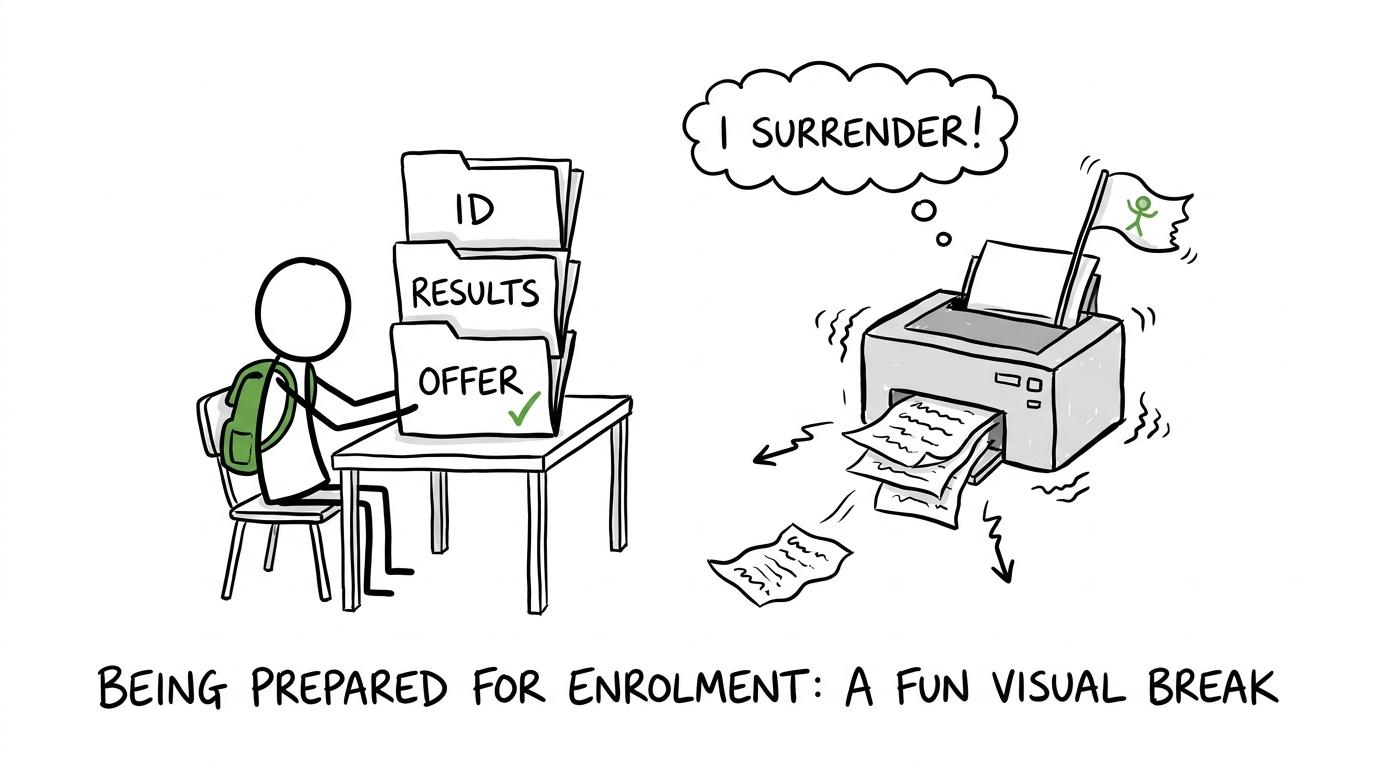 A calm student organises ID, results and offer documents while a printer surrenders
What to do if your English Literature result is delayed
A missing result is stressful because it sits between what you have done and what you can prove. It does not automatically mean you have failed.
Your statement may show a pending or no-result indicator instead of a grade, or English Literature may be absent altogether. If that happens:
- Speak to your school's examinations officer immediately.
- Ask whether the issue affects the whole qualification or one component.
- Give the officer your candidate number, exam board and subject details.
- Contact your sixth form or college admissions team on the same day.
- Explain that the result is pending and ask what temporary evidence it will accept.
- Keep copies of emails and note the names of people you speak to.
- Follow up at the time agreed rather than sending repeated messages to several departments.
Your school or exam centre communicates with the awarding body. Students should not try to solve a live missing-result query by contacting multiple exam-board teams independently unless the centre directs them to do so.
The admissions decision belongs to the sixth form or college. It may consider the rest of your results, school information or other evidence while waiting, but you should never assume that a place is either confirmed or lost. Ask directly and obtain the response in writing where possible.
What if the grade is below the entry requirement?
First, send the actual result promptly. Silence gives the provider no information with which to help you.
Contact admissions and state:
- the course or subjects in your offer;
- the required English Literature grade;
- the grade shown on your results slip;
- whether English Language or another relevant result meets the requirement; and
- whether your school is discussing a review of marking.
The provider may confirm your place, suggest a different subject combination, place you on a waiting list or discuss another course. Its published entry requirements matter, but the provider must make the decision.
If you think the marking should be checked, speak to your school quickly. A clerical re-check checks processes such as whether marks were recorded and totalled correctly. A review of marking considers whether the mark scheme was applied correctly; it is not simply a fresh re-mark. Your grade can go down, stay the same or go up, so written candidate consent is required.
For the June 2026 series, JCQ's deadline for most clerical re-checks and reviews of marking is 24 September 2026, although schools usually set earlier internal deadlines. If progression is affected, tell both your examinations officer and the destination provider immediately. Do not wait until the national deadline.
Provisional results, certificates and later proof
The results slip is designed to support immediate decisions such as post-16 enrolment. Your certificate arrives later through the centre where you sat the examinations and becomes the final record of achievement.
Collect it when your school tells you it is available and store it safely. A certificate may be requested years later for employment, higher education or professional training. If an old GCSE certificate is lost, exam boards generally provide a certified statement of results rather than a replacement GCSE certificate, usually after identity checks and payment of a fee.
For results-day enrolment, however, waiting for the certificate is normally impractical. Provide the centre-endorsed provisional statement requested by your new institution and update it if a post-results process changes the grade.
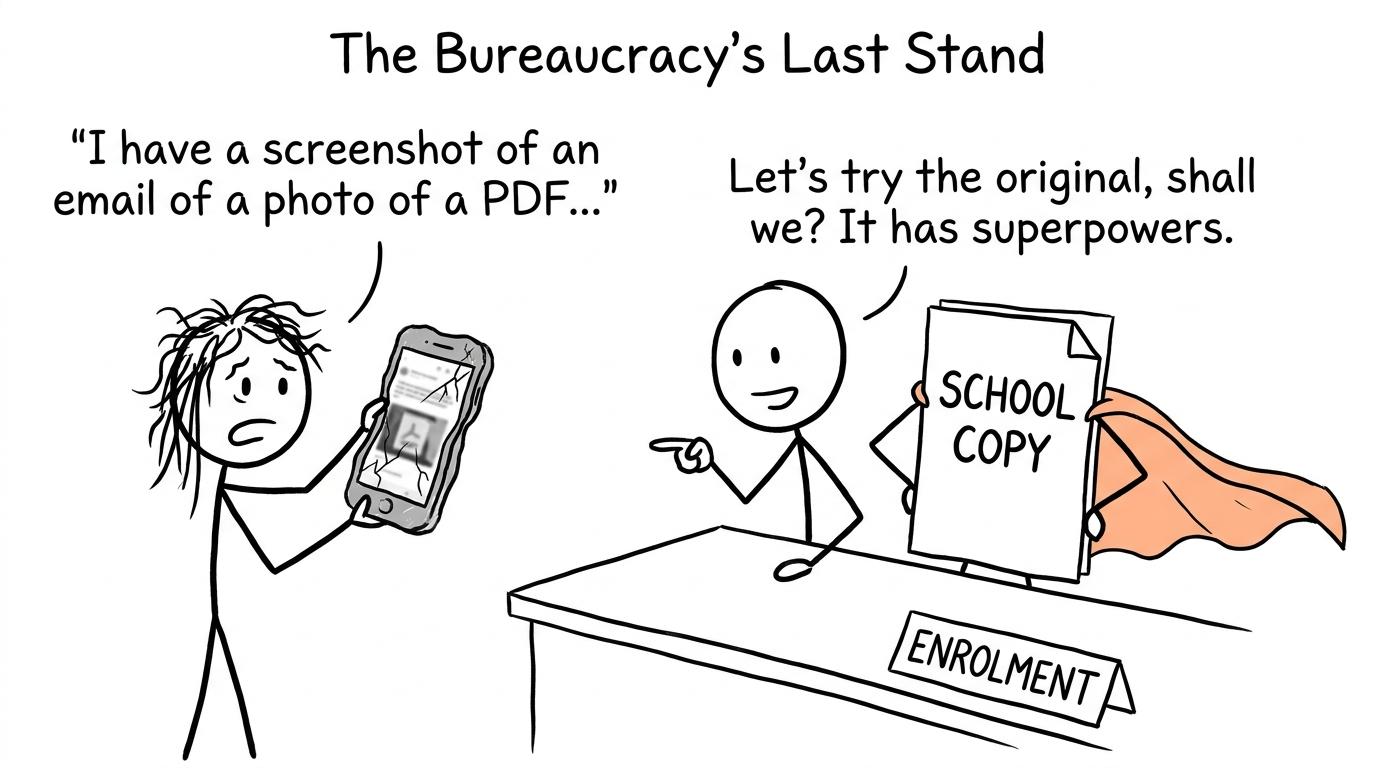 An official school results copy arrives at enrolment wearing a superhero cape
Common mistakes when sharing GCSE results
Assuming results transfer automatically
Some schools and local providers have secure arrangements, but you should not assume yours does. Complete every enrolment step in your offer instructions.
Sending English Language instead of English Literature
They are separate GCSE qualifications. Check the exact title and grade before submitting evidence.
Relying only on a cropped screenshot
A crop can omit your name, centre details or other information needed to verify the result. Use the complete school-issued statement or the secure digital method requested.
Waiting silently when a result is missing
A delay becomes harder to manage when admissions staff do not know about it. Contact your examinations officer and destination provider on results day.
Treating a review as a guaranteed grade increase
Marks and grades can decrease, remain unchanged or increase. Discuss the evidence, risks, fees and deadlines with your school before giving consent.
Forgetting to report an updated grade
If a review changes your result, ask your school for updated evidence and send it to the named admissions contact promptly.
Keep the administration separate from your revision
One awkward result should not consume every remaining day of summer. Give the problem a clear next action, a named contact and a follow-up date. Then return your attention to what you can control.
If GCSE maths is still part of your plans, start with the free GCSE maths revision hub, where resources are organised by exam board. You can build a manageable routine with the GCSE maths revision timetable, practise shorter sets through Edexcel GCSE maths mini tests, or use the GCSE maths resit results-day plan if you are preparing for another examination series.
When you are ready for full-paper practice, use Edexcel GCSE maths past papers or the wider board-specific resources in the revision hub. Nearer the exams, GCSE predicted papers can add fresh practice, while the guide to using past papers properly explains how to turn mark schemes and mistakes into useful revision.
The result-sharing process is ultimately a chain: receive the official school evidence, check it carefully, follow the provider's instructions and communicate early if the chain breaks. Once that is done, let MathsGenie support the next stage with free revision lessons, practice questions, mini tests, past papers, predicted papers, mark schemes and video solutions. Paperwork opens the door. Consistent preparation helps you make the most of what comes next.