

Send Your GCSE Economics Result to Sixth Form
Send GCSE economics result to sixth form or college confidently. Learn who receives it, what evidence to provide and how to handle results-day delays.

Results day can feel strangely compressed. Months of revision are reduced to a sheet of grades, while enrolment instructions, email addresses and deadlines compete for your attention.
If you need to send your GCSE Economics result to sixth form, the immediate answer is simple: follow the receiving institution's enrolment instructions. A new sixth form or college will usually ask you to upload your results slip, enter your grades through an applicant portal, email evidence or bring the slip to enrolment. Do not assume it receives your Economics grade automatically.
Your school or exam centre receives the result from the awarding organisation. How it then reaches the place you are joining depends on that provider's admissions process. Economics has no separate national transfer system; it is handled alongside your other GCSE results.
Your results-day checklist
Keep this short checklist beside you:
- Read the sixth form or college's results-day instructions.
- Check its applicant portal and your email, including the junk folder.
- Collect or securely access your official results slip.
- Confirm whether grades must be uploaded, entered online, emailed or shown in person.
- Send every requested result, not only GCSE Economics.
- Make sure your name, school and grades are clearly visible.
- Keep the original slip and save a copy of anything submitted.
- Ask admissions to confirm receipt if the instructions require it or a deadline is close.
- Contact your school's exams officer promptly if a result is missing.
 A confused results-day carrier pigeon choosing between sixth form and college
How GCSE Economics results actually travel
The journey normally has two separate stages. Understanding the difference prevents most confusion.
From the exam board to your school
Your awarding organisation, such as AQA, OCR or Eduqas, issues results to the school or college entered as your examination centre. The centre then makes those results available according to its arrangements, commonly through a results slip, a secure online system or collection at school.
You generally deal with your school's exams officer rather than asking the exam board to send a grade directly to your future college. The exams officer can investigate missing results, candidate-detail problems and post-results requests through the appropriate awarding organisation process.
A results slip is normally provisional. Your final GCSE certificate is produced later and should be stored safely because employers or education providers may request it in the future.
From you to your new provider
If you are moving to a different institution, the applicant usually has an active role in reporting results. The provider might ask you to:
- enter each subject and grade in its admissions portal;
- upload a photograph or scan of the complete results slip;
- email the admissions or enrolment team;
- attend an enrolment appointment with the original document; or
- complete an online results form sent before results day.
Procedures vary. One college may accept an upload while another requires an in-person check, so its own written instructions take priority over general advice.
If you are remaining at your current school's sixth form, staff may already be able to view your results internally. Even then, you may still need to complete enrolment, confirm subject choices or attend a meeting. Access to your grades does not necessarily enrol you automatically.
What evidence should you send?
Send the evidence the institution requests, no more and no less. In most cases, this means a legible copy of the complete results slip rather than a cropped image showing only Economics.
A useful submission should clearly display:
- your full name;
- the name of your examination centre, where shown;
- each relevant subject title;
- the awarded grades; and
- any candidate or reference information requested by admissions.
Take the photograph in good light and check it before uploading. Blurred text, a covered grade or a cropped name can turn a simple submission into several emails.
Treat the slip as personal information. Use the official portal or email address supplied by the provider, check the recipient carefully and avoid posting an identifiable copy on social media.
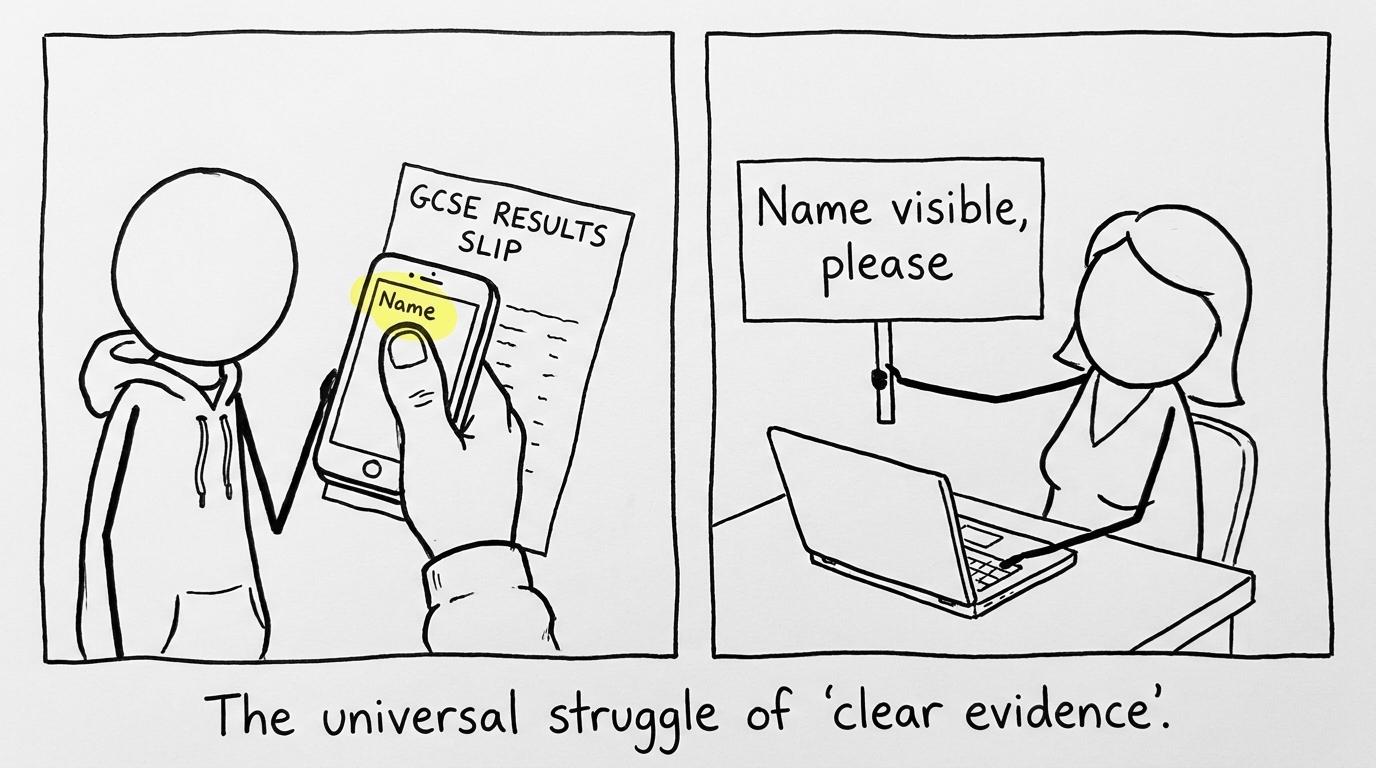 A student's thumb nearly covering a photograph of a results slip
Check the conditions of your offer
Receiving a result and meeting an offer are different things. Before results day, read your conditional offer and note:
- the overall GCSE profile required;
- any minimum grades in English and Maths;
- subject-specific requirements for your chosen courses;
- the enrolment deadline; and
- what to do if you narrowly miss a condition.
A GCSE Economics grade may be relevant to an Economics or Business course, but requirements are not uniform. Some providers set a particular subject requirement; others consider your wider GCSE profile or place greater weight on Maths and English. Never infer a rule from another student's offer.
If your grade is lower than expected, still contact the sixth form or college. Admissions staff can explain whether the offer remains available, whether another course combination is possible or whether they need to wait for further evidence. Do not reject yourself before the provider has considered your actual results.
What to do if your result is delayed or missing
A missing grade is different from a disappointing grade. If GCSE Economics is absent from your results slip, contact your school or exam centre's exams officer immediately. Provide your full name, candidate details and the exact subject concerned.
Then tell the receiving sixth form or college that the result is being investigated. Send the grades you do have if its system permits this, explain that Economics is pending and ask what temporary evidence it will accept. Keep the message factual and include your applicant reference.
Do not repeatedly submit conflicting versions of the same form. One accurate submission followed by a clear update is easier for admissions staff to process.
If the whole results system or portal is temporarily unavailable, save screenshots of error messages where appropriate, note when you attempted to submit and contact admissions through its published alternative channel. A technical delay is less worrying when you communicate before the deadline.
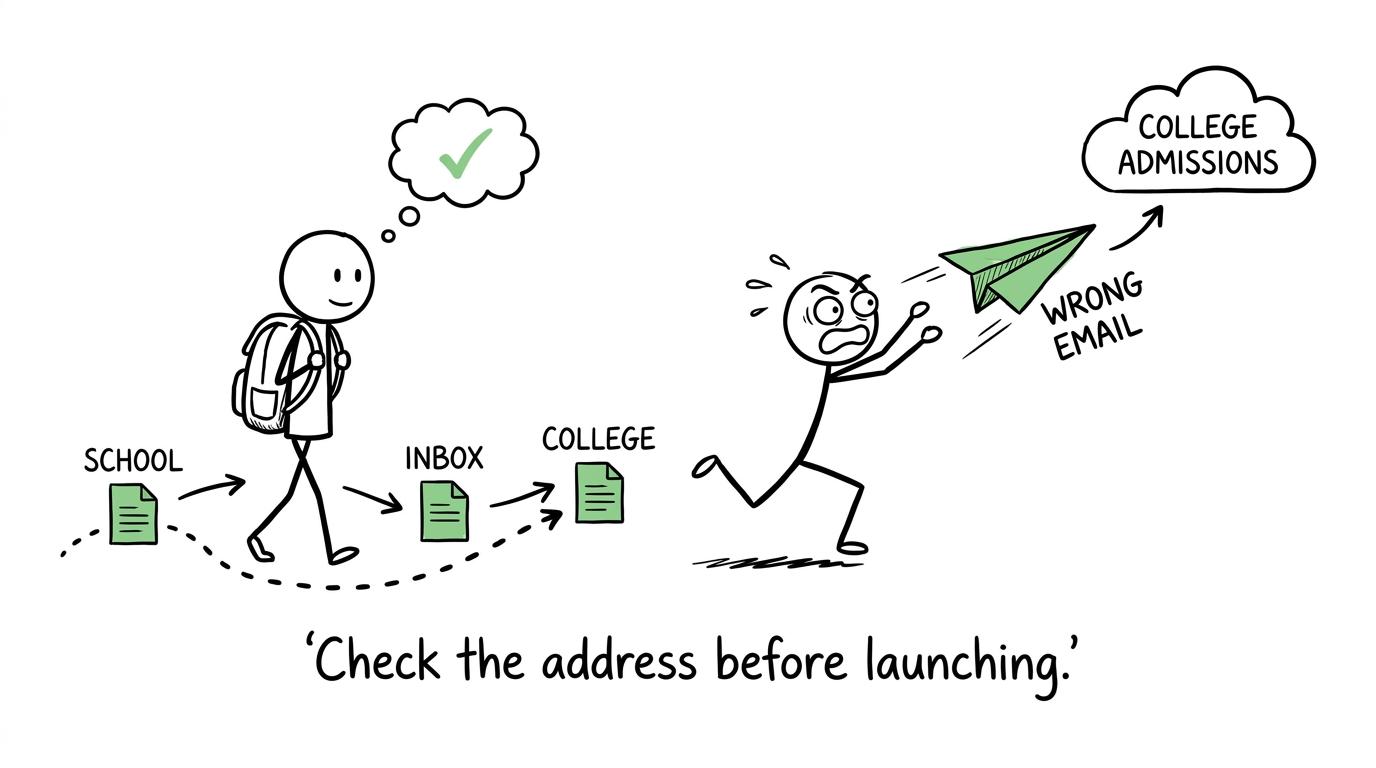 A calm student following paperwork while another chases an email sent to the wrong address
What if you request a review of marking?
Start by speaking to your school or college. Post-results services are normally handled through the examination centre, and the centre can explain the available options, deadlines, fees and possible outcomes.
A review is not simply a second attempt to gain a higher grade. Depending on the service requested, checks can identify administrative errors or review whether the mark scheme was applied correctly. A mark and grade may stay the same, rise or fall.
Tell your prospective sixth form or college promptly if a review could affect an entry condition. Ask whether it will hold your place and what evidence it needs from your current school. Do not assume that requesting a review automatically pauses enrolment deadlines.
If an updated grade is later issued, send the revised official evidence through the method admissions specifies. Keep both the original correspondence and confirmation of the final outcome.
A simple message for the admissions team
When you need to report a missing result or ask whether evidence has arrived, clarity matters more than formality. Include:
- your full name and applicant reference;
- the course or subjects you plan to take;
- the date and method of your submission;
- the result affected;
- the action your school is taking; and
- one direct question about your next step.
For example, you can explain that your GCSE Economics result is currently missing from the slip, that your exams officer is investigating it and that you would like to know what interim evidence the college accepts. This is not a worked academic example; it is simply a structure for giving admissions staff the information needed to help you.
Common mistakes when reporting GCSE results
Assuming every provider receives grades automatically
A new college may depend on information supplied through its own applicant system. Check rather than assume.
Sending only the Economics grade
The offer may depend on several GCSEs, particularly English and Maths. Submit the complete set requested by the institution.
Using an unofficial email address
Send personal documents only through the admissions channel published by the sixth form or college. A teacher's general email address may not reach the enrolment team.
Uploading an unreadable or cropped image
Open the file after taking it. Confirm that your identifying details, subject names and grades can all be read.
Waiting silently when something is missing
Contact both the exams officer and admissions team early. Silence gives the receiving institution no way to distinguish a delayed result from a missed enrolment.
Throwing away the original slip
Retain the original and collect your final certificates when your school says they are available. Store them somewhere secure.
Prepare for sixth form beyond the paperwork
Results submission is an administrative task, but the habits behind it matter: read the instructions, check the details and act before a small issue becomes urgent. The same habits make revision more reliable.
If Maths is part of your sixth-form offer, use the free GCSE Maths revision lessons and practice questions to strengthen topics before results day. You can test exam technique with GCSE Maths past papers and use MathsGenie predicted papers as focused preparation alongside the specification and your exam board's official materials.
Students considering Maths after GCSE can also explore the A Level Maths revision resources. The MathsGenie home page brings together revision lessons, video solutions, practice questions, mini tests, past papers and mark schemes in one free revision resource.
Take the next step calmly
To send your GCSE Economics result to sixth form or college, begin with the institution's own enrolment instructions. Obtain your official results, provide clear evidence through the specified channel and keep a record of the submission. If a grade is delayed, contact your exams officer and admissions team rather than waiting for the problem to resolve itself.
Then return your attention to what you can control. Build a sensible revision plan, practise the topics that cost you marks and learn from mark schemes and video solutions. Start with MathsGenie's free GCSE resources today, then use past papers and predicted papers to turn preparation into a routine rather than a last-minute rescue.











