Self-Study GCSE Engineering: A Realistic Plan
Self study GCSE Engineering with a realistic 24-week plan. Understand the NEA, centre rules, practical work, engineering maths and exam preparation.
A student can learn about materials, manufacturing and mechanical systems at a kitchen table. The difficulty begins when that knowledge must become an assessed prototype made under controlled conditions.
So, can you self study GCSE Engineering? You can independently learn much of the theory and engineering maths, but completing the full qualification outside school is more complicated. AQA GCSE Engineering includes substantial practical non-exam assessment, so you need an approved centre willing and able to supervise, authenticate, assess and administer that work.
That distinction matters. Self-teaching the content is realistic. Entering for the complete GCSE entirely alone may not be.
The short answer
Before buying equipment or building a revision timetable, check these essentials:
- Identify the exact qualification and specification code. For AQA GCSE Engineering, this is currently 885288528852.
- Ask AQA whether the specification is available under your circumstances.
- Find an approved centre before beginning assessed work.
- Confirm that the centre can provide workshop access, supervision and NEA assessment.
- Obtain the current specification, NEA rules and assessment materials.
- Allow enough time for theory, practical skills and exam practice.
- Continue revising GCSE maths alongside engineering.
There is an important complication. Current AQA public information has not always appeared consistent: its general administration page has stated that the specification is not available to private candidates, while some entry-code information has listed private-candidate availability. Do not interpret an entry code as permission to complete the course independently. Ask AQA and the prospective centre for written confirmation before committing money or beginning a project.
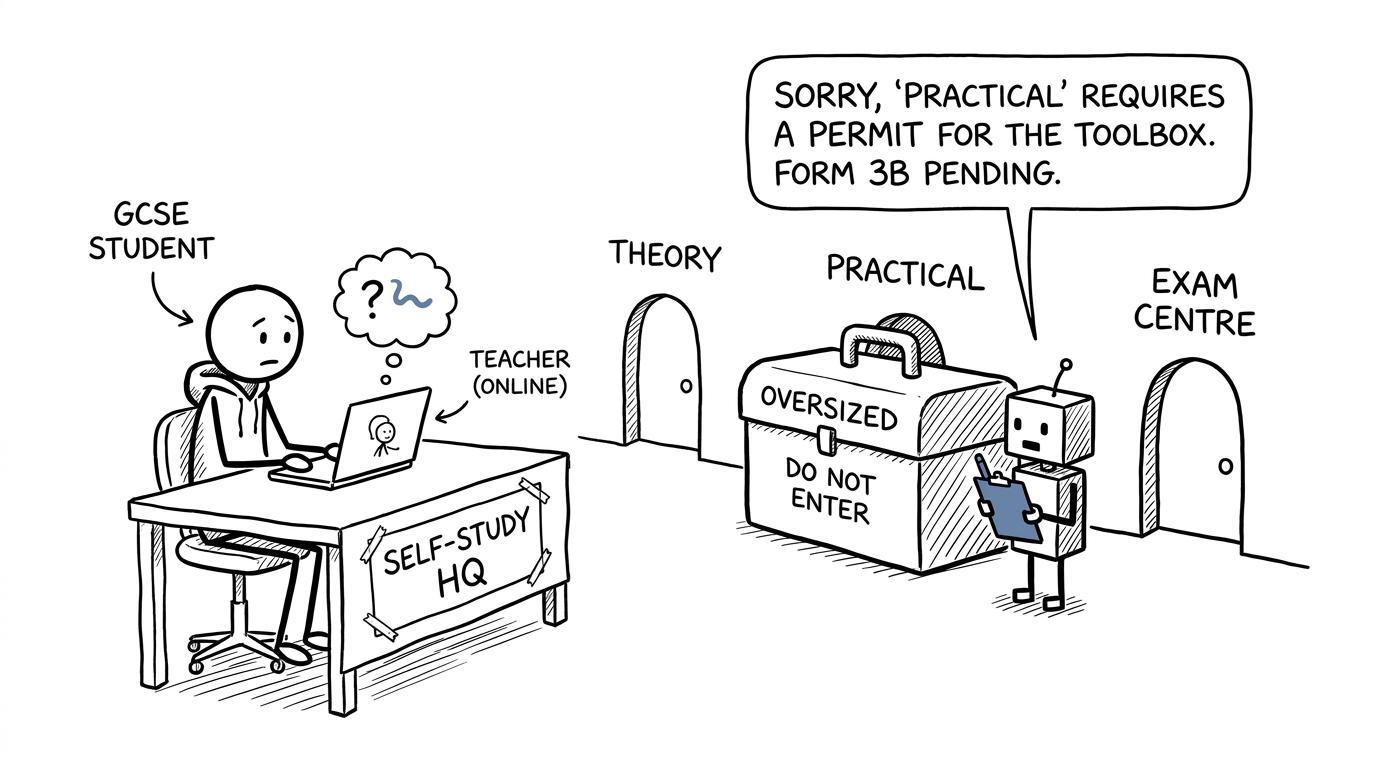 A student discovers that self-studying engineering involves theory, practical work and an exam centre
Why GCSE Engineering is difficult to take entirely alone
The obstacle is not intelligence or motivation. It is the assessment structure.
AQA GCSE Engineering is a linear qualification designed to be completed over two years. Its written paper lasts two hours, carries 120120120 marks and contributes 60%60\%60% of the qualification. The remaining 40%40\%40% comes from an NEA practical engineering project worth 808080 marks.
The NEA is expected to take approximately 303030 hours. Students respond to a contextual brief and produce a working prototype alongside a concise portfolio. The work covers areas such as problem analysis, engineering drawings, production planning, manufacturing, systems, testing and evaluation.
You cannot normally make an assessed product at home and simply take it to an exam centre afterwards. The centre has responsibilities involving supervision, authentication, health and safety, assessment and administration. It must also have suitable facilities and staff with the necessary subject knowledge.
This means there are three realistic routes:
Study through a school or college
This is the simplest option because workshop access, NEA supervision and exam entry are built into the course. You can still self-study much of the theory to move faster or recover missed learning.
Find a centre that will support the complete qualification
Ask specifically whether it accepts external candidates for GCSE Engineering 885288528852, not merely whether it accepts private candidates generally. A centre that offers written GCSE exams may not have an engineering workshop or an assessor for the NEA.
Confirm arrangements, fees, deadlines and permitted access before starting. Never assume that a centre can approve work retrospectively.
Learn engineering without entering immediately
If no suitable centre is available, you can still follow the specification as a structured introduction to engineering. That learning can support GCSE Maths, Physics, Design and Technology, or a later technical course. You would not receive the GCSE Engineering qualification without completing its formal assessments, but the knowledge is not wasted.
What you need to teach yourself
The AQA course is organised around six broad areas:
- engineering materials;
- manufacturing processes;
- systems;
- testing and investigation;
- the impact of modern technologies;
- practical engineering skills.
A useful self-study cycle is learn, retrieve, apply and check. Read or watch a short lesson, close the resource and recall the important ideas, answer questions, then correct your work using a mark scheme. Passive note-copying can feel productive while hiding gaps in understanding.
Your revision records should distinguish between three kinds of knowledge:
| Knowledge type | What you should be able to do |
|---|---|
| Factual | Recall properties, processes, components and terminology |
| Applied | Select suitable materials, processes or systems for a context |
| Evaluative | Compare options and justify a decision using evidence |
The written paper does not reward isolated definitions alone. A strong response connects an engineering choice to the product, user, manufacturing scale, cost, performance and environmental consequences.
The maths you will need for engineering
Engineering maths is not separate from the subject. It is the language used to describe whether a product is the right size, strong enough, economical or operating as intended.
The specification includes arithmetic, percentages, ratio, standard form, significant figures, algebra, graphs, Pythagoras' theorem and trigonometry. It also expects students to recall and use engineering relationships such as:
ρ=mV\rho=\frac{m}{V}ρ=Vmfor density,
σ=FA\sigma=\frac{F}{A}σ=AFfor stress, and
I=VRI=\frac{V}{R}I=RVfor current using Ohm's law.
You may also need to rearrange equations, convert units and interpret experimental graphs. Units are part of the answer, not an optional label added at the end.
Use the free GCSE Maths revision lessons to strengthen weak topics. In particular, revisit ratio revision, Pythagoras' theorem, trigonometry revision and graphs practice. These skills also protect marks in your GCSE Maths papers, whether you take Edexcel, AQA or OCR at foundation or higher tier.
A realistic 24-week self-study plan
AQA's published scheme of work is based on roughly 120120120 guided learning hours across the course. Therefore, a short revision sprint is not a convincing substitute for complete teaching and practical experience.
The plan below allows approximately five focused hours each week. It is a foundation for independent learning, not a replacement for the centre-controlled NEA arrangements.
| Weeks | Main focus | Evidence of progress |
|---|---|---|
| 111-222 | Confirm the specification, centre, assessment rules and deadlines | Written confirmation and a complete topic checklist |
| 333-444 | Metals, alloys, polymers, ceramics and composites | Comparison cards based on properties and uses |
| 555-666 | Material supply, cost, sustainability and maintenance | Timed contextual questions with self-correction |
| 777-888 | Cutting, forming, casting, moulding and additive manufacture | A process-selection grid with justified choices |
| 999-101010 | Joining, finishing, heat treatment, quality control and production scale | Practice responses using precise terminology |
| 111111-121212 | Mechanical systems, gears, pulleys, cams and linkages | Labelled system diagrams and retrieval tests |
| 131313-141414 | Electrical, electronic, programmable, pneumatic and hydraulic systems | Input-process-output explanations |
| 151515-161616 | Forces, structures, testing and material behaviour | Questions involving evidence and test results |
| 171717-181818 | Engineering maths, units, algebra and graphs | A corrected calculation log showing recurring errors |
| 191919-202020 | CAD, technical drawings, production planning and safe manufacture | Centre-approved practical skill development |
| 212121-222222 | Modern technologies, sustainability and extended responses | Timed answers planned around evidence and judgement |
| 232323 | Complete a written paper under timed conditions | Marked paper and an error analysis |
| 242424 | Target weaknesses and repeat difficult questions | Final specification audit and improvement list |
If you are completing the NEA through a centre, its timetable takes priority. The current brief, controlled conditions and permitted assistance must determine when and how the assessed project is completed.
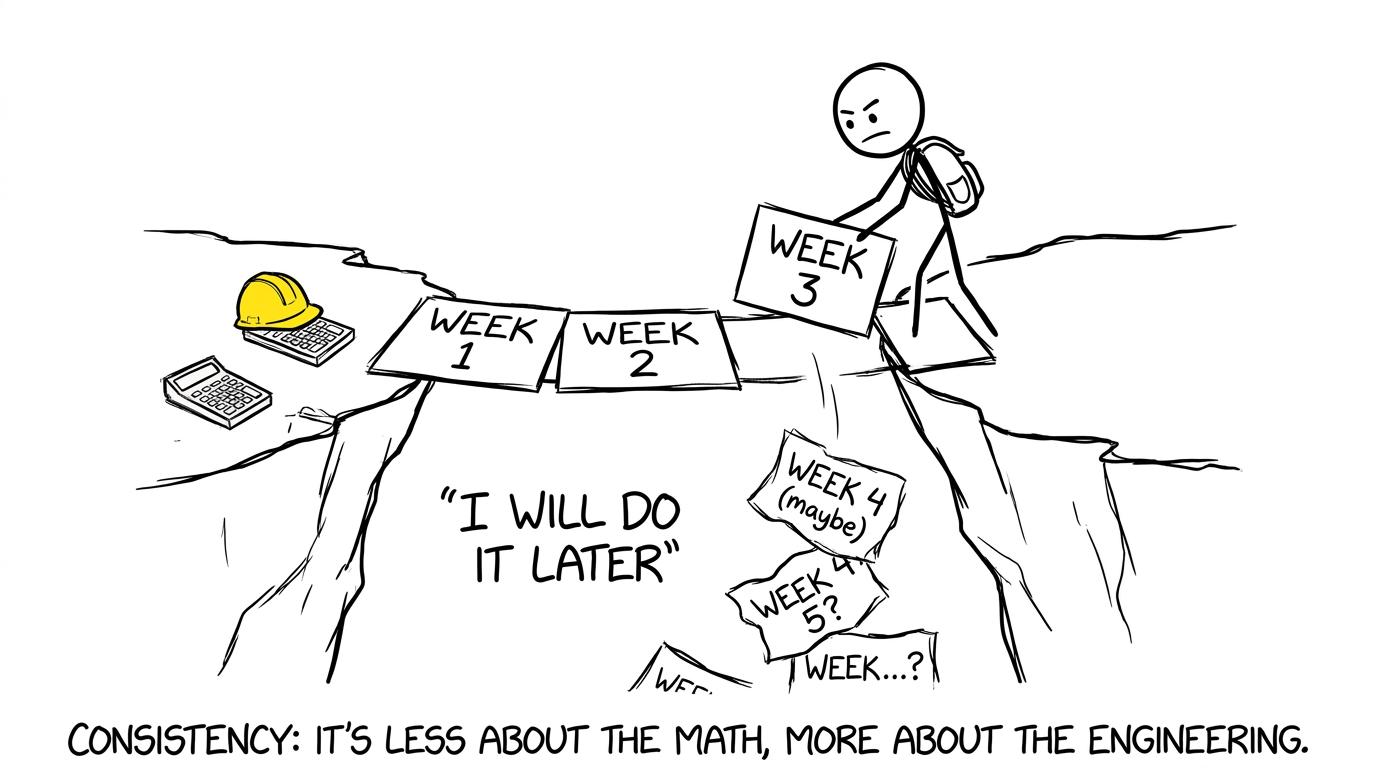 A student builds a bridge over procrastination using weekly revision cards
How to organise each week
A five-hour week might contain:
- two 454545-minute theory sessions;
- one 454545-minute retrieval and vocabulary session;
- one 606060-minute engineering maths session;
- one 606060-minute exam-question session;
- one 454545-minute review and planning session.
Keep sessions small enough to repeat. Consistency is more useful than an ambitious timetable that survives for four days.
During the maths session, use MathsGenie's video solutions and practice questions. During exam practice, separate engineering papers from GCSE Maths papers. They assess overlapping skills, but their contexts and mark schemes are different. MathsGenie's GCSE Maths past papers help you build calculation fluency, while predicted GCSE Maths papers provide further timed practice near the exam period.
How to revise without a teacher beside you
Independent learning needs a feedback system. Otherwise, the same mistake can be repeated until it feels familiar.
Create an error log with four headings: topic, mistake, correction and next review date. Record whether the problem came from missing knowledge, incorrect mathematics, weak interpretation or imprecise language.
When using a mark scheme, ask why each mark was available. Engineering answers often require a linked justification. Naming a material may earn little unless you explain why its relevant properties suit the stated application.
Complete full papers only after you have practised individual topics. Early full papers can diagnose gaps, but repeated papers without targeted improvement simply measure the same weaknesses.
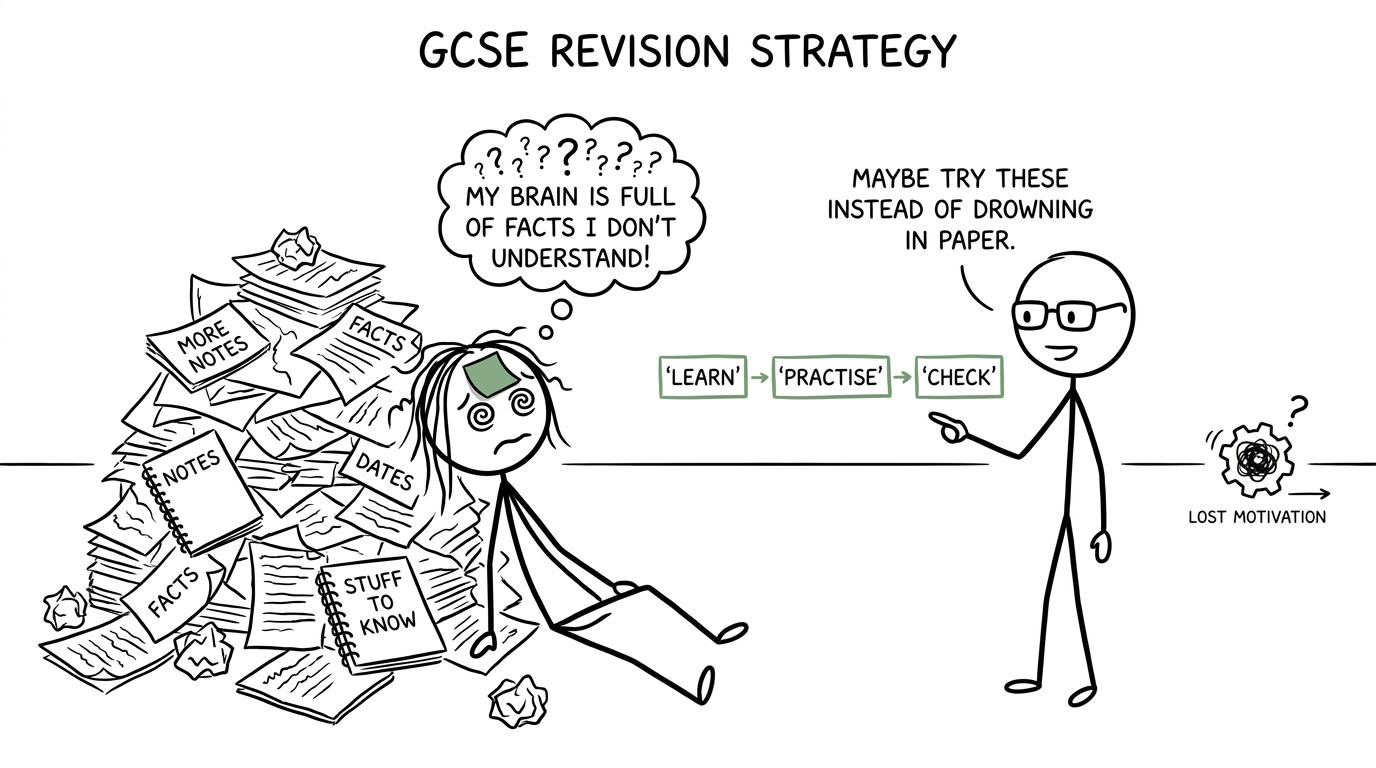 A sensible revision system defeats a mountain of notes using learn, practise and check
Common mistakes when self-studying GCSE Engineering
Arranging an exam centre too late
The written exam is only one component. Ask about the NEA, workshop access and assessment before beginning the course, not shortly before entries close.
Treating the NEA as an unrestricted home project
A personal prototype can develop useful skills, but it does not automatically become admissible assessed work. Follow only the instructions supplied by the approved centre.
Learning lists without applying them
Knowing that a material is tough or corrosion-resistant is not enough. Practise connecting each property to a specific design requirement and manufacturing context.
Neglecting units and conversions
A correct method can lose marks through inconsistent units. Make unit checks part of every calculation and revise significant figures alongside measurement and tolerances.
Spending too long making attractive notes
Engineering is an applied subject. Your plan needs retrieval, calculations, diagrams, practical experience and exam questions, not only highlighted pages.
Assuming GCSE Engineering is the same as every Level 1 or Level 2 engineering course
OCR, Pearson and other awarding organisations offer technical qualifications with different titles and assessment structures. Check the exact qualification rather than relying on the word “engineering”.
Build a plan around the real constraint
The realistic answer is encouraging, but conditional. You can self-study the theory of GCSE Engineering and become confident with its mathematics. You cannot safely assume that the complete qualification can be entered or assessed without a supporting centre.
Resolve that practical question first. Then work steadily through the specification, giving equal attention to knowledge, application and evaluation. Use MathsGenie's free GCSE resources for the mathematical foundation, then combine revision lessons with practice questions, mini tests, past papers, predicted papers, mark schemes and video solutions.
Engineering turns ideas into things that work. Your revision plan should do the same: begin with a clear requirement, test it honestly and improve it one week at a time.