Self Study GCSE Biblical Hebrew: A Realistic Plan
Self study GCSE Biblical Hebrew with a realistic 24-week plan covering exam entry, language, set texts, past papers and balancing maths revision.
A subject can look manageable until you imagine learning it without a classroom, teacher or weekly deadline. Biblical Hebrew adds another layer: a different writing system, unfamiliar grammar and prescribed literature that must be understood closely.
So, can you self study GCSE Biblical Hebrew? Yes, provided you secure an exam centre early, follow the current Pearson Edexcel specification and obtain reliable feedback on translations and extended responses. It is much harder if you are beginning from zero shortly before the exams. For a complete beginner, a school year is safer; the plan below is a focused 242424-week route for someone with basic reading knowledge or enough weekly time to build it quickly.
If you are also preparing for GCSE maths, the central problem is not intelligence. It is capacity. Biblical Hebrew must fit beside your main subjects without quietly consuming every evening.
The realistic answer at a glance
Before committing, check that you can do all of the following:
- enter Pearson Edexcel GCSE Biblical Hebrew, specification code 1BH0, through an approved exam centre
- study consistently for about four to six hours each week
- read pointed Biblical Hebrew accurately or learn to do so early in the course
- access the correct set texts for your examination year
- receive occasional feedback from a suitably knowledgeable teacher or tutor
- complete both language and literature practice under timed conditions
- protect your GCSE maths and other core-subject revision time
The qualification is assessed through two externally examined components. Component One is Language: a two-hour paper worth 50%50\%50% and 100100100 marks. Component Two is Literature: another two-hour paper worth 50%50\%50% and 100100100 marks. Both components are taken in the same May or June examination series. Unlike GCSE maths and many modern languages, Biblical Hebrew is not divided into foundation and higher tiers.
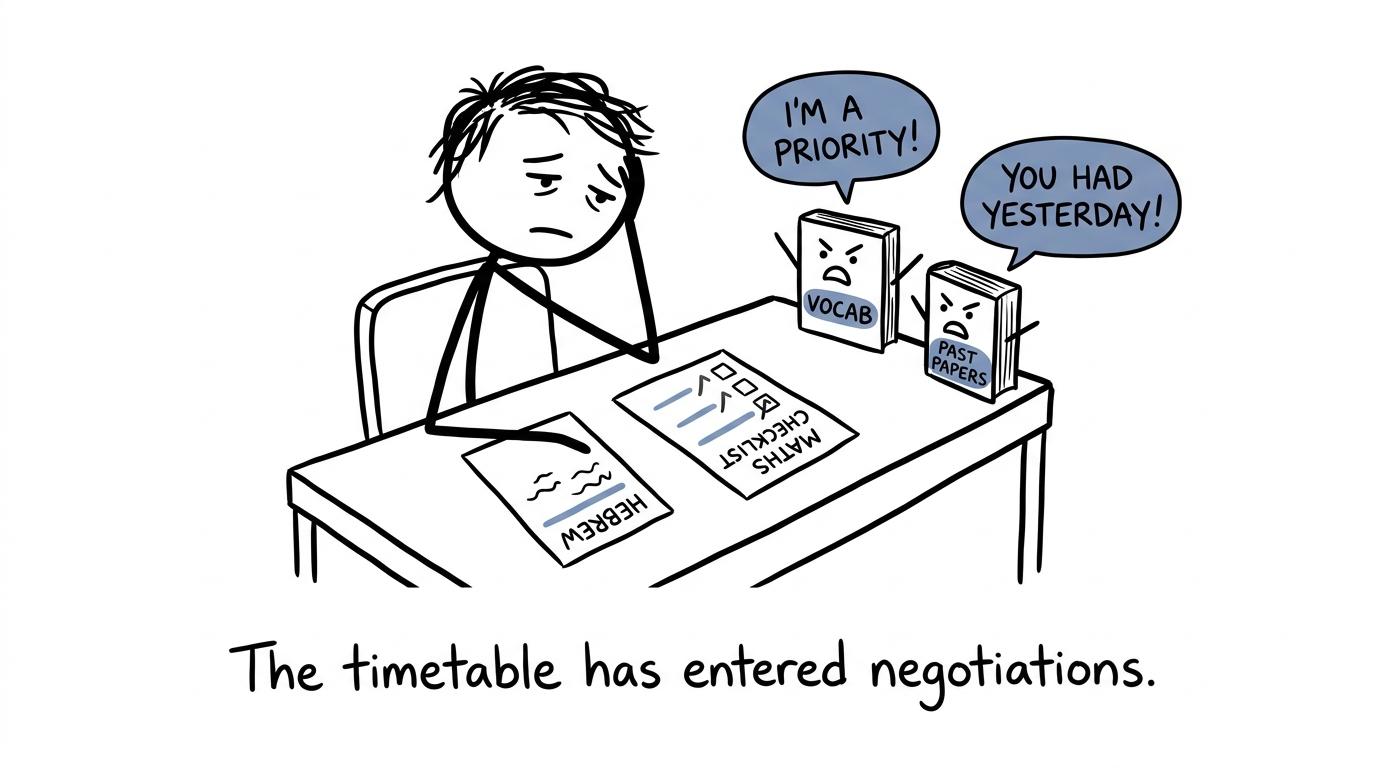 A student negotiates a timetable with competing revision books
Confirm the exam before beginning the course
Independent learners sometimes start with vocabulary because it feels productive. The better first action is administrative: find out whether you can actually sit the qualification.
Pearson currently lists GCSE Biblical Hebrew 1BH0 as available, including to private candidates. However, an approved centre is not obliged to accept you or offer this particular subject. Contact centres directly, ask whether they accept a private entry for 1BH0 and confirm their entry deadline, identification requirements, access-arrangement process and total fees. Charges vary by centre, so obtain the figure in writing.
Do this months before the normal entry deadline. A centre that accepts private GCSE candidates generally may not offer Biblical Hebrew, and leaving the search until spring can make an otherwise sound revision plan useless.
Next, download the latest specification and check your examination year. For examinations from 2026 to 2028, the prescribed literature is:
- Genesis, chapters 41 to 43: Joseph's rise to power
- Kings, chapters 4 to 7: the miracles of Elisha
Specifications and set texts can change. Treat the current Pearson document, rather than an old textbook or school handout, as the final authority.
What you need to learn independently
Language knowledge
Paper One requires more than recognising familiar verses. You must read and understand unseen Biblical Hebrew, answer comprehension questions and translate unseen passages into English. The specification also provides an optional route involving grammatical understanding or translation of simple English sentences into pointed Biblical Hebrew.
Your language work therefore needs four strands:
- accurate reading and recognition of pointed forms
- vocabulary recall in both directions where required
- morphology and syntax, including how forms operate inside sentences
- unseen comprehension and translation
A vocabulary list is necessary, but vocabulary alone is not a course. You need to recognise what a word is doing, not merely what its dictionary entry might mean.
Literature knowledge
Paper Two tests the prescribed texts through comprehension, grammar, translation and extended responses. There is also a synoptic element connecting the two set texts.
Build a text file for every passage containing:
- a secure translation
- important grammatical forms
- literary or linguistic features
- relevant themes and context found within the prescribed books
- short evidence references for comparative writing
Ofqual's subject requirements keep Biblical Hebrew context tied to the books from which the set texts are taken. You are not expected to turn the course into a broad survey of the entire ancient world. Depth in the specified material matters more than unrelated background reading.
A realistic 24-week self-study plan
This schedule assumes four sessions each week: three sessions of roughly 454545 minutes and one longer session of 757575 to 909090 minutes. If you are a complete beginner, spend an additional term developing reading fluency before Week One.
| Week | Main focus and evidence of progress |
|---|---|
| 1 | Confirm the specification, exam year and centre. Print the assessment overview and create separate language, literature and error-log folders. |
| 2 | Diagnose alphabet, pointing and reading fluency. Record exactly which signs and sound patterns cause hesitation. |
| 3 | Review core noun patterns, gender, number, articles and common particles. Begin daily vocabulary retrieval. |
| 4 | Review pronouns, suffixes and construct relationships. Complete a short untimed unseen passage. |
| 5 | Consolidate regular verb recognition. Sort errors by form, vocabulary and sentence structure. |
| 6 | Study common irregular or weak forms required by the specification. Retest Week Five material without notes. |
| 7 | Practise comprehension responses and precise English translation. Compare your work with an authoritative key or qualified feedback. |
| 8 | Complete a timed language section. Decide which optional language route suits your current strengths. |
| 9 | Begin Genesis 41. Prepare a secure translation and annotate significant grammar. |
| 10 | Study Genesis 42, revisiting Genesis 41 through closed-book retrieval. |
| 11 | Study Genesis 43 and map the development of characters and themes across all three chapters. |
| 12 | Complete a mixed Genesis test: translation, comprehension, grammar and a planned extended response. |
| 13 | Begin Kings 4. Keep language analysis separate from general narrative summary. |
| 14 | Study Kings 5 and retrieve key material from Kings 4 before opening notes. |
| 15 | Study Kings 6. Add evidence to a comparison grid rather than writing long descriptive notes. |
| 16 | Study Kings 7 and review the sequence, themes and linguistic features across the complete set text. |
| 17 | Complete a mixed Kings assessment and obtain feedback on one extended response. |
| 18 | Plan synoptic comparisons between Genesis and Kings using precise textual evidence. |
| 19 | Sit a complete Paper One under the correct two-hour conditions. Mark it and classify every lost mark. |
| 20 | Repair the three largest Paper One weaknesses through targeted unseen work and vocabulary retrieval. |
| 21 | Sit a complete Paper Two under timed conditions. Review both factual gaps and response structure. |
| 22 | Repair literature weaknesses. Relearn uncertain passages and rewrite one weak extended response. |
| 23 | Complete a second timed paper or sample assessment. Check whether earlier mistakes have actually disappeared. |
| 24 | Use short retrieval sessions, translations and response plans. Confirm exam arrangements and avoid last-minute content expansion. |
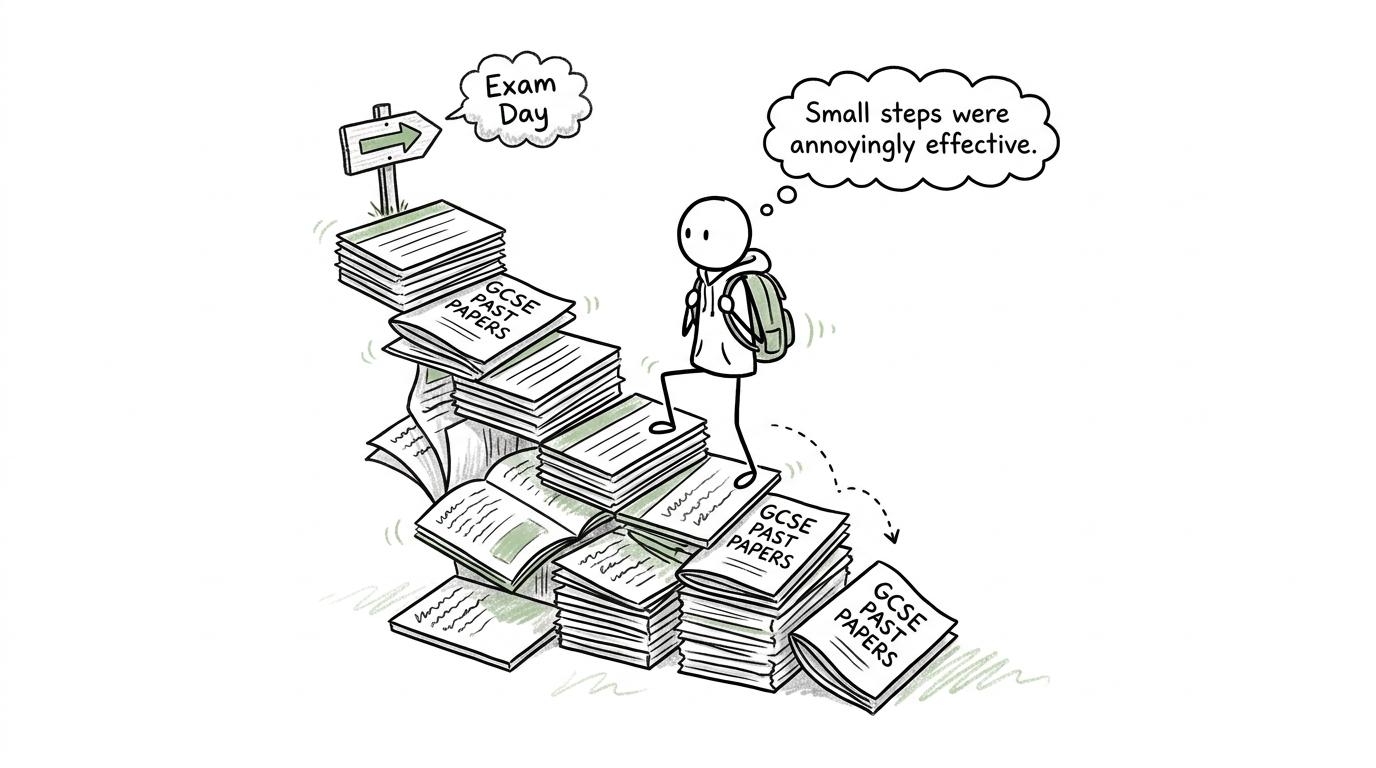 A student climbs a staircase made from small revision tasks
How to make independent revision reliable
Self-study becomes risky when there is no feedback loop. Use the same cycle that works in maths:
- learn one defined area
- attempt questions without support
- mark against a reliable scheme or model
- identify the exact cause of each error
- practise that weakness
- retest it several days later
MathsGenie's guide to using GCSE past papers properly explains this process clearly. The subject changes, but the logic does not. A marked paper is evidence, not a verdict.
Do not wait until every chapter feels finished before testing yourself. The advice in when to start GCSE past papers is equally relevant here: begin with sections, then progress towards complete timed papers.
For Biblical Hebrew, external feedback is particularly valuable. A fluent reader is not automatically familiar with GCSE mark schemes, so seek someone who understands Biblical Hebrew grammar and the Pearson assessment. Even occasional review can catch mistranslations or unsupported literary claims that self-marking misses.
Balancing Biblical Hebrew with GCSE maths
An extra GCSE should not weaken the subjects already filling your timetable. Give each week a fixed capacity. For example, reserve four Biblical Hebrew blocks and protect separate maths sessions rather than deciding each evening which subject feels most urgent.
Use the GCSE maths revision hub to select your board and move directly to lessons, practice questions and papers. If your schedule is crowded, a realistic GCSE maths revision timetable can help you establish non-negotiable weekly blocks.
Keep the feedback loops separate. Your Hebrew error log might contain vocabulary, morphology, translation or textual-evidence problems. Your maths log should identify precise topics and methods. The weak-topic diagnostic approach prevents a vague feeling of being behind from controlling either subject.
If you take Edexcel maths, the Edexcel GCSE maths past-paper library provides official mark schemes and worked solutions where available. Students following AQA, OCR or Eduqas can choose their board through the main revision hub.
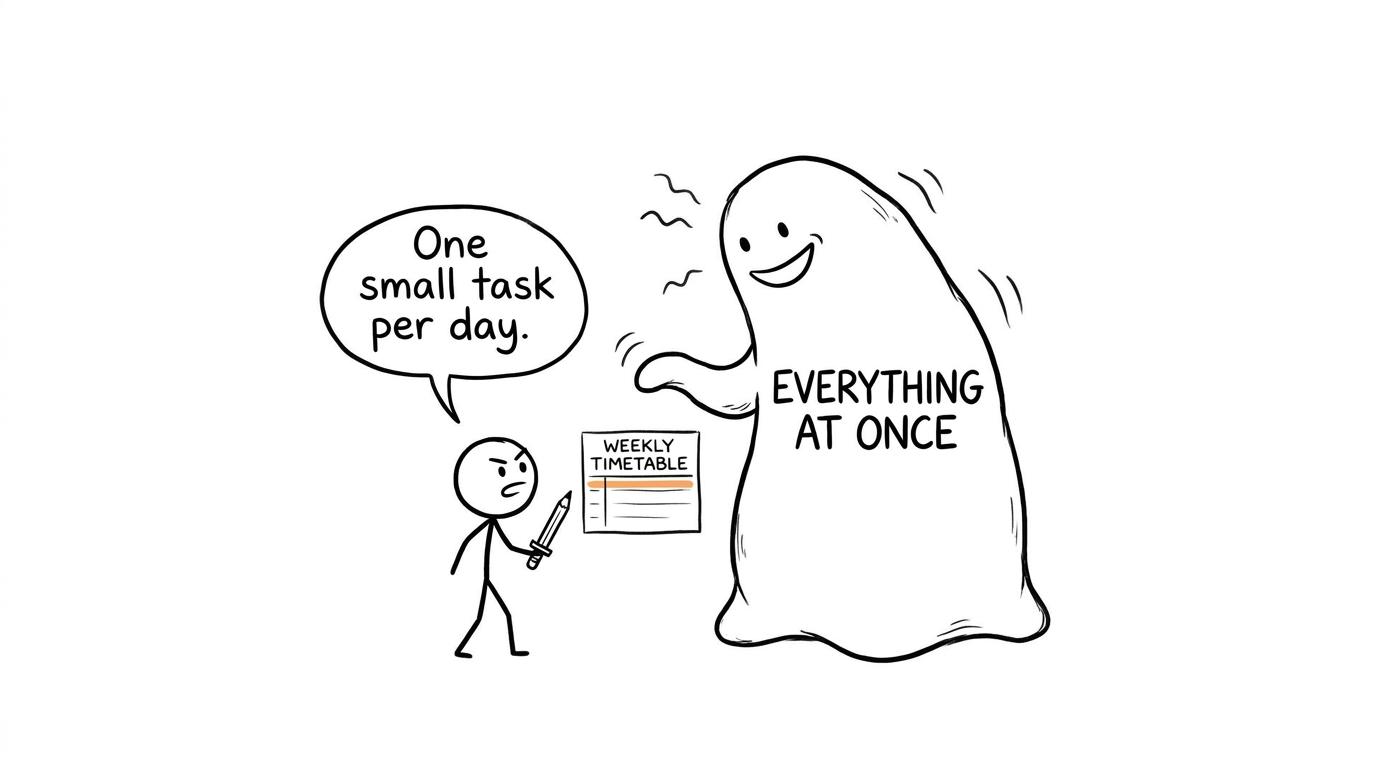 A student protects one small task from the Everything At Once monster
Common mistakes when self-studying GCSE Biblical Hebrew
Confusing Biblical Hebrew with Modern Hebrew
They are related, but GCSE Biblical Hebrew has its own prescribed grammar, unseen-text demands and literature assessment. General fluency does not remove the need to study the specification.
Learning translations without learning the language
Memorising an English version may help with a known passage, but it will not prepare you for unseen material or grammatical questions. Analyse forms and sentence structure as you learn each set text.
Using the wrong prescribed texts
Old papers may assess earlier text cycles. They remain useful for question style, but their literature content may not match your examination year.
Treating rereading as revision
Familiar pages create confidence without proving recall. Close the book, translate, answer and then check. The one-month GCSE revision plan shows how retrieval, marking and spaced revisits can structure a busy final phase.
Avoiding full timed papers
Two-hour papers require concentration as well as knowledge. Build stamina gradually and use mark schemes to understand how credit is awarded. MathsGenie's past-paper tools show the value of timing attempts and reviewing solutions systematically.
Trying to do everything alone
Independent study means owning the plan, not refusing help. Ask an exams officer about entries, a qualified specialist about language accuracy and your school about managing the workload.
A calm final decision
Self-studying GCSE Biblical Hebrew is doable outside school, but it is not a casual extra. The strongest candidate has a confirmed centre, the correct set texts, regular language practice, informed feedback and enough time to sit both papers properly before the real examination.
Start with the practical questions today: check the specification, contact centres and complete an honest reading diagnostic. Then follow the weekly plan one small task at a time.
For the maths part of your GCSE journey, let MathsGenie reduce the number of decisions you must make. Build your revision planner around free revision lessons and practice questions, then use mini tests, GCSE past papers, predicted papers, mark schemes and video solutions to turn weak areas into specific next steps. Ambitious plans become manageable when every session has a clear purpose.