Self Study GCSE Arabic: A Realistic Plan
Self study GCSE Arabic with a realistic week-by-week plan covering exam entry, speaking practice and revision alongside your GCSE maths workload.
It is possible to self study GCSE Arabic, but learning alone does not mean doing everything alone. You need the correct specification, regular feedback from a strong Arabic speaker and, crucially, an exam centre able to enter you and conduct the speaking assessment.
That administrative step matters more than most students realise. You can build an impressive vocabulary at home, yet still be unable to complete the qualification if no centre will accept you for every component. Find the centre first. Then build your revision around the actual assessment.
The plan below assumes that Arabic must fit beside GCSE maths and your other subjects. It is deliberately realistic: four focused sessions each week over sixteen weeks, followed by a final exam phase. If you are starting from the alphabet, allow considerably longer.
Your self-study checklist
Before beginning, make sure you can:
- identify your exact qualification and exam board;
- obtain the current specification and assessment materials;
- find an approved centre accepting private candidates;
- confirm that the centre can conduct and record the speaking assessment;
- choose the correct tier with appropriate advice;
- arrange regular speaking and writing feedback;
- protect enough time for maths and your other GCSEs.
Self-study is most realistic for somebody who already reads Arabic script and can understand some Modern Standard Arabic. A complete beginner can still learn independently, but one short school year is an ambitious timescale.
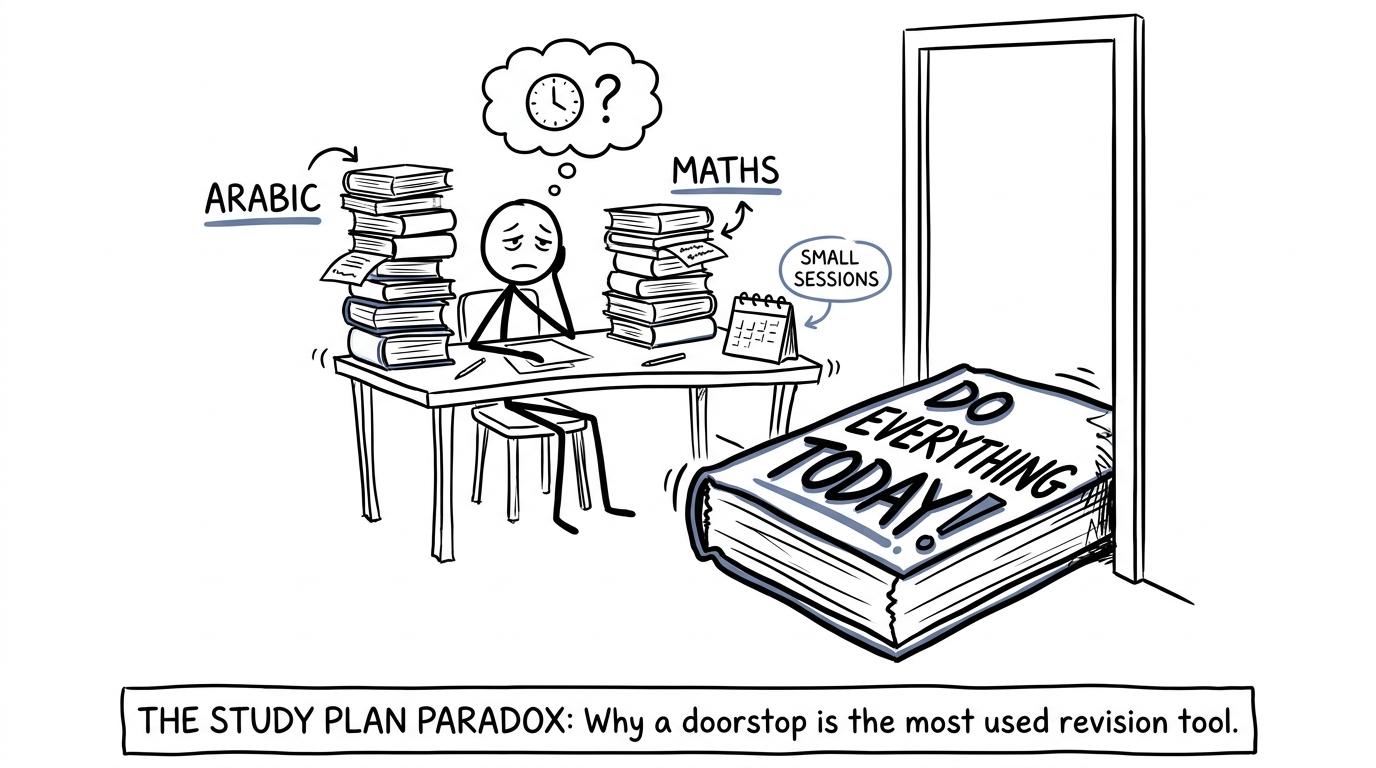 A student balancing Arabic and maths revision with a sensible calendar
Understand the GCSE Arabic assessment first
For students taking the qualification in England, Pearson Edexcel GCSE Arabic, specification code 1AA0, is available to private candidates at the time of writing. Always confirm the live specification and current arrangements with Pearson and your chosen centre before paying an entry fee.
It assesses four skills:
| Component | Weighting | What it tests |
|---|---|---|
| Listening | 25%25\%25% | Understanding spoken Arabic in different settings |
| Speaking | 25%25\%25% | A role play, picture-based task and conversation |
| Reading | 25%25\%25% | Comprehension of different texts and translation into English |
| Writing | 25%25\%25% | Written responses and translation into Arabic |
All four papers must be taken at the same tier: foundation or higher. You cannot mix tiers. Speaking is conducted face to face by a suitable person at the centre, recorded and submitted for external assessment. It normally takes place before the main written examinations, within the board's prescribed window.
That is why the centre search belongs at the beginning of your plan rather than the end. Ask explicitly whether the centre accepts private candidates for GCSE Arabic 1AA0, provides the speaking assessment and can supply an appropriate person to conduct it. Ask about fees, deadlines and identification requirements too. Arrangements and costs differ between centres.
Is GCSE Arabic genuinely doable outside school?
Yes, provided three conditions are met.
First, you need a reasonable starting point. Reading slowly is not the same as reading fluently, but it is enough to begin. If you cannot yet recognise and join letters reliably, build that foundation before starting an exam-focused sixteen-week plan.
Second, you need feedback. Listening and reading can be marked quite independently, but speaking errors are hard to hear in your own voice and writing errors can become habits. A tutor is useful, although not essential every week. A fluent adult who understands Modern Standard Arabic can also help with pronunciation and meaning, but exam-specific feedback should follow the official mark scheme.
Third, your routine must include all four skills. Heritage speakers sometimes underestimate writing accuracy, while classroom learners may postpone spontaneous speaking because it feels uncomfortable. Since each skill contributes 25%25\%25%, consistently avoiding one component places a firm ceiling on the result you can achieve.
The larger lesson is familiar from maths revision: confidence grows from tested performance, not from recognising a page of notes. MathsGenie's guide to finding your weakest GCSE topics explains a diagnose, practise and re-test cycle that transfers well to language learning.
A sustainable weekly routine
Aim for four Arabic sessions each week, lasting roughly thirty to forty-five minutes. A balanced pattern is:
- Session A: vocabulary retrieval and reading;
- Session B: grammar and writing;
- Session C: listening and transcription checks;
- Session D: speaking, recording and review.
Add one short vocabulary review on another day if possible. Frequent recall is more valuable than saving everything for a long Sunday session.
Keep maths on a separate rotation so that Arabic does not quietly consume every revision evening. The twenty-minute GCSE maths routine is useful on crowded days, while the main GCSE Maths revision hub lets you select resources for Edexcel, AQA, OCR, Eduqas and other boards.
A realistic sixteen-week GCSE Arabic plan
Weeks one and two: organise and diagnose
Confirm the exam board, centre, tier decision process and entry arrangements. Read the specification rather than relying on a generic Arabic course.
Attempt small samples from listening, reading, speaking and writing without heavy preparation. Record what prevented you from earning marks: unknown vocabulary, slow reading, weak verb control, misunderstanding instructions or hesitation when speaking.
Create one error log with four headings, one for each assessed skill. This becomes the evidence for what you revise next.
Weeks three and four: build the language core
Review high-frequency vocabulary across the specification themes, including identity and culture, local area and travel, school, future aspirations and the wider world. Learn words inside useful phrases rather than as disconnected translations.
At the same time, secure the grammar that carries meaning: pronouns, agreement, common verb forms, tense control, negatives, connectives, questions and opinions. The goal is not to memorise every grammatical label. It is to produce clear Arabic accurately enough for the examiner to understand your message.
Complete short listening and reading tasks throughout. Grammar should improve communication, not replace it.
Weeks five and six: strengthen listening and reading
Use short recordings repeatedly but with a different purpose on each listen. First identify the overall message, then details, and finally the words that caused difficulty. Practise coping with more than one speaker and with information that corrects or contradicts an earlier statement.
For reading, work with varied text types rather than only textbook paragraphs. Track whether mistakes come from vocabulary, grammar, inference or rushing. Begin regular Arabic-to-English translation practice, checking that the English preserves the complete meaning rather than following Arabic word order mechanically.
Weeks seven and eight: make writing measurable
Write under a clear time limit and compare your response with the task requirements and official assessment criteria. Check whether you answered every bullet, communicated opinions, justified them and used a suitable range of language.
Ask a competent Arabic speaker to annotate errors rather than rewriting the response for you. Then produce a corrected version from the feedback. Keep a personal checklist of repeated issues such as agreement, spelling, tense or missing detail.
This resembles good maths revision: use a mark scheme, identify the lost mark and repair the smallest relevant skill. MathsGenie's guide to using Edexcel GCSE maths papers properly shows how to turn marking into a next action rather than merely recording a score.
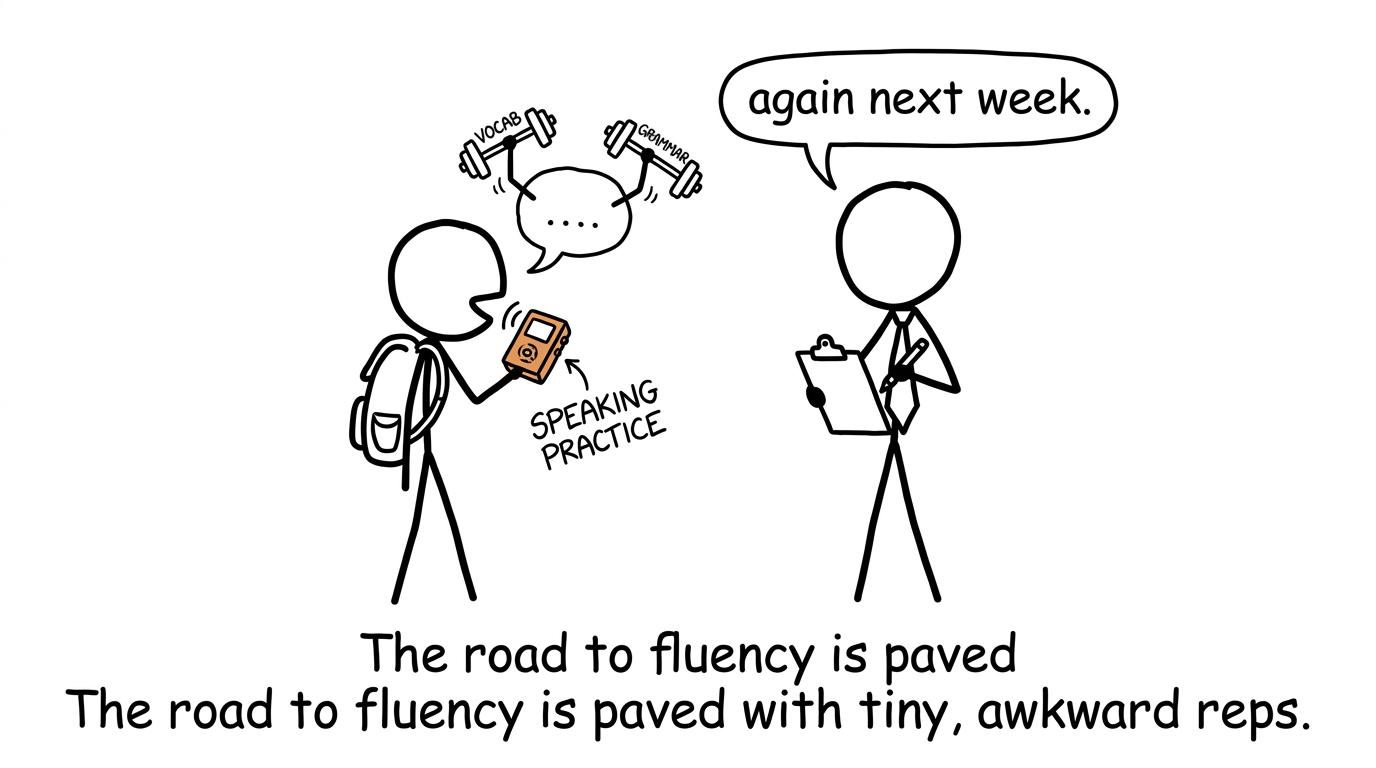 A shy speech bubble training for the speaking assessment
Weeks nine and ten: train speaking deliberately
Practise the three speaking formats specified by Pearson: role play, a picture-based task and conversation. Do not memorise one enormous script. A conversation must survive follow-up questions, and memorised language can collapse when the wording changes.
Record short answers, listen back and repeat them with clearer pronunciation and fuller development. Arrange a weekly live conversation with someone who will interrupt, ask an unexpected question and require clarification. That gentle unpredictability is valuable preparation.
Weeks eleven and twelve: combine the four skills
Complete one substantial task from every component each week. Use the results to rebalance your sessions. If listening is improving but writing remains inaccurate, your next week should not contain equal amounts of both simply because equal feels organised.
Continue revisiting vocabulary from earlier themes. New learning is fragile; retrieval makes it usable.
Weeks thirteen and fourteen: introduce timed assessment
Begin timed sections using official sample materials and available past papers. Reproduce exam conditions: no phone, no dictionary unless the current rules expressly permit one, and no pausing the listening recording outside the published procedure.
Mark reading and listening closely. Have writing reviewed against the official criteria, and conduct a mock speaking session in the correct task order. Decide with your centre or teacher whether your chosen tier remains appropriate.
Students often wait until they feel ready before attempting papers. Usually, papers are part of becoming ready. The same principle applies in maths, as MathsGenie's guide to when to start GCSE past papers explains.
Weeks fifteen and sixteen: repair, retest and reduce
Choose your three largest weaknesses and repair them through focused practice. Then re-test them with unseen material. Do not spend the final fortnight rebuilding beautiful notes.
Complete a full mock sequence across the four skills if your timetable allows. Review mistakes, but reduce the volume as assessments approach. Short, accurate recall and calm speaking practice are more useful than exhausted late-night cramming.
For maths, this is also the stage to move from isolated topics towards GCSE predicted papers, past papers, mark schemes and video solutions. Predicted papers are practice tools, not promises about what will appear.
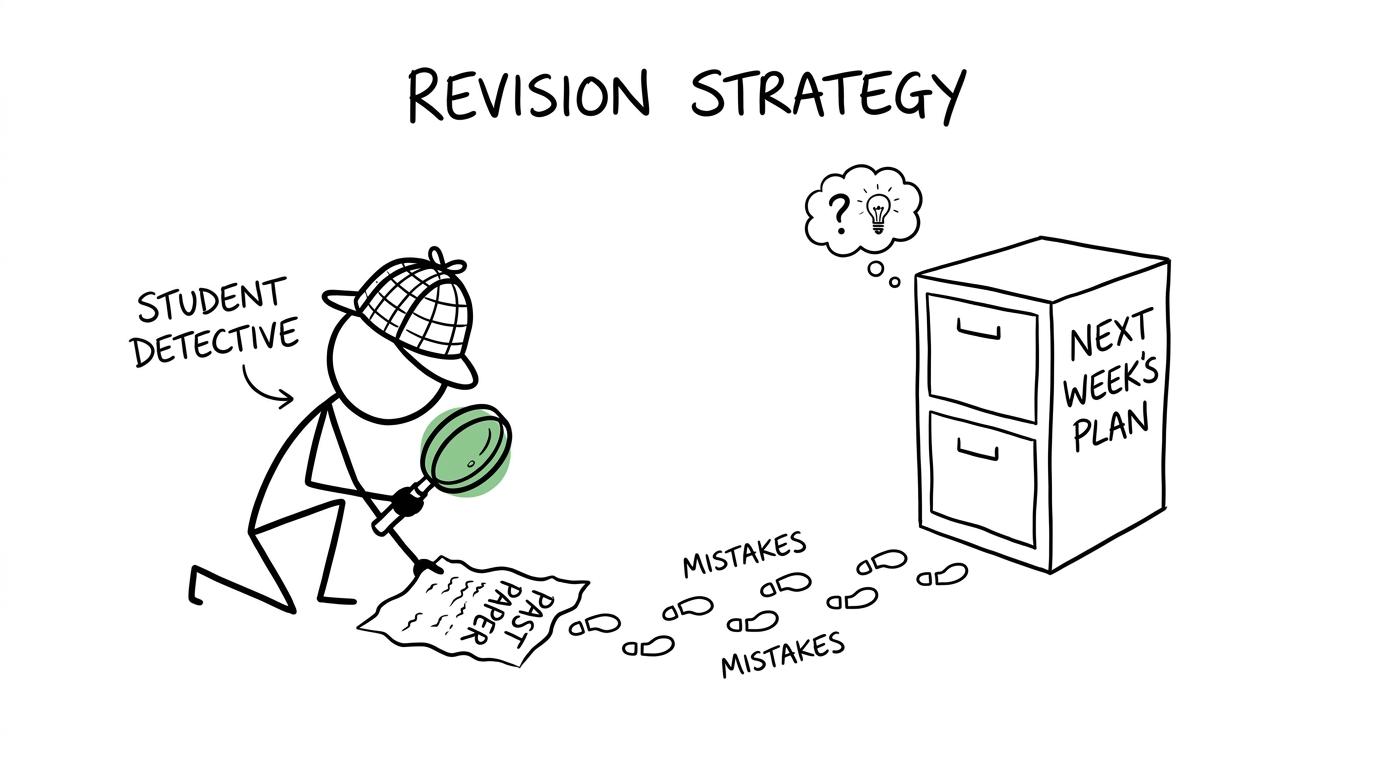 A revision detective following mistakes towards next week's plan
How to balance Arabic with GCSE maths
Treat revision time as a budget. Every extra hour assigned to one subject is unavailable elsewhere, so your timetable should respond to evidence.
Reserve fixed sessions for Arabic because language learning benefits from frequency. Then use maths test results to direct the remaining time. MathsGenie's Edexcel revision strategy follows a useful loop: learn one method, answer exam-style questions, mark them and re-test the weakness.
Use the MathsGenie revision planner to see the whole workload rather than making daily decisions from scratch. Revision lessons and practice questions build individual skills; mini tests check recall; past papers develop stamina; mark schemes and video solutions reveal where marks were lost. In the final run-in, fresh predicted papers can pressure-test whether those repairs have held.
Common mistakes when self-studying GCSE Arabic
Booking the exam too late
A centre must handle your entry and speaking assessment. Availability may be limited, so contact centres early and confirm everything in writing.
Learning a different form of Arabic
GCSE Arabic assesses Modern Standard Arabic. Experience with a regional dialect, Qur'anic Arabic or informal family conversation can be valuable, but it does not automatically cover the required reading, writing and exam vocabulary.
Revising only comfortable skills
Reading vocabulary can feel productive because progress is visible. Speaking into a recorder feels less comfortable, which is precisely why it is often postponed. Keep all four components active from the beginning.
Memorising answers without developing flexibility
Prepared phrases help, but answers must fit the question. Practise adapting language, changing time frames and responding to follow-up prompts.
Marking without acting
A score describes the past. Improvement comes from correcting the cause, attempting a fresh task and checking whether the error returns.
Build a plan you can still follow in a difficult week
Self-study works when the routine survives ordinary life: homework, mock exams, tired evenings and competing deadlines. Four purposeful Arabic sessions each week are more dependable than an ambitious timetable abandoned after ten days.
Secure your exam centre, follow the live specification and obtain regular feedback on speaking and writing. Then use the sixteen-week plan as a framework, adjusting it according to what your assessments reveal.
For the maths side of your GCSE timetable, make MathsGenie's free GCSE revision resources your base. Move from revision lessons to practice questions, mini tests and past papers, then use mark schemes, video solutions and predicted papers to convert mistakes into better marks. A good plan does not ask you to feel motivated every day. It makes the next useful action obvious.