Revision Timetable Mistakes to Avoid
Revision timetable mistakes to avoid, with practical fixes for realistic GCSE and A Level planning, stronger routines and productive revision.

A parent looks at a beautifully colour-coded timetable on Sunday evening. Every box is full. Maths at 4:004{:}004:00, chemistry at 5:005{:}005:00, dinner at 6:006{:}006:00, then two more subjects before bed.
By Wednesday, the timetable has quietly disappeared beneath a pile of exercise books.
This is one of the most important revision timetable mistakes to avoid: creating a plan for an imaginary week rather than the week a student will actually live. A useful timetable should prioritise weak topics, include specific tasks, leave room for disruption and make progress easy to check. It should guide revision, not become another source of guilt.
Here is the practical checklist:
- Start with exam dates and genuine weekly availability.
- Prioritise weaker and higher-value topics.
- Give every session a specific outcome.
- Mix learning, retrieval and exam-question practice.
- Include breaks, spare capacity and catch-up time.
- Review the plan weekly rather than rebuilding it daily.
- Measure completed work, not decorative planning.
For the full process, begin with the GCSE maths revision timetable guide. The mistakes below explain why otherwise sensible plans often fail.
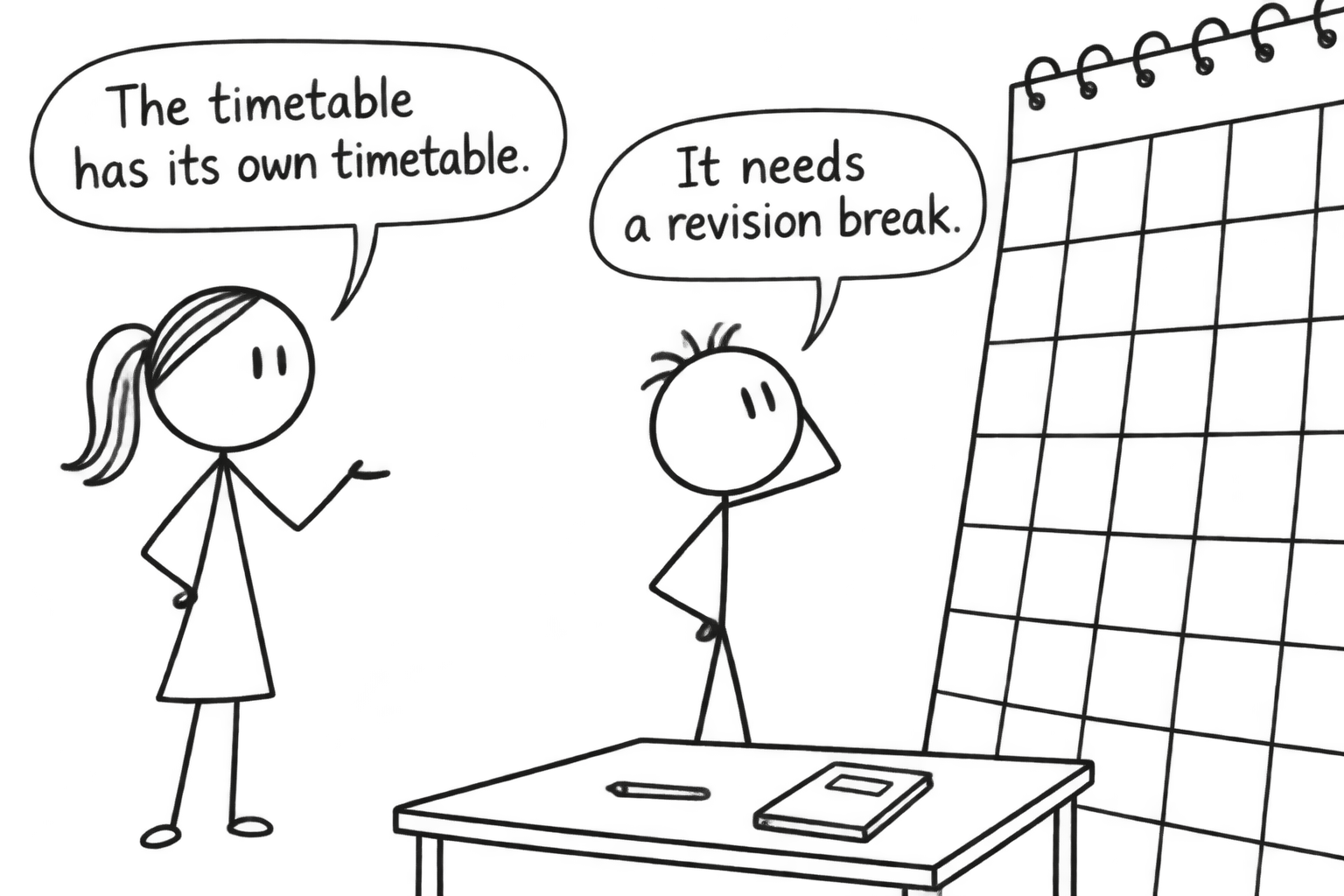 A student discovers that an enormous revision timetable needs its own revision break
Mistake: planning every available minute
A timetable can look efficient precisely because it is unrealistic. Filling every evening assumes there will be no late bus, difficult homework, family commitment, headache or unexpectedly tiring school day.
Treat time as a limited budget. If a student has ten possible hours outside lessons and commitments, scheduling all ten leaves no margin for ordinary life. Planning about seven or eight creates room to move an unfinished task without collapsing the week.
This does not mean revision should be vague. It means the plan needs:
- defined start and finish times;
- proper breaks;
- at least one lighter session;
- one catch-up space each week;
- protected sleep and normal commitments.
On crowded school days, a focused short session may be more sustainable than an ambitious evening. The 20-minute maths revision routine shows how a small block can still have a clear purpose.
Mistake: writing subjects instead of tasks
“Revise maths” is not a useful instruction. It creates a decision at the exact moment the student is supposed to begin. Should they watch a lesson, answer questions or attempt a paper?
Replace broad subject labels with actions that can be completed and checked:
| Vague timetable entry | Actionable timetable entry |
|---|---|
| Revise maths | Complete simultaneous equations practice questions and mark them |
| Do biology | Retrieve the stages of mitosis, then correct gaps from notes |
| English revision | Plan one response to a named past-paper question |
| Past papers | Complete one timed section and record errors |
A productive session has three parts: the topic, the activity and the expected output. “Quadratic graphs, practise six questions, then correct every error” gives the student somewhere to start and a clear definition of finished.
Mistake: giving every topic equal time
Equal does not always mean sensible. A familiar topic can feel pleasant because success comes quickly, while a weaker topic feels slow and uncomfortable. Left unchecked, a timetable fills with the work a student already knows how to do.
Use a simple traffic-light review:
- Red: cannot answer standard questions without help.
- Amber: understands the method but makes errors or needs prompts.
- Green: can answer independently and explain the method.
Schedule red topics first, amber topics regularly and green topics occasionally for maintenance. GCSE maths students can use the topic resources on the GCSE maths revision page to identify an appropriate lesson or question set rather than revising randomly.
This principle matters at A Level too. Harder content needs enough uninterrupted time for reasoning, but strong topics should not absorb the whole week simply because they are reassuring.
Once those red, amber and green priorities are clear, you can build the day-by-day schedule in the Revision Planner instead of arranging every block by hand.
Mistake: confusing time spent with work learned
Two hours at a desk may contain twenty minutes of real thinking. Reading notes, highlighting and watching explanations can support learning, but they do not reliably show whether knowledge can be recalled or applied independently.
A stronger study technique moves from input to output:
- learn or review a small section;
- close the notes and retrieve the key ideas;
- answer practice questions without support;
- use the mark scheme or solution to diagnose errors;
- return to the topic later.
For maths, most sessions should eventually reach questions. MathsGenie’s revision lessons and video solutions can clarify a method, while practice questions, mini tests, past papers and mark schemes reveal whether the student can actually use it.
Do not record only “454545 minutes completed”. Record what happened: “factorising questions completed; errors with negative signs; review on Friday”. That note makes the next session more intelligent.
Mistake: leaving past papers until the end
Students sometimes treat past papers as a final performance, something to attempt only after every topic feels secure. That moment may never arrive.
Past-paper work can begin earlier in smaller forms. Start with individual questions or short sections, then progress towards complete timed papers as exams approach. This makes papers diagnostic rather than intimidating.
A sensible sequence is:
- Topic questions while learning the method.
- Mixed questions to practise selecting methods.
- Short timed sections to develop pace.
- Full papers under realistic conditions.
- Corrections followed by targeted topic revision.
The value is not merely the mark. It is the list of mistakes generated afterwards. A paper marked but not reviewed is only half finished.
Mistake: building one perfect plan and never reviewing it
A timetable is a forecast, not a promise. Forecasts improve when new information arrives.
Set aside ten minutes at the end of each week. Ask:
- Which sessions were completed?
- Which tasks repeatedly overran?
- What did recent practice expose?
- Which exam is now closest?
- What should be moved, shortened or removed?
Move unfinished priority work into the catch-up block. Do not copy every missed task into the following week, because this creates an expanding backlog. Decide whether each task is still important.
Students with a short runway can adapt the structure in the one-month GCSE maths revision plan. Those taking an additional qualification can also see how the GCSE Further Maths study planner works backwards from exam day.
Mistake: ignoring energy and concentration
Not every hour has the same value. A student may be capable of demanding algebra shortly after arriving home but struggle with it late at night. Another may need food and a genuine break before beginning.
Place difficult, unfamiliar or timed work in stronger concentration periods. Use lower-energy slots for flashcards, correcting previous questions, organising materials or reviewing a short lesson. This is not avoiding hard work. It is matching the work to the conditions in which it is most likely to happen.
Parents can help by asking, “When do you concentrate best?” rather than prescribing every hour. The student still needs responsibility for completing the work, but a jointly understood routine often creates less friction than constant reminders.
Common revision planning mistakes in one week
Imagine the timetable from the opening scene being revised. The student removes two low-priority sessions, changes broad subject labels into exact tasks and adds a Saturday catch-up block. A full maths paper becomes one timed section because the original slot was too short. Sunday evening is reserved for checking progress and planning the next week.
The new timetable looks less impressive. It is also more useful.
Watch particularly for these warning signs:
- copying an online timetable without adapting it;
- scheduling favourite subjects first every day;
- using breaks as rewards that can be cancelled;
- repeatedly moving the same avoided task;
- planning resources instead of using them;
- treating one missed day as failure;
- allowing revision to displace sleep.
Missing one session is a scheduling problem. Abandoning the whole week because of it turns a small disruption into a large one. Resume at the next planned block and use catch-up time only for work that still matters.
Build a timetable you can follow
The goal is not to produce the fullest grid. It is to know what to do next, practise the right material and adjust before lost sessions become lost weeks. The student in our opening scenario did not need more determination; they needed a plan with fewer assumptions and clearer tasks.
You have seen how to make that plan realistic. Now build your schedule in the MathsGenie Revision Planner, using your exam date, available study time and weakest topics to turn good intentions into day-by-day revision.