OCR GCSE maths grade 3 boundary: Marks Explained
OCR GCSE maths grade 3 boundary explained with June 2024 and 2025 marks, Foundation and Higher tier guidance, and practical revision advice for students.
For the OCR GCSE maths grade 3 boundary, Foundation students needed 959595 marks out of 300300300 in June 2025. In June 2024, the boundary was 939393 out of 300300300. These are historical references, not guaranteed targets: OCR sets boundaries separately for each exam series.
Imagine a Year 11 student looking at a marked mock and asking, “How many more marks do I need?” The answer depends on the tier, exam series and total across all three papers. Once those details are clear, a boundary becomes a useful reference for revision.
The quick checklist
Before comparing your marks with an OCR boundary, check:
- Qualification: OCR GCSE Mathematics, specification J560.
- Tier: Foundation or Higher boundaries must match your entry.
- Series: use the exact June or November exams you attempted.
- Total: add all three paper marks, giving a total out of 300300300.
- Purpose: use historical boundaries as guidance, allowing for future changes.
The MathsGenie OCR GCSE Maths revision hub brings together revision resources, past papers and mark schemes to support that comparison.
Which tier offers grade 333?
Foundation tier awards grades 111-555, so grade 333 sits within its normal range.
Higher tier is designed to award grades 444-999, with an allowable grade 333 for students who narrowly miss grade 444. Below that threshold, students receive an ungraded result rather than grades 111 or 222.
Foundation and Higher marks come from different papers, so their numerical totals do not describe equivalent performances.
If grade 333 is your current target, discuss your tier with your teacher. They can consider your recent work, confidence and potential. Do not choose a tier simply because its boundary looks lower: question difficulty matters too.
Past OCR GCSE maths grade 333 boundary examples
OCR’s published June 2024 and June 2025 boundaries give these overall qualification thresholds for J560 Foundation:
| Exam series | Maximum total mark | Minimum mark for grade 333 | Percentage of total, approximately |
|---|---|---|---|
| June 2024 | 300300300 | 939393 | 31%31\%31% |
| June 2025 | 300300300 | 959595 | 31.7%31.7\%31.7% |
These percentages provide context, not a permanent requirement. November resits have their own boundaries, and Higher tier has separate thresholds.
The OCR GCSE Maths grade calculator helps you compare totals with a selected historical series. Check the tier and year before interpreting the result.
Do you need a particular mark on every paper?
No. OCR J560 has three papers at each tier, each worth 100100100 marks. Your qualification grade depends on the combined total out of 300300300.
Stronger performance on one paper can compensate for a weaker paper. You do not need to reach a separate grade 333 threshold on each.
OCR also publishes component boundaries for individual papers. These provide reference points, but the overall qualification boundary determines your final grade.
For our student, the useful question becomes: “What does my total show, and where can I recover marks?”
Why do OCR grade boundaries change?
Papers cannot be made exactly equal in difficulty every series. Questions test the specification through different numbers, contexts and combinations of skills.
OCR sets boundaries after marking, using examiner judgement and statistical evidence to help maintain standards between series. More demanding papers may have lower boundaries; more accessible papers may have higher ones.
A mock grade also needs context. If your school combined papers from different series or used specially written questions, a historical boundary may not fit precisely. Ask your teacher how your grade was calculated.
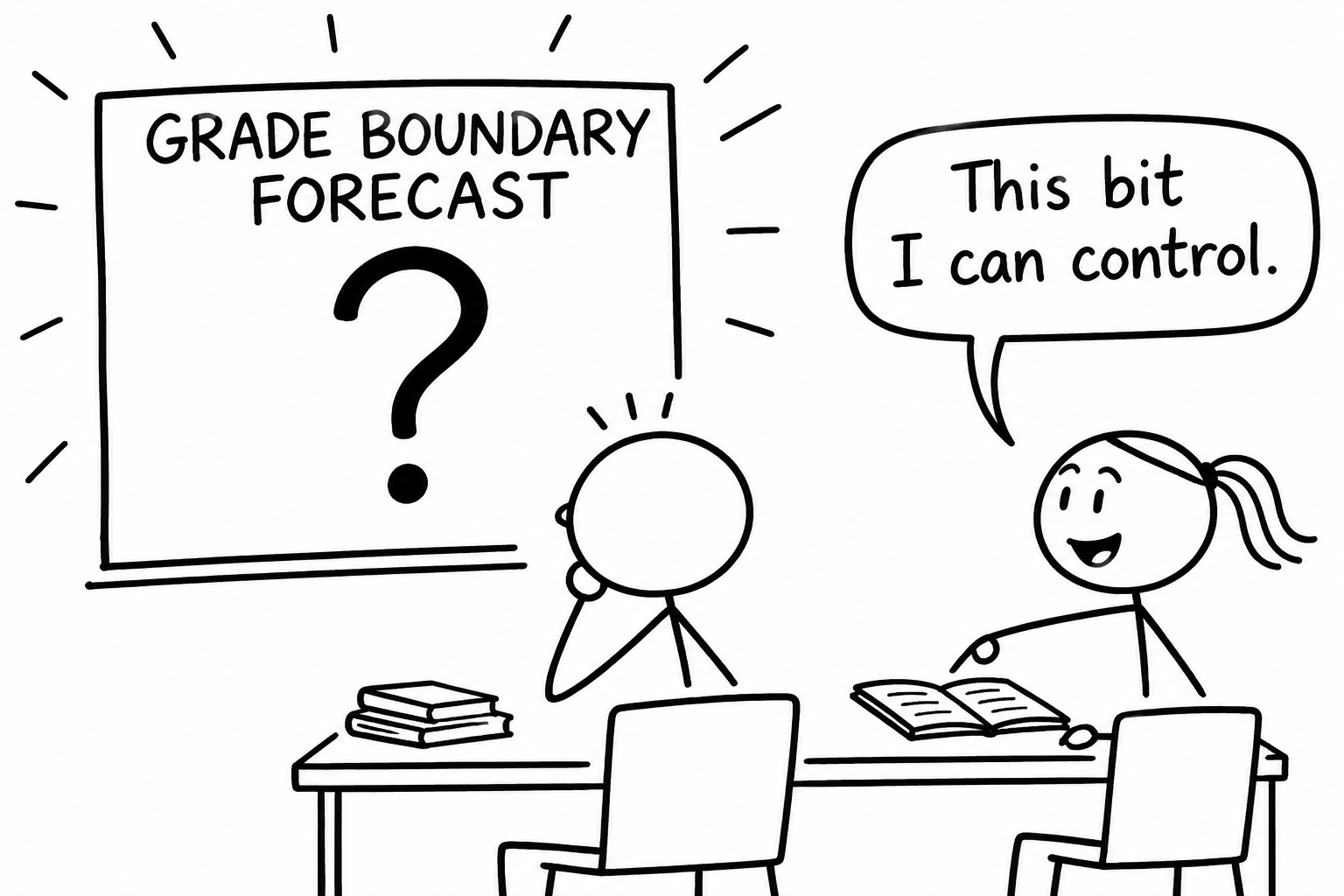 Stick-figure students compare an uncertain grade boundary forecast with the revision they can control.
Turn the boundary into a revision plan
Start with a complete set of papers from one series, attempted under realistic conditions. Use the matching mark schemes, then review incorrect answers and questions left blank.
Keep your first attempt separate from any corrections. A total earned with hints, extra time or a video solution answers a different question from an independent attempt. Both can support learning, but recording the conditions makes comparisons more useful. When you repeat a paper you remember, use it to check methods; use an unfamiliar paper to assess how confidently you can apply those methods.
Sort gaps by cause: an unfamiliar method, arithmetic slip, misread instruction or unfinished working. Each needs a different response. Revisit a lesson for an unfamiliar method; practise checking to reduce arithmetic slips.
Prioritise topics your paper review identifies
Your best priorities are skills that appear across several questions and that you can improve with focused practice. For many Foundation students, starting points include:
- Fractions, decimals and percentages: strengthen conversions using fractions, decimals and percentages revision.
- Percentages of amounts: practise finding the required amount with OCR percentages resources.
- Percentage increases and decreases: identify the starting amount through percentage change revision.
- Basic algebra and measures: revisit substitution, simple equations, units, perimeter and area where your marked work reveals gaps.
After a lesson, attempt questions independently. Return to the skill in a mixed set to practise recognising when to use it.
Keep a short revision record with the topic, the mistake and the action you will take next. Write something specific, such as checking units before calculating an area, rather than simply recording that the question was difficult. In your next session, revisit the question without looking at your correction. This helps distinguish a method you recognise from one you can reproduce independently under exam conditions.
Aim above a historical boundary to allow for errors, awkward questions or boundary changes.
Common mistakes when checking grade boundaries
Using the wrong exam board. OCR, Edexcel and AQA have different assessments and boundaries. Check the qualification first.
Comparing one paper with the overall threshold. One OCR paper is out of 100100100; the qualification total is out of 300300300.
Treating a past boundary as a forecast. June 2025 figures establish no fixed future rule.
Counting only final answers. Follow the mark scheme: some questions award marks for valid intermediate working.
Stopping at the minimum. Continued practice makes your performance more dependable.
Start with the marks you can improve
A boundary tells you what earned grade 333 in a particular series. Your marked papers show what to practise next.
Choose a recurring weakness and open the matching MathsGenie OCR Maths lessons. Learn the method, practise independently and check your working. Then return to a full paper to see what has improved.