

Revision Plan for an A in A-Level Maths
Revision plan for an A in A-Level Maths: prioritise key topics, balance weak and secure areas, and use a practical weekly timetable to target grade A calmly.

Aiming for an A can make revision feel strangely complicated. You are probably not starting from nothing, yet being reasonably good at most topics is not the same as being ready for an A-Level paper. A successful revision plan for an A in A-Level Maths should do three things: protect the marks you can already earn, repair weaknesses that limit several topics, and give you regular experience of unfamiliar multi-step questions.
The central idea is simple. Spend more time on weaknesses, but never abandon secure topics. Then move gradually from topic practice to mixed, timed papers.
Your grade A revision checklist
Before building a timetable, check that your plan includes:
- a diagnostic paper completed under timed conditions
- a list of topics classified as secure, inconsistent or weak
- more time for high-impact weaknesses than isolated gaps
- weekly mixed practice covering pure maths, statistics and mechanics
- careful marking using the official mark scheme
- an error log that records why each mark was lost
- timed past papers as the exams approach
- one lighter session or rest day each week
Start from the A-Level Maths revision hub, where you can select your exam board and find relevant revision materials, questions and papers.
Which topics matter most for an A-Level Maths grade A?
There is no honest list of topics that guarantees an A. Individual topic weightings vary between papers and exam boards, including Edexcel, AQA, OCR and Eduqas. Grade boundaries also change between examination series, so do not build your plan around a guessed mark target from one previous year.
Instead, prioritise topics according to how strongly they connect to the rest of the course.
Algebra, functions and graphs
Algebra is the infrastructure of A-Level Maths. Weak manipulation can cost marks in calculus, trigonometry, coordinate geometry, logarithms and mechanics, even when you understand the main method.
Prioritise indices, surds, quadratics, inequalities, functions, transformations and algebraic fractions. These skills often appear inside longer questions rather than as isolated exercises.
Trigonometry and calculus
Differentiation, integration and trigonometry deserve regular attention because questions can combine several ideas. A student may know how to differentiate but lose marks when the question also requires an identity, a tangent equation or interpretation of a stationary point.
Use topic lessons to rebuild a method, then complete exam-style questions without notes. MathsGenie's integration revision resources and integration practice questions show how this progression can work for Edexcel students.
Exponentials, logarithms and numerical methods
These topics reward accurate algebra and careful calculator use. They also expose small gaps quickly. If rearranging logarithmic equations still feels uncertain, fix that before repeatedly attempting full papers.
Statistics and mechanics
Applied maths should not become the section you plan to rescue at the end. Statistics requires interpretation as well as calculation, while mechanics depends on clear modelling, diagrams, signs and units.
Your weekly plan should include both areas. Rotate through probability, statistical distributions and hypothesis testing, alongside kinematics, forces and moments, according to your specification.
The Edexcel A-Level Maths revision page provides a useful specification-shaped view of pure and applied topics for Edexcel students. If you follow another board, select it through the main A-Level hub.
Split your time between weak and secure areas
A productive starting split is:
- 60%60\%60% of revision time on weak or inconsistent areas
- 40%40\%40% on secure areas, mixed questions and retrieval
This is not a permanent rule. It is a way to prevent two common extremes. Spending all your time on comfortable questions creates confidence without enough improvement. Spending every session on your weakest topic can make secure knowledge fade.
Classify each topic honestly:
| Category | Evidence | Best revision activity |
|---|---|---|
| Secure | You can answer unfamiliar questions accurately without notes | Short retrieval sets and mixed papers |
| Inconsistent | You know the method but make errors or need prompts | Exam questions followed by error analysis |
| Weak | You cannot choose or complete the method independently | Revision lesson, guided practice, then a mini test |
Give extra priority to weaknesses that affect several areas. For example, unreliable algebra is usually more urgent than one narrow statistical definition because algebraic errors can spread across an entire paper.
A weekly A-Level Maths revision template
This template assumes roughly 777-999 hours of independent maths revision per week. Adjust it around lessons, other subjects and your exam date. Consistency matters more than constructing an impressive timetable that cannot survive a busy week.
| Day | Session | Main purpose |
|---|---|---|
| Monday | 606060 minutes | Relearn one weak pure topic and complete short practice |
| Tuesday | 606060 minutes | Statistics or mechanics exam questions |
| Wednesday | 757575 minutes | Inconsistent topic followed by a closed-book mini test |
| Thursday | 454545 minutes | Secure-topic retrieval and error-log corrections |
| Friday | Rest or 303030 minutes | Formula recall and calculator fluency |
| Saturday | 120120120 minutes | Mixed questions or one timed paper section |
| Sunday | 909090 minutes | Mark work, classify errors and plan the next week |
If setting this up feels like another revision task, build the structure in the Revision Planner rather than repeatedly redrawing it on paper.
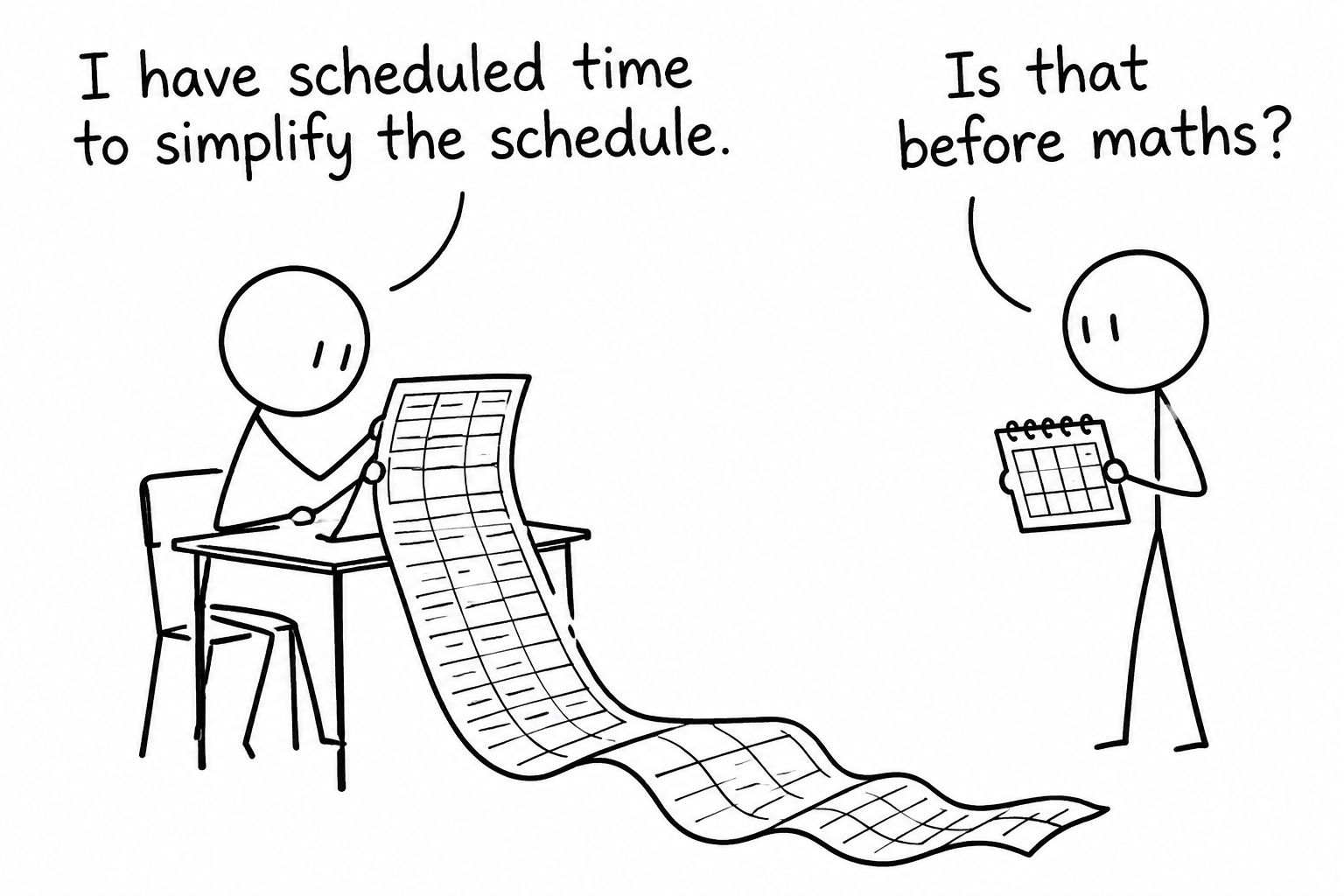 Stick figures compare an enormous revision timetable with a simple weekly calendar
Move from learning to exam performance
A revision plan should change as your knowledge improves. Use three overlapping phases.
Repair the foundations
Begin with revision lessons, worked video solutions and focused practice questions. Keep this phase active until you can identify the required method without looking at an example.
Build mixed-topic control
Once individual techniques are reliable, combine them. Complete mixed mini tests and exam-style sets because real papers rarely announce the exact skill being assessed. The challenge is often recognising that a question involves a particular identity, model or theorem.
Practise timed papers
Complete past papers under realistic conditions, then mark them more slowly than you sat them. Record whether each lost mark came from:
- missing knowledge
- choosing the wrong method
- algebra or arithmetic
- calculator use
- incomplete reasoning
- poor time management
Past papers become valuable when they change what you do next. Return to the relevant lesson or question set, correct the mistake without copying, and test the same skill again several days later. The A-Level Maths resit revision plan also explains how diagnostic evidence can shape a longer rebuilding programme, while the revision timetable guide offers broader planning principles that remain useful beyond GCSE.
Common mistakes when targeting an A
Revising only the hardest questions
An A is not built solely from the final question on each paper. Routine and medium-demand marks matter. Practise completing them accurately and efficiently so that you have time for demanding problems.
Counting hours instead of completed work
A two-hour session can produce little if most of it is spent rereading notes. Define each session by an output, such as one question set, one mini test or one marked paper section.
Treating the mark scheme as a score sheet
Mark schemes reveal required reasoning. Check where method marks are awarded, whether conclusions need context and how exact values should be presented. Then rewrite incomplete solutions properly.
Ignoring repeated small errors
A lost sign may look insignificant, but repeated sign errors are a pattern. Your error log should group mistakes by cause so that you can practise the underlying weakness.
Doing full papers too early
Past papers diagnose performance, but they are inefficient teaching tools when several topics are still unfamiliar. Use MathsGenie's revision lessons and practice questions first, then move into papers, mark schemes and video solutions.
Turn the template into your own schedule
Knowing what to revise is different from deciding what to do each day. Your exam dates are fixed, and every unplanned week reduces the time available to repair weak topics while protecting secure marks. You have seen how the weekly structure works; now turn it into a schedule based on your own gaps and available time.
Build your day-by-day A-Level Maths schedule in the Revision Planner.















