

A-Level Maths Resit: Your Results Day Plan
A-level maths resit plan for after Results Day: diagnose gaps, set milestones, practise papers and use mark schemes to prepare for the next exam series.

Results Day compresses two years of work into one letter. If that letter closes a door you expected to walk through, disappointment is natural. But an A-level maths resit is not simply another attempt at the same journey. It is an opportunity to prepare differently: diagnose what cost you marks, rebuild weak knowledge and practise complete papers until exam decisions feel familiar.
In England, A Level exams are generally available in the summer series, so resitting usually means taking the qualification the following May or June. Current A Levels are linear, which means you normally retake all required papers in the same series rather than keeping individual paper results. Confirm the arrangements with your school, college or approved exam centre.
Your immediate resit checklist
Before beginning months of revision, settle the practical questions:
- Ask your school or college whether it can enter you for the resit.
- Confirm your exam board and specification: Edexcel, AQA, OCR or Eduqas.
- Check entry dates, examination fees and centre arrangements directly with the centre.
- Ask for access to your scripts if available.
- Discuss a review of marking promptly if there is evidence of an error. Your mark can rise, remain unchanged or fall.
- Check whether your preferred university or course accepts resit grades.
- Record your marks by paper and topic before creating a timetable.
If you are reading this while preparing for GCSE maths, remember the distinction: GCSE English and maths have a November resit opportunity for eligible students, but A Level maths normally returns in the following summer series.
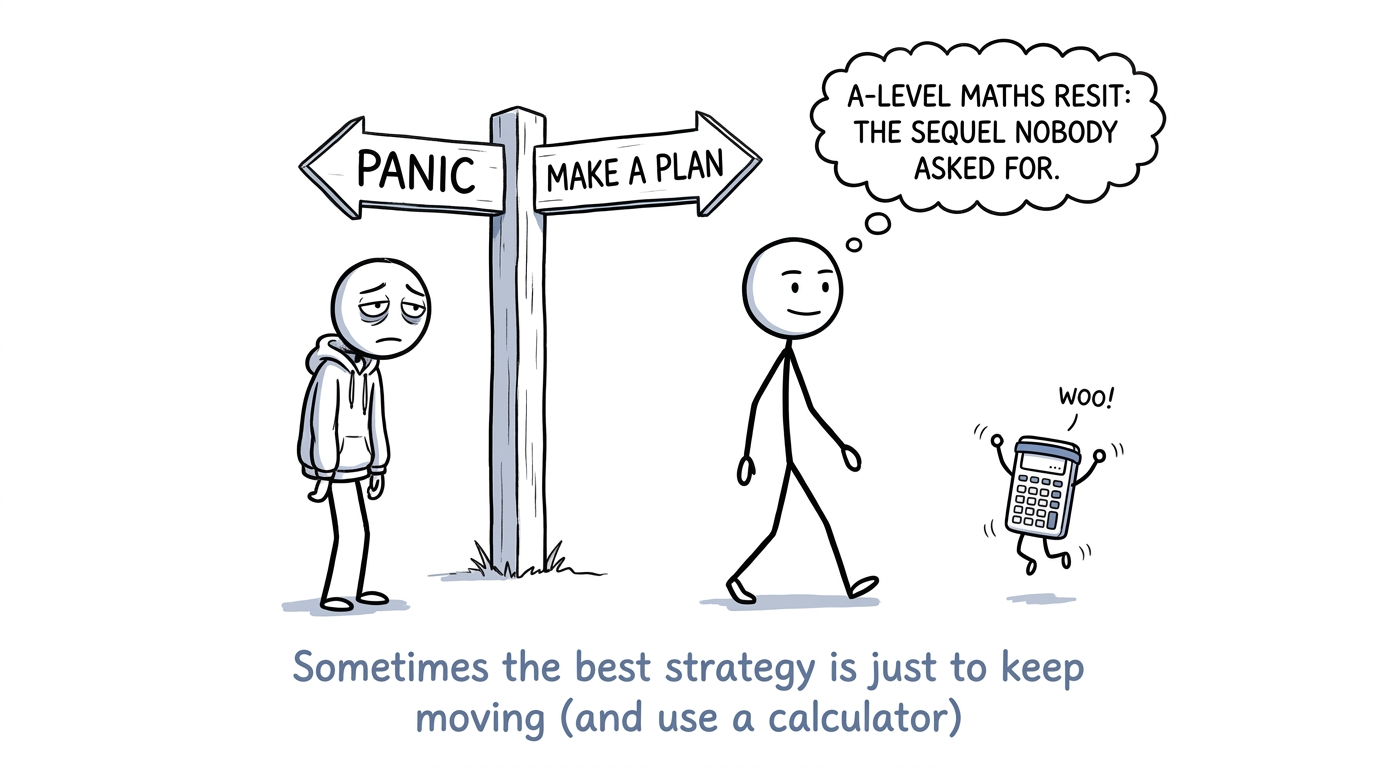 A student choosing a calm resit plan instead of panic after Results Day
Build your A-level maths retake revision plan
A useful resit plan has milestones rather than vague promises. “Revise calculus” is difficult to act on. “Complete a differentiation lesson, answer a focused question set and correct every error” tells you exactly what to do.
Start by opening the A Level Maths revision hub and selecting the correct exam board. AQA, Edexcel and OCR cover broadly shared pure, statistics and mechanics content, but their paper structures and question styles differ. Your own specification remains the rulebook.
Results Day to the end of August: diagnose
Do not immediately repeat every topic from the beginning. First establish why the original result happened.
Sort mistakes from your scripts or previously completed papers into four groups:
- Knowledge: you did not know the required fact or method.
- Execution: you knew the method but made an algebraic, arithmetic or calculator error.
- Interpretation: you misunderstood the wording, model or context.
- Timing: you could have answered but did not reach or finish the question.
This distinction matters. Watching another video will not fix poor timing, while completing more timed papers will not repair a missing understanding of integration.
September to December: rebuild the course
Divide the specification into pure mathematics, statistics and mechanics. Give more time to high-frequency weaknesses, but continue mixing in stronger topics so they remain secure.
Use a repeatable weekly cycle:
- learn or revisit one idea through a revision lesson;
- complete topic-specific practice questions without notes;
- mark the work and identify the first incorrect line;
- redo missed questions after a short delay;
- finish the week with a mixed mini test.
The Edexcel A Level Maths question bank, AQA A Level Maths revision resources and OCR A Level Maths question bank provide board-specific routes through lessons, questions, worksheets and revision tools.
January to March: connect topics
Real papers rarely announce the exact method required. A question may combine trigonometry with differentiation, or mechanics with vectors and algebra. Begin completing mixed sets and keep an error log with three short entries: the topic, the reason marks were lost and the action needed.
Return to each error later without looking at the solution. A corrected answer seen once can feel familiar without becoming retrievable. Resitting A-level maths successfully depends on being able to choose a method independently.
 A student training with past papers while an enormous textbook gathers dust
April to the exams: rehearse complete papers
Move towards full papers under realistic conditions. Use the permitted calculator, formula booklet and time limit for your specification. Keep your phone away and stop when time expires.
Choose papers from the Edexcel A Level Maths past papers, AQA A Level Maths past papers or OCR A Level Maths past papers. Mark each attempt carefully, using mark schemes and worked solutions where available.
Do not treat the total mark as the end of the exercise. The paper is a diagnostic tool. Identify which method marks were available, repair the relevant topics and attempt the missed questions again. Nearer the examination, A Level predicted papers can add fresh exam-style practice, but they should complement rather than replace official past papers.
Make revision sustainable
A resit year can become emotionally heavy because every session appears connected to the previous result. Reduce that pressure by measuring actions you control: sessions completed, errors corrected and papers reviewed.
Four focused sessions across a week are usually more useful than one exhausting weekend marathon. Protect time for work, other qualifications and rest. If a timetable repeatedly fails, shrink it until it becomes realistic rather than abandoning it entirely.
Common mistakes when resitting A-level maths
Repeating the previous revision method
If passive note-reading produced limited progress before, more note-reading is unlikely to transform the outcome. Shift towards retrieval, practice questions and marked exam work.
Using the wrong board or specification
The mathematical content overlaps, but paper organisation and assessment details vary. Match every resource to the entry confirmed by your exam centre.
Saving papers until the final month
Past papers teach timing, interpretation and method selection. Introduce paper sections early, then preserve several complete papers for final rehearsal.
Recording marks without analysing them
A score tells you where you are. An error log tells you what to do next. Always turn lost marks into a specific revision action.
Ignoring administration
Revision cannot compensate for a missed entry deadline. Confirm the centre, fees, specification and examination series early, and keep written records of the arrangements.
Turn the result into a better system
An A-level maths resit begins with an unwanted result, but it does not have to remain defined by it. The productive question is not “How do I work harder?” It is “What must I change?”
Start today with the MathsGenie A Level Maths revision hub. Choose your exam board, diagnose one weak topic and complete a focused question set. Then build towards mini tests, predicted papers and full past papers, using mark schemes and video solutions to understand exactly where marks are earned. A calm system, repeated for long enough, gives the next Results Day a different foundation.











