

Revision Order GCSE Economics: Does It Matter?
Revision order GCSE economics guide: learn when subject order matters, how to prioritise weak areas and build a spaced timetable that supports maths.
The timetable looks sensible until you sit down. Economics is pencilled in after maths, but your attention is already fading. Should you swap them? Should the hardest subject always come first? Or is the whole question a distraction?
The short answer is that revision order for GCSE Economics matters, but not because Economics must occupy one fixed position. It matters when order affects your concentration, how often you revisit material and whether weaker areas receive enough attention. A flexible sequence based on evidence is better than always revising subjects alphabetically, by preference or in the same daily order.
The goal is not to discover a perfect timetable. It is to make sure Economics appears regularly, at useful times, alongside active practice in maths and your other GCSE subjects.
A quick revision order checklist
Use these principles before changing your timetable:
- Put a demanding or weak subject in a high-energy slot.
- Revisit Economics across several days rather than completing it in one block.
- Alternate recall, quantitative skills, data interpretation and extended responses.
- Move the next examination closer to the front of the queue.
- Use test results and mark schemes to decide what comes next.
- Keep short maths practice in the week because its skills support Economics.
- Change the order when the evidence changes.
MathsGenie's free revision planner can help you give each subject a clear place without turning every evening into an unrealistic list.
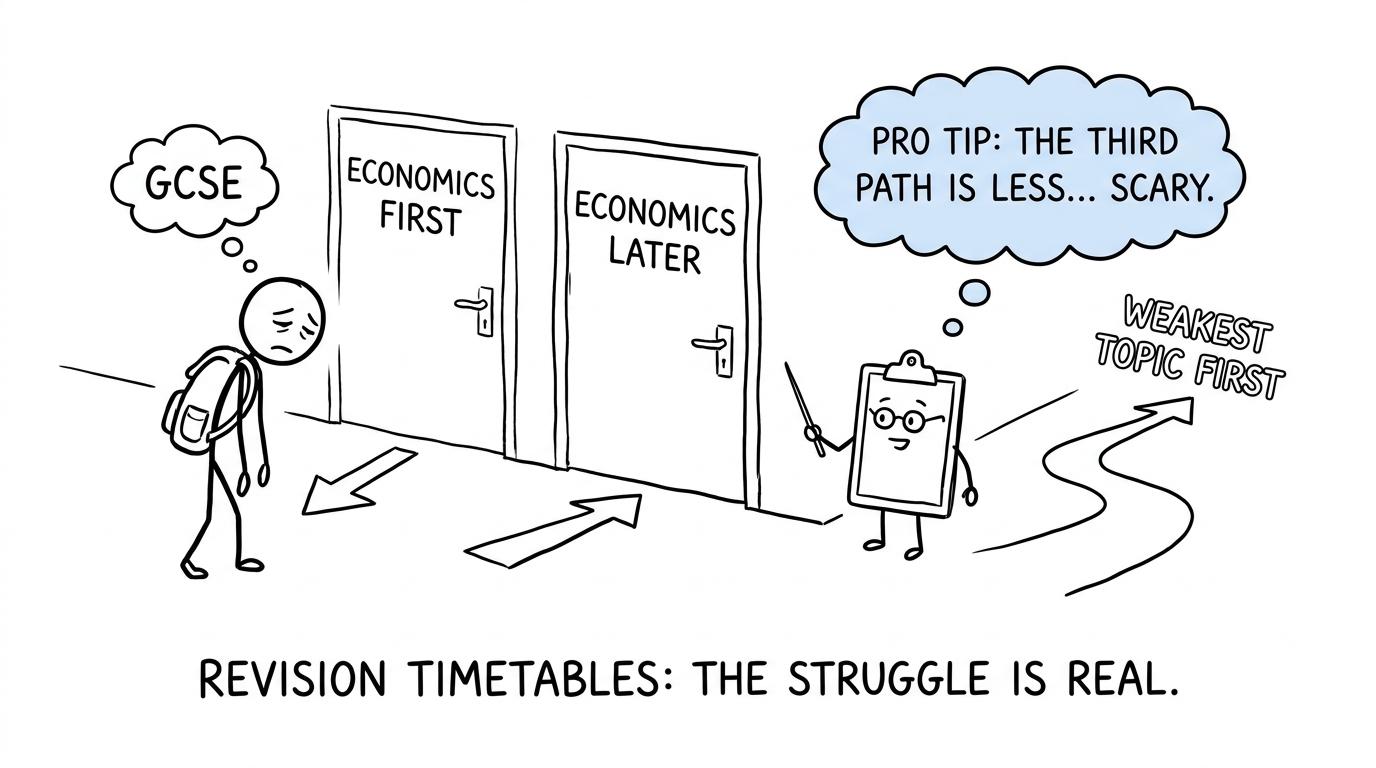 A student choosing between Economics first, Economics later and weakest topic first
When revision order for GCSE Economics matters
Order matters most when it changes the quality of the work you can produce. An hour labelled “Economics” has little value if it becomes passive rereading while your difficult topics remain untouched.
Your attention changes during the day
Most students have periods when they can think more clearly and periods when only lighter work feels manageable. The exact time varies, so the advice is not simply “revise Economics first”. Instead, match the task to your available attention.
Use a strong concentration period for activities such as:
- analysing unfamiliar economic data;
- planning evaluative answers;
- interpreting supply and demand diagrams;
- correcting a difficult paper;
- learning a topic you have repeatedly avoided.
A lower-energy slot can still be useful for flashcards, definitions or reviewing an error log. MathsGenie's AQA GCSE Economics flashcards for quantitative skills are suited to brief retrieval sessions, but flashcards should not replace full exam-question practice.
One subject may unlock another
Maths and Economics overlap in practical ways. Official GCSE Economics subject requirements include percentages, percentage change, averages, revenue, costs, profit, income, graphs and the interpretation of data. At least 10%10\%10% of the total marks must reward quantitative skills at no lower than Key Stage 333 demand.
That makes the order of nearby sessions useful. Revising percentages or graphs in maths before applying them in Economics can reduce the amount of mental juggling required. The relevant relationships include:
percentage change=new value−original valueoriginal value×100%\text{percentage change}=\frac{\text{new value}-\text{original value}}{\text{original value}}\times 100\%percentage change=original valuenew value−original value×100% profit=total revenue−total cost\text{profit}=\text{total revenue}-\text{total cost}profit=total revenue−total cost average cost=total costoutput\text{average cost}=\frac{\text{total cost}}{\text{output}}average cost=outputtotal costThese are not isolated calculations. In Economics, you may also need to interpret the result, connect it to the context and use it within an argument. MathsGenie's quantitative skills in Economics revision guide brings those calculation and interpretation skills together.
Exam dates change the sensible priority
A timetable should become more responsive as examinations approach. If Economics is tomorrow and maths is next week, Economics usually deserves the first substantial session. Maths should not disappear, but it may become a shorter maintenance task.
After the Economics examination, the order changes again. A revision plan is a decision tool, not a promise made to your past self.
When subject order is mostly irrelevant
There is no reliable rule saying Economics must always come before maths, science or English. If you complete focused, active sessions and revisit the material over time, the difference between “Economics then maths” and “maths then Economics” may be small.
The larger risks are usually:
- leaving Economics untouched for a week;
- repeatedly choosing favourite subjects first;
- spending whole sessions copying notes;
- failing to mark completed questions;
- allocating equal time despite unequal weaknesses.
In other words, frequency and quality usually matter more than a rigid sequence. A student who revises Economics second but does it carefully will gain more than one who puts it first and reads without retrieval.
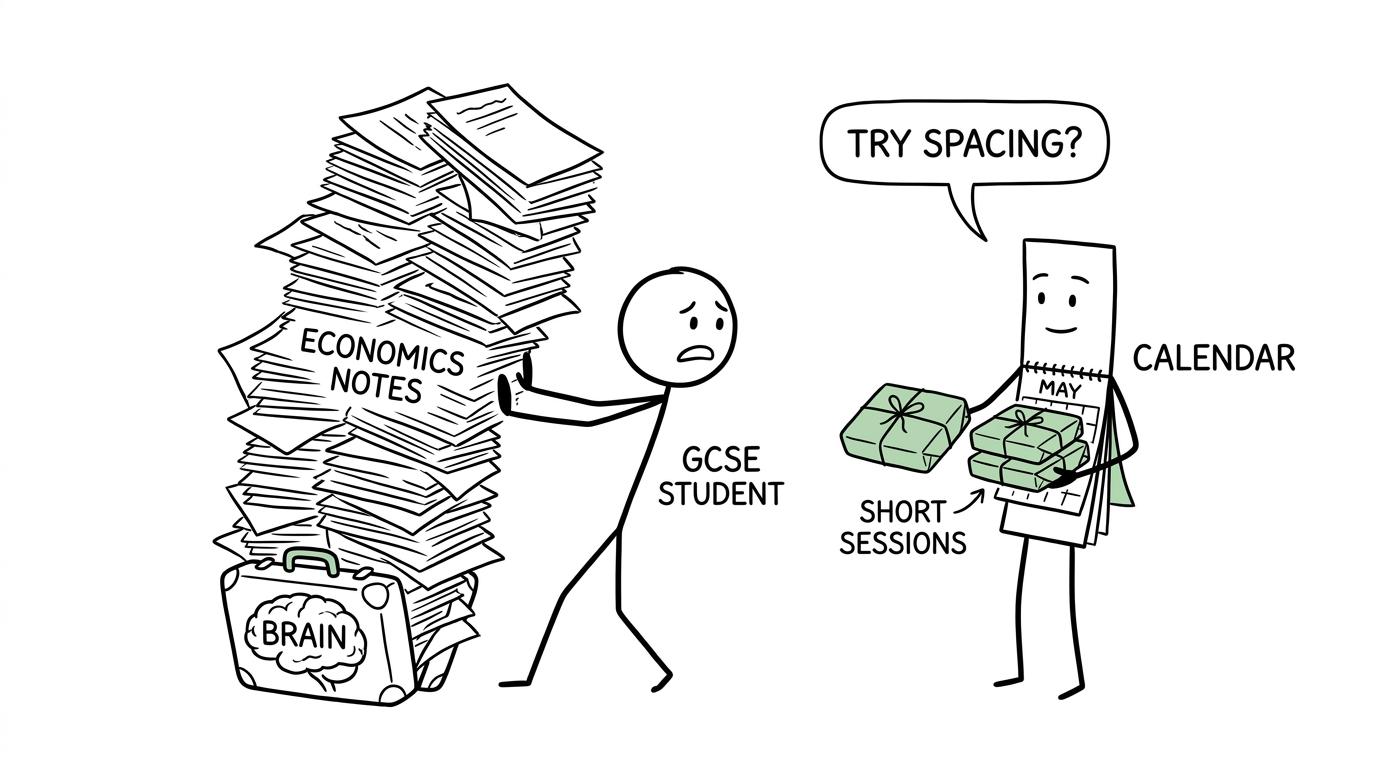 A student trying to cram notes into a tiny suitcase while a calendar offers short sessions
The best order inside an Economics revision session
Subject order is only one layer. The sequence within the session often matters more because it determines whether you merely recognise content or can actually retrieve and apply it.
A strong session can follow this order:
Begin with retrieval
Without opening your notes, write down definitions, causes, consequences or diagram labels from an earlier topic. This exposes what you can recall independently. Research on learning consistently supports retrieval practice and spacing over relying only on repeated reading.
Keep this brief. Its purpose is diagnosis, not producing perfect notes.
Repair one specific gap
Use the retrieval result or a previous mark scheme to select one weakness. “Macroeconomics” is too broad. “How interest rate changes may affect consumption and investment” is a usable target.
Students following AQA can organise this work through the AQA GCSE Economics revision hub, which groups lessons, questions and past-paper resources around the course.
Apply the knowledge
Move quickly from reviewing content to answering questions. Economics examinations assess more than recall. Ofqual's assessment objectives allocate approximately 35%35\%35% to knowledge and understanding, 35%35\%35% to application and 30%30\%30% to analysis and evaluation.
Your revision order should therefore move beyond definitions. Practise applying ideas to a context, following a chain of reasoning, interpreting evidence and reaching a supported judgement.
Mark, correct and schedule a return
Use the mark scheme to identify whether a lost mark came from knowledge, application, analysis, evaluation, calculation or exam technique. Write a short correction and schedule the topic again after a gap.
This final step creates the next revision order. Instead of asking what you feel like revising tomorrow, you already have evidence.
How to combine Economics and maths revision
For students preparing for GCSE Maths as well as Economics, the subjects can support each other without becoming interchangeable. Economics does not have foundation and higher tiers in the way GCSE Maths does, so check the precise AQA or OCR Economics specification used by your school. For maths, continue using resources for your own exam board and tier.
A useful rotation is:
- Session A: maths percentages, averages or graphs;
- Session B: Economics questions that apply quantitative information;
- Session C: Economics explanation and evaluation;
- Session D: mixed maths mini test or paper section;
- Session E: spaced retrieval from the earlier Economics topics.
This is interleaving at a manageable level. You are not changing subjects every few minutes. You are giving related skills repeated encounters in different contexts.
If your mathematical foundations need attention, the GCSE Statistics revision area supports data-handling skills, while the guide to the best order for learning GCSE Maths topics explains how number, percentages and graphs fit into a wider learning sequence.
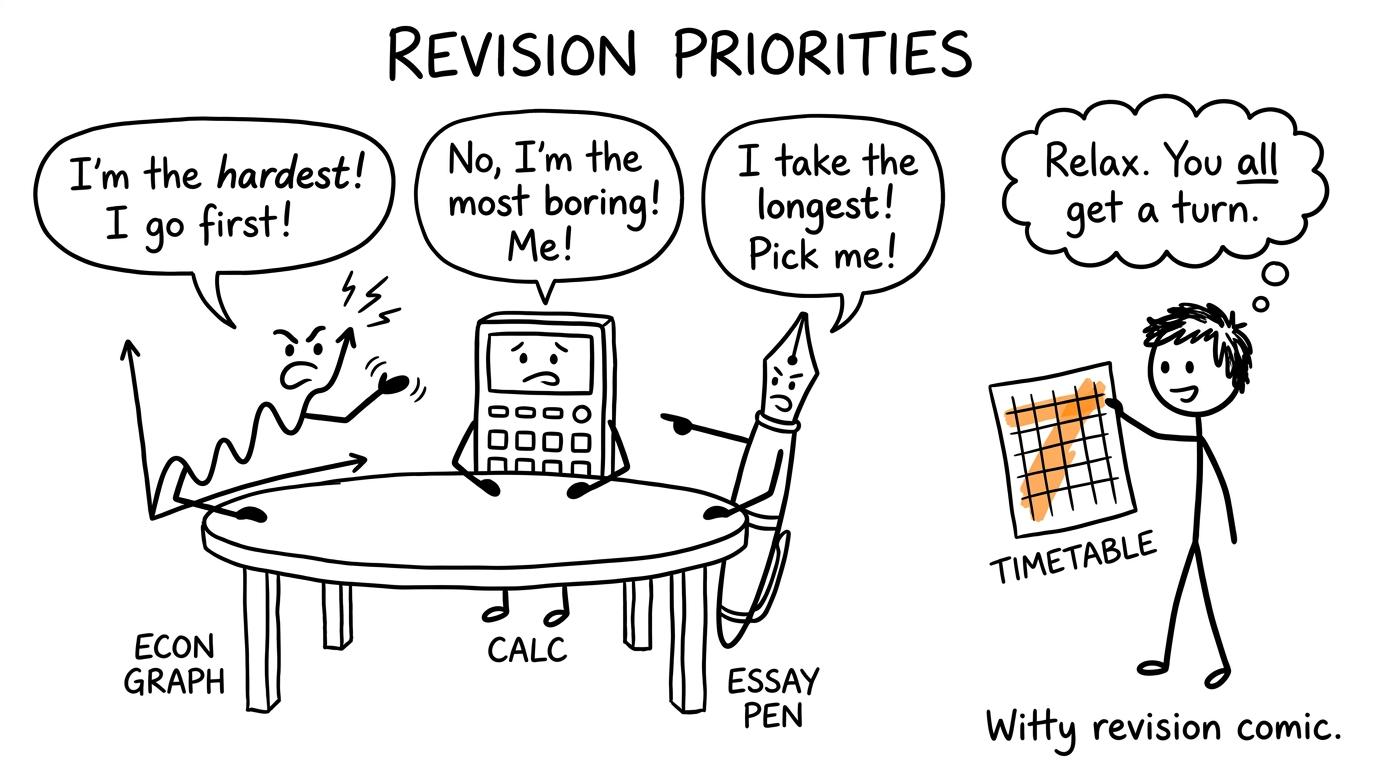 A graph, calculator and essay pen negotiating their places in a revision timetable
A flexible weekly approach
Early in revision, prioritise coverage and diagnosis. Place Economics somewhere in the week more than once, even if one appearance is only a short retrieval session. Spacing gives you opportunities to forget a little and then reconstruct the knowledge, which is more demanding than immediate repetition but better suited to durable recall.
As examinations approach, increase question practice and timed work. A sensible progression is:
- short topic questions;
- mixed questions from different parts of the specification;
- timed paper sections;
- complete papers under realistic conditions;
- targeted repair followed by another test.
The same principle works for maths. MathsGenie's past-paper platform places papers alongside official mark schemes and selected worked or video solutions. Predicted papers can add fresh practice nearer the examination, but they should supplement specification coverage and official past papers rather than encourage topic guessing.
For a broader structure, use the GCSE Maths revision timetable guide to balance topic learning, practice and paper review across the week.
Common revision-order mistakes
Always starting with your favourite subject
Starting is easier when the work feels comfortable, but the preferred subject can quietly consume the best part of the evening. Use a short warm-up if necessary, then move to the priority identified by tests and mark schemes.
Always putting the hardest subject first
This sounds disciplined, but it can make every revision day feel punishing. Some days the nearest examination or a quick retrieval task should come first. Difficulty is one factor, not the only factor.
Blocking Economics into one weekly marathon
One long session can create familiarity without reliable recall. Divide the time into shorter encounters across the week and vary the activity.
Treating note-making as the final task
Notes may clarify a topic, but they do not show whether you can answer an unfamiliar question. End with retrieval, exam questions or a concise answer plan.
Separating calculations from economic reasoning
A correct figure may be only part of the response. Practise stating what the result means, who may be affected and how it supports or limits an economic judgement.
Refusing to alter the timetable
A plan that survives despite new evidence is not organised; it is merely rigid. Move a subject forward when a mini test exposes a weakness, and reduce its share when performance becomes secure.
Make the order serve the outcome
The best revision order for GCSE Economics is not a universal list of subjects. It is a changing sequence shaped by concentration, exam dates, weaknesses and the need to revisit knowledge. Put demanding work where your attention is strongest, connect maths skills to economic applications and let marked questions decide what returns next.
MathsGenie gives you the free tools to make that process concrete: Economics revision guides and flashcards, maths revision lessons, practice questions, mini tests, past papers, predicted papers, mark schemes and video solutions. Open the revision planner, choose one genuine weakness and schedule both the first attempt and the return. A useful timetable does not simply tell you where to begin; it makes improvement visible.










