

Revising Maths Mocks Alongside Other Subjects
Revising maths mocks alongside other subjects? Build a balanced November plan, target weak topics and use each mock as a useful diagnostic.
November can make revision feel like an argument between subjects. Maths wants practice. English wants quotations. Science wants equations and required practicals. Each teacher has a sensible reason why their subject deserves attention, but the student still has only one evening.
The practical answer to revising maths mocks alongside other subjects is not to divide every hour equally. Give each subject regular attention, then adjust the balance according to exam dates, confidence and evidence from practice. For maths, short sessions of targeted questions are usually more useful than occasionally spending an entire evening rereading notes.
Most importantly, a mock is a diagnostic, not a verdict. It shows what you can do under today’s conditions and which skills need attention next. It does not decide your final GCSE grade.
A balanced mock revision checklist
Use this as a starting point through November and December:
- List every mock date and exam paper.
- Identify two or three priorities for each subject.
- Schedule short, focused maths sessions several times a week.
- Practise questions rather than only reading methods.
- Mark your work and record why marks were lost.
- Keep one flexible session for unfinished work or unexpected problems.
- Protect sleep, meals and genuine breaks.
- Use each mock result to plan the next round of revision.
The GCSE Maths revision hub is a useful starting point because you can choose your exam board and find relevant questions, worksheets and papers rather than revising from an unfiltered list.
November: turn the timetable into decisions
Imagine a Year 11 student opening the mock timetable in early November. There are ten or more exams, some crowded into the same week. The instinctive response is often to create a beautiful colour-coded plan in which every available minute is occupied.
It looks organised. It is also fragile.
A workable plan leaves space. Start by adding fixed commitments, mock dates and school deadlines. Then assign revision blocks of around 252525-454545 minutes, depending on your concentration and the task. A maths block should have a precise purpose, such as practising simultaneous equations or completing part of a non-calculator paper. “Revise maths” is too vague to guide a tired mind.
Use three labels when deciding what belongs in the week:
- Urgent: the exam is close or the topic is seriously insecure.
- Important: the topic regularly costs marks but is not the next exam.
- Maintain: knowledge is secure but needs occasional retrieval.
This prevents the nearest exam from consuming every evening while other subjects quietly disappear. Parents can help by discussing the plan once a week, rather than checking every session. The aim is to make priorities visible, not to turn revision into surveillance.
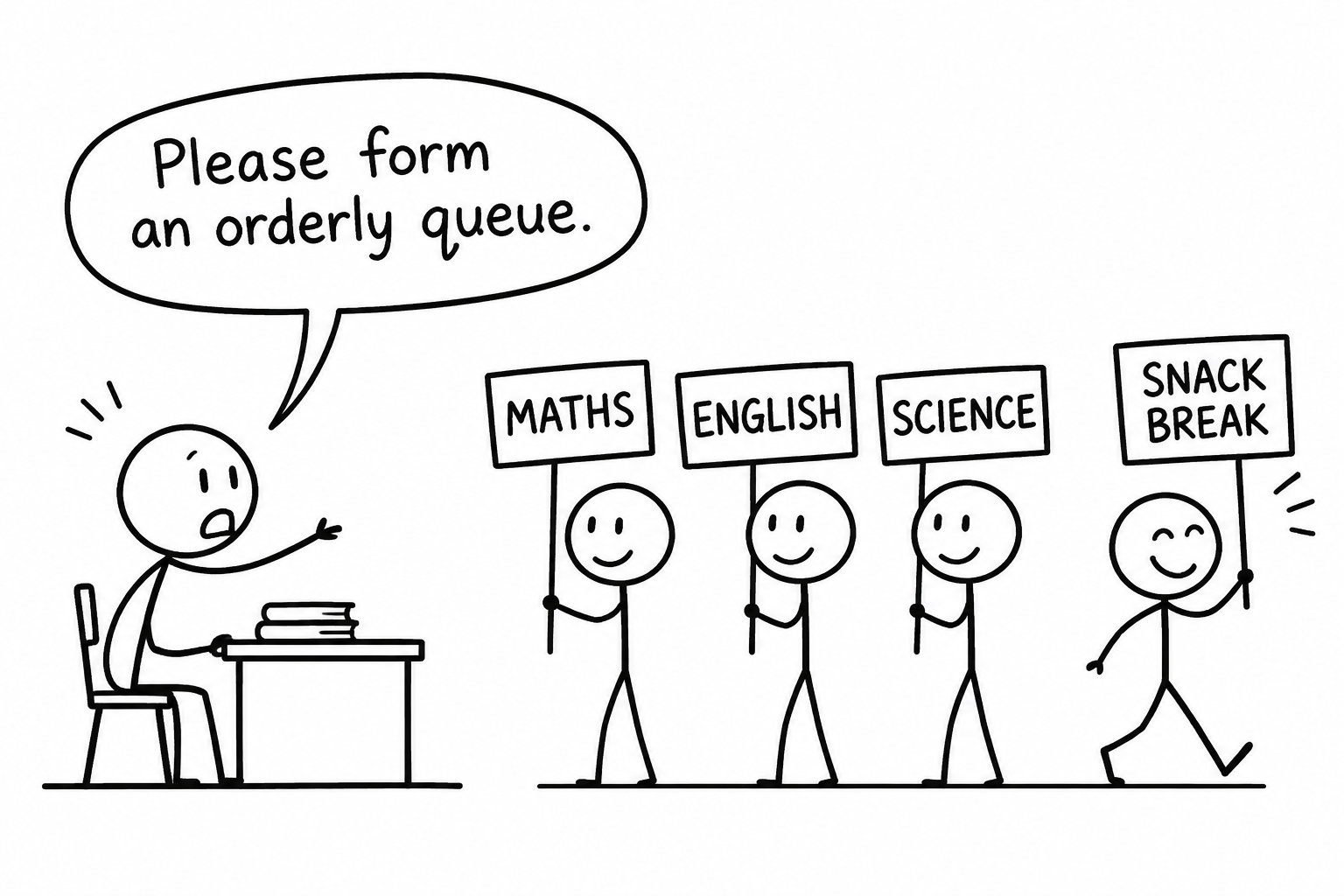 A student asks Maths, English and Science to queue, while Snack Break walks to the front
Give maths a regular rhythm
Maths benefits from repeated contact because understanding a method and retrieving it independently are different experiences. Instead of one three-hour maths session, consider three or four shorter sessions across the week.
A balanced week might include:
| Session | Focus |
|---|---|
| Monday | Target one weak topic and check the method |
| Wednesday | Complete mixed exam questions without notes |
| Friday | Mark the work and correct errors |
| Weekend | Attempt a timed paper section or targeted mock |
This is not a compulsory timetable. During a week containing an English mock, English may receive more time. Before a calculator paper, maths may receive more. Balance should be measured across several days, not forced into every evening.
If a topic is unfamiliar, begin with a revision lesson or video solution. Then close the explanation and answer questions independently. Use the mark scheme afterwards, not while solving the question. MathsGenie’s AQA GCSE Maths resources illustrate how revision can be organised by exam board and tier, while the main revision hub also covers Edexcel, OCR and Eduqas.
Make GCSE maths mocks diagnostic
A completed paper contains more information than its total mark. Two students can receive the same result for quite different reasons. One may have gaps in algebra; the other may know the content but lose marks through timing and incomplete working.
After marking practice, classify each lost mark:
- Knowledge gap: you did not know the fact or method.
- Application gap: you knew the method but did not recognise when to use it.
- Accuracy error: arithmetic, signs or copying caused the problem.
- Exam technique: working was unclear, units were missing or time ran out.
This turns an uncomfortable result into a useful plan. If most errors come from one topic, return to the relevant lesson and practice questions. If the issue is timing, practise a paper section under controlled conditions. If careless errors dominate, slow down at key stages and build in a final check.
The guide to efficient GCSE maths revision can help students connect topic practice, papers and marking into one routine. When foundations are the main issue, the recommended order for learning GCSE maths topics offers a clearer route than jumping randomly between difficult questions.
December: respond rather than judge
When mock results arrive in December, the number on the front can feel final. It is not. A mock reflects the specification content covered so far, the paper chosen by the school, preparation, timing and performance on that particular day.
The useful question is not, “What does this say about me?” It is, “What should I do differently next?”
Choose a small number of actions. For example:
- revisit two weak topics;
- practise one non-calculator skill each week;
- show complete working more consistently;
- complete a timed section every fortnight;
- ask a teacher about a method you still cannot explain.
Keep the list short enough to use. A ten-page error log can become another task to avoid. A single page containing the topic, type of error and next action is often more practical.
Mock exam tips when every subject matters
Match the task to your energy
Use higher-energy periods for unfamiliar maths problems, extended writing and difficult science topics. Save lower-energy periods for marking, flashcards, formula retrieval or organising corrections. This is not an excuse to avoid hard work. It is a way to place hard work where it has the best chance of succeeding.
Revise at the level of the actual gap
Do not complete a full paper every time one topic needs work. A full paper is valuable for timing, stamina and mixed retrieval, but targeted questions are better when the diagnosis is specific. The GCSE Mock Exam Builder lets you build a mock from past-paper questions, sit it and mark it, so practice can reflect the topics that actually need attention.
Keep foundation and higher tier relevant
Practise material for the tier your school expects you to sit. Foundation and higher papers overlap in some content, but they are not interchangeable. If you are unsure about your tier or exam board, ask your teacher before choosing resources.
Use marking as revision
Mark schemes show what examiners need to see, while video solutions can reveal where your reasoning changed direction. Correcting a question means attempting it again without copying the solution. Recognition can feel like understanding, but independent completion is the stronger test.
Common mistakes during mock season
Trying to revise every topic equally: secure topics need maintenance, while weaker and frequently assessed skills deserve more time.
Dropping maths until the weekend: long gaps make methods harder to retrieve. Short, repeated sessions are easier to sustain.
Completing papers without analysing them: a score records performance; corrections create improvement.
Letting one poor mock reshape the whole story: treat the result as evidence from one moment, then compare it with classwork and later practice.
Building an impossible timetable: if every slot is full, one difficult homework task can break the week. Leave some capacity unused.
Turn the mock into your next step
Through November, the student’s task is to build a rhythm. In December, it is to interpret the evidence calmly. The goal is not to give maths every hour. It is to give maths enough regular, deliberate practice that methods remain available under exam conditions, while other subjects continue moving forward.
Start with MathsGenie’s free revision lessons, practice questions, past papers, mark schemes and video solutions. Then use the Mock Exam Builder to build a targeted practice paper around the topics your mock has exposed. A mock is most valuable when it changes what you do next.















