

Revising GCSE Economics With Music: Does It Help?
Revising GCSE Economics with music may help motivation but hinder reading and recall. Learn when music works, when silence wins, and how to test it.
The first song feels harmless. Then a familiar chorus arrives while you are trying to explain inflation, and suddenly your brain is remembering lyrics rather than evaluating economic policy.
So, is revising GCSE Economics with music a good idea? Sometimes. Quiet, familiar instrumental music may make revision feel more comfortable and help some students begin a session. But music with lyrics, dramatic changes or a high volume is more likely to compete with the reading, writing and recall that Economics requires. Silence is usually the safer choice for demanding tasks and exam practice.
The most useful answer is not simply “music is good” or “music is bad”. It is to match your sound environment to the task, test whether you can recall the material afterwards, and regularly practise in the quiet conditions you are likely to face in the exam.
The quick checklist
Music is more likely to be helpful when:
- it is quiet, familiar and instrumental;
- you are organising notes or completing a routine task;
- it masks unpredictable background noise;
- it helps you settle without becoming the focus;
- you can still recall and apply the material later.
Silence is usually better when:
- you are learning an unfamiliar concept;
- you are reading a dense case study;
- you are planning or writing an extended response;
- you are interpreting unfamiliar data;
- you are completing timed past-paper questions;
- you keep singing along, changing tracks or checking your phone.
That distinction matters because GCSE Economics is not one single activity. Defining a term, analysing a graph and evaluating a policy place different demands on attention.
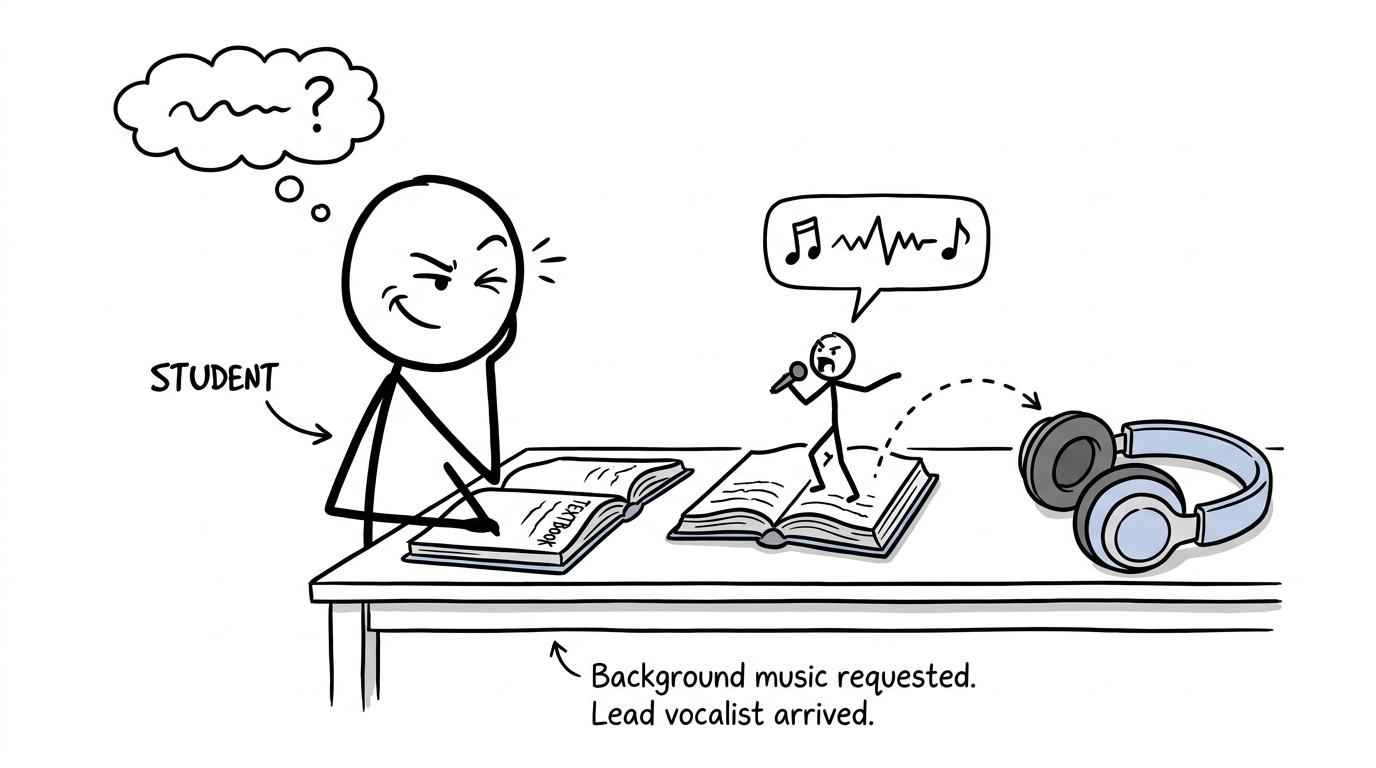 A student discovers that background music has brought its own lead vocalist
What research suggests about music and concentration
Research into background music does not produce one rule that applies to every student and every task. Results vary with the type of music, the difficulty of the work, the learner and what researchers measure.
One finding is reasonably consistent: sound containing intelligible speech can interfere with language-based work. GCSE Economics involves reading, retrieving definitions, following chains of reasoning and constructing precise written arguments. Song lyrics use some of the same limited mental resources.
This does not mean that every lyric instantly destroys concentration. It means that, when the task becomes demanding, lyrics create an extra source of information for the brain to process. A song can feel enjoyable while still making recall or comprehension less accurate.
Instrumental music removes the competition from words, but it is not automatically neutral. Fast, loud or unpredictable music can still capture attention. A calm track that you barely notice is different from a cinematic soundtrack that changes mood every thirty seconds.
There is also an important difference between feeling focused and learning effectively. Music may improve mood or make a revision session easier to start. Those are genuine benefits. Yet enjoyment is not proof that knowledge will be available tomorrow or under exam pressure. The result that matters is what you can retrieve without the notes and soundtrack.
Why GCSE Economics is especially sensitive to distraction
Economics asks you to move between several forms of thinking. You may need to recall a definition, read a source, identify a trend, carry out a calculation and then explain how one change leads to another.
Quantitative skills can include working with percentages, interpreting tables and graphs, and understanding economic measures. For example, percentage change is represented by:
Percentage change=new value−original valueoriginal value×100\text{Percentage change} = \frac{\text{new value} - \text{original value}}{\text{original value}} \times 100Percentage change=original valuenew value−original value×100Price elasticity of demand may be expressed as:
PED=percentage change in quantity demandedpercentage change in price\text{PED} = \frac{\text{percentage change in quantity demanded}}{\text{percentage change in price}}PED=percentage change in pricepercentage change in quantity demandedThese formulas are not difficult because they contain many symbols. They become difficult when attention slips and a student uses the new value instead of the original value, misses a negative sign or interprets the result incorrectly.
The underlying maths is worth strengthening separately. MathsGenie’s free GCSE maths revision lessons bring together videos and practice questions by grade, making it easier to revisit percentages, proportion, averages and graphs. Secure techniques leave more mental capacity for the economic interpretation surrounding a calculation.
The same principle applies to extended responses. Evaluation is not a stream of remembered phrases. You must select relevant evidence, build a logical chain and reach a supported judgement. Music with lyrics can be particularly unhelpful here because your internal wording is competing with someone else’s.
Match the soundtrack to the revision task
Learning new content
Use silence first. New content requires you to decide what matters, connect it to prior knowledge and notice what you do not understand. If your room is noisy, low-volume instrumental audio or neutral background sound may be less distracting than unpredictable conversations.
After reading a section, close the book and retrieve the key definition, diagram or chain of reasoning. If you cannot do that, replaying the playlist is unlikely to fix the problem. Return to the content and test yourself again.
Reviewing familiar material
Quiet music is less risky when you are reviewing material you already understand. This might include sorting flashcards, checking a topic list or redrawing familiar diagrams from memory.
Keep the activity active. Looking at neat notes while listening to music can create familiarity without reliable recall. Write down what you know before checking, then correct omissions in a different colour.
Calculations and data interpretation
Try silence when the question contains several stages or unfamiliar information. A routine calculation may tolerate background music, but interpreting what an answer means in context requires more attention.
If percentages or graphs are slowing you down, use the topic resources within MathsGenie GCSE revision, followed by questions completed without notes. Economics and maths specifications are separate, so always follow your Economics teacher’s guidance and current exam-board specification for the precise quantitative content required.
Extended writing
For analysis and evaluation questions, silence is usually the best starting point. Read the command word carefully, plan the logical chain and then write. Background lyrics can influence wording or interrupt the thread of an argument without you noticing.
You can use music during a short break after finishing the response. That turns the song into a boundary between focused blocks rather than an extra demand inside them.
Past papers and timed practice
Complete serious timed practice in silence. Exam conditions vary by centre and access arrangement, but personal music is not part of normal GCSE written-exam conditions. Revision should therefore include practice without it.
Maths students can build this habit with GCSE maths past papers, using the relevant paper and mark scheme to identify errors. Closer to the exam, MathsGenie predicted papers provide further exam-style practice. Predicted papers are revision resources, not forecasts of exact questions, so they should supplement rather than replace official past papers and full specification coverage.
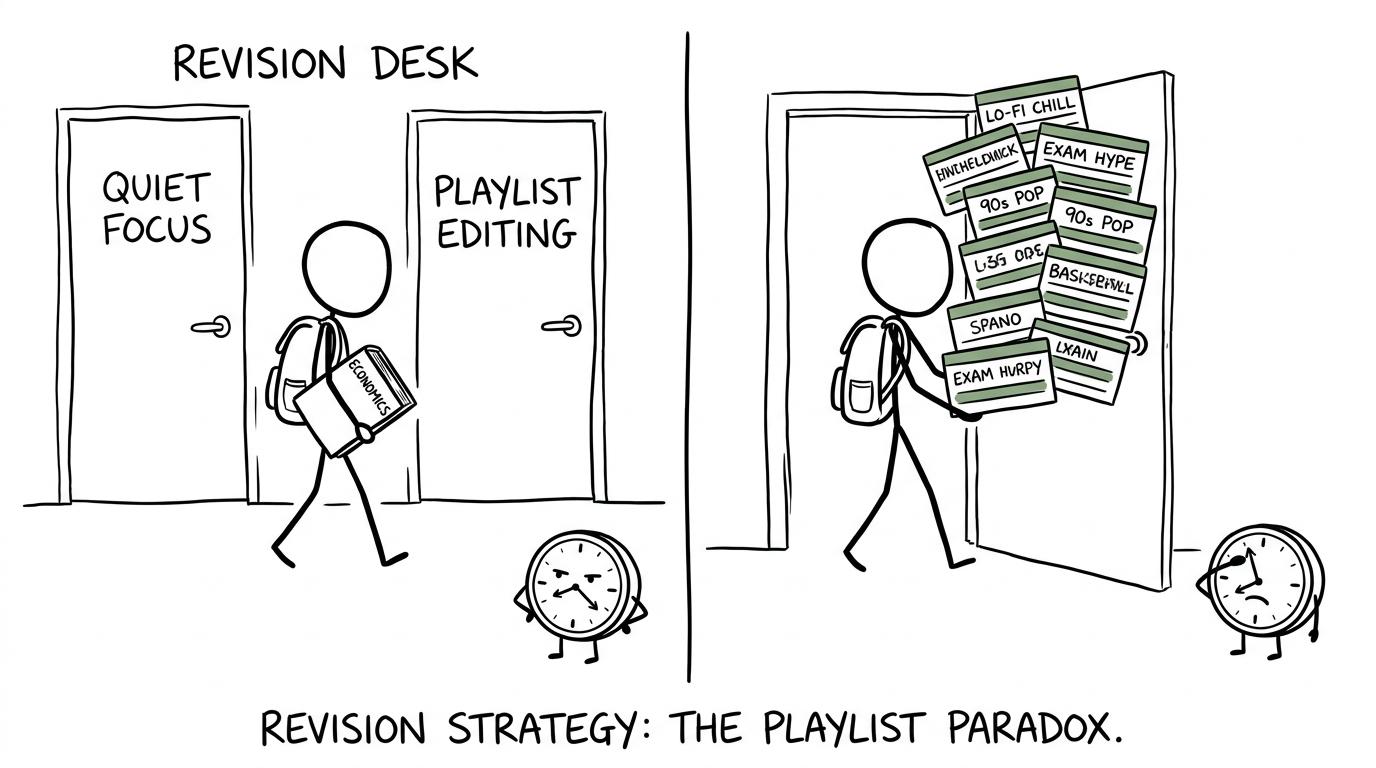 A revision session quietly turns into an elaborate playlist-management project
How to test whether music actually helps you
Personal preference matters, but it should be tested rather than assumed. Run a simple comparison over several sessions:
- Choose two similar Economics topics or question sets.
- Revise one in silence and one with your usual background music.
- Keep the time, task difficulty and access to notes as similar as possible.
- Test yourself immediately after each session.
- Test the same material again the following day.
- Compare accuracy, explanations, omissions and time taken.
Do not judge only by how pleasant the session felt. Ask whether you could define terms precisely, reconstruct a chain of reasoning, interpret the data and remember the content later.
One session is not enough to establish a pattern. Sleep, topic knowledge and question difficulty can alter the result. Repeat the comparison, then choose the environment that produces stronger work most consistently.
If music helps you begin but harms demanding work, use a compromise: one track while setting up, silence for a focused block, then music during the break. The aim is not to prove that you are a “music person” or a “silence person”. It is to design a routine that works.
Build a revision routine that survives the exam
The best soundtrack cannot rescue passive revision. A stronger session has a clear task and a visible finish line. For example, decide that you will retrieve the causes of inflation, answer a set of questions and check your response against the mark scheme.
MathsGenie applies the same structure to maths revision. Start with a targeted lesson, complete the accompanying practice questions, and use video solutions or mark schemes to understand errors. MathsGenie’s free revision resources make it possible to move from explanation to independent practice without turning resource-hunting into another distraction.
Use a revision planner to spread topics over time rather than leaving everything for one long session. Short, repeated retrieval is more useful than repeatedly rereading the same page. Mini tests can reveal whether a topic is secure, while full papers develop timing and stamina.
Students continuing beyond GCSE can use the same habits with MathsGenie A Level revision. The content becomes more demanding, but the principle stays simple: reduce avoidable distractions when your working memory is carrying the heaviest load.
Common mistakes when revising with music
Choosing songs because they are motivating
A song can increase energy while decreasing attention. If you know every lyric, it is more likely to pull you away from reading and writing. Save favourite songs for breaks, travel or routine organisation.
Spending revision time building the perfect playlist
Playlist editing can feel productive because it is connected to revision. It is still avoidance if no Economics is being retrieved or applied. Prepare one short instrumental playlist in advance and stop adjusting it.
Letting a phone become the music player
Every track change creates an opportunity to check a notification. Use do-not-disturb mode, put the device out of reach and decide on the audio before the session begins.
Assuming longer revision means better revision
Two hours at a desk does not guarantee two hours of learning. Measure completed questions, accurate recall and corrected mistakes instead of time alone.
Never practising in silence
If every revision session depends on headphones, the exam room can feel unusually bare. Include regular silent sessions, especially when using GCSE past papers and mark schemes.
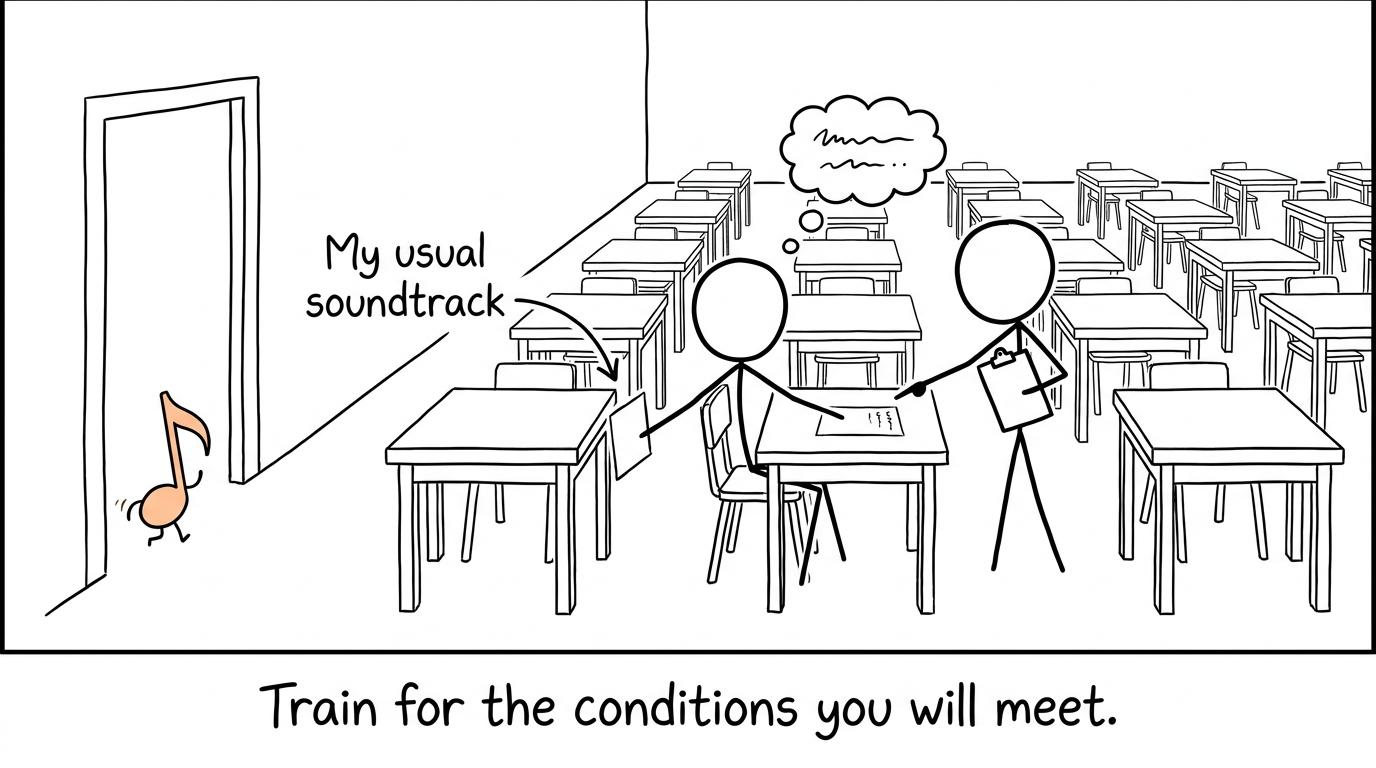 A student realises that the usual revision soundtrack will not be sitting beside them in the exam
The best choice is the one your results support
Revising GCSE Economics with music is not automatically helpful or harmful. Quiet instrumental music may improve comfort and make it easier to begin, particularly when it masks a distracting environment. Lyrics, high volume and frequent track changes are more likely to interfere with reading, recall and extended writing.
Use silence for new ideas, demanding calculations, case studies, evaluation and timed papers. If you use music for familiar or routine tasks, keep it quiet and test what you remember afterwards. Most importantly, practise regularly under realistic exam conditions.
Then make the work itself count. Use MathsGenie’s GCSE revision lessons and practice questions, past papers with mark schemes, predicted papers, video solutions, mini tests and revision planning tools to turn focused time into stronger exam skills. Choose a topic, remove the distractions and begin with one question.










