Revising for GCSE Resit at College: A Busy-Week Plan
Revising for GCSE resit at college: build a realistic short-session timetable for Maths and English around lessons, work shifts and everyday life calmly.
Revising for GCSE resit at college can feel like trying to add another day to the week. Your course has deadlines, your employer publishes a new rota, and the subjects you hoped to leave behind are asking for your attention again.
The answer is not to find huge empty evenings. It is to use short, specific sessions consistently. Build a weekly plan around your fixed commitments, practise one skill at a time, and use longer sessions only when they genuinely fit. For GCSE Maths and English Language, four or five focused sessions can achieve far more than an ambitious timetable you abandon after Monday.
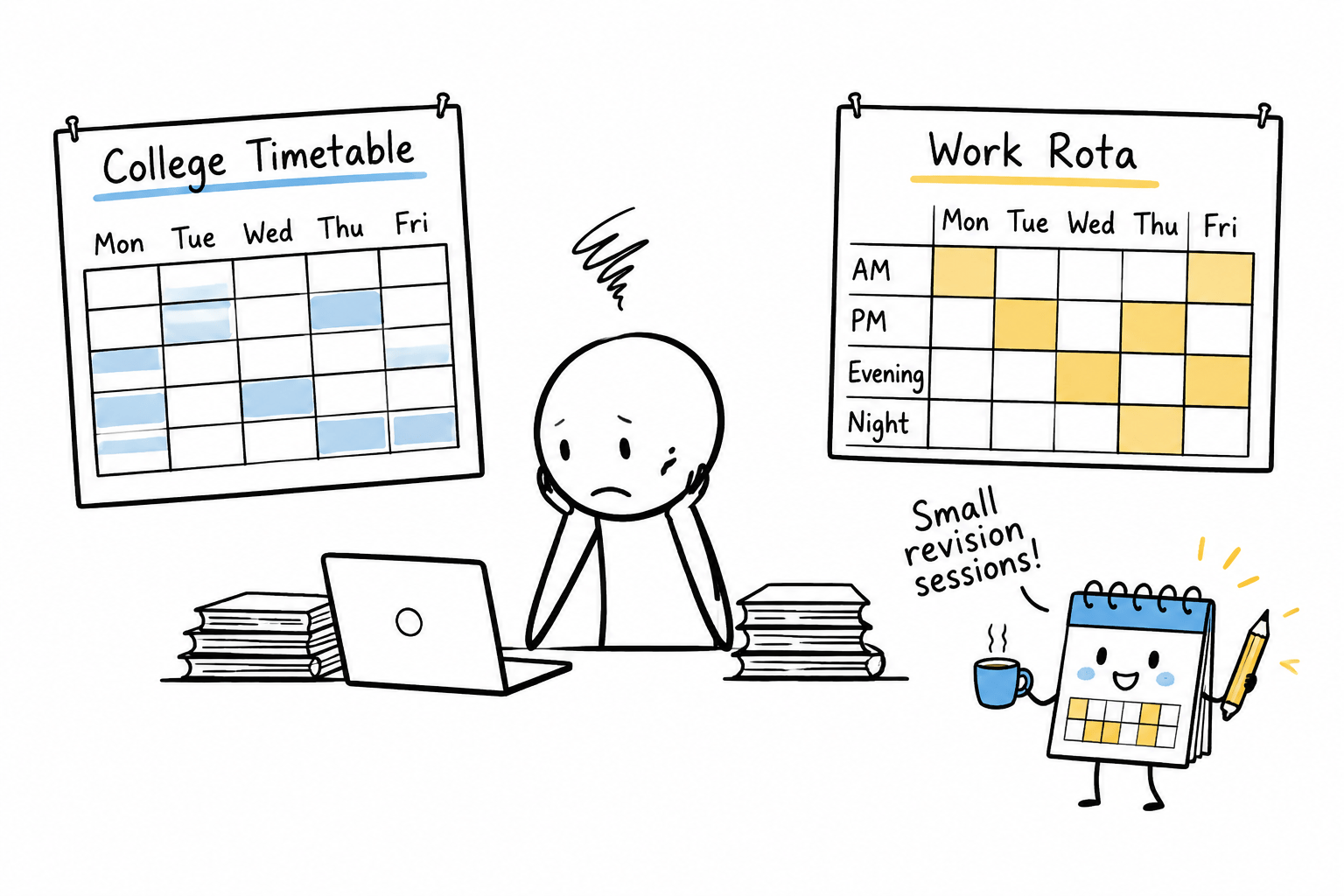 A busy student negotiates with a college timetable, work rota and cheerful revision calendar
Your resit revision checklist
Before filling every spare hour, establish a simple system:
- Confirm your exam board, papers and exam dates with your college or examination centre.
- Protect your college resit lessons rather than treating them as optional revision.
- Identify two or three weaknesses in each subject.
- Schedule short sessions beside habits that already happen.
- Use active practice, not repeated reading or video watching alone.
- Mark your work and record errors after every session.
- Complete timed sections before moving to full papers.
- Review the plan each Sunday when you know your next work rota.
Your college can also explain your entry arrangements and any support available. Rules depend on your age, previous grades, programme and location, so ask rather than relying on another student's situation.
Build the timetable around your real week
A resit study timetable should begin with reality. Add college lessons, travel, work, meals and sleep first. Revision belongs in the remaining spaces, not in imaginary hours when you are usually travelling home or exhausted after a shift.
Look for repeatable windows. A free period on Tuesday, twenty minutes before work or part of Sunday morning may be more dependable than a vague promise to revise later. Give every window a subject and task:
- "Maths" is too broad.
- "Complete ratio questions and mark them" is actionable.
- "English" encourages delay.
- "Plan one language analysis response, then improve one paragraph" creates a finish line.
Keep one flexible slot each week. If work changes or a college deadline appears, move a missed session there. This prevents one disruption becoming a reason to discard the whole plan.
Sample weekly plan for a full-time college student
This schedule suits someone attending college during the week. The exact tasks should follow your exam board and current weaknesses.
| Day | Short-session plan |
|---|---|
| Monday | 25 minutes of Maths practice after college, followed by 10 minutes marking |
| Tuesday | 30 minutes of English Language reading analysis during a free period |
| Wednesday | Attend the scheduled resit lesson and spend 15 minutes reviewing corrections later |
| Thursday | 25 minutes of Maths on one weak topic, then record errors |
| Friday | Rest or use as a flexible catch-up slot |
| Saturday | 45 minutes of English planning and timed writing |
| Sunday | 45 minutes of mixed Maths questions, followed by a 10-minute weekly review |
That is a manageable week, not a perfect one. It contains repeated contact with both subjects and enough marking to reveal whether the work is helping.
For Maths, start at the GCSE Maths revision hub and select your exam board. Topic lessons and practice questions are useful for the shorter weekday blocks. Maths mini tests can then show whether a skill survives without prompts.
Sample weekly plan if you revise while working
When shifts change, plan in two layers. Set a minimum routine that survives a busy week, then add optional sessions after receiving your rota.
| Day | Short-session plan |
|---|---|
| Monday | 20 minutes of Maths questions before or after work |
| Tuesday | 20 minutes improving one English Language paragraph |
| Wednesday | Rest or attend a college resit class |
| Thursday | 25 minutes of Maths retrieval and corrections |
| Friday | Flexible catch-up session |
| Saturday | 30 minutes of English questions before a shift, or after breakfast on a day off |
| Sunday | 45-60 minutes of timed practice, alternating subjects each week |
If you revise while working, define a minimum version of each task. On a difficult day, complete three Maths questions or plan one English response. The session may be small, but it preserves the routine. On better days, continue.
A practical approach is to keep materials ready on your phone or in one folder. Choosing a resource should not consume half the available session. MathsGenie's free GCSE resources provide one place for lessons, questions, tests and papers, reducing the effort needed to begin.
Make short Maths sessions active
Short revision works when most of the time is spent answering questions. Use this structure:
- First 3 minutes: Recall a method or formula without notes.
- Next 15-20 minutes: Answer focused questions.
- Final 5-10 minutes: Mark the work and rewrite incorrect steps.
If a topic is unfamiliar, use a revision lesson or video solution first, but pause and attempt each step yourself. Watching a correct method can feel comfortable while hiding the fact that you cannot yet reproduce it.
Once individual topics improve, introduce mixed questions. Then attempt timed sections and complete papers. The Edexcel GCSE Maths past papers include mark schemes and worked solutions where available. If you use AQA, OCR, Eduqas, WJEC or CCEA, choose the correct board through the main Maths hub rather than practising a mismatched specification.
Near the examination, GCSE predicted papers can provide additional practice. They should supplement specification coverage and past papers, not replace them.
Make English Language revision measurable
English Language can seem harder to divide into short sessions because a full paper takes time. Do not wait for a free afternoon. Separate the process into smaller skills:
- Read an extract and identify evidence.
- Annotate how language or structure creates an effect.
- Plan a response without writing it fully.
- Write one analytical paragraph under time pressure.
- Create an opening or ending for a transactional or creative task.
- Edit a previous answer for clarity, accuracy and organisation.
Use the GCSE English Language revision hub to select your exam board and practise the correct question formats. Students following AQA can use the AQA English Language revision resources and move towards AQA English Language past papers.
English practice needs feedback. Compare your answer with the mark scheme, note what the question assesses, and ask your college teacher to review selected work. One carefully improved response is more valuable than several rushed answers left unmarked.
Use an error log instead of restarting revision
A disappointing test can tempt you to return to the beginning of the course. Usually, that wastes time. Keep a brief error log with four details:
- the topic or question type;
- what went wrong;
- the correct method or improvement;
- when you will try a similar question again.
For Maths, distinguish between a knowledge gap, a calculation error and a misunderstood question. For English Language, record whether you missed evidence, analysed vaguely, managed time poorly or made frequent technical errors.
Review the log once a week. It becomes a personal revision planner built from evidence rather than anxiety.
Common mistakes when balancing a resit with college or work
Planning long sessions every evening
A timetable requiring constant energy is fragile. Schedule a realistic minimum and treat additional revision as a bonus.
Revising only the comfortable topics
Familiar work feels productive because answers arrive quickly. Use marked questions and teacher feedback to select weaknesses instead.
Watching without practising
Videos and notes explain ideas, but examinations require you to produce an answer independently. Follow every explanation with questions.
Completing work without marking it
Unmarked practice cannot tell you what to change. Use mark schemes, video solutions and teacher feedback, then correct errors while the attempt is still fresh.
Ignoring the exact exam board
GCSE Maths content overlaps considerably across boards, but paper structures and resources differ. English Language question formats differ too. Confirm the specification and use matching materials.
Sacrificing sleep to catch up
Late-night revision after college or work often produces poor concentration. Move the task to the flexible slot, reduce it to the minimum version or continue the following day.
Build a routine that can survive ordinary life
A resit is not proof that you are incapable. It is another attempt made under different circumstances, often while carrying more responsibility than before. Progress comes from returning to the work regularly, noticing errors and making the next attempt slightly better.
Start today with one short session. Choose the correct exam board through MathsGenie's free revision platform, complete a focused set of questions and mark it. Then put the next session in your calendar. Revision lessons, practice questions, mini tests, past papers, predicted papers, mark schemes and video solutions are there to give each small block a clear purpose.