

Revising Before Bed GCSE Economics: Help or Harm?
Revising before bed GCSE Economics can support recall if it protects sleep. Learn what to review, when to stop and how to build a calmer nightly routine.
There is a familiar trap during exam season. You intend to revise one final Economics definition, then notice another diagram, another calculation and another chapter that suddenly feels urgent. Before long, revision has borrowed an hour from sleep.
So, does revising before bed GCSE Economics help? A short, calm review can support memory consolidation, particularly when you actively retrieve material and then get sufficient sleep. But late-night cramming that delays or disrupts sleep is more likely to hurt attention, recall and judgement the following day.
The useful distinction is not simply revision or sleep. It is between revision that works with sleep and revision that competes with it.
The short answer
Bedtime Economics revision is most helpful when you:
- keep it to roughly 151515-303030 minutes;
- test your memory rather than rereading everything;
- review familiar material instead of starting a difficult new topic;
- finish with enough time to settle before sleeping;
- protect a consistent sleep schedule;
- return to the material briefly the next day.
It is likely to become harmful when you continue because of panic, use caffeine to stay awake, work in bed for hours or sacrifice the sleep needed to think clearly in tomorrow's lesson or exam.
This principle applies beyond Economics. Students balancing the subject with GCSE maths can use MathsGenie's GCSE maths revision resources to organise daytime practice, leaving the final part of the evening for light recall rather than unfinished problem-solving.
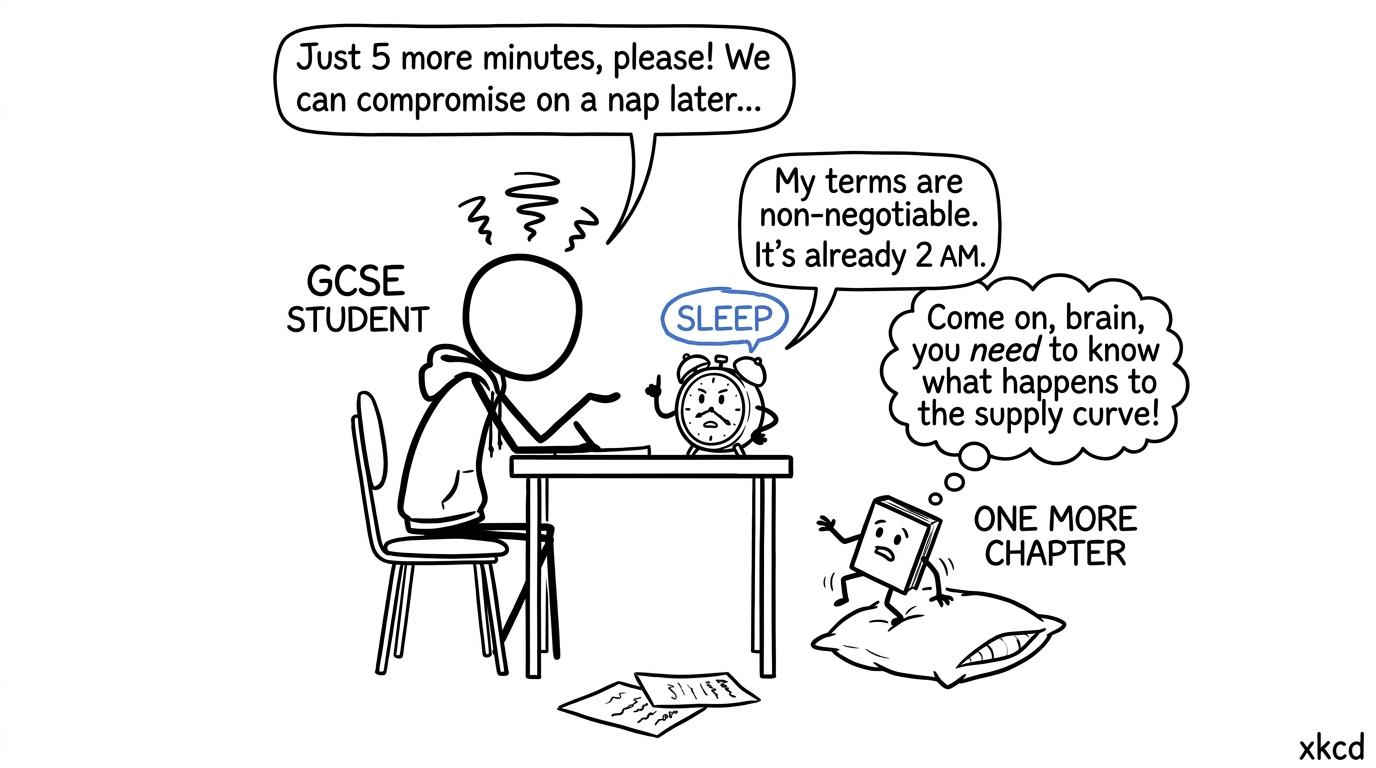 A tired student negotiating with an alarm clock while a textbook approaches the pillow
Why sleep matters after revision
Learning does not finish when you close the book. During sleep, the brain continues processing and stabilising memories formed while you were awake. This is usually described as memory consolidation.
That does not mean everything read immediately before sleep will be remembered. Memory still depends on attention, understanding and retrieval. A distracted scan of several pages gives the brain less useful material to consolidate than a focused attempt to recall five key ideas.
Sleep also supports functions that matter in an Economics exam: sustained attention, working memory, flexible thinking and decision-making. These help when you must interpret data, select relevant knowledge and build a balanced judgement. Losing sleep to cover more content can therefore create an awkward trade-off. You may have seen more pages, but be less able to use what you saw.
Health guidance commonly recommends around 888-101010 hours of sleep for teenagers, although individual needs vary. The practical message is more important than treating that range as a target to calculate backwards from once: revision should fit around adequate sleep, not repeatedly replace it.
Can revising immediately before sleep improve recall?
It can, but timing is only one part of the process. Research into sleep and learning supports the broader idea that sleep after learning helps stabilise memories. It does not justify an unlimited late-night session or prove that bedtime is the best learning time for every student.
The strongest bedtime review has three features.
It uses active recall
Close the notes and retrieve information from memory. You might list the causes of inflation, explain the purpose of taxation aloud, sketch the shape of a familiar diagram from memory or outline both sides of an evaluation question.
The effort of retrieval tells you what is actually available in memory. Rereading can feel smooth because the words are in front of you, but familiarity is not the same as independent recall.
It revisits material you already understand
Late evening is rarely the ideal moment to untangle an entirely new concept. If you are first encountering exchange rates, market failure or price elasticity when tired, confusion may increase alertness and delay sleep.
Use the final review to strengthen existing knowledge. Put demanding learning, extended writing and quantitative practice earlier in the day, when you have more mental energy.
It ends on time
A stopping time is part of the revision method, not an optional reward for finishing. Decide beforehand what the session contains and when it ends. A short checklist gives the evening a boundary:
- retrieve five definitions;
- reproduce two familiar diagrams;
- plan one evaluation chain;
- note one weak area for tomorrow;
- stop.
The unfinished weak area belongs on tomorrow's plan. It does not automatically become tonight's emergency.
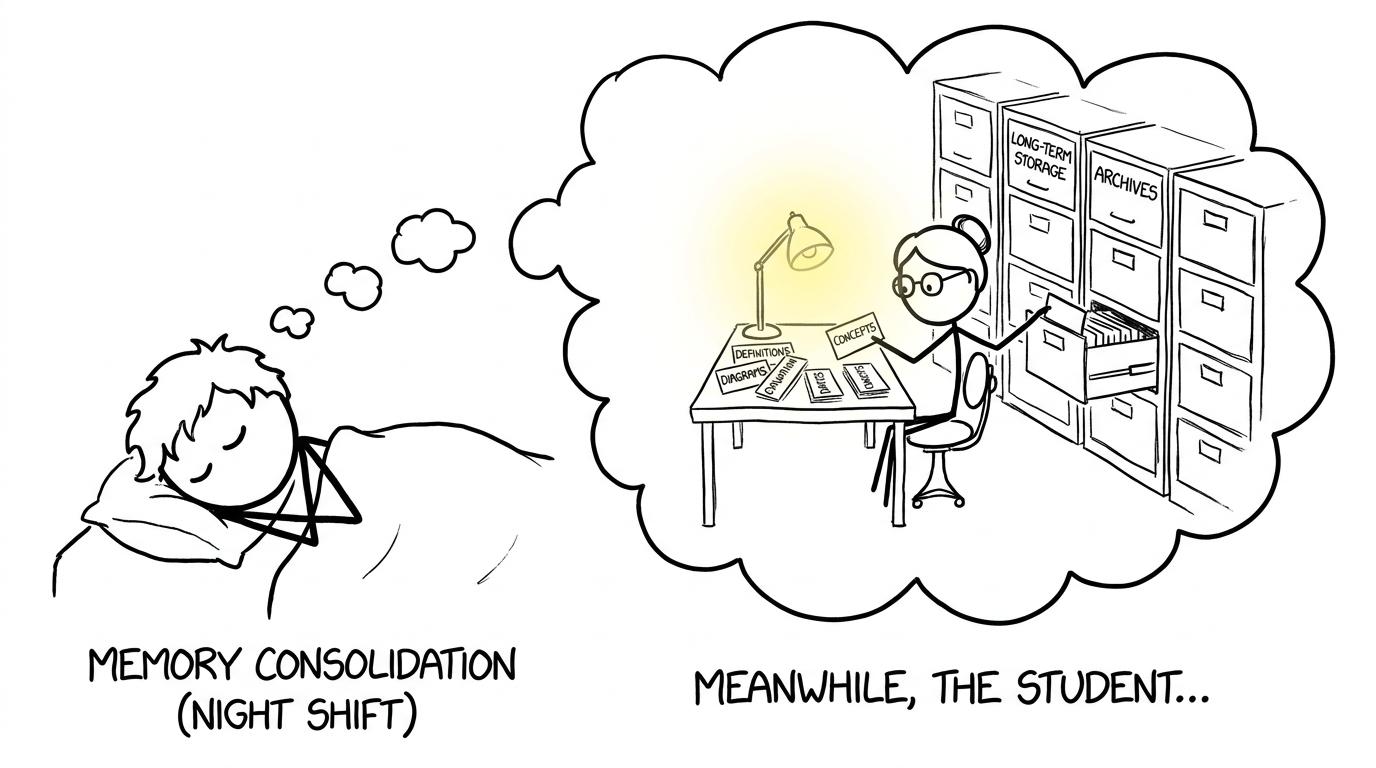 A sleeping student's brain working as a night-shift librarian for definitions and diagrams
What to revise before bed for GCSE Economics
A good bedtime task should be compact, familiar and easy to stop. The precise content depends on whether you follow AQA, Edexcel, OCR, Eduqas or another specification, so use your own specification and teacher guidance to check what is assessed.
Definitions and chains of reasoning
Retrieve a small set of definitions without looking, then check their precision. Follow each definition with a short causal chain. For example, ask yourself what could happen next, why it could happen and which condition might change the outcome.
This is more useful than memorising isolated phrases because Economics questions often reward application, analysis and evaluation as well as knowledge.
Diagrams from memory
Practise recalling the labels, curves, movements and economic meaning of diagrams you have already learnt. The aim is not to produce pages of artwork at bedtime. It is to notice whether you can reconstruct the essential information independently.
If a diagram remains unclear after checking it once, add it to the next day's revision rather than beginning a long rescue session.
Formula recall
Economics can involve percentages, ratios, index numbers and interpreting numerical information. A brief formula check can be effective before sleep, provided you already understand the calculation. For instance, percentage change uses:
Percentage change=new value−original valueoriginal value×100\text{Percentage change} = \frac{\text{new value} - \text{original value}}{\text{original value}} \times 100Percentage change=original valuenew value−original value×100Do not turn this into a large set of unfamiliar calculations at the end of the night. Use daytime sessions for deeper practice. MathsGenie's GCSE past papers and video solutions can help you build the percentage, ratio and graph skills that support quantitative work across subjects.
Evaluation prompts
Take one claim and ask:
- What assumption does it depend on?
- Would the short-run and long-run effects differ?
- Which group gains or loses?
- What evidence would help me judge the likely outcome?
- Why might the size of the effect vary?
These prompts are short enough for bedtime but develop the judgement required in longer responses.
A sleep-friendly revision routine
The best routine is deliberately unremarkable. It should be easy to repeat without negotiation.
Earlier in the evening
Complete the demanding work first. This includes learning new content, writing timed answers and solving multi-step quantitative questions. If GCSE maths is also on your timetable, choose a focused topic from the GCSE revision programme, attempt practice questions and check errors while you are still alert.
Students preparing for future study can follow the same principle with A Level maths revision lessons: hard thinking earlier, light retrieval later.
During the final review
Use a timer for about 151515-303030 minutes. Work from a short list rather than an open-ended chapter. Retrieve first, check second and write down only the gaps that deserve attention tomorrow.
Keep the emotional temperature low. The goal is not to prove that you know everything. It is to strengthen a manageable selection and create a clear next step.
After the review
Put notes away and allow time to wind down. A regular routine, a quiet environment and reduced stimulation can make sleep easier. Caffeine late in the day may interfere with sleep, while messages, videos and revision notifications can keep the session expanding long after its planned end.
If using a screen, avoid letting the device turn a brief review into unrelated scrolling. Paper flashcards or a small recall sheet may provide a clearer stopping cue.
The following morning
Spend a few minutes retrieving the same ideas again. This checks what survived without another full revision session. Anything forgotten becomes useful feedback, not evidence of failure.
Across your wider exam plan, alternate topic practice with full-paper experience. MathsGenie's predicted GCSE papers can support preparation for current exam-style questions, while GCSE mini tests make it easier to diagnose smaller gaps without attempting a complete paper every night.
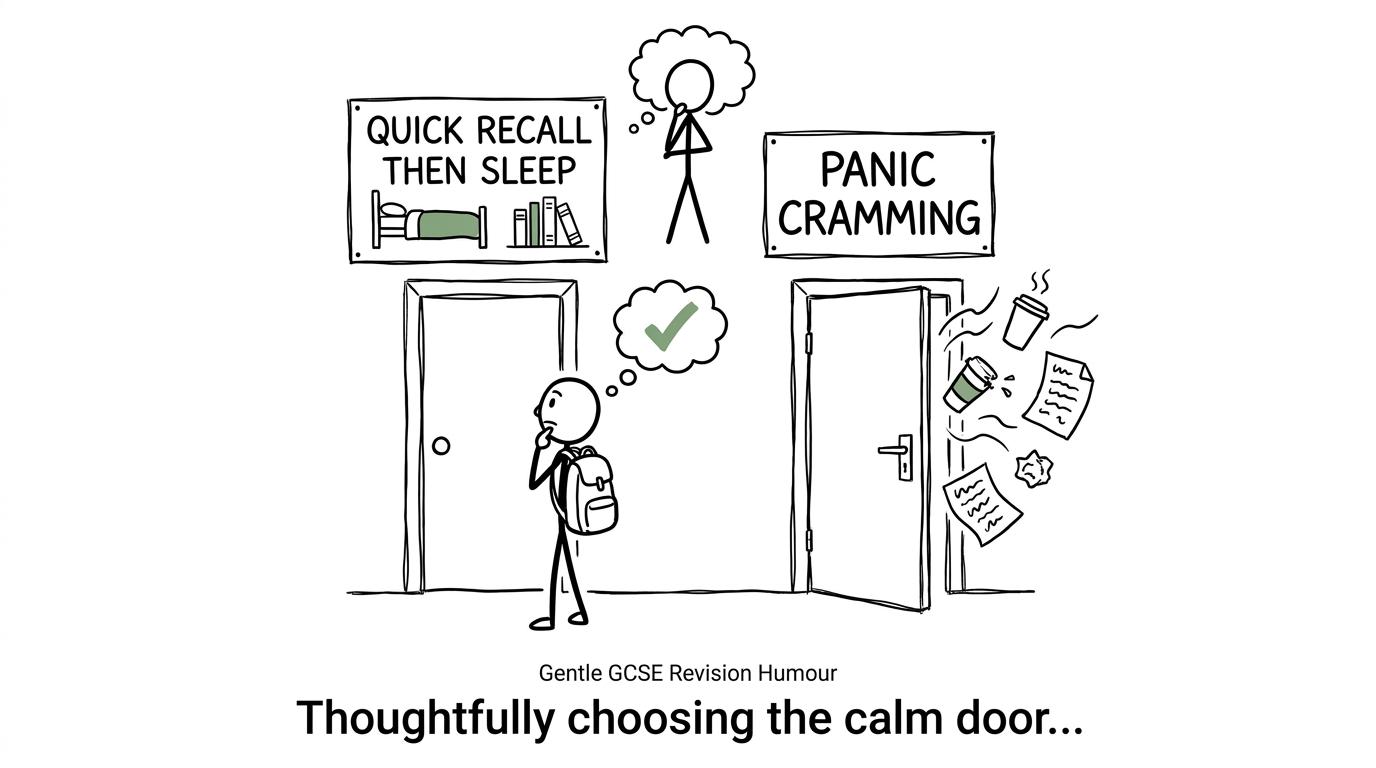 A student choosing calm recall and sleep instead of chaotic panic cramming
When late-night revision starts costing more than it gives
The warning signs are usually ordinary. You reread the same sentence, make mistakes in material you normally understand or keep changing tasks because nothing feels finished. These are not signals to increase the workload. They suggest the quality of the session has fallen.
Stopping can feel uncomfortable because revision produces visible effort while sleep does not. Yet an extra hour at the desk is not automatically an extra hour of learning. Revision should be judged by what you can later retrieve and apply, not by how late the light stayed on.
The night before an exam, protect this distinction carefully. Check essential information, organise equipment and stop. A new topic discovered at midnight is unlikely to become secure knowledge through panic alone.
Common mistakes when revising before bed
Turning a review into a full revision session
A five-minute definition check becomes an entire unit because there is no planned endpoint. Decide the content and finishing time before opening your notes.
Mistaking rereading for learning
Recognition feels reassuring but does not show that you can produce an answer independently. Begin with closed-book retrieval, then use notes to check accuracy.
Learning difficult new content when exhausted
Tiredness can make a challenging topic feel impossible. Schedule new learning earlier and reserve bedtime for familiar concepts.
Sacrificing sleep repeatedly
One unusually late evening is different from a routine of shortened sleep. Repeatedly trading rest for revision can undermine the attention and memory that revision needs.
Using caffeine to extend the session
Caffeine may make stopping harder and can interfere with sleep. It does not replace the cognitive benefits of rest.
Revising only Economics because it feels urgent
GCSE preparation is a portfolio, not a single bet. Give each subject planned time. For maths, use MathsGenie's free revision resources alongside mark schemes and video solutions for past papers, rather than allowing every topic to drift into the final hour of the day.
Make bedtime revision small enough to work
Revising GCSE Economics before bed can help when it is a brief round of active recall followed by sufficient sleep. It hurts when it becomes panic-driven cramming that steals the rest needed to concentrate, remember and evaluate.
The sensible routine is simple: learn demanding material earlier, retrieve a small amount before bed, stop at the planned time and check your recall the next day. Sleep is not time taken away from revision. It is one of the conditions that allows revision to become usable knowledge.
Build the rest of your exam preparation with the same discipline. Start a focused lesson on MathsGenie's GCSE revision page, complete practice questions, mark them honestly, and progress to past papers and predicted papers when you are ready. Calm, repeated practice usually has more value than one heroic night.











