Should You Revise Your Weakest GCSE Economics Topic First?
Revise weakest topic first GCSE Economics? Learn when to tackle it, when to warm up, and how recall and exam practice can strengthen weak areas.
The hardest topic on your revision list has a peculiar power. Even when you are revising something else, you know it is still there. Waiting.
So, should you revise weakest topic first GCSE Economics, or leave it until you feel more prepared? For most students, the best answer is to tackle it near the beginning of the session, after a brief warm-up. You are more likely to have the concentration required to diagnose the problem and improve it. Leaving the topic until last often means reaching it when your attention is fading, or postponing it again.
There is an important qualification, though. Starting with your weakest topic does not mean spending the entire session struggling with it. The aim is focused contact, useful feedback and another planned attempt later.
The short answer
Use this checklist to decide how to organise your session:
- Begin with approximately 555 minutes of straightforward recall.
- Spend the next 202020 to 303030 minutes on your weakest economics area.
- Identify whether the weakness is knowledge, application, written analysis or calculation.
- Check your work against the specification, notes or mark scheme.
- Finish with a stronger topic or a short mixed quiz.
- Return to the weak area in a later session rather than trying to repair everything at once.
This approach combines the advantage of working while alert with the confidence of an achievable start. It also makes the final part of the session useful: instead of meeting difficult content for the first time, you can retrieve what you revised earlier.
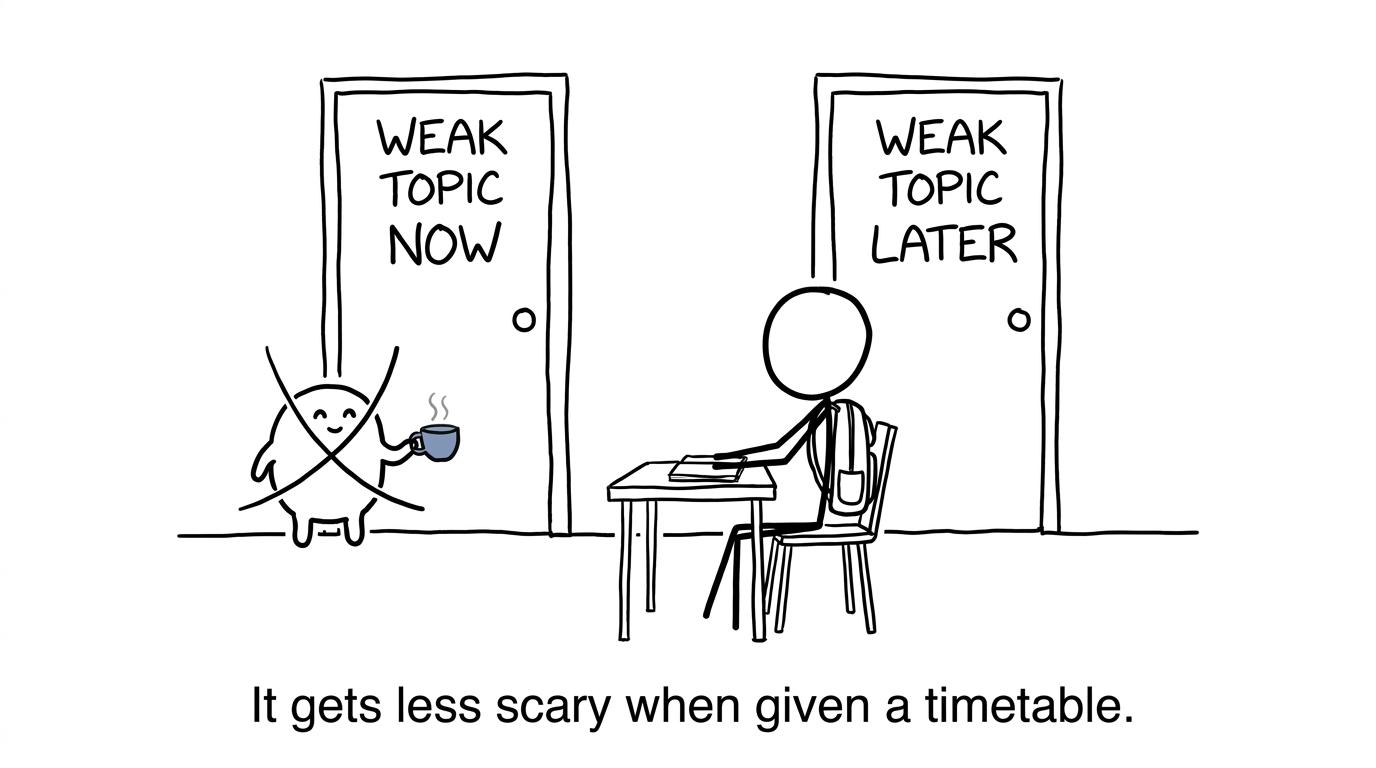 A student choosing when to confront a weak revision topic
Why your weakest topic usually belongs near the start
A weak topic demands more than time. It demands decisions.
You must work out what the question is asking, retrieve relevant economic knowledge, decide which information matters and evaluate your answer. If the question includes data, you may also need to select and perform a calculation accurately. Those decisions are harder to make when a revision session has already drained your attention.
Beginning early also reduces avoidance. A student who plans to study market failure at the end of a session can easily spend too long making notes on demand and supply first. The plan feels productive, but the difficult topic remains untouched.
Putting the weak area near the start creates a clearer rule: deal with the important work before optional work expands to fill the available time.
However, this is not an argument for opening your folder and immediately attempting the most intimidating question you can find. A short warm-up can help you settle. Retrieve several definitions, label a familiar diagram or answer a few accessible questions. Then move to the priority topic while that momentum is still useful.
When revising the weakest topic last can work
There are situations in which starting with the weakest area is counterproductive.
If the topic creates enough anxiety that you stare at the page without attempting anything, begin with a small, familiar task. This should be a warm-up, not an escape. Set a clear boundary such as 555 or 101010 minutes before switching.
Leaving a weak topic until later may also make sense when it depends on prerequisite knowledge. For example, difficulty interpreting percentage changes may come from uncertainty about percentages rather than economics. Revising the prerequisite first is not avoiding the weak topic; it is removing the obstacle beneath it.
MathsGenie's free GCSE maths revision lessons can help you locate that underlying gap. If percentages are the problem, the percentages revision resources provide focused practice before you return to an economics calculation.
The key distinction is between sequencing and postponing. Sequencing gives the difficult topic a definite start time. Postponing gives it a vague promise.
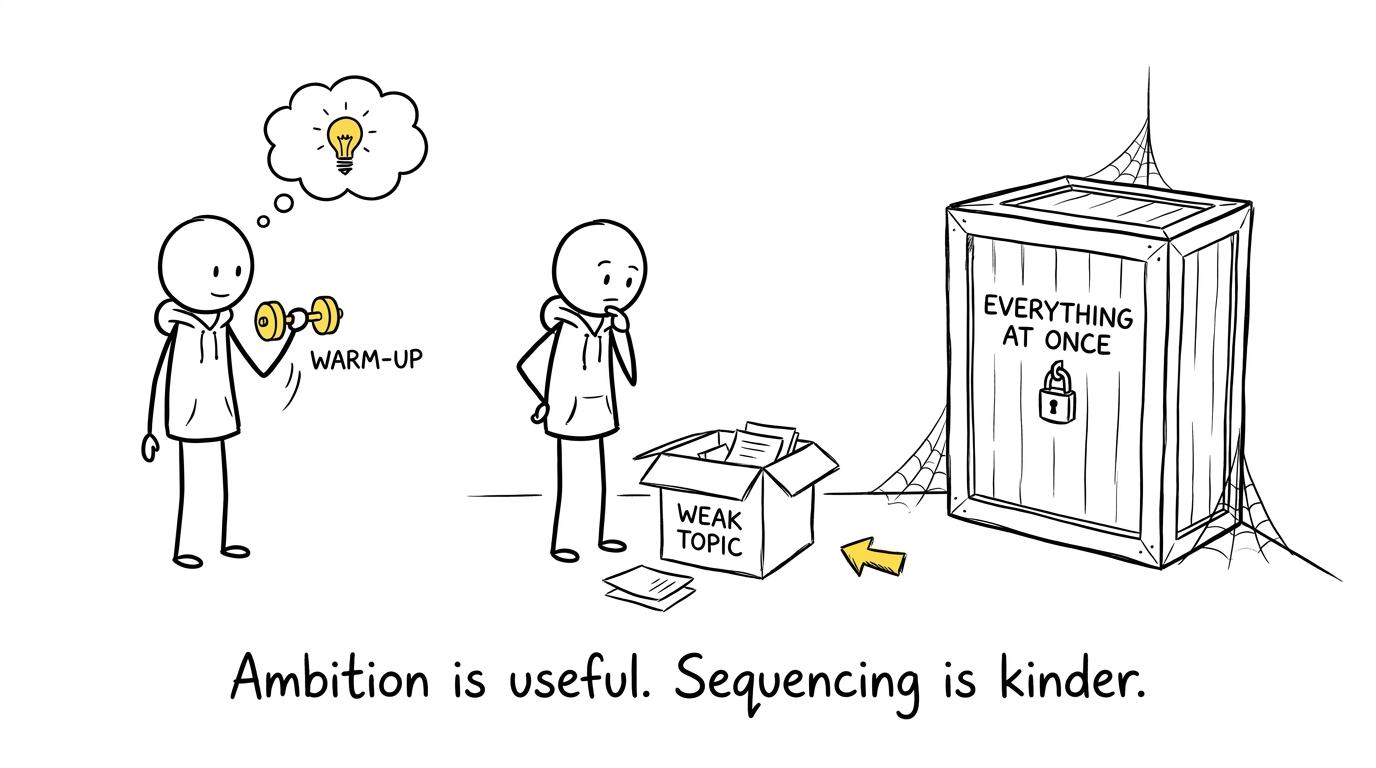 A student using a warm-up before tackling a weak topic
Identify what “weakest” actually means
Students often describe a whole unit as weak when the real problem is narrower. “I cannot do macroeconomics” is difficult to act upon. “I confuse monetary policy with fiscal policy” gives you somewhere to begin.
Your weakness will usually fall into one or more of these categories.
Missing knowledge
You cannot recall an essential definition, cause, consequence or policy. Use closed-book retrieval before checking your notes. Repeatedly reading a correct definition can create familiarity without reliable recall.
Weak application
You know the theory but do not connect it to the context or data in the question. Practise identifying the specific business, consumer, market or economy described before writing.
Incomplete chains of reasoning
You can state an effect but cannot explain how one change leads to another. Break the reasoning into linked stages and check that each step follows from the previous one.
Weak evaluation
You make a judgement without explaining the conditions on which it depends. Consider factors such as time, scale, stakeholder effects and the reliability of the information provided.
Inaccurate quantitative skills
GCSE Economics specifications include quantitative skills, although students should check the precise requirements for their exam board. Common demands include reading graphs and tables, interpreting data, ratios, averages and percentage change.
The general percentage-change relationship is:
Percentage change=changeoriginal value×100\text{Percentage change} = \frac{\text{change}}{\text{original value}} \times 100Percentage change=original valuechange×100If calculation errors are weakening otherwise sound economics answers, use MathsGenie's percentage change revision lesson and related practice questions. Strengthening the maths separately can release more attention for economic interpretation in the exam.
A better structure for each revision session
A useful session has several distinct jobs. It should retrieve knowledge, expose errors, correct them and create a reason to return.
Start with brief retrieval
Without notes, write down what you can remember from a previously revised topic. Keep this short. Its purpose is to switch your brain into retrieval mode rather than consume the session.
Tackle one defined weakness
Do not choose “the whole of international trade”. Choose a manageable target such as explaining the possible effects of a tariff or distinguishing imports from exports.
Use the revision material permitted by your course and exam board. AQA, Edexcel and OCR specifications organise content differently, so your own specification should determine what you need to know.
Test rather than simply reread
Close the book and produce something: a definition, diagram, calculation plan, paragraph outline or response to an exam question. Retrieval gives you information that rereading cannot; it reveals what is missing.
Check and classify errors
A mark scheme is more useful when it becomes a diagnostic tool. For every lost mark, decide whether the cause was missing knowledge, weak application, incomplete analysis, calculation error or poor exam technique.
For quantitative practice, MathsGenie's collection of GCSE maths past papers lets you practise selecting methods under exam conditions rather than only completing isolated exercises.
Finish by retrieving the weak topic again
At the end of the session, return briefly to the content you tackled earlier. Try to recall the key idea without looking. This second contact is more useful than merely ending with the feeling that the page looked familiar.
Then schedule another attempt. A weak topic becomes secure through successful returns, not one heroic evening.
Balance Economics revision with maths preparation
Students preparing for both GCSE Economics and GCSE maths should avoid treating the subjects as entirely separate. Economics uses numerical information to describe real decisions; maths supplies the tools for handling it accurately.
If you struggle with proportions, percentage changes, averages or graphs in Economics, look for the same weakness in your maths work. MathsGenie's averages revision resources can support data interpretation, while the full MathsGenie GCSE revision programme organises topics by grade and includes videos and practice questions.
You should still use economics-specific questions to practise interpretation. Knowing how to calculate a percentage change is not the same as explaining why that change matters to households, firms or government. The calculation and the economic argument must work together.
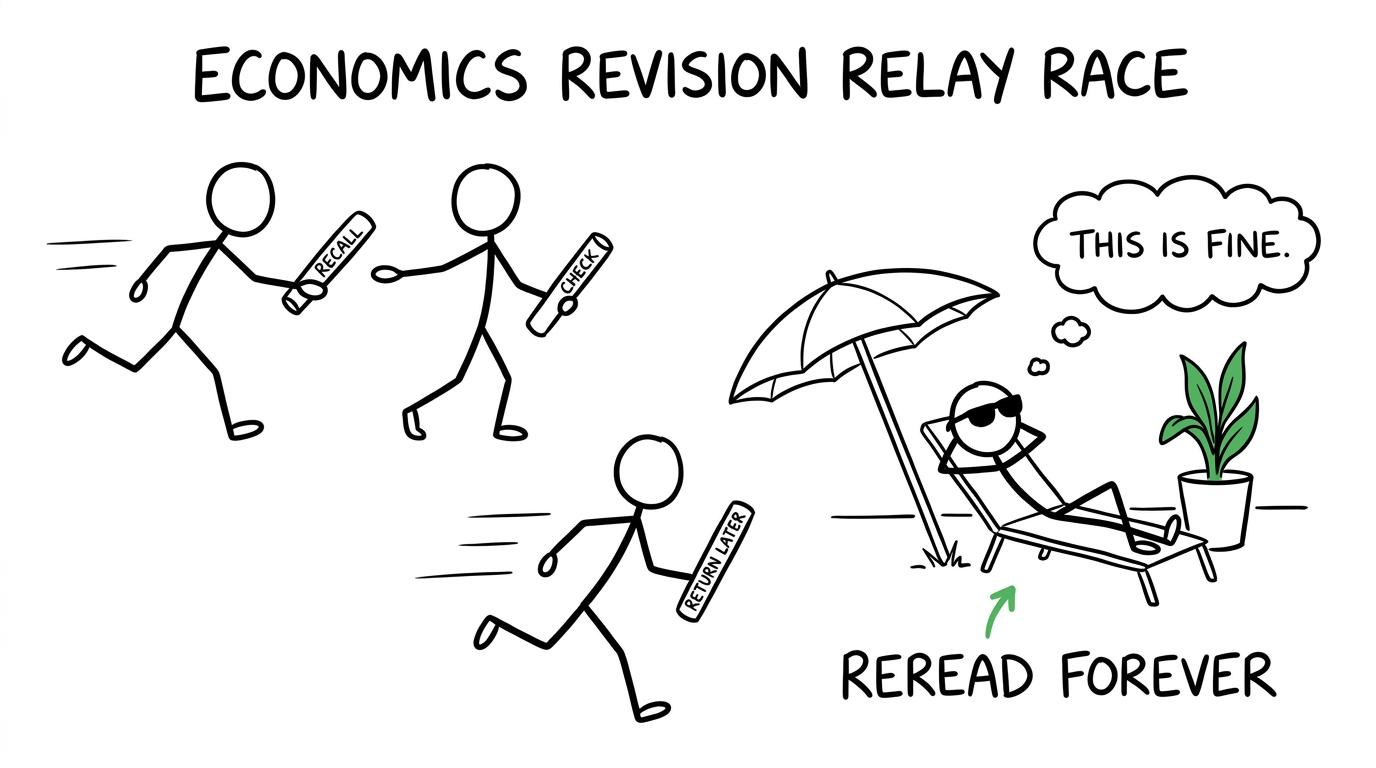 A revision relay using recall, checking and planned returns
Common mistakes when prioritising weak topics
Spending the whole session on one problem
Persistence is valuable, but unstructured struggle is not automatically productive. If you have made no progress after a focused attempt, identify the missing prerequisite, consult an explanation and try a simpler question before returning.
Starting with something impossibly broad
A target such as “revise microeconomics” offers no clear finishing point. Narrow the task until you can test it within one session.
Confusing recognition with understanding
Highlighted notes may look familiar because you have seen them repeatedly. Test whether you can reproduce and apply the idea without the page in front of you.
Revising only weak areas
Weak topics deserve additional time, but stronger topics can decay when ignored. Include mixed questions and short retrieval from secure areas so that your overall performance remains balanced.
Ignoring the mark scheme
Completing questions without checking them can reinforce incomplete answers. Compare your response carefully with the mark scheme and note what kind of improvement is needed.
Saving every difficult task until last
This turns tiredness into a revision strategy. If you repeatedly fail to reach the topic, move it forward and give it a fixed time limit.
Make the order serve the goal
Whether tackling your weakest GCSE Economics area at the start or end makes a difference, but the clock is not the only issue. What matters is the quality of the attempt and whether you revisit the topic afterwards.
For most students, the strongest pattern is simple: warm up briefly, address the weakest defined area while concentration is relatively fresh, test it actively, check the result and retrieve it again before finishing. If anxiety or missing prerequisites make an immediate start unproductive, delay it deliberately by a few minutes, not indefinitely.
MathsGenie can support the numerical side of that plan with free GCSE revision lessons and practice questions, past papers and mark schemes, and predicted GCSE maths papers. Choose one weak skill today, give it a defined place near the start of your next session, and let repeated practice make it smaller.