Revise GCSE Psychology: Screen vs Paper Guide
Revise GCSE psychology screen vs paper with a practical hybrid plan for stronger recall, evaluation, research methods and confident exam writing at GCSE.
There is a familiar revision trap: a student spends an hour scrolling through psychology notes, recognises nearly every term, then closes the laptop and cannot explain one study clearly. The screen made the material feel familiar. It did not prove that it had stuck.
If your search is “revise GCSE psychology screen vs paper”, the short answer is this: neither medium always wins. Screens are excellent for finding resources, organising topics, watching explanations and running quick quizzes. Paper is often better for concentrated reading, closed-book recall, planning extended responses and rehearsing the handwritten exam. The strongest approach is usually a deliberate hybrid.
That matters for maths students too. GCSE Psychology includes research methods, data interpretation and quantitative skills, while the habits that improve psychology revision, retrieval, feedback and repeated practice, also strengthen GCSE maths.
The screen vs paper revision checklist
Use each medium for the job it handles well:
- Use a screen to access and organise information: specifications, digital flashcards, videos, topic lists and revision schedules.
- Use paper to retrieve information: blank-page recall, study summaries, essay plans, diagrams and timed responses.
- Practise in the format of the assessment: handwriting complete answers and working without digital prompts.
- Mark every attempt: compare it with a mark scheme or trusted model, then correct it.
- Retest later: recognition today is not the same as recall tomorrow.
- Choose accessible tools: if typing, text-to-speech or digital annotation supports an access need, use the method agreed with your school.
The important choice is not simply device or notebook. It is whether the task makes you think.
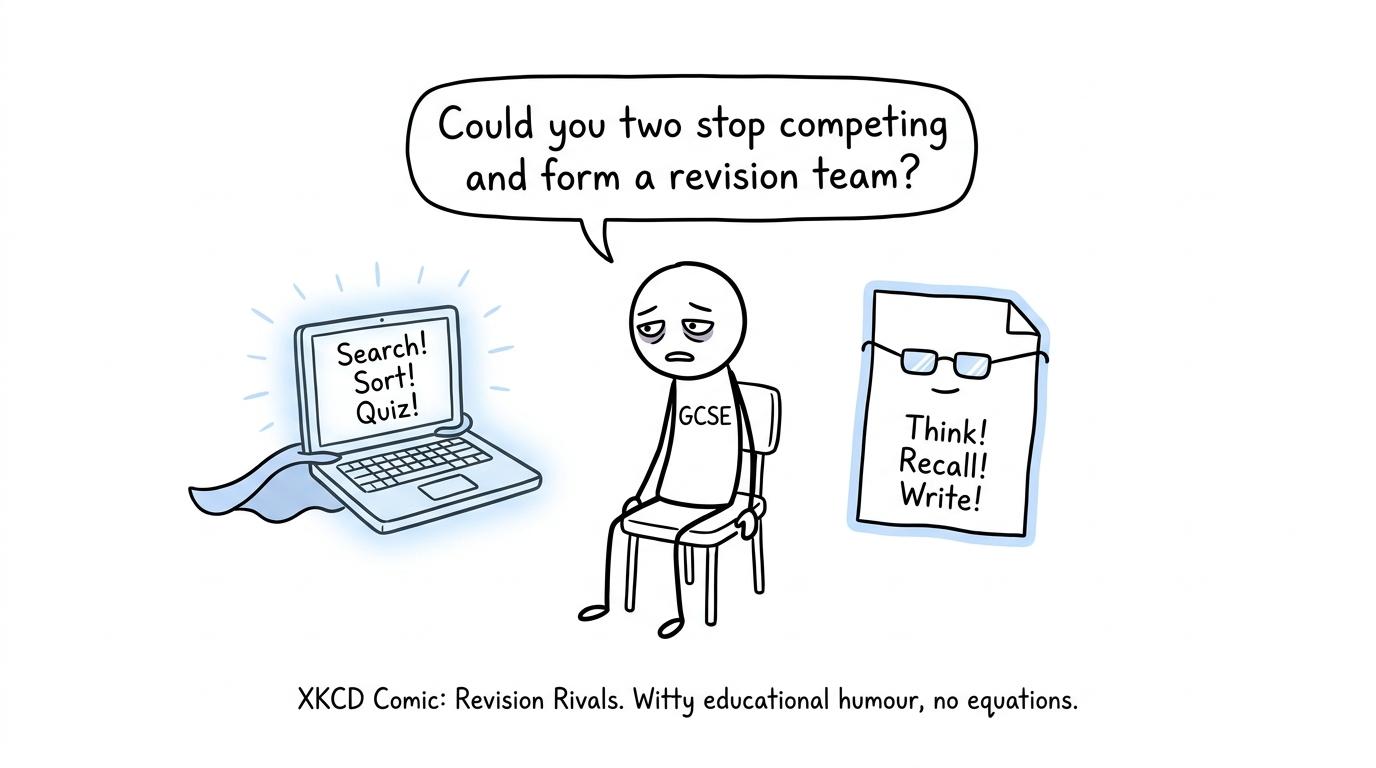 A student asks a laptop and paper to become a revision team
Does psychology revision stick better on paper?
Research comparing screen and print reading does not support a dramatic claim that screens prevent learning. However, several reviews have found a small average comprehension advantage for print, particularly when readers must process longer or more demanding informational texts. Other findings are more mixed, especially for shorter passages and narrative reading.
The sensible conclusion is modest: paper may help with deep, uninterrupted reading, but the learning activity matters at least as much as the medium.
A printed page also removes some temptations. There are no incoming messages, extra tabs or links inviting you elsewhere. Its physical layout can make it easier to remember where information appeared, annotate relationships and see a whole argument without scrolling.
Yet paper is not automatically active. Copying a textbook, decorating headings or repeatedly highlighting a study can remain passive. A beautiful page of notes may record work without producing much recall.
When paper is the stronger choice
Choose paper when you need to:
- recall a theory or study without prompts;
- compare evidence across a full page;
- plan an AO3 evaluation;
- practise extended writing under time pressure;
- draw and interpret graphs or tables;
- rehearse research-method calculations;
- correct an answer in a memorable, visible way.
Handwriting is slower than typing. That can be inconvenient, but it can also force selection: you must decide what matters instead of copying every sentence. Evidence about handwritten and typed notes is not completely uniform, and much of it comes from older students, so it should not be treated as a universal rule for every GCSE learner. Still, handwriting is useful when it makes you summarise and reconstruct ideas.
When screen-based GCSE Psychology revision works well
Digital revision earns its place through speed and flexibility. A screen can hold the specification, class materials, flashcards, a timer and an error log without filling a desk with folders. Search functions help you locate a term immediately, while digital quizzes can shuffle questions and schedule repeated retrieval.
The danger is that convenience becomes consumption. Watching three explanations in succession can feel productive because each makes sense at the time. Unless you pause and produce an answer independently, you have tested the presenter, not yourself.
Turn screen time into active revision
A productive digital session should create an output. After reading or watching a short section:
- close or hide the source;
- type or say everything you can remember;
- answer a question without autocomplete or notes;
- check the answer against the source;
- record the missing detail;
- return to it on another day.
This is the same learn-practise-check cycle behind MathsGenie’s free GCSE maths revision resources. A video can introduce a method, but questions and feedback reveal whether you can use it independently.
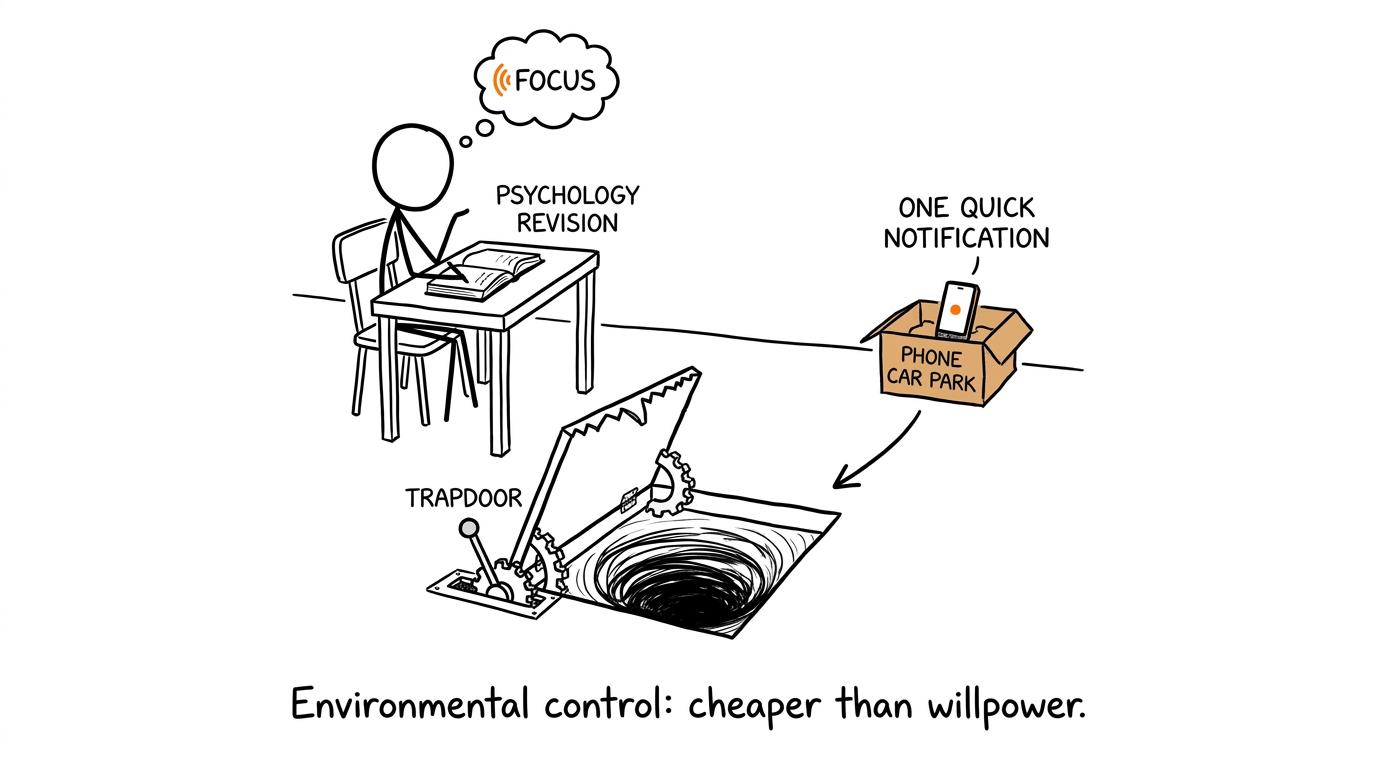 A student's phone waits in a revision car park
Control the digital environment
Do not rely entirely on willpower. Make distraction less convenient:
- put the phone in another room if it is not needed;
- use full-screen mode for the resource you need;
- close messaging and entertainment tabs;
- disable non-essential notifications;
- keep only one clear task on your screen;
- take breaks away from the device.
A screen is not inherently distracting. An uncontrolled screen is.
Match the medium to GCSE Psychology assessment
For regulated GCSE Psychology specifications, AO1 concerns knowledge and understanding, AO2 concerns application, and AO3 concerns analysis and evaluation. AQA and Pearson Edexcel currently weight these objectives at approximately 35%35\%35%, 35%35\%35% and 30%30\%30% respectively. Their topic structures and paper formats differ, so always follow your own board’s current specification.
That balance tells you something important. Memorising definitions alone cannot prepare you for the whole examination.
AO1 knowledge and terminology
Digital flashcards are efficient for definitions, researchers, findings and key vocabulary. Paper flashcards work equally well if you test yourself before turning them over. In both cases, the useful moment is the pause before the answer appears.
AO2 application
Application questions require you to connect knowledge to an unfamiliar scenario. Practise these without notes. A screen can supply question banks quickly, but writing the answer on paper helps you slow down, select relevant evidence and rehearse exam conditions.
AO3 analysis and evaluation
For evaluation, paper is particularly useful for building concise argument plans. Write the claim, supporting evidence, limitation and resulting judgement. Do not memorise disconnected evaluation phrases; practise explaining why a strength or weakness changes confidence in a conclusion.
Research methods and maths skills
Psychology can assess data handling, graphs, averages, sampling and experimental design. These skills improve through doing, not rereading. Complete questions on paper, show your reasoning and check each stage.
If research methods expose a wider maths weakness, use MathsGenie’s GCSE maths hub for targeted lessons and questions. You can then test exam technique with AQA GCSE maths past papers or Edexcel GCSE maths past papers, depending on your maths exam board.
A hybrid revision routine that tests what sticks
Begin on screen with a narrow target, such as one explanation, study or research-method skill. Spend a short period learning it, then move away from the source.
On paper, retrieve the content from memory. Write key terminology, outline the evidence and produce a brief answer plan. Check it against your notes or mark scheme in a different-coloured pen. Your correction should identify exactly what was absent or inaccurate.
Later, retest the same material without reopening the corrected page first. This delayed, closed-book attempt is more informative than how confident you felt during the original session.
Use the MathsGenie revision planner to organise psychology alongside maths rather than allowing one subject to consume the week. For maths, short Edexcel GCSE maths mini tests can provide the same quick cycle of retrieval, marking and correction.
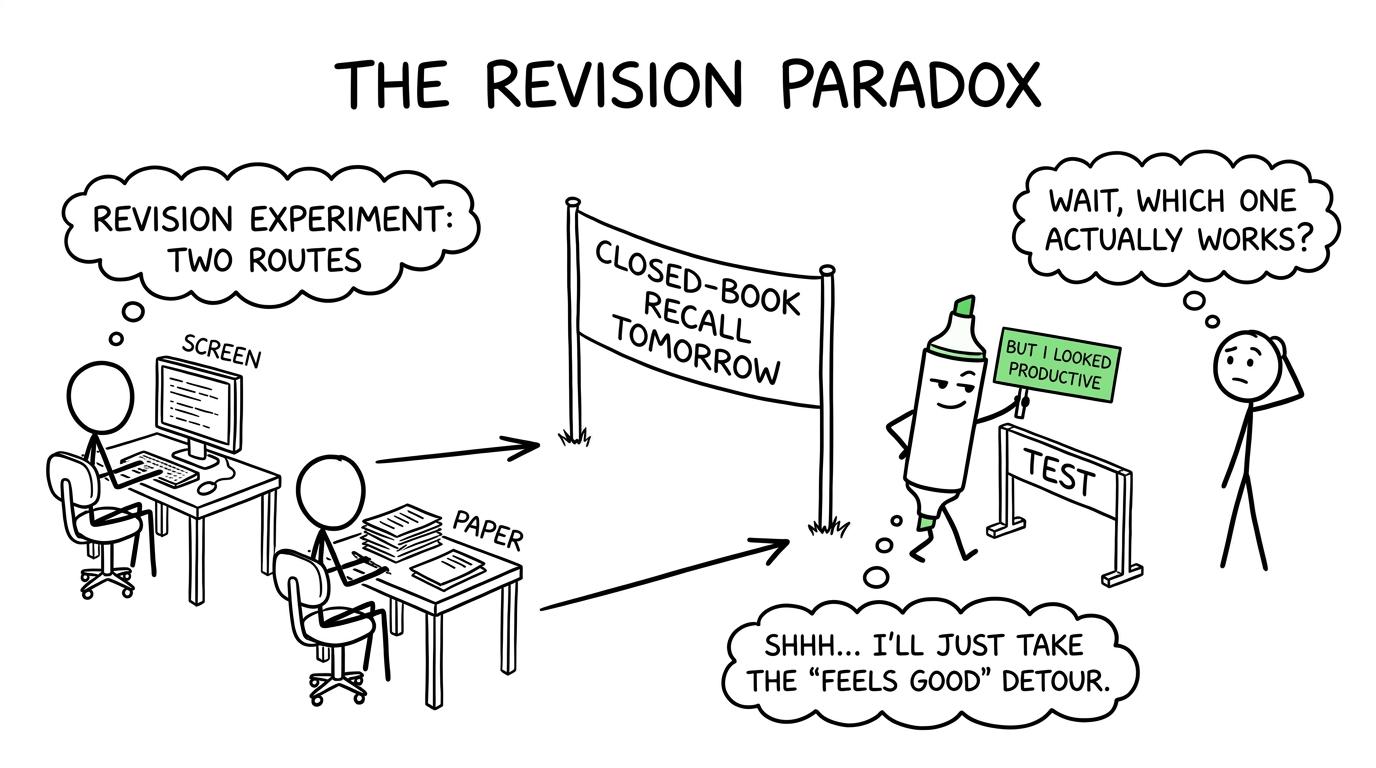 A highlighter attempts to avoid a closed-book recall test
Test screen vs paper for yourself
Individual preferences matter, but preference is not proof. A method may feel easier because it demands less effort.
Run a fair personal comparison. Revise two similarly difficult psychology sections for the same length of time, using screen-based revision for one and paper-based revision for the other. Keep the activity as similar as possible. On the following day, complete equivalent closed-book questions and compare:
- accurate facts recalled;
- correct psychological terminology;
- quality of application;
- strength of evaluation;
- time required to produce the answer.
Do not judge the methods immediately after revision, when both topics are still familiar. The delayed test is the useful part. You may discover that digital flashcards support factual recall while paper plans improve longer answers. That is not an untidy result. It is a personalised hybrid system.
For another evidence-led approach, use MathsGenie’s guide to finding your weakest GCSE topics rather than choosing revision tasks by mood.
Common screen and paper revision mistakes
Mistaking recognition for memory
Seeing a term and thinking “I know that” is not retrieval. Hide the definition and produce it before checking.
Typing notes word for word
Fast transcription creates a large document, not necessarily understanding. Compress the idea, explain it in your own words and test it.
Making paper notes too decorative
Colour can organise information, but presentation should not replace questions, marking and correction.
Revising only AO1
Definitions feel controllable, so students can avoid application and evaluation. Build all three assessment objectives into weekly practice.
Ignoring handwritten timing
Knowing the content is not enough if you cannot produce a clear answer within the examination. Include timed paper practice.
Switching media without a reason
Opening a laptop, tablet, phone and notebook at once increases friction. Decide the purpose first: learn on screen, retrieve on paper, then mark.
Never revisiting mistakes
A correction is only useful if it changes a later answer. MathsGenie’s guide to revision mistakes that waste time explains why marking and reattempting matter across GCSE subjects.
Build a system, not an allegiance
The screen-versus-paper debate becomes simpler when you stop asking which tool is universally superior. The better question is: what must your brain do during this task?
Use screens for access, organisation, explanation and efficient testing. Use paper for deliberate recall, evaluation plans, calculations and handwritten exam rehearsal. Then use delayed questions to discover what genuinely remained.
If you are preparing for psychology and maths together, let MathsGenie organise the maths side of that routine. Start with free revision lessons and practice questions, move into mini tests, and build towards past papers, predicted papers, mark schemes and video solutions. The medium helps, but the cycle creates progress: learn, retrieve, check, fix and return.