

Revise GCSE Geography With No Quiet Space at Home
Revise GCSE geography with no quiet space using short sessions, portable resources, active recall and a realistic plan designed for a busy home routine.
Revision advice often begins with a fantasy: find a silent room, clear a large desk and work without interruption. That is useful if you have those things. Many students do not.
If you need to revise GCSE geography with no quiet space, the answer is not to wait for perfect conditions. Build a method that survives ordinary ones. Use short, clearly defined tasks at home, reserve quieter locations for demanding exam practice, and make every session active enough that background noise has less room to steal your attention.
Your home environment may be difficult, but it does not have to decide the quality of your revision.
Your no-quiet-space revision checklist
Start with these practical decisions:
- identify the calmest times rather than searching for a permanently quiet room;
- break geography into tasks that take between 101010 and 252525 minutes;
- keep a portable revision kit ready;
- use retrieval questions instead of repeatedly reading notes;
- match each task to the noise level around you;
- ask your school about supervised revision spaces;
- use libraries or other suitable public study spaces when available;
- save timed papers and extended answers for your quietest periods;
- protect sleep and take regular breaks;
- plan GCSE maths separately using the free MathsGenie revision planner.
The important shift is simple: stop treating silence as the starting condition for revision. Treat it as one useful resource among several.
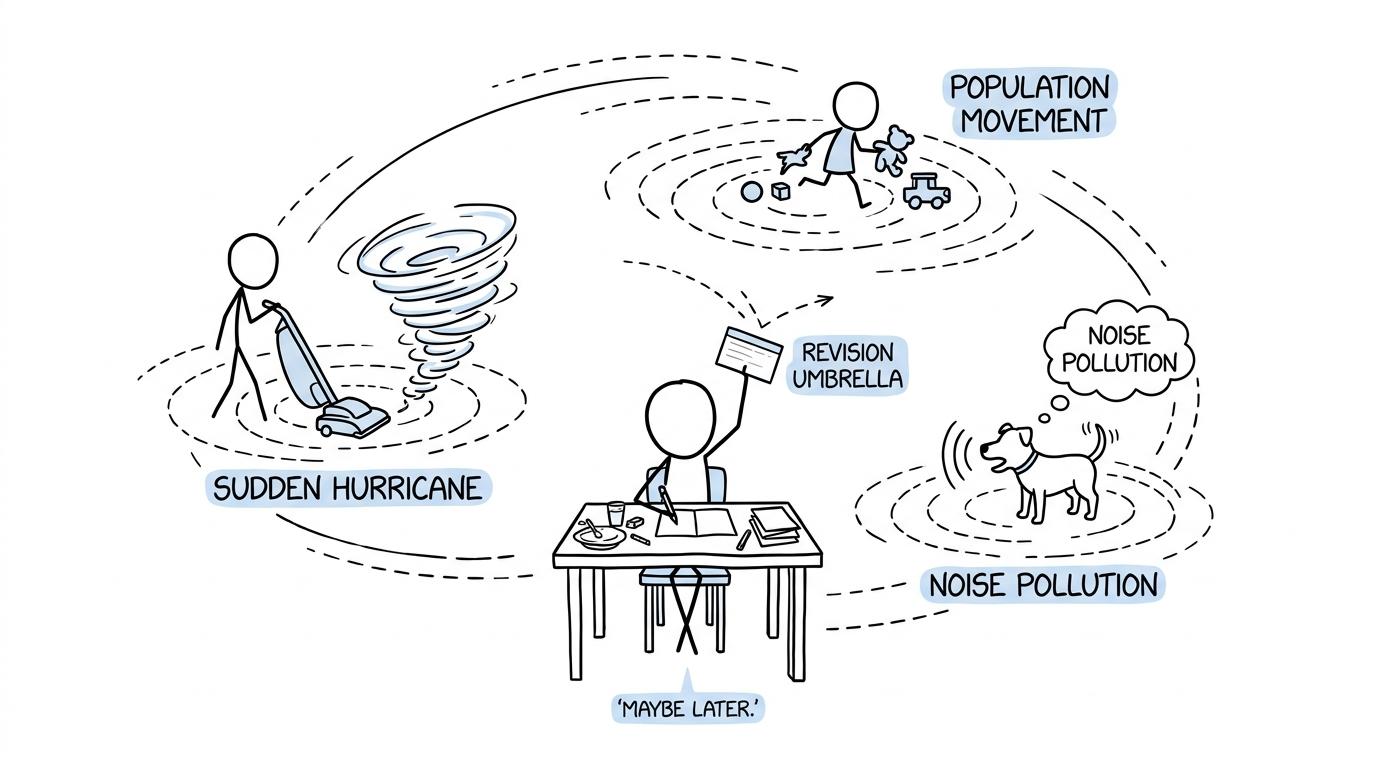 A student calmly revising while household distractions behave like weather systems
Find quiet moments, not a perfect room
A noisy home is rarely equally noisy all day. There may be a calmer period before other people wake up, immediately after school or later in the evening. Observe your household for several days and note when interruptions are least likely.
Do not automatically choose the latest possible time. Revision that damages your sleep is a poor trade. NHS exam guidance recommends a realistic schedule, manageable chunks, regular short breaks and asking for support when stress becomes difficult. Your plan should fit around rest, meals and school rather than competing with all three.
Create two categories of geography work:
High-concentration tasks
These include timed extended responses, interpreting unfamiliar resources, evaluating fieldwork methods and completing substantial sections of a paper. Put these into the quietest periods you can access.
Noise-tolerant tasks
These include sorting flashcards, recalling definitions, labelling a familiar diagram, reviewing case-study facts, correcting an answer and testing map symbols. They still require thought, but they can be completed in shorter bursts.
This distinction prevents a common frustration: attempting the hardest task during the loudest part of the day, struggling, and concluding that no revision is possible.
Build a portable GCSE geography revision kit
When your working space changes, preparation matters. Keep the essentials in one folder, pencil case or small bag:
- specification or teacher checklist;
- concise case-study cards;
- blank paper or a small whiteboard;
- pens, pencil, ruler and calculator;
- printed exam questions and mark schemes;
- earplugs or headphones where safe and permitted;
- a short list of your next three tasks.
Download or print important resources in advance if internet access is unreliable. A portable kit lets you use a school study room, library, relative's home or calm corner without spending the first 151515 minutes looking for materials.
Ask before using headphones in shared or public spaces, keep the volume at a safe level and remain aware of announcements and your surroundings. Instrumental music, neutral background sound or ordinary ear defenders may help some students mask unpredictable noise, but they are optional. The aim is not to manufacture total silence. It is to make the sound environment more consistent.
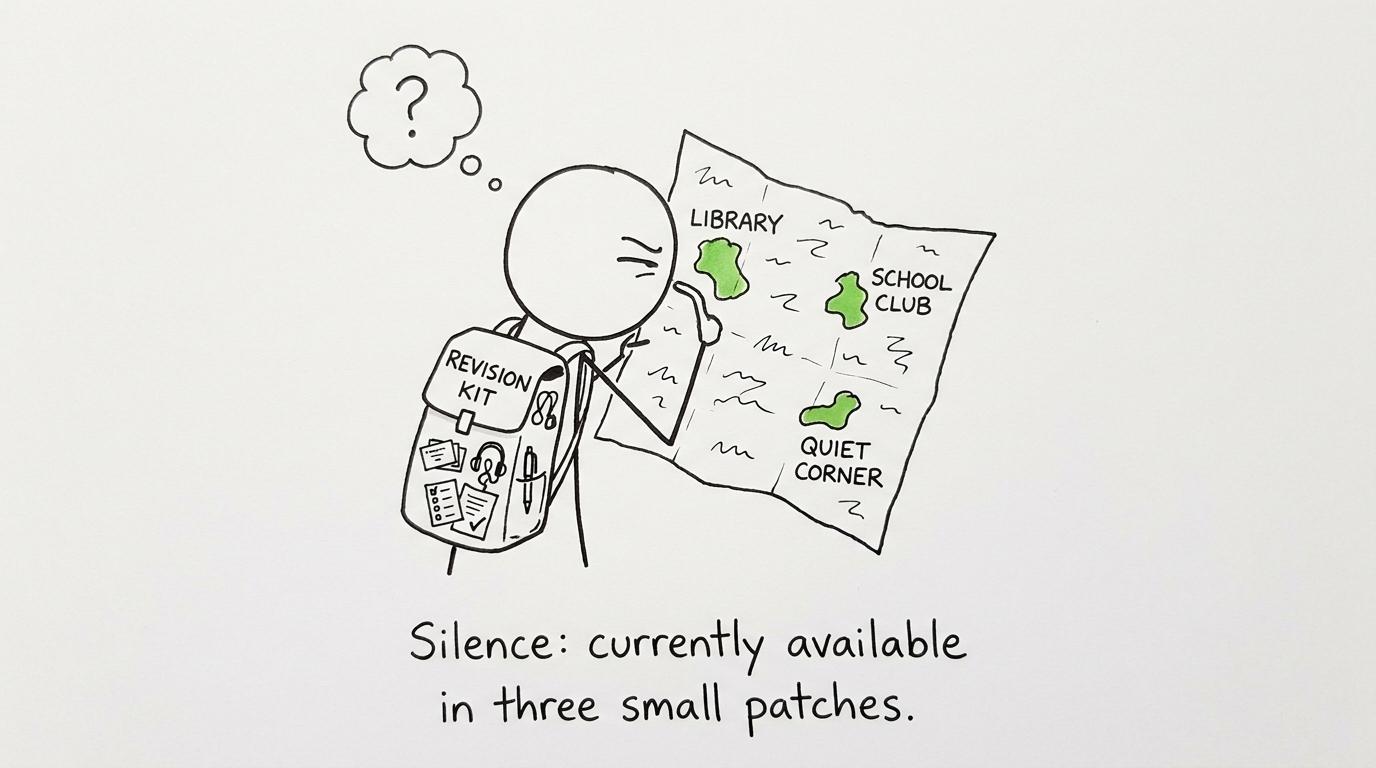 A student searches a map for small islands of silence while carrying a portable revision kit
Use short sessions that produce evidence
A vague instruction such as “revise coasts” is difficult to begin. A concrete task is easier: “Recall four erosion processes, check them, then answer one question.”
Try a repeatable 202020-minute geography block:
- First 222 minutes: choose one narrow objective.
- Next 888 minutes: retrieve information without notes.
- Next 777 minutes: check against reliable class materials or a mark scheme.
- Final 333 minutes: record one gap and schedule a return.
This is not a worked geography example or a rigid formula. It is a session structure that makes interruptions less damaging. If you are stopped, you know exactly where to restart.
Research summarised by the Education Endowment Foundation supports planning, monitoring and evaluating learning within specific subject content. It also stresses that retrieval requires an active attempt to remember, followed by feedback so that errors are not reinforced.
The same principle runs through MathsGenie's guide to finding weak GCSE topics: attempt, check, identify the precise gap and retest. Although the resources are for maths, that revision logic transfers well to geography.
Revise geography actively when the house is noisy
Rereading can feel productive because it is calm and familiar. Unfortunately, familiarity is not the same as recall. Your exam requires you to retrieve knowledge, interpret resources and construct answers without your notes open.
Use active tasks such as:
- writing everything you remember about one process before checking;
- turning a case study into question-and-answer cards;
- explaining a concept aloud or silently from memory;
- planning an extended answer using only key headings;
- drawing a process diagram, then comparing it with your notes;
- answering one past-paper question and marking it immediately;
- correcting a weak response in a different-coloured pen.
Case studies should be reduced to usable evidence, not copied into decorative pages. Keep the location, relevant process or issue, specific evidence, impacts, responses and an evaluative point. Check these categories against your own exam board's specification and your teacher's guidance because AQA, Edexcel, OCR and Eduqas organise and assess content differently.
GCSE geography also includes geographical skills. Depending on the specification, students may need to interpret maps, graphs, numerical or statistical information, photographs and fieldwork evidence. Do not revise only place facts. Include unfamiliar resources and practise explaining what the evidence shows.
For the numerical skills that overlap with geography, MathsGenie's free GCSE and A Level maths revision can help you strengthen the underlying maths separately.
Match the place to the task
Some revision can happen in a busy home. Some work is genuinely easier elsewhere. This is not failure; it is sensible planning.
Ask a teacher, form tutor, librarian or pastoral member of staff whether your school offers:
- lunchtime or after-school revision rooms;
- supervised library access;
- homework clubs;
- a quiet space before an exam;
- printed resources if working online at home is difficult.
Be specific. “I find it hard to revise at home because there is no quiet space. Is there somewhere I can work after school on Tuesdays?” is easier to act on than a general statement that revision is difficult.
A public library may also be suitable, but check opening times, membership arrangements, travel and rules with a parent or carer. Choose safe, authorised locations rather than isolated places. If leaving home is not possible, negotiate a predictable short window with the people you live with. A visible note or agreed signal can mean, “I need 202020 uninterrupted minutes.”
Plan around geography, maths and your other GCSEs
Geography should not consume every quiet period simply because it involves long answers. Allocate scarce quiet time according to task difficulty and exam proximity.
A useful weekly rhythm might contain:
- two short geography recall sessions;
- one case-study or fieldwork session;
- one timed geography question in a quieter location;
- separate maths topic practice;
- one review of mistakes from both subjects.
Use the MathsGenie GCSE revision timetable guide to build a realistic wider plan. If exams are close, the one-month GCSE maths revision plan shows how to combine short retrieval, focused practice and paper work without relying on endless sessions.
The goal is not to fill every available minute. It is to decide what each minute is for.
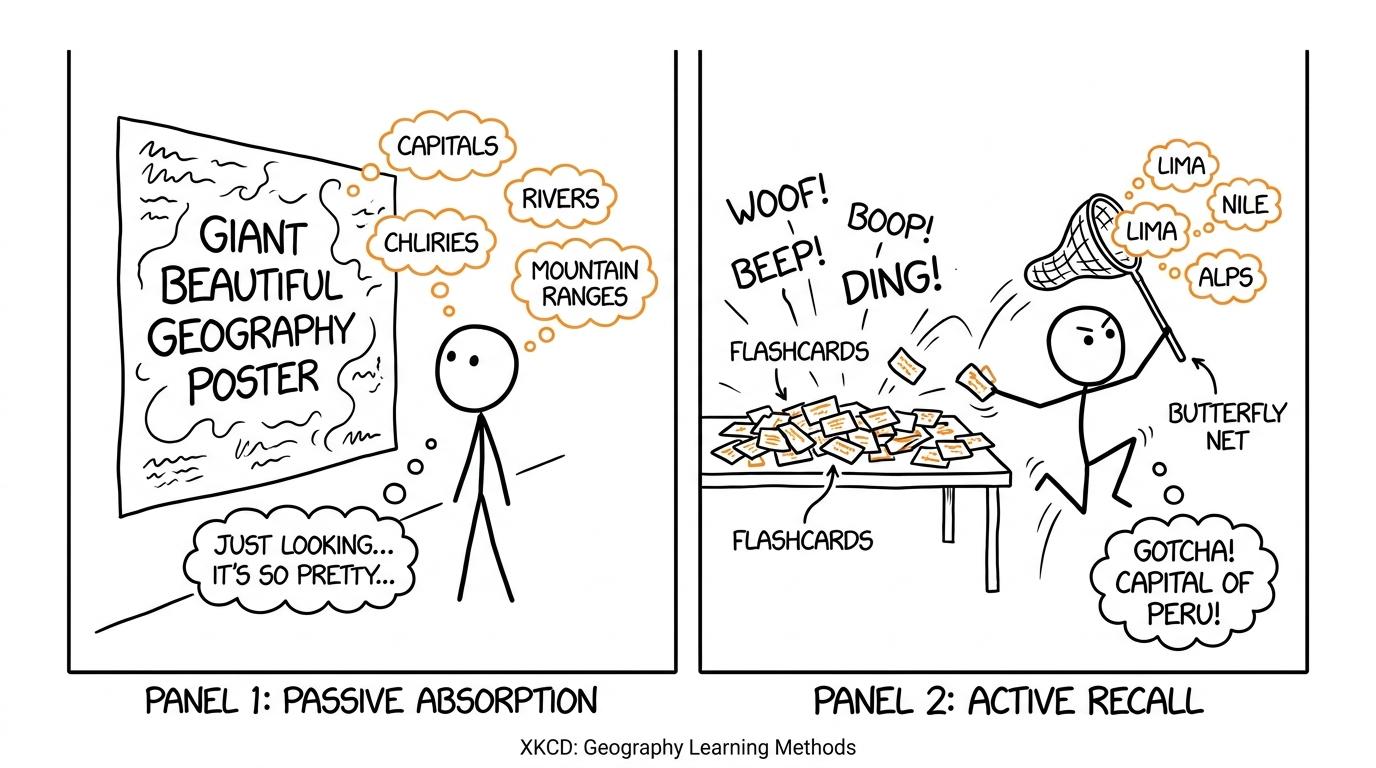 Active recall catches facts while passive rereading lets them drift away
Save full exam conditions for the right moment
You do not need silence for every flashcard. You do need occasional practice that resembles the exam.
When you secure a quiet room at school, a library desk or a calmer period at home, use some of it for timed answers. Work with questions for your actual exam board and current specification. Then use the mark scheme or teacher feedback to separate problems with knowledge from problems with command words, evidence, structure or timing.
A paper is most useful after it has been marked and analysed. MathsGenie's guide to using GCSE past papers properly explains the cycle clearly: complete, mark, repair and retest. You can apply that cycle to authorised geography papers from your school or exam board.
For maths, shorter GCSE mini tests are useful when a full paper is unrealistic. Predicted papers should supplement official past papers rather than replace them, and they should always match the relevant subject, board and current assessment arrangements.
Common mistakes when revising without quiet space
Waiting for ideal conditions
A perfect afternoon may never arrive. Begin with one small, noise-tolerant task and reserve demanding work for the best space you can realistically access.
Trying to block out every sound
You may not control the whole house. Focus on reducing unpredictable interruptions, choosing a manageable task and agreeing short protected periods.
Revising passively
Highlighting and rereading can occupy time without testing memory. Close the notes, retrieve first, check afterwards and correct inaccuracies.
Writing beautiful notes but avoiding questions
Presentation is not the exam skill. Use concise notes as a launch point for recall, resource interpretation and exam responses.
Ignoring fieldwork and geographical skills
Specifications assess more than case-study facts. Revisit your own fieldwork, enquiry stages, data presentation, conclusions, limitations and unfamiliar contexts as required by your board.
Using noise as a reason to sacrifice sleep
Working deep into the night may provide silence, but exhaustion can undermine the next day. Choose a sustainable routine and speak to a trusted adult if your environment makes revision or sleep consistently difficult.
Make the next session small enough to start
Not having a quiet room is a real constraint. It is not a character flaw, and it does not mean you are incapable of revising well.
Choose one geography topic. Set a task that can be finished in 202020 minutes. Retrieve before looking, check your answer, and write down the next gap. Then arrange one quieter session this week for a timed response.
For your maths exams, let MathsGenie remove the search and set-up time. Start with the revision planner, then use free revision lessons, practice questions, mini tests, past papers, predicted papers, mark schemes and video solutions. A calm system will not make your home silent. It will make your next step clear.










