Revise GCSE English Language and Literature Screen vs Paper
Revise GCSE English Language and Literature screen vs paper with a practical hybrid plan for deeper reading, stronger recall and realistic exam practice.
The screen makes revision feel effortless. Every quotation, video and past paper is a click away. Yet convenience can hide a problem: finding information is not the same as remembering it.
If you are deciding how to revise GCSE English Language and Literature screen vs paper, the short answer is to use both, but for different jobs. Screens are excellent for organising resources, watching explanations, searching texts and receiving quick feedback. Paper is often better for close reading, recalling quotations and practising the handwritten responses required in most GCSE English examinations.
The strongest approach is therefore hybrid: learn and organise digitally, then retrieve, annotate and practise on paper. This matters particularly if you are balancing English with GCSE maths, where the same principle applies: understanding something on screen must eventually become independent exam performance.
The screen vs paper revision checklist
Use this as your starting point:
- Read demanding extracts on paper when possible, particularly if they require sustained attention.
- Use a screen to organise quotations, themes, vocabulary and teacher feedback.
- Recall before reviewing rather than repeatedly rereading notes.
- Write timed responses by hand if that matches how you will sit the examination.
- Mark against the correct exam-board materials, not a generic online checklist.
- Remove digital distractions before beginning a screen-based session.
- Revisit mistakes later so that improvement is tested rather than assumed.
The aim is not to defend paper or celebrate technology. It is to give each medium the work it performs best.
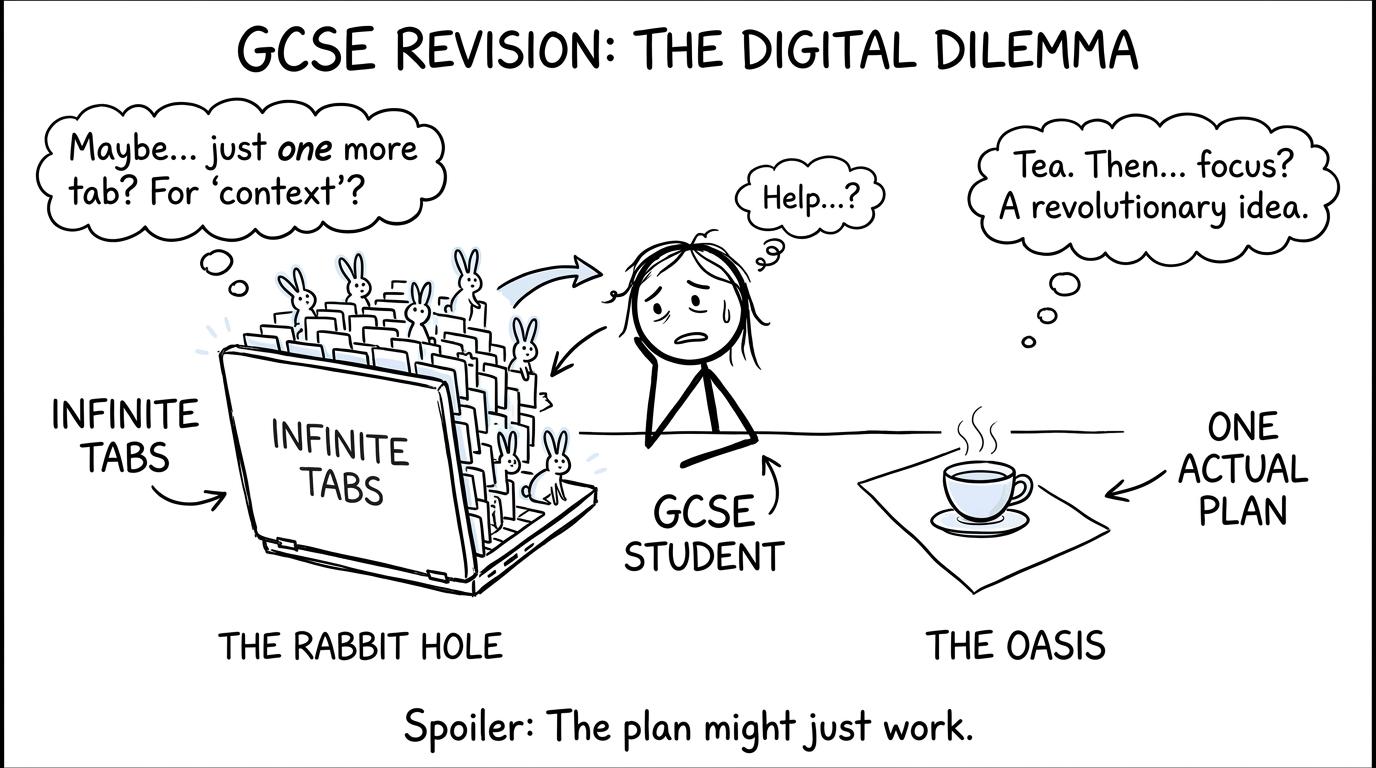 A student choosing between infinite digital tabs and one calm revision plan
Does revising GCSE English digitally work as well as paper?
Sometimes. The research is more nuanced than the claim that screens are either harmful or automatically modern and efficient.
Systematic reviews comparing digital and print reading have produced mixed findings, but several have identified a small comprehension advantage for paper. That difference appears more consistently with longer, informational texts and tasks involving scrolling. Research on narrative reading is less decisive, with some reviews finding little or no reliable difference between media.
That distinction is useful for GCSE English. Literature revision often involves narratives, poems and plays, while English Language may require careful navigation of unfamiliar fiction and non-fiction extracts. Neither subject is simply “reading”. You must locate evidence, infer meaning, analyse choices and construct a response under time pressure.
Paper can reduce navigation demands and give a text a fixed physical layout. Screens, however, can make searching, enlarging text, rearranging notes and accessing resources much easier. Accessibility needs also matter: digital text may be preferable when a student benefits from text resizing, colour changes, assistive technology or typing as a reasonable adjustment.
So the evidence does not justify abandoning screens. It suggests that passive screen reading should not become your entire revision method.
What screens do particularly well
A screen is a powerful revision library. The danger begins when the library is mistaken for the lesson.
Organising quotations and themes
Digital documents and flashcard systems let you group material by character, relationship, theme or writer’s method. You can reorganise the same quotation without copying an entire page again. This is useful when one short quotation supports several interpretations.
Keep entries brief. A quotation bank should prompt thought, not reproduce every paragraph your teacher has given you. Record the quotation, where it occurs, a precise method and two possible ideas. Then close the document and retrieve those ideas from memory.
Watching explanations strategically
Videos can clarify a difficult scene or show how an examiner approaches a question. Pause before the explanation finishes and predict the next point. Afterwards, close the video and write what you remember.
This is the difference between consumption and revision. The first feels smooth. The second reveals what has actually stuck.
The same rule supports maths revision. A video solution only becomes useful when you can reproduce the method independently. MathsGenie’s free GCSE maths revision hub brings together revision lessons, questions, papers and solutions, but the learning still happens when you attempt the work yourself.
Editing and comparing writing
Typing makes it easy to move sentences, test alternative openings and highlight repeated words. Use that flexibility during the drafting stage. Compare your answer with the assessment objectives and an official mark scheme from your exam board, then identify one change that would make the response more precise.
Do not edit indefinitely. A polished digital paragraph can conceal the fact that it took far longer than exam conditions allow.
What paper does particularly well
Paper creates useful friction. You cannot instantly search for a quotation or drag a sentence into a better position. That inconvenience forces retrieval and planning, two abilities the examination needs.
Close reading and annotation
Print an unfamiliar extract and give it one focused reading purpose. You might track changes in tone, contrasts in setting or the development of a viewpoint. Keep annotations selective. Covering every margin with terminology can leave you with plenty of labels but no interpretation.
After annotating, turn the page over and summarise the writer’s main effect from memory. This checks whether the details formed a coherent understanding.
Remembering Literature content
For Literature, create small recall sheets rather than enormous posters. Begin with a blank page and reconstruct a character arc, theme map or sequence of important moments. Add quotations only after you have recalled the argument they support.
The exact examination format depends on your board and specification. For example, AQA English Literature uses closed-book written examinations, while its English Language papers use unseen texts. OCR, Pearson Edexcel and Eduqas organise components differently, so check your specification rather than borrowing another student’s revision list.
Building handwriting stamina
If your examination will be handwritten, some revision must be handwritten too. Timed practice helps you learn how much you can plan and produce within the available time. It also exposes practical problems such as slow paragraph openings, cramped handwriting or spending too long annotating the source.
This is rehearsal, not punishment. Start with one timed section before attempting a complete paper.
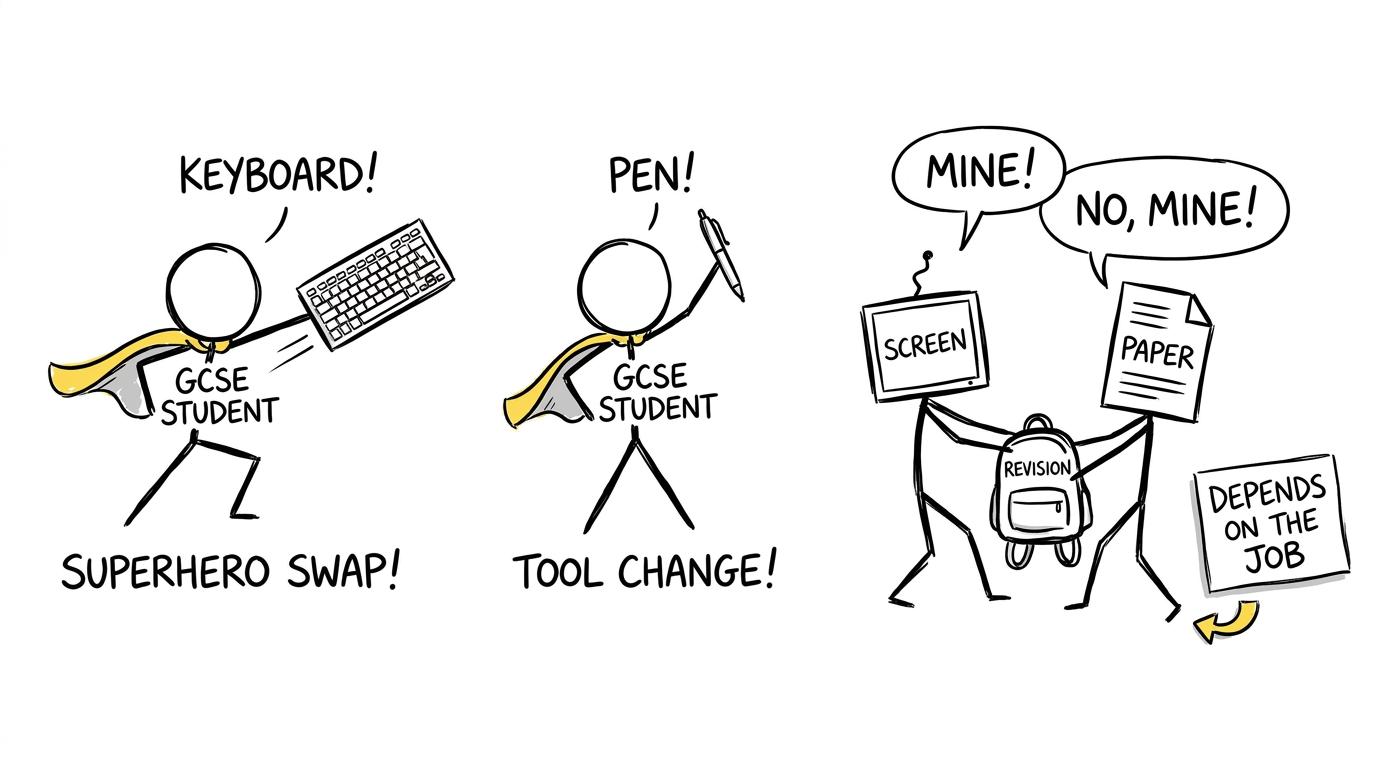 Screen and paper compete to carry the revision backpack
A hybrid method that improves what sticks
A useful revision cycle has four stages: collect, compress, retrieve and perform.
Collect on screen
Bring together the correct specification, set texts, class materials, past questions and official mark schemes. Separate English Language from English Literature, then divide Literature by text and Language by question skill.
Do not spend the evening perfecting folders. Organisation should remove friction from revision, not replace it.
Compress into usable prompts
Reduce a long digital document to a short set of prompts. A Literature prompt might name a character, theme or turning point. A Language prompt might ask you to identify a writer’s viewpoint or evaluate how successfully an atmosphere is created.
The prompt should make your brain supply the detail.
Retrieve on paper
Close the source and respond from memory. Write a quotation, interpretation, paragraph plan or opening sentence. Check it only after making a genuine attempt.
Students balancing several subjects can adapt MathsGenie’s twenty-minute revision routine: retrieve first, complete a short exam task, mark it and choose the next weakness. The content changes between English and maths, but the feedback loop remains valuable.
Perform under realistic conditions
Complete a timed response without notes, extra browser tabs or mid-task checking. Mark it with the materials for your board and record the reason marks were lost.
That reason should be specific: limited textual evidence, unclear comparison, weak analysis of a method, inaccurate punctuation or unfinished evaluation. The MathsGenie guide to finding weak GCSE topics uses the same evidence-first principle for maths: diagnose, practise and retest.
Fit English revision around GCSE maths
Students preparing for maths examinations rarely have unlimited time for English. A plan should therefore reduce decisions.
Alternate the type of concentration required. A screen-based quotation review can sit beside handwritten maths practice, while a timed English response can be followed by a shorter maths mini test. Avoid making every session a full paper.
MathsGenie’s one-month GCSE revision plan shows how retrieval, targeted practice and timed papers can fit into a repeatable week. When maths needs more attention, use revision lessons and exam-board resources to target a precise gap instead of vaguely revisiting an entire topic.
Past papers should enter gradually. Short sections are useful early; full papers become more important when content knowledge and stamina are ready to be tested. The guidance on when to start GCSE past papers explains why papers work best as diagnostic tools, not just final scores.
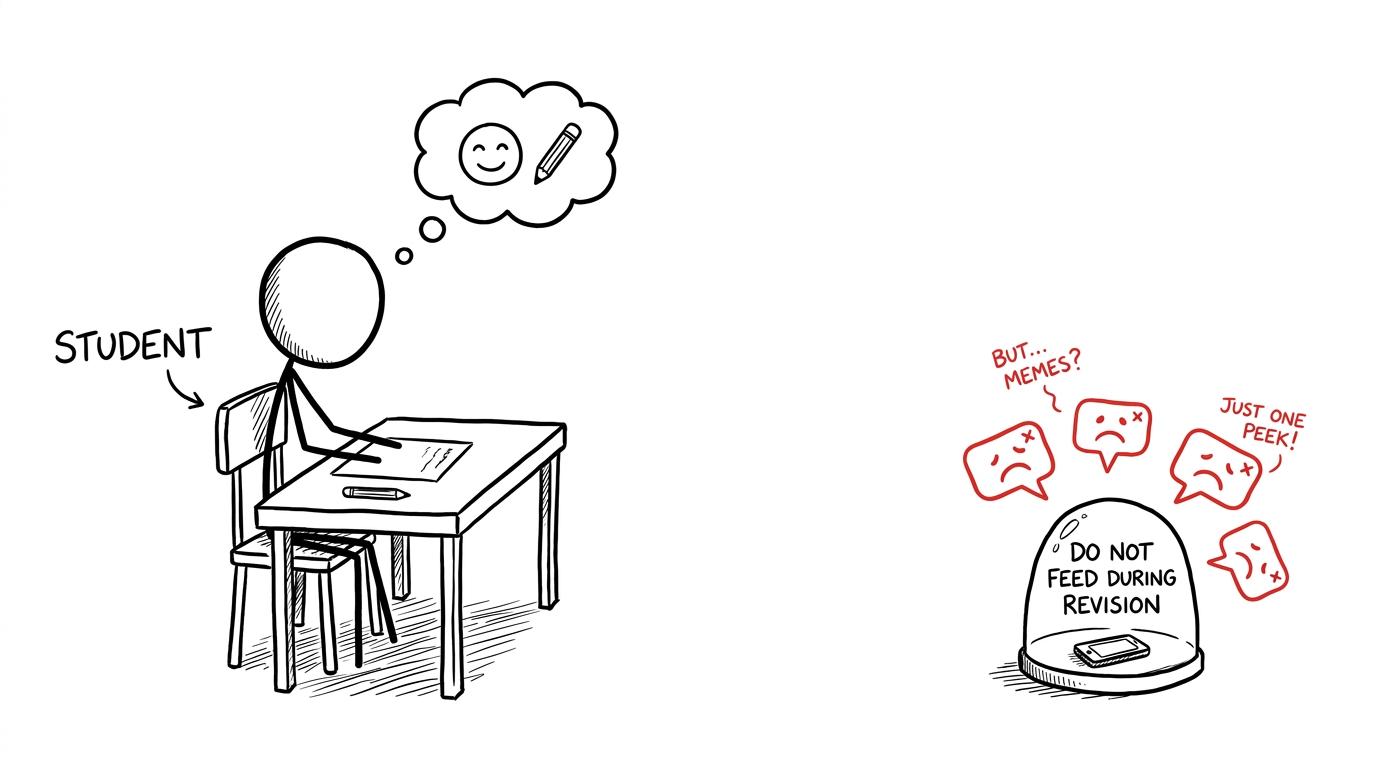 A phone placed safely away while a student completes focused revision
Common mistakes when choosing screen or paper
Treating preference as proof
You may prefer typing because it feels faster, or paper because it feels more serious. Neither feeling proves that you will remember more. Test yourself after a delay and compare the quality of your recall.
Copying notes instead of retrieving
Copying a digital quotation bank into a notebook changes the surface, not the thinking. Hide the source first. What you can reconstruct is more informative than what you can transcribe.
Revising in a different mode from the exam
Digital learning can remain part of your routine, but your final practice should reflect the conditions you expect. If you will handwrite, build handwriting stamina. If your school has confirmed an approved on-screen arrangement or reasonable adjustment, practise with that format and follow its guidance.
Using generic advice for the wrong specification
English GCSEs are untiered, unlike foundation and higher tier maths, but paper structures, set texts and question wording vary across AQA, Pearson Edexcel, OCR and Eduqas. Confirm your board, qualification and current specification before downloading resources.
Allowing the screen to fragment attention
Notifications and unrelated tabs make close reading harder. Use full-screen mode, silence alerts and place your phone beyond reach. If distraction continues, print the extract. Changing the environment is often more reliable than repeatedly testing your willpower.
Make the medium serve the memory
Screen versus paper is not a contest with one permanent winner. It is a choice about the next task.
Use the screen when access, organisation, feedback or accessibility matters. Use paper when you need sustained reading, retrieval, annotation or realistic handwritten practice. Then judge both by the same question: can you still explain and apply the idea when the notes are gone?
Carry that habit into maths. Start with the MathsGenie GCSE maths revision hub, choose your exam board and use revision lessons to repair gaps. Follow them with practice questions, mini tests, past papers and predicted papers. Mark carefully, use video solutions where needed, and return to the questions you could not initially complete.
A resource can live on a screen. Your understanding cannot stay there.