

Revise GCSE Dance With a Sibling: What Helps?
Revise GCSE Dance with a sibling effectively: use their feedback and exam experience, avoid outdated notes, and protect time for GCSE maths revision.
There is something reassuring about revising with someone who has already faced the exam. They know what the pressure feels like. They may remember the questions that caught them out. Most importantly, they can make revision feel less lonely.
So, does it help to revise GCSE Dance with a sibling who has already completed the course? Yes; provided you use them as a practice partner, not as the final authority on the current specification. Their feedback, questioning and experience can be genuinely useful. Their old deadlines, set-work details and memories of mark schemes may not be.
That distinction matters, especially when Dance revision must fit alongside GCSE maths and other subjects. Good support saves time. Outdated advice quietly wastes it.
The short answer: what should your sibling help with?
Ask your sibling to:
- quiz you on terminology and professional works;
- listen to your explanations and ask for evidence;
- watch practice performances and describe what they observe;
- help you rehearse under mild pressure;
- test whether you can recall ideas without notes;
- share general exam-day and revision experience;
- help you protect a balanced timetable across Dance and maths.
Do not rely on them to confirm:
- the current specification or assessment arrangements;
- this year's choreography stimulus;
- exact administrative requirements or deadlines;
- which anthology works you must study;
- current mark schemes, grade boundaries or teacher instructions.
Those details should come from your teacher and the current official exam-board materials.
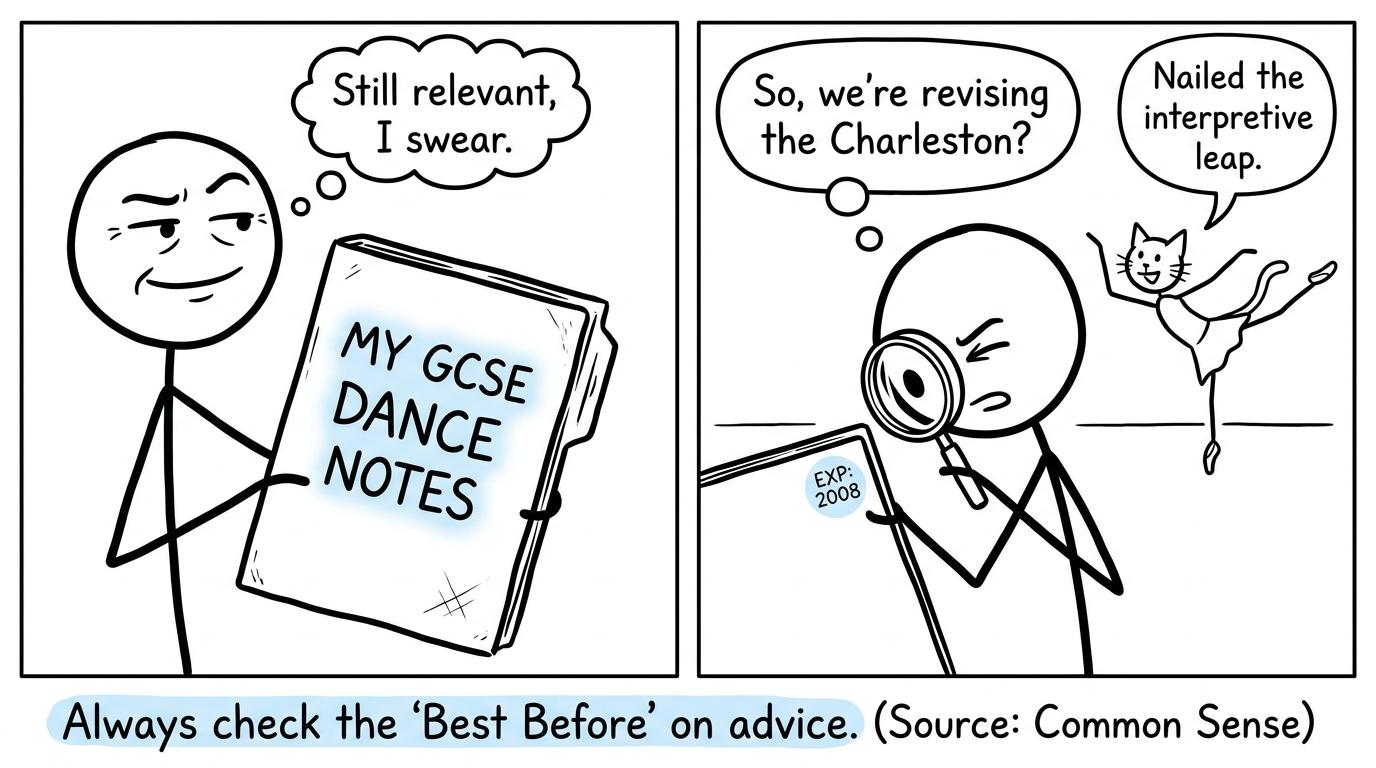 An older sibling presents dusty GCSE Dance notes while the younger student checks whether they have expired
Why an experienced sibling can be genuinely useful
A sibling does not need to remember every detail of the course to help. In fact, the best forms of support depend more on attention than subject expertise.
They can make your recall visible
Reading notes can create a comfortable illusion: everything looks familiar, so it feels learned. Close the book and the picture often changes.
Give your sibling a list of prompts and ask them to question you in an unpredictable order. For Dance appreciation, they might ask you to explain choreographic intent, movement content, performance environment or aural setting. They should not supply the answer too quickly. Their role is to reveal what you can retrieve independently.
This is also a useful principle for maths. Watching a method is not the same as producing it. The GCSE Maths revision hub lets you move from revision lessons into practice questions, where understanding has to become action.
They can ask the question exam answers often need: “So what?”
A Dance response can contain accurate description yet remain underdeveloped. If you identify a movement, design feature or choreographic device, your sibling can ask:
- What effect does it create?
- How does it communicate the intention?
- What evidence supports that interpretation?
- Can you use more precise Dance terminology?
They are not marking the answer. They are training you to move beyond naming a feature towards analysing and evaluating it.
The same habit strengthens mathematical reasoning. An answer is more secure when you can explain why a method works, check whether the result is sensible and show enough working for the mark scheme.
They can provide an audience
Performance changes when somebody watches. Concentration, movement memory and confidence are harder to maintain when a rehearsal no longer feels private.
A sibling can create a small, manageable version of that pressure. Ask them to watch without interrupting and record observations afterwards. Their feedback should be descriptive rather than vague: not “That was good”, but “Your focus dropped during the transition” or “The ending communicated the intention clearly”.
Your teacher remains the person who can connect feedback accurately to assessment criteria. A sibling simply helps you practise being observed.
They understand the emotional shape of a GCSE
Someone who has completed a GCSE knows that one difficult rehearsal, mock or practice paper does not decide the final grade. That perspective can be calming.
Their most valuable advice may be ordinary: start earlier than feels necessary, keep sessions manageable, and do not let one subject consume every evening. If your week feels crowded, the GCSE maths revision timetable guide can help you build repeatable sessions around school, practical rehearsals and rest.
What may be outdated in your sibling's advice?
Memory preserves experiences better than specifications. Your sibling may vividly remember how their exam felt while misremembering a duration, mark allocation or assessment rule.
At the time of writing, the current AQA GCSE Dance specification is 823682368236. It divides assessment between performance and choreography, worth 60%60\%60%, and a Dance appreciation written examination, worth 40%40\%40%. The written paper lasts 111 hour 303030 minutes and is marked out of 808080. Students study all six works in the prescribed anthology.
Those facts should still be checked against the current specification and your teacher's guidance when you revise. A sibling's course may have been affected by different arrangements, school decisions or temporary assessment changes. Even when the specification title looks familiar, the materials used by their class may not match yours.
Old notes may contain useful ideas but unreliable instructions
Old notes can still help with broad concepts such as physical, technical and expressive skills, choreographic devices, or the difference between description and analysis. Treat them as prompts, not proof.
Be cautious if the notes refer to:
- a particular annual choreography task;
- submission dates or recording procedures;
- reduced or altered content;
- remembered question wording;
- predicted anthology combinations;
- grade boundaries from a previous series.
Grade boundaries are set for a particular examination series. A previous boundary does not guarantee the boundary for your year.
Their successful method may not suit you
A sibling might have revised by making detailed posters. That does not mean posters are your best use of time. They may remember movement accurately after watching it once; you may need systematic repetition. They may enjoy verbal questioning; you may initially need written prompts.
Borrow methods, then test them. The useful question is not “Did this work for my sibling?” but “Can I now recall, explain or perform this more accurately?”
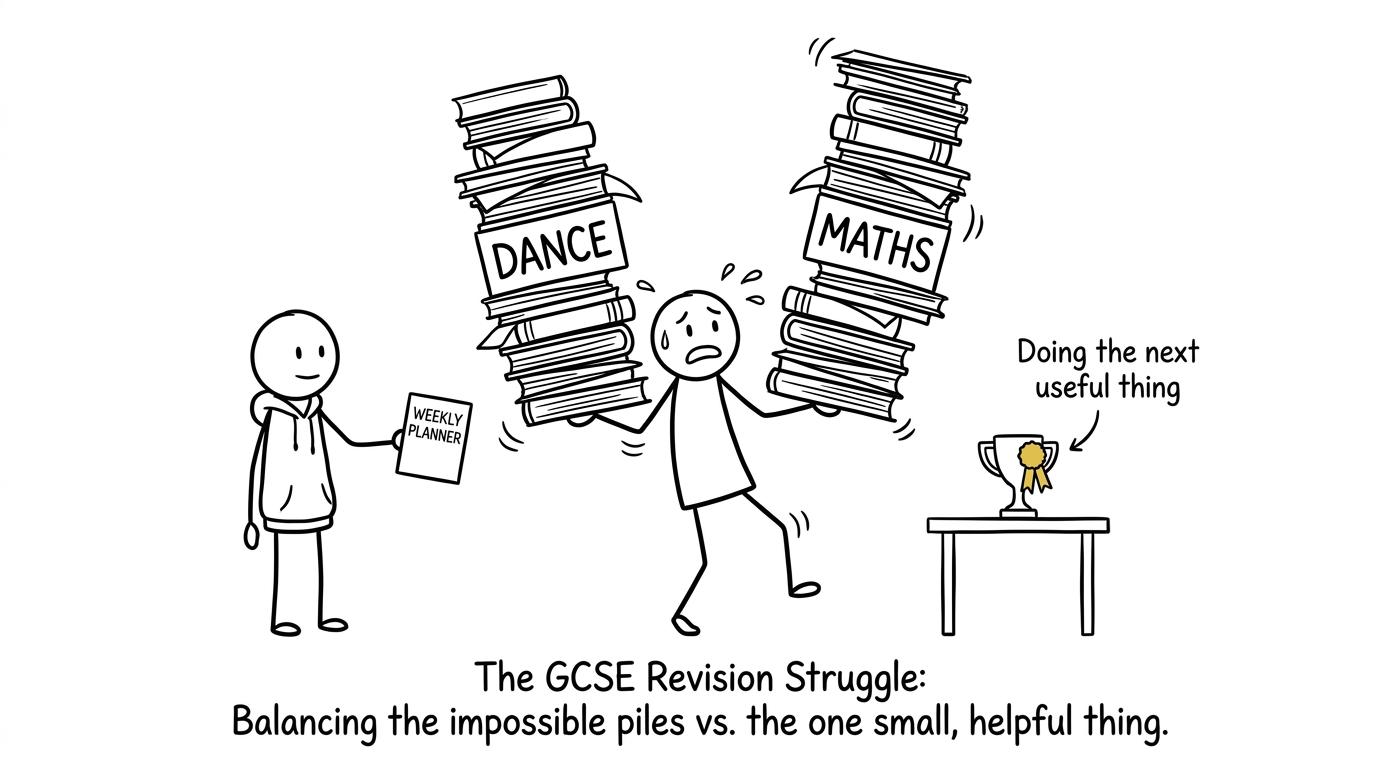 A student balances giant Dance and Maths piles while a sibling offers a small weekly planner
A practical sibling revision routine
Keep the session focused enough that family familiarity does not turn it into a long conversation.
Agree on one outcome
Choose a precise goal before beginning. You might revise the production features of one professional work, practise explaining your own choreography, or receive feedback on one performance section.
“One topic well” is usually more productive than “all of GCSE Dance”.
Give your sibling reliable prompts
Prepare questions from your current class materials, specification and teacher guidance. This prevents your sibling from accidentally rebuilding the course from memory.
For written revision, include a mixture of definitions, short explanations and prompts requiring analysis. For practical work, give them two or three observable features to watch. Do not ask them to judge everything at once.
Work without immediate rescue
Ask your sibling to leave a short pause after each question. If you struggle, they can offer a prompt rather than the full answer. Productive difficulty tells you where knowledge is fragile.
Maths revision benefits from the same honesty. The guide to finding your weakest GCSE topics explains how evidence from marked questions can replace guesswork.
Finish with a short action list
Record no more than three improvements. For example:
- relearn one set-work detail;
- make one explanation more analytical;
- rehearse a transition with greater consistency.
Then decide when you will check those improvements. Feedback becomes useful only when it changes the next attempt.
Protecting your GCSE maths revision time
Dance combines practical work, creative decisions and written preparation. It can expand to fill every available evening, particularly near performance deadlines. Maths can do the same when a practice paper exposes several gaps at once.
The answer is not to choose whichever subject feels most urgent each night. Give each subject a defined job.
A balanced week could include:
- scheduled Dance rehearsal and appreciation recall;
- focused maths topic practice;
- one timed maths section or mini test;
- time to mark, correct and revisit mistakes;
- recovery time rather than continuous late-night revision.
For maths, follow a simple cycle: learn, practise, mark, fix and retest. The article on using GCSE past papers properly shows how to turn a completed paper into a useful error log rather than just a score.
If you take Edexcel, you can practise with Edexcel GCSE Maths past papers, including mark schemes and available worked solutions. Students taking AQA, OCR or Eduqas can select their board through the main GCSE hub. Always match the correct exam board and Foundation or Higher tier.
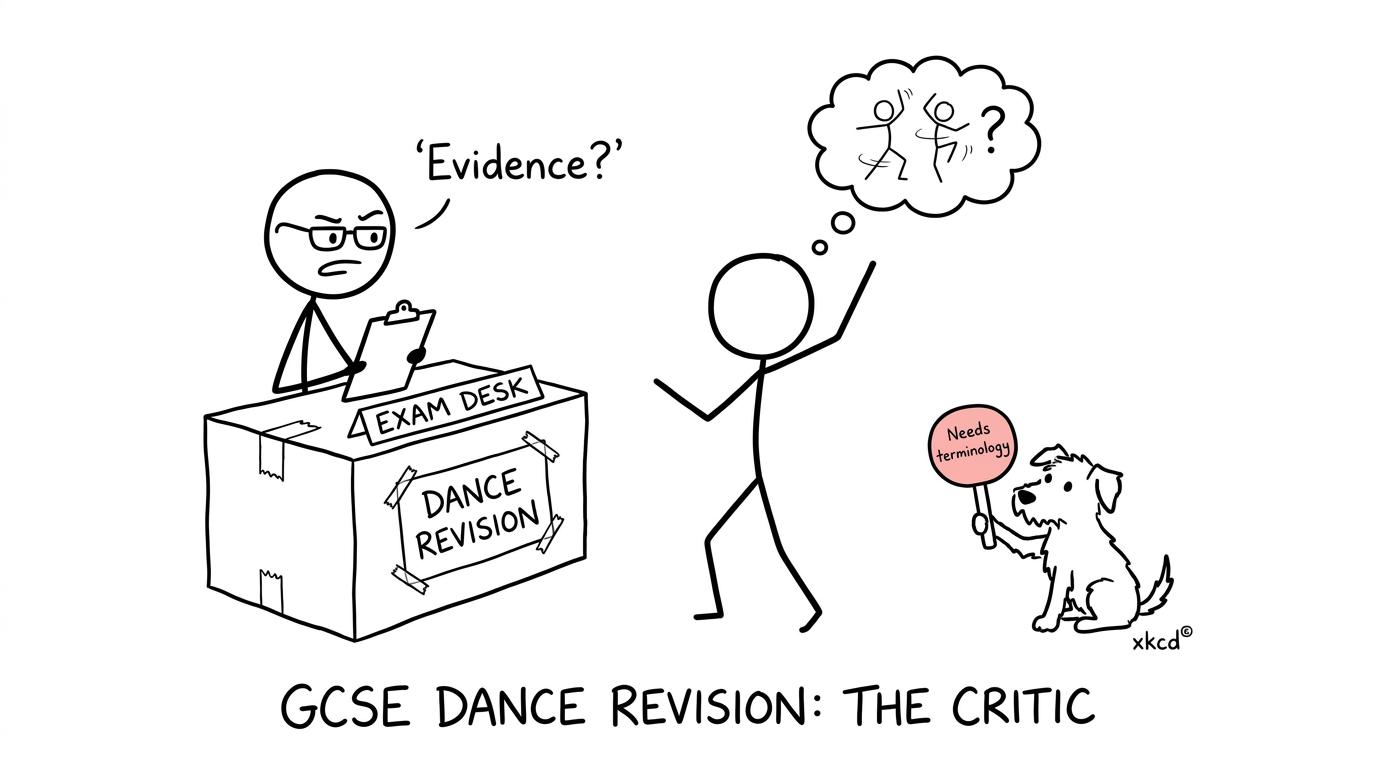 A sibling conducts a mock Dance interview while the family dog demands better terminology
Common mistakes when revising GCSE Dance with a sibling
Treating memory as official guidance
Your sibling may sound confident because they remember their own course clearly. Confidence does not make information current. Check assessment details against today's specification and teacher instructions.
Asking for general feedback
“Was it good?” usually produces “Yes”. Ask your sibling to watch for a specific feature, quote something you said or identify where an explanation became unclear.
Turning help into comparison
Your sibling's grade, performance style and revision habits belong to their experience. They are not a prediction of yours. Use their perspective without measuring your progress against it.
Spending the whole session discussing revision
Planning can become a substitute for retrieval and practice. Set the goal quickly, begin the task and save general advice until the end.
Letting one subject erase the others
A productive Dance session should not automatically consume the time reserved for maths. When exams are close, use a contained plan such as the GCSE one-week revision plan. The night before a maths paper, the calm GCSE maths preparation guide can also help you avoid an unfocused final cram.
Use your sibling for support, not certainty
A sibling who has completed GCSE Dance can give you something no revision guide can: a responsive audience who knows what it is like to prepare for the qualification. Let them quiz you, notice patterns, ask for evidence and help you rehearse calmly.
But keep the boundary clear. Your teacher, current specification and current assessment materials decide what is required. Your sibling helps you practise meeting those requirements.
Then bring the same discipline back to maths. Open MathsGenie's free GCSE revision resources, choose the correct board and tier, and turn one weakness into today's task. Use revision lessons to relearn it, practice questions and mini tests to test it, then past papers, predicted papers, mark schemes and video solutions to make the improvement stick.
The best revision support does not do the work for you. It makes the next useful step easier to see.











