

Revise GCSE Dance: Screen vs Paper
Revise GCSE Dance screen vs paper with a practical hybrid plan for stronger recall, sharper analysis, confident exam answers and focused performance review.
Revision can look productive without producing much learning. A dance video plays. Notes are highlighted. Another tab opens. An hour passes, yet explaining the choreographic intention without looking still feels difficult.
So, when you revise GCSE Dance screen vs paper, which format actually helps information stick? The short answer is that neither wins every task. Screens are strongest for observing movement, replaying professional works and recording performance. Paper is often better for focused reading, retrieval practice, planning extended answers and recreating exam conditions. Effective GCSE Dance revision combines both, alongside physical rehearsal.
The medium matters, but the action matters more. Watching is not the same as remembering. Reading is not the same as answering.
The screen vs paper revision checklist
Use each format for the job it handles best:
- Screen: watch set works, slow down movement, compare sections and review recordings of your performance.
- Paper: recall facts from memory, annotate printed resources, plan answers and complete timed questions.
- Physical practice: rehearse technical, physical and expressive skills safely.
- Feedback: check what was accurate, specific and relevant.
- Spacing: return to the same content after a gap instead of completing one long session.
- Exam practice: write by hand if that matches how you will complete the examination.
This is not a contest between old and new technology. It is a question of matching the tool to the thinking.
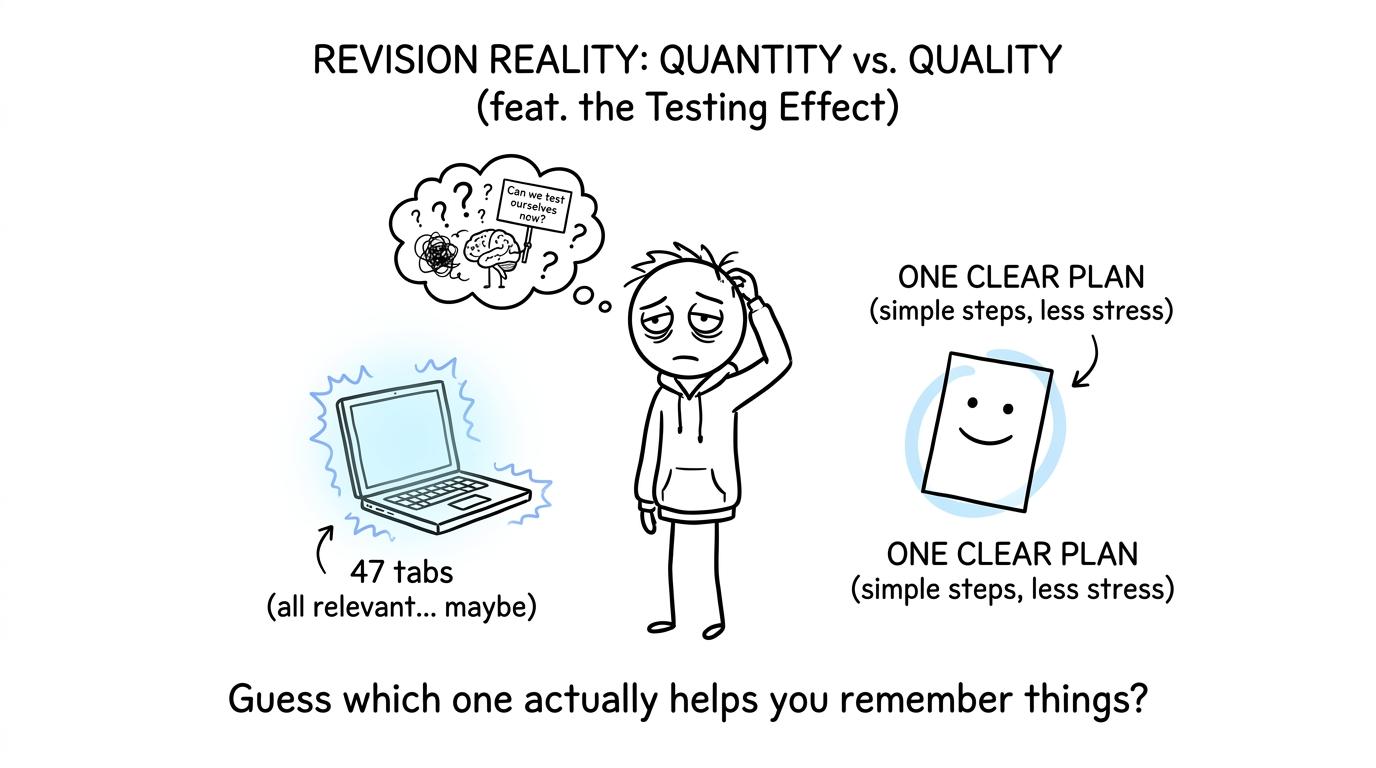 A student choosing between an overloaded laptop and one clear revision plan
Does digital GCSE Dance revision hold up against paper?
Research comparing reading on screens and paper does not support an absolute verdict. Reviews involving school-aged readers report mixed findings: some studies find little meaningful difference, while others find a modest paper advantage, particularly for longer informational texts and deeper comprehension. Distraction, scrolling, time pressure, reading habits and the design of the digital material can all affect the result.
That nuance matters for Dance. GCSE Dance revision is not simply reading. It includes visual analysis, practical reflection, factual recall and extended writing. A screen can show timing, dynamics, spatial relationships and production features in a way that a printed page cannot. But repeatedly viewing a work can also create familiarity without secure recall.
Paper has different strengths. A printed page offers a stable layout and fewer opportunities to drift into messages or unrelated tabs. It also makes it easy to cover notes, retrieve an answer and reveal the information afterwards. Yet copying a textbook onto paper is still passive. The page does not make revision effective by itself.
A useful rule is:
Use the screen to gather visual evidence. Use paper to prove that you can recall, organise and communicate it.
Match revision to the GCSE Dance assessment
Always follow the current specification and guidance supplied by your school. For AQA GCSE Dance, Component 1 covers performance and choreography and contributes 60%60\%60% of the qualification. Component 2 is Dance appreciation, a written examination worth 40%40\%40%, lasting 111 hour 303030 minutes and marked out of 808080.
The written paper assesses knowledge of choreographic processes and performing skills, critical appreciation of your own work, and critical appreciation of professional works. It requires more than recognising a scene when it appears on a laptop. You must retrieve relevant knowledge and express analysis, interpretation and evaluation clearly.
Use screens for observation
Digital video is valuable when the evidence is movement-based. Use it to:
- observe action, space, dynamics and relationships;
- replay short sections rather than watching an entire work automatically;
- identify how production features support choreographic intention;
- compare different moments within a work;
- review a recording of your own performance or choreography;
- pause before a significant moment and predict what happens next.
Give every viewing a question. For example, focus on spatial content during one viewing and expressive skills during another. This reduces the temptation to notice everything vaguely and remember nothing precisely.
Where permitted by your teacher and school, recordings of your own work can help you compare intention with effect. They should support practical rehearsal, not replace it. Performance develops through safe, repeated physical practice and informed feedback.
Use paper for retrieval and written precision
Paper becomes especially useful after viewing. Close the video and write what you can remember before checking. You might create:
- blank grids for the professional works;
- flashcards with questions rather than copied paragraphs;
- comparison plans linking two works;
- vocabulary lists grouped by action, space, dynamics and relationships;
- timed plans for longer responses;
- an error log recording missing evidence or vague explanations.
The act of retrieving is important. A beautiful page created while looking at the source may feel fluent because the information is visible. The examination asks whether it remains available when the source disappears.
This principle also applies when you are balancing Dance with maths. The MathsGenie GCSE Maths revision hub uses lessons, questions and assessment resources to move students from recognition towards independent performance. Different subject, same useful distinction: seeing a correct answer is easier than producing one.
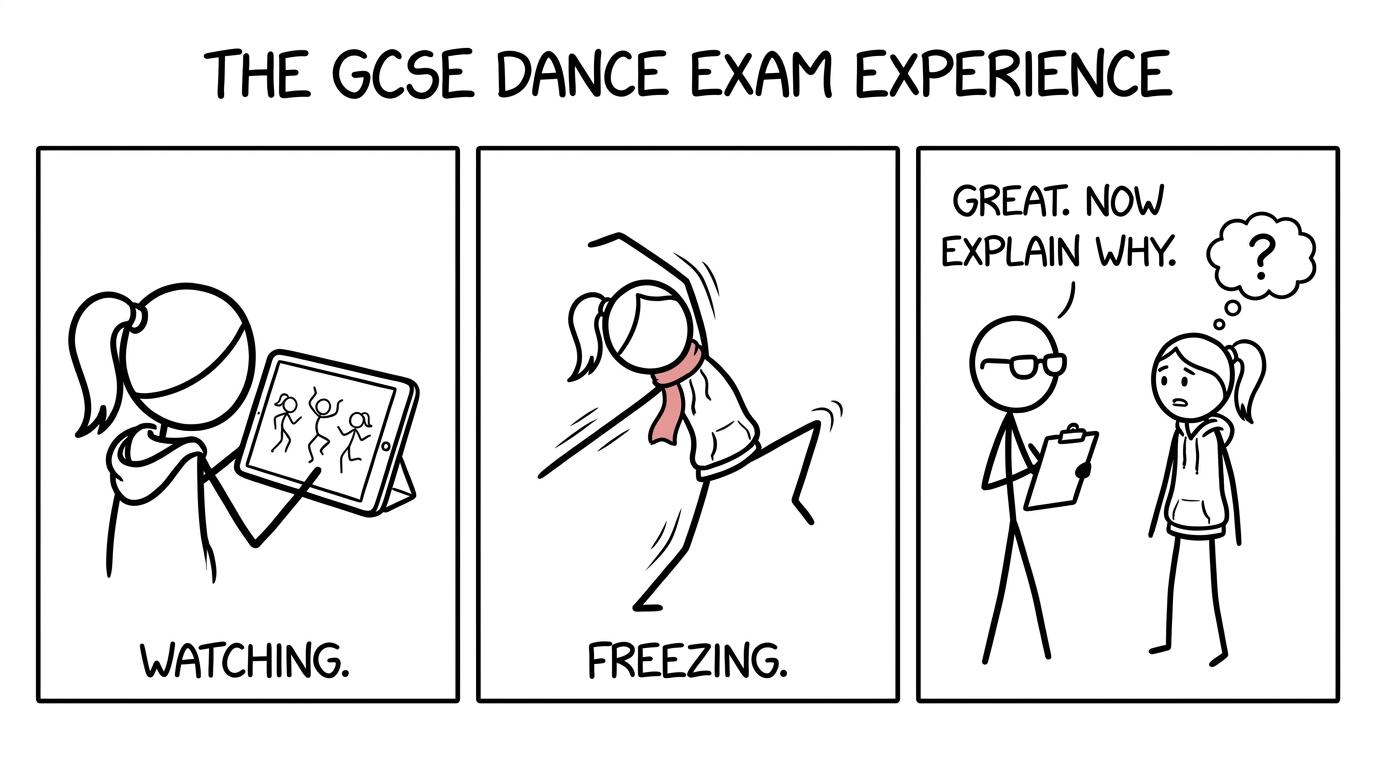 A dance student being asked to explain rather than merely watch
Build a hybrid GCSE Dance revision session
A good hybrid session has three phases: observe, retrieve and apply. It does not require expensive equipment or elaborate notes.
Observe on screen
Choose one narrow focus, such as choreographic intention, expressive skills or lighting. Watch a short relevant section and record only essential evidence. Avoid writing a running description of everything that happens.
Retrieve away from the screen
Close the source. On blank paper, reconstruct the key content from memory. Add terminology, evidence and the effect on the audience or intention where appropriate. Only then reopen the source and correct omissions in another colour.
Apply under exam-like conditions
Answer or plan a question without notes. Afterwards, compare your response with teacher guidance, the mark scheme or an approved model. Record one precise improvement, such as using more specific movement evidence or making the link to intention explicit.
This resembles the attempt-mark-fix-retest cycle used in MathsGenie's guide to using GCSE past papers. It is also the logic behind finding weak GCSE topics from evidence: revision becomes more efficient when mistakes decide the next task.
Make screen revision active rather than comfortable
Screens become weak revision tools when they encourage uninterrupted consumption. Make them active by introducing decisions:
- pause and name the feature you noticed;
- watch without sound and consider what the aural setting contributes;
- listen without watching and recall the corresponding movement or atmosphere;
- hide your notes and explain a work aloud;
- compare your explanation with the specification language;
- keep only the necessary tab open and place your phone elsewhere.
Digital notes can work well when they are searchable, concise and organised around questions. They work less well when they become an archive that you never test yourself on.
If you also have maths to revise, short digital checks can stop large gaps hiding inside broad topics. Edexcel GCSE Maths mini tests provide that kind of focused diagnosis, while the same principle can guide Dance: test one work, one skill or one question type at a time.
Make paper revision more than copying
Paper is not automatically active. Copying a revision guide word for word can take a long time while demanding very little recall.
Instead, begin with a blank page. Write a heading, then produce everything you know before consulting your notes. Turn weak areas into questions. Compress longer material into a comparison grid or answer plan, but keep the details that earn marks: accurate terminology, relevant evidence and a clear explanation of significance.
Handwritten practice also reveals practical issues that on-screen planning can hide. Can you sustain a clear answer? Is your handwriting readable at speed? Do you spend too long on the opening idea? A timed paper response provides more useful evidence than another hour spent decorating notes.
The same discipline supports maths preparation. MathsGenie's advice for stopping GCSE content from being forgotten combines active recall, spaced returns and exam-style questions rather than relying on repeated reading.
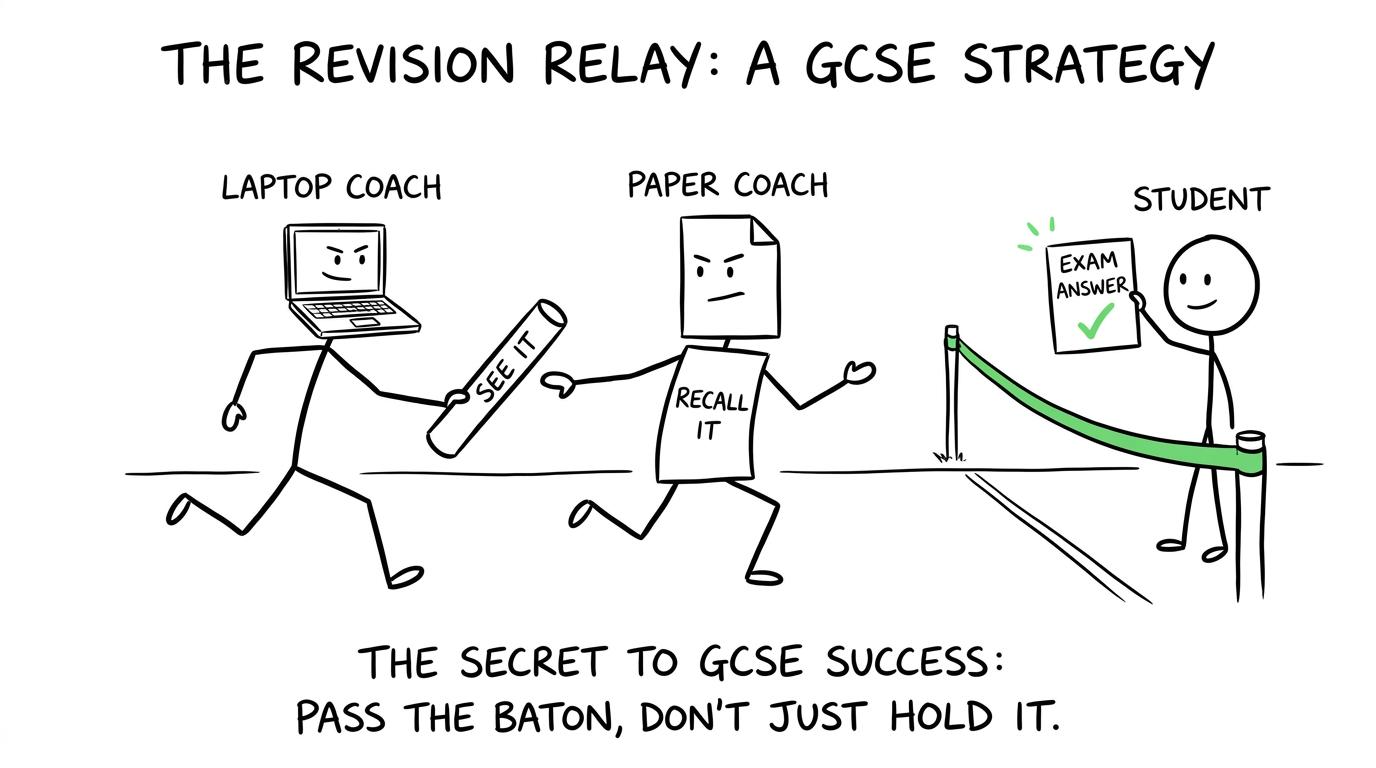 A laptop and paper passing the revision baton from seeing to recalling
Space your revision across the week
Memory strengthens when knowledge is retrieved after some forgetting has occurred. Instead of revising one professional work for an entire evening and abandoning it, return to it in shorter sessions across several days.
A balanced week might include:
- one screen session analysing selected extracts;
- one closed-book paper recall session;
- one practical rehearsal with a defined performance focus;
- one timed written response;
- one review session correcting earlier weaknesses.
Keep the schedule realistic beside your other GCSE subjects. A simple planner is more useful than an ambitious timetable that survives for two days. For students coordinating several maths papers and topics, the GCSE one-week maths revision plan offers a useful model of diagnosis, focused repair and timed practice.
Common mistakes when revising GCSE Dance
Watching complete works without a purpose
Repeated exposure can feel like knowledge. Set a question before pressing play and retrieve the answer afterwards.
Creating notes but never testing them
Notes store information outside your head. Add closed-book recall, verbal explanation and exam questions.
Treating digital speed as understanding
Fast scrolling and familiar images can create overconfidence. Slow down, pause and explain the significance of the evidence.
Treating paper as automatically superior
Copying paragraphs is passive regardless of the medium. Paper works best when it forces retrieval, selection or timed writing.
Neglecting practical rehearsal
Performance and choreography cannot be secured through screen and paper alone. Use safe physical practice, teacher feedback and purposeful review.
Using resources for the wrong specification
Dance content and assessment details are specification-specific. Check the current information from your school and exam board rather than assuming that any online checklist applies.
Marking without changing anything
A marked answer is only useful when it produces a next action. Correct the weakness and test it again. Maths students can see this process in the guide to using Edexcel GCSE Maths past papers properly.
Choose the tool that makes you think
The screen is not the enemy of memory, and paper is not a guarantee of learning. Screens are exceptionally useful for seeing dance. Paper is often better for slowing thought down, retrieving detail and rehearsing handwritten answers. Physical practice turns knowledge into performance. The strongest revision plan moves deliberately between all three.
Start with one short extract. Watch it with a question, close the screen, write what you remember and check the gaps. Then return later and retrieve it again. That small loop tells you more about your learning than the number of hours spent looking at notes.
For your maths exams, build the same habit with MathsGenie. Begin at the free GCSE Maths revision hub, use revision lessons and practice questions to repair weak topics, then test them with mini tests, past papers and predicted papers. Mark schemes and video solutions show what needs changing. The improvement comes when you return and do it independently.











