Revise GCSE Astronomy Alone or With Others?
Revise GCSE astronomy alone or with others using a practical hybrid plan for facts, calculations, observations, feedback and confident exam practice.
Revision can look productive from the outside while achieving very little underneath. A group spends an hour discussing black holes but answers no questions. A student works alone in perfect silence yet keeps rereading the same comfortable notes.
So, is it better to revise GCSE astronomy alone or with others? For most students, the strongest answer is both. Revise alone when you need concentration, honest testing and calculation practice. Work with others when explanation, comparison and challenge will reveal gaps you cannot easily see yourself.
The important choice is not whether solo or group revision is universally better. It is which approach fits the task in front of you.
The quick decision checklist
Choose solo revision when you need to:
- retrieve facts without prompts;
- practise calculations independently;
- complete timed exam questions;
- review a personal weak area;
- analyse your mistakes without interruption.
Choose revision with others when you need to:
- explain an astronomical process aloud;
- compare observational methods;
- test vocabulary and definitions;
- debate the strengths and limitations of evidence;
- receive immediate questions and feedback.
Use a hybrid session when a topic requires both knowledge and application. Learn and practise alone first, then explain your reasoning to someone else. Finish by answering another question independently.
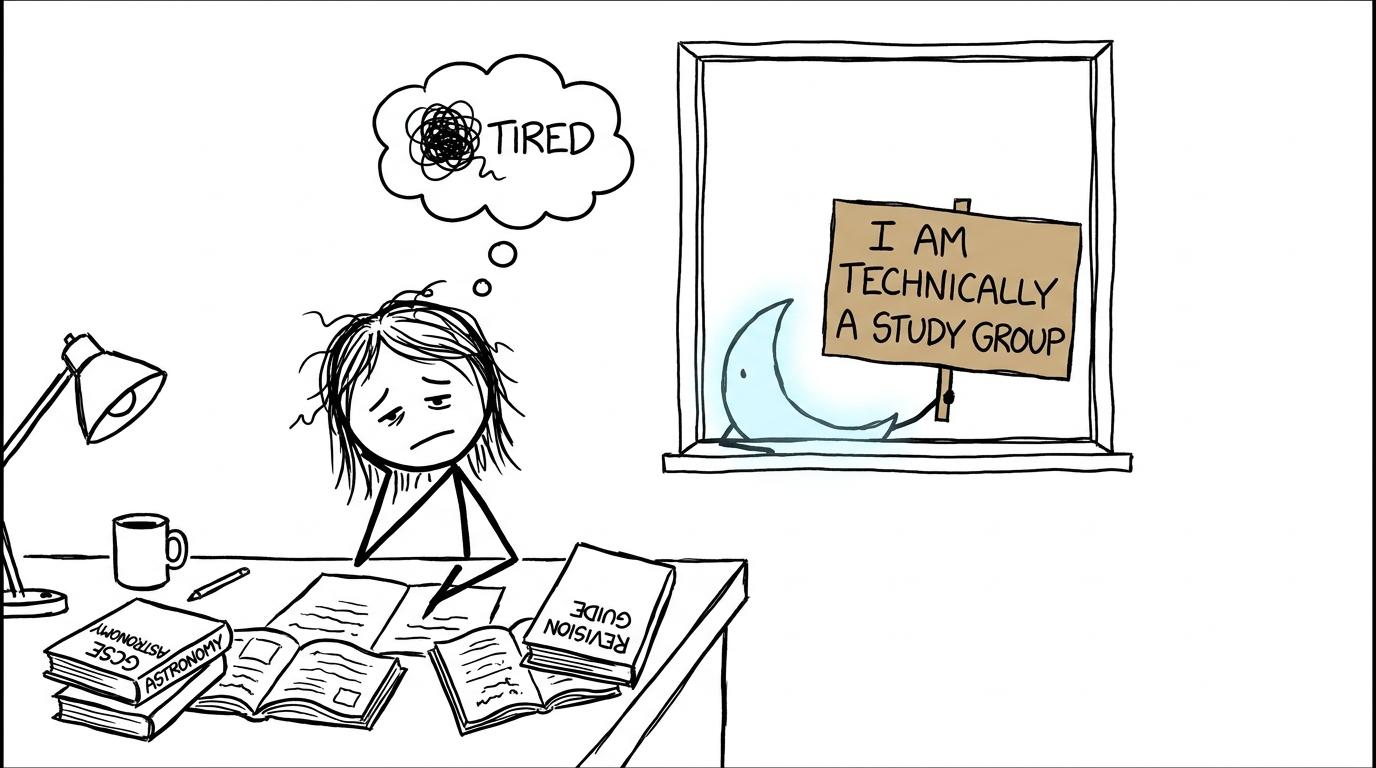 A GCSE student discovers that the Moon is a very quiet revision partner
Why the type of revision matters in GCSE Astronomy
Pearson Edexcel GCSE Astronomy is not simply a collection of facts about planets and stars. Its written assessment covers knowledge, application, calculations, graphs, observational understanding and evaluation.
The current specification has two equally weighted written papers: Naked-eye Astronomy and Telescopic Astronomy. Mathematical skills account for at least 20%20\%20% of the qualification's marks. Students must also undertake both unaided and aided observational work, while their understanding of observational methods is tested in the written examinations.
That mixture changes how you should revise. Remembering the order of stellar evolution is one kind of task. Rearranging an astronomical formula is another. Evaluating why cloud cover or light pollution affected an observation demands something different again.
Research used in current UK education guidance supports active retrieval, purposeful practice, spacing and feedback. In practical terms, trying to recall an answer is more useful than repeatedly looking at it. Whether you are alone or in a group, revision should make you think before revealing the answer.
When revising GCSE Astronomy alone works best
Solo revision is strongest when independence is part of the skill being tested. In the examination, nobody can supply the next step, correct your units or remind you which graph to use.
Calculations and mathematical skills
Astronomy includes standard form, ratios, inverse-square relationships, logarithms, unit conversions, significant figures, algebra and gradients. These need quiet practice because you must discover whether you can complete each process without hints.
Useful mathematical forms include:
a×10n a \times 10^n a×10nand relationships such as:
y∝1x2 y \propto \frac{1}{x^2} y∝x21You may also need to substitute into or rearrange formulae supplied in the examination. MathsGenie's free resources on standard form, changing the subject of a formula and direct and inverse proportion are useful for strengthening these transferable GCSE maths skills.
Work without notes first. Check the mark scheme or solution only after committing to an answer. If you always practise beside an open solution, you may become good at recognising a method without becoming able to produce it.
Graphs and data interpretation
Hertzsprung / Russell diagrams, light curves and data linked to redshift or cosmology require careful reading. Solo practice lets you slow down and check axis labels, scales, trends and units.
Where a straight-line relationship is involved, you may need to interpret:
m=ΔyΔx m=\frac{\Delta y}{\Delta x} m=ΔxΔyThe gradient of a line revision guide can help you practise this underlying method before applying it in an astronomical context.
Timed questions and honest diagnosis
A timed paper section should usually be completed alone. Silence matters because it reproduces one feature of the real examination: you must decide what to do next.
Afterwards, classify every lost mark as one of four things:
- missing knowledge;
- incorrect mathematical method;
- misunderstood command word;
- avoidable accuracy or unit error.
MathsGenie's guidance on when to start past papers explains how shorter sections can develop into full timed practice. Use official astronomy papers for astronomy assessment, while the MathsGenie past-paper tools can support your wider maths revision and teach a disciplined mark-and-review routine.
When revising with others works best
Group revision becomes valuable when interaction forces you to explain, defend or refine an idea. It becomes weak when everyone merely reads from the same page.
Processes, models and comparisons
Topics such as Moon phases, eclipses, retrograde motion, stellar evolution and competing Solar System models benefit from explanation. One student describes the process without notes; another listens for missing stages, inaccurate vocabulary or confused cause and effect.
Explaining is harder than recognising. You may feel that you understand an eclipse diagram until someone asks why eclipses do not happen every month. A precise follow-up question can reveal the gap quickly.
Keep explanations aligned with the specification. Interesting conversations about space can easily drift beyond what earns GCSE marks.
Observational planning and evaluation
Revising observational astronomy with a partner can be particularly effective. Compare how you would select a target, choose equipment, record data, control risks and evaluate reliability.
Ask each other questions such as:
- What could prevent the observation from succeeding?
- Which variable should be measured or controlled?
- How could repeated observations improve confidence?
- What limitation remains even after improving the method?
Different students often notice different limitations. One may focus on weather, another on equipment resolution, timing, light pollution or observer judgement. The discussion widens your evaluation without requiring invented data.
Definitions and rapid retrieval
A partner can test short facts efficiently, provided the answer remains hidden until you respond. Swap roles regularly and revisit missed questions later rather than immediately repeating them from short-term memory.
This works well for specialist vocabulary, astronomical units, telescope components and the properties of celestial objects. Feedback should be specific: not simply “nearly”, but which term, stage or distinction was missing.
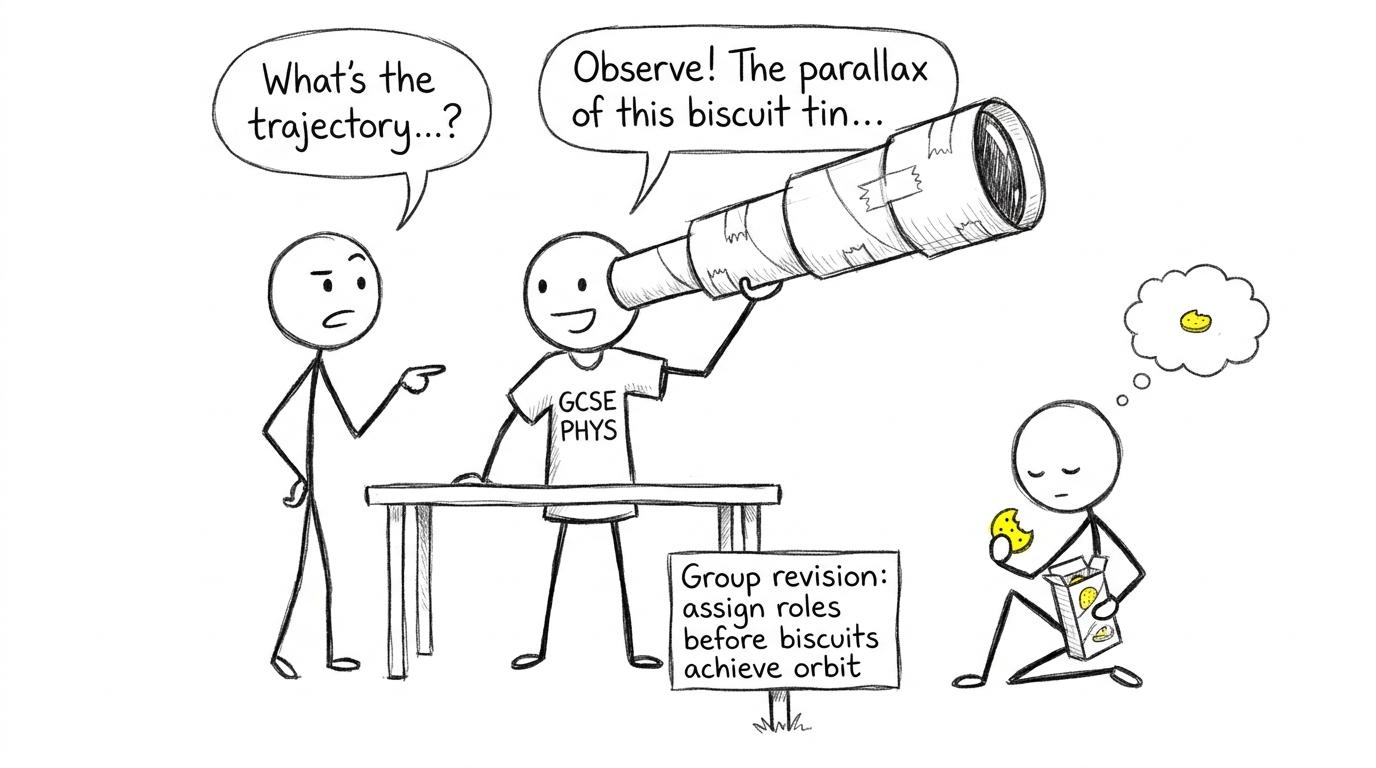 A revision group attempts to keep biscuits from becoming the main topic
Which revision method suits each astronomy topic?
| GCSE Astronomy area | Best starting method | Why it fits |
|---|---|---|
| Standard form, units and significant figures | Alone | Accuracy and calculator fluency must survive without prompts. |
| Formula substitution and rearrangement | Alone, then partner check | Independent practice builds the method; comparison can expose hidden algebra errors. |
| Moon phases, eclipses and tides | With others | Explaining the sequence reveals confused causes and vocabulary. |
| Observational planning | With others, then alone | Discussion generates possible limitations; independent writing tests examination readiness. |
| Stellar evolution | With others | Verbal retrieval helps secure the order and links between stages. |
| Graphs, light curves and numerical data | Alone | Careful interpretation needs concentration and personal error checking. |
| Historical models and scientific evidence | With others | Comparing claims encourages justification rather than simple recall. |
| Full or timed paper sections | Alone | This gives the most honest measure of independent performance. |
The pattern is simple: use other people to create useful challenge, but use solitude to verify that the learning belongs to you.
How to structure a productive hybrid session
A balanced session can follow three phases.
Prepare alone
Spend around half the session retrieving knowledge or answering questions without notes. Choose one narrow target, such as celestial coordinates, telescope properties or astronomical calculations.
If the weakness is mathematical, use MathsGenie's resources on converting units, significant figures and standard form before returning to astronomy questions.
Test together
Meet one or two focused partners. Take turns as questioner, respondent and checker. Require explanations, not guesses. Keep the specification, answers or mark scheme available to the checker only.
A group of two or three is often easier to manage than a large gathering because everyone must contribute. Set a finish time and assign roles before beginning.
Confirm alone
End with an unseen question completed independently. This final step matters. A lively discussion can create confidence, but only an unaided response confirms whether you can retrieve and apply the idea yourself.
Space another check across the following days. MathsGenie's GCSE revision timetable guide can help you build short, repeated sessions instead of relying on one long revision day.
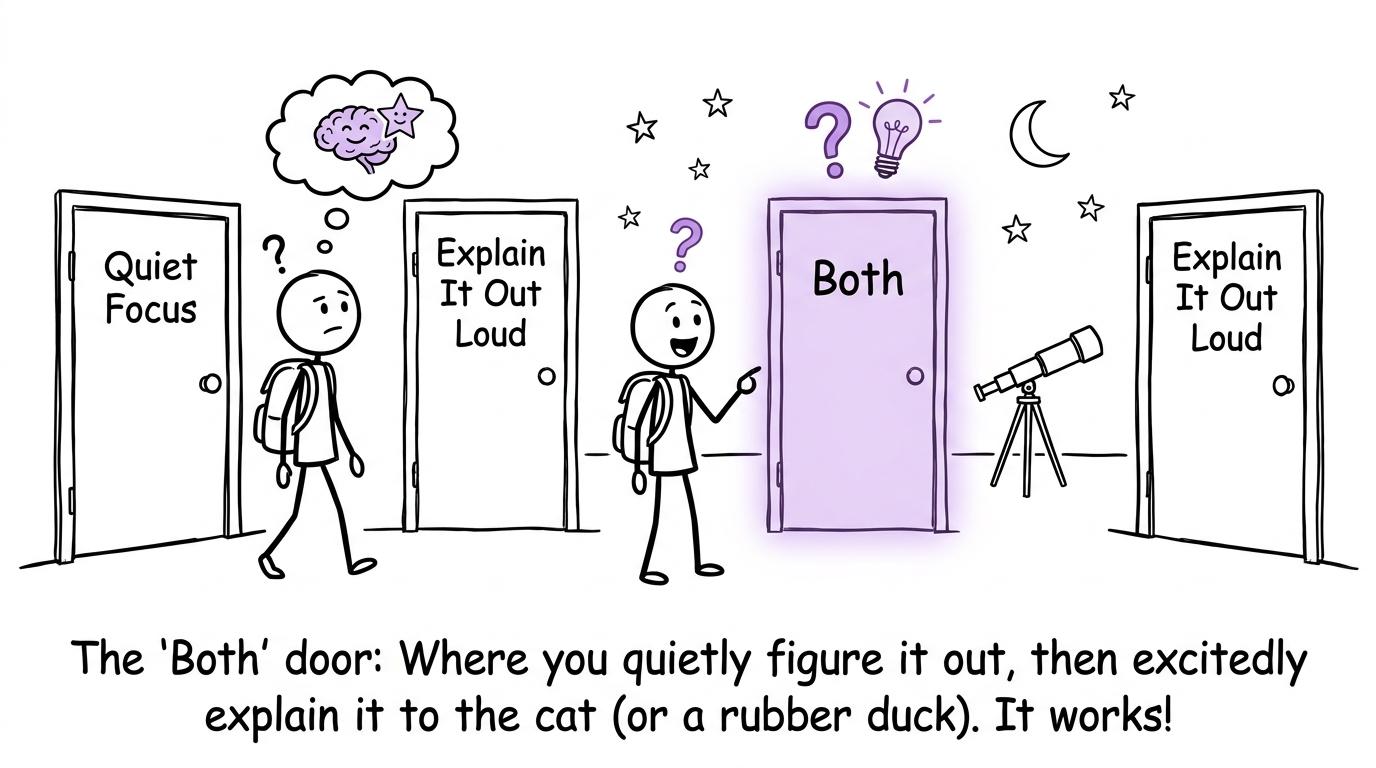 A student finds the sensible middle door between solo and group revision
Common mistakes when revising alone or with others
Mistaking silence for progress
Quiet revision is not automatically effective. Copying notes or highlighting pages can feel controlled while demanding little retrieval. Close the book and write, draw or answer from memory.
Letting the strongest student carry the group
Listening to a confident explanation is not the same as producing one. Every person should answer before discussion begins. Otherwise, weaker areas remain comfortably hidden.
Discussing astronomy without practising exam questions
Curiosity is valuable, but examination performance also depends on command words, calculations and concise written reasoning. Move from discussion to a question that can be marked.
Checking answers too quickly
Immediate hints remove the productive effort of recall. Allow thinking time. Then use accurate feedback, preferably from an official mark scheme or trusted revision resource.
Ignoring the maths inside astronomy
Students sometimes revise descriptions thoroughly while avoiding calculations. Yet mathematical skills form at least 20%20\%20% of the qualification. Build them deliberately, particularly standard form, formulae, graphs, ratios and units.
Treating predicted material as a replacement for coverage
Predicted papers can provide fresh practice, but they cannot guarantee what will appear. MathsGenie's Edexcel GCSE Maths predicted papers are designed for maths rather than GCSE Astronomy, but they demonstrate the right principle: use predictions to test skills after covering the specification, not to justify skipping topics.
Choose the method that makes your thinking visible
The better revision method is the one that exposes what you cannot yet do. Alone, that may be a calculation you cannot start. With others, it may be an explanation that falls apart under one careful question.
Use solo sessions for calculations, data, timed practice and honest diagnosis. Use focused group sessions for explanation, observational evaluation and rapid questioning. Then combine them: retrieve alone, explain together, and confirm alone.
MathsGenie can support the mathematical side of that journey with free revision lessons, practice questions, mini tests, past papers, predicted papers, mark schemes and video solutions. Choose the maths skill currently limiting your astronomy answers, practise it actively, and return to the specification stronger. The goal is not to feel busy beneath the stars. It is to become independently ready for the paper in front of you.