Revise GCSE Arabic With a Sibling: What Helps?
Revise GCSE Arabic with sibling support effectively: learn what their exam experience can teach you, what may be outdated, and how to practise safely.

Revision advice often arrives wrapped in confidence. An older sibling remembers the strange silence before the speaking assessment, the vocabulary they wished they had learnt and the mistakes they made under pressure. That experience can be genuinely useful. But memory is not a specification.
If you want to revise GCSE Arabic with sibling support, the best approach is to use them as a practice partner, listener and source of exam-day perspective, while checking every technical detail against your current exam board materials and teacher guidance. Their habits may still work. Their paper format, timings and mark-scheme knowledge may not.
This matters particularly when GCSE Arabic sits beside demanding subjects such as maths. Your sibling should make revision more focused, not turn it into an open-ended lesson that consumes the evening.
A quick sibling revision checklist
Before beginning, agree on a simple structure:
- Confirm your current qualification, exam board and tier.
- Choose one skill: listening, speaking, reading or writing.
- Set one measurable task rather than saying, “Let’s revise Arabic.”
- Ask your sibling to test you before explaining anything.
- Use the current specification, sample materials and mark schemes.
- Record mistakes without turning them into an argument.
- Finish with an independent retry.
- Keep enough time for your other subjects, including GCSE maths revision.
The principle is simple: your sibling supplies interaction; current official materials supply accuracy.
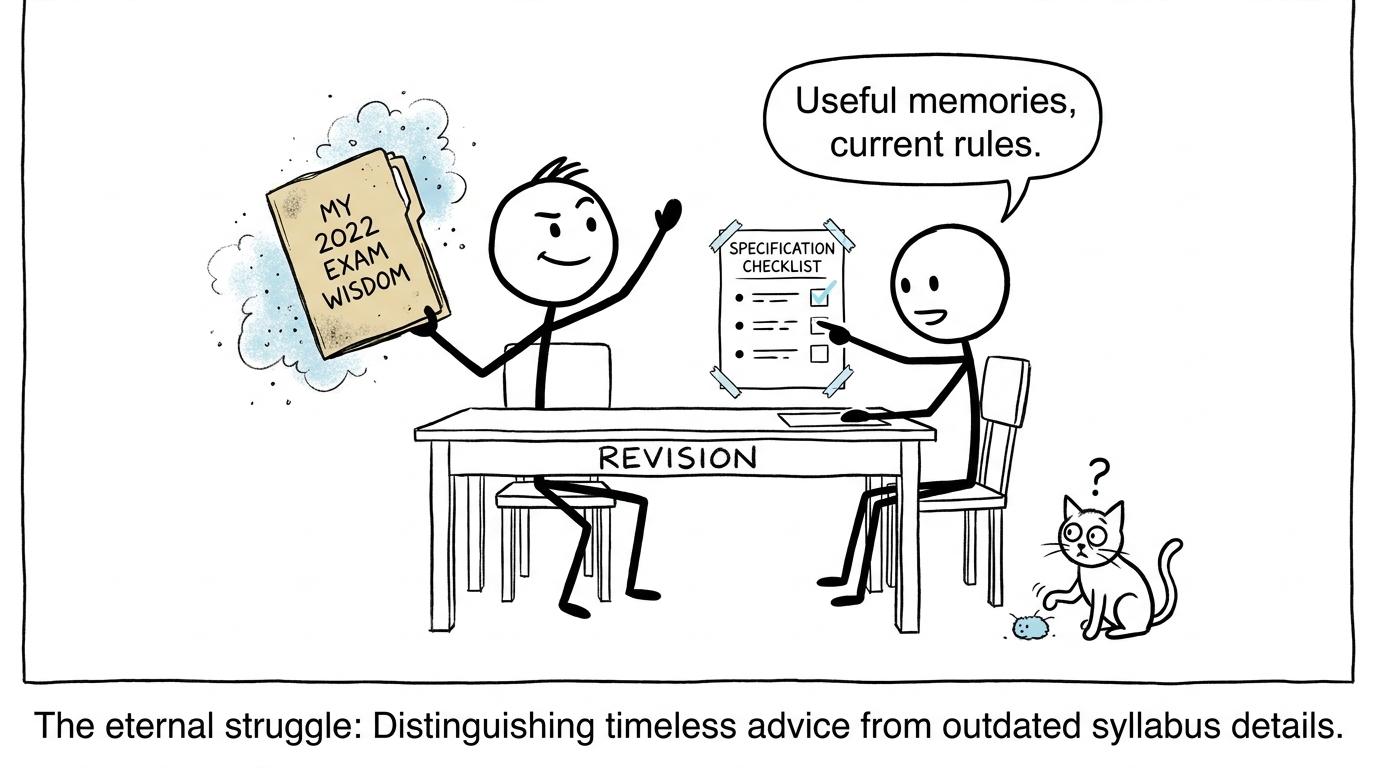 An older sibling offers dusty exam wisdom while a student checks the current specification
What an older sibling can genuinely help with
A sibling who has already sat the qualification understands something a textbook cannot reproduce: what it feels like to retrieve language while a clock is running. Used carefully, that experience can make practice more realistic.
Speaking without a prepared script
Speaking improves when another person can interrupt, change the wording of a question or ask for clarification. A sibling can conduct short mock conversations, present an unfamiliar prompt and ask natural follow-up questions.
This is more useful than memorising one polished answer. A memorised paragraph can feel secure until the question changes slightly. Your aim is to understand your own vocabulary and structures well enough to adapt them.
Ask your sibling to note:
- where an answer becomes hesitant;
- whether you actually answer the question;
- words you repeat too often;
- places where your meaning becomes unclear;
- whether you can refer confidently to different time frames;
- when pronunciation prevents understanding.
They do not need to imitate an examiner perfectly. They need to listen carefully and make you respond without a script.
Listening practice with a real voice
Recorded exam material remains essential because it reflects the assessed style and conditions. However, a sibling can add variety by reading current, level-appropriate material aloud, changing the order of details or asking you to identify a speaker's opinion.
This helps expose a common weakness: recognising familiar vocabulary only when it appears in the same voice, speed or sequence used during revision. Your sibling can also ask you to distinguish the overall message from individual details.
The source text should come from current course materials. Otherwise, the session may drift into vocabulary or dialect that does not match what you are preparing to understand.
Honest feedback on writing
A fluent or confident sibling may spot unclear sentences, missing agreements, unsuitable register or a sudden shift from Modern Standard Arabic into informal family speech. They can also check whether your response communicates what you intended.
But there is an important boundary. “That sounds better” is not the same as “that earns the mark”. Final decisions about assessment requirements should come from the current mark scheme, specification and your teacher.
A useful order is:
- complete the task independently;
- read it aloud yourself;
- let your sibling identify unclear sections without rewriting them;
- compare the response with the current assessment criteria;
- improve it in your own words;
- attempt a similar task later without help.
If your sibling rewrites every sentence, the finished answer improves while your exam performance stays still.
Exam-day perspective
Some advice ages well. Arriving prepared, reading instructions carefully, moving on when stuck and recovering calmly from one difficult question are not tied to a particular specification.
An older sibling can also describe how they managed nerves or balanced Arabic with other subjects. Treat this as perspective rather than a guaranteed formula. What suited their confidence, school and exam series may not suit yours.
What may now be outdated
The most dangerous advice is often almost correct. It sounds familiar enough that nobody checks it.
As of the current Pearson Edexcel GCSE Arabic specification used for the 2026 and 2027 series, candidates take listening, speaking, reading and writing assessments. Each skill contributes 25%25\%25% of the qualification, and candidates are entered for either foundation or higher tier across the papers. That does not mean every GCSE or International GCSE Arabic qualification follows the same structure.
Your sibling may have taken:
- a different exam board or qualification;
- an International GCSE rather than a GCSE;
- an older version of the specification;
- different speaking tasks or preparation arrangements;
- papers with different timings or mark totals;
- a different tier;
- assessments affected by temporary arrangements in their exam year.
Do not inherit those details from memory. Ask your school for the exact qualification title and specification code, then use the latest official information provided for your series.
Old papers are practice, not instructions
An older paper can still build reading stamina, vocabulary and writing fluency. It cannot automatically tell you what your current assessment looks like.
Check whether its topics, task types, timings, permitted support and mark scheme match your present course. If they do not, label it as general language practice rather than a mock paper.
The same principle applies in maths. MathsGenie separates resources by board and paper so students can use Edexcel GCSE maths past papers under the right conditions. Arabic revision deserves the same care.
Grade boundaries are not targets to memorise
A sibling may remember the mark they needed for a particular grade. Historical boundaries describe one assessment series; they are not a promise about yours. Your practical target should be stronger performance across the assessed skills, not an old number remembered around the dinner table.
Home fluency is not automatically exam fluency
A sibling may communicate brilliantly in a regional variety of Arabic while the assessment expects understanding and production appropriate to the course, including standard forms and suitable register. That knowledge is still valuable, but fluent conversation alone does not guarantee familiarity with exam conventions, translation demands or formal writing.
This is one of the best reasons to combine family support with current teacher feedback.
A revision session that works for both of you
Sibling revision works best when the roles are clear. Otherwise, the session can become a vague conversation, an unsolicited lecture or a debate about whose Arabic is “right”.
Try this structure:
| Stage | What happens |
|---|---|
| Choose | Select one current task and one skill to improve. |
| Attempt | Complete it without hints while your sibling listens or observes. |
| Diagnose | Identify no more than three specific weaknesses. |
| Check | Compare advice with current course materials or assessment criteria. |
| Retry | Repeat the task, or a closely related one, independently. |
| Record | Write the next action in your revision plan. |
Keep the task short enough to remain focused. A sibling is particularly useful for activities that are difficult to do alone: unpredictable questions, listening checks, timed prompts and immediate requests for clarification.
 A sibling runs an unnecessarily dramatic mock speaking assessment
How to give useful feedback without falling out
Family feedback can be unusually honest. That is its strength and its risk.
Agree in advance that comments must be specific and actionable. “Your Arabic is bad” offers no next step. “Your answer gave an opinion but did not explain it” identifies something that can be corrected.
A useful feedback sentence has three parts:
- what was understood;
- where meaning or accuracy weakened;
- what the student should try on the next attempt.
The student should also be allowed to ask, “Is that your preference, or is it required by the current mark scheme?” That one question separates style advice from assessment advice.
Your sibling should not supply answers midway through every pause. Give yourself thinking time. Struggle is not proof that revision has failed; it is often the moment that reveals what needs attention.
Protecting your GCSE maths revision time
The target audience for this advice may be taking Arabic alongside GCSE maths, where regular problem practice is difficult to replace at the last minute. A helpful sibling session should therefore fit inside a wider plan.
Use a weekly timetable that separates subjects and gives each session a defined outcome. MathsGenie's GCSE maths revision timetable guide explains how to prioritise personal gaps rather than repeatedly revising comfortable topics. If exams are close, the one-month GCSE maths revision plan provides a more compressed structure.
On a busy day, you might pair a short Arabic speaking practice with one focused maths task. Edexcel GCSE maths mini tests are useful when you need timed practice without committing to a full paper.
Near the exams, full papers and fresh questions become more important. Use GCSE predicted papers as additional practice rather than prophecy, and read MathsGenie's guide to when to start GCSE past papers when planning the transition from topic work to timed assessments.
The larger lesson applies to both subjects: attempt, receive feedback, correct and return later. Recognition feels comfortable. Retrieval shows whether the knowledge is actually available.
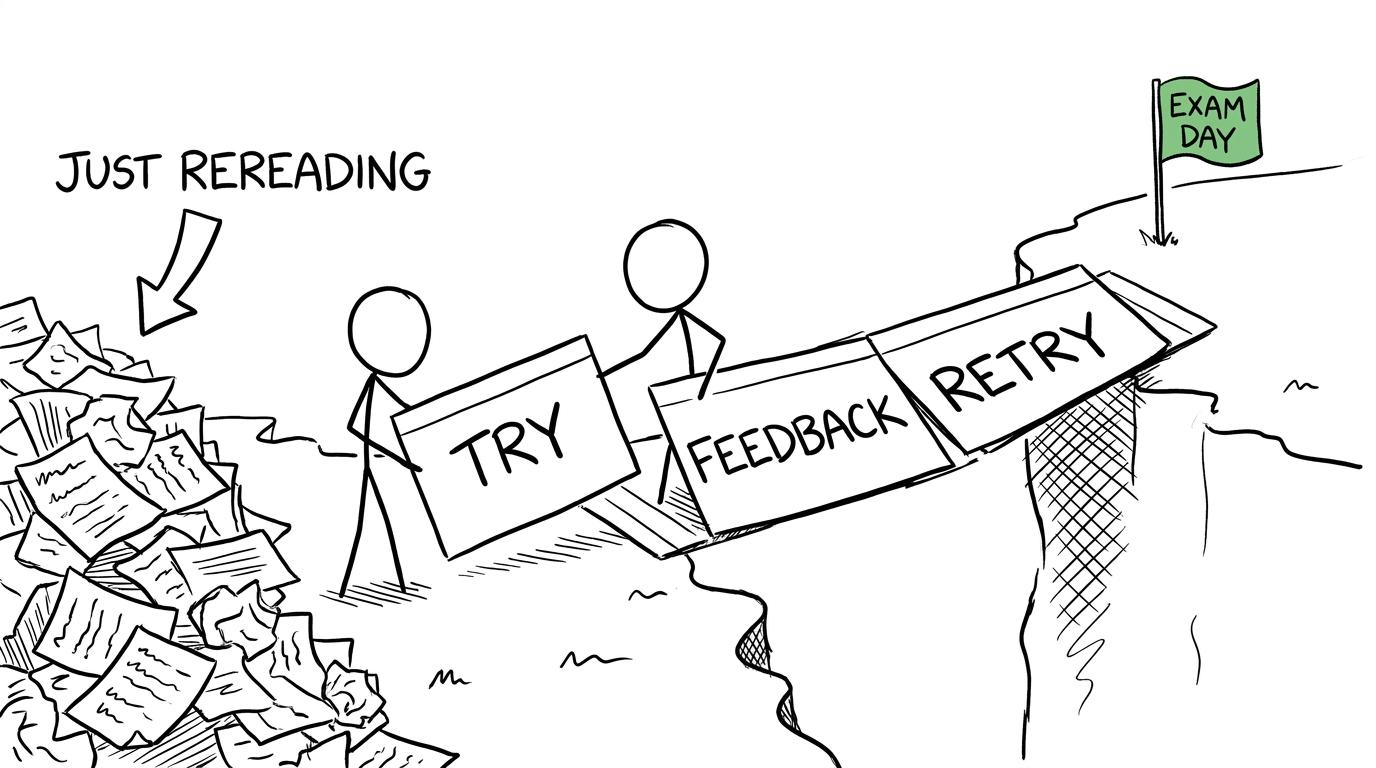 Two siblings build a bridge from trying, feedback and retrying
Common mistakes when revising GCSE Arabic with a sibling
Treating memory as official guidance
Your sibling's recollection may be sincere and still be outdated. Check the board, specification, tier, task format and timing yourself.
Letting the stronger sibling dominate
Listening to an elegant answer is not the same as producing one. You should do most of the speaking, writing and decision-making.
Correcting everything at once
A page covered in corrections is hard to act upon. Choose the few errors that most affect communication, accuracy or the demands of the task, then retry.
Practising only comfortable conversations
Family, hobbies and school may feel easy because you have rehearsed them repeatedly. Include unfamiliar prompts and less predictable follow-up questions from the current course content.
Turning every disagreement into a language debate
Arabic varies across regions and contexts. If you disagree about a form or register, note the question and check it with your teacher or current authoritative course material.
Forgetting independent practice
Your sibling will not sit beside you in the examination. Every supported session should end with something you complete alone.
Make sibling support a tool, not a shortcut
Yes, revising GCSE Arabic with an older sibling can help. They can create real conversation, notice unclear language, challenge memorised answers and make exam practice less lonely. Their most valuable knowledge is often about habits and pressure, not the precise format of your current paper.
Keep the division of responsibility clear: your sibling provides practice and perspective; your current specification, teacher and mark schemes provide authority. Then protect the rest of your timetable. For maths, start with the free MathsGenie GCSE revision hub, use revision lessons and practice questions to repair weak topics, and move into mini tests, past papers, predicted papers, mark schemes and video solutions as the exams approach.
Good support does not remove the work. It makes the next piece of work obvious.