

Review Mock Mistakes GCSE Economics: Now or Later?
Review mock mistakes GCSE Economics effectively: learn when to check errors, what delay costs and how to turn feedback into better exam performance.
A returned mock can feel heavier than the paper it is printed on. You see the grade first. Then the red marks. Only later do you begin to wonder what they can teach you.
If you want to review mock mistakes GCSE Economics effectively, the best approach is not simply “now” or “later”. Review the paper briefly as soon as you receive useful feedback, while your reasoning is still familiar. Then revisit the mistakes after a gap of a few days, without looking at the answers. The first review diagnoses the problem; the delayed review tests whether you have actually fixed it.
Waiting several days before doing anything can cost you valuable information about why you chose an answer. Reviewing everything only once, immediately, can create a different problem: the correction feels obvious because the mark scheme is in front of you.
The strongest routine combines immediate feedback with delayed retrieval.
The short answer: review now, test again later
Use this simple sequence after a GCSE Economics or maths mock:
- Immediately after the exam: record questions that felt uncertain, rushed or confusing. Do not search for unofficial answers.
- When the marked paper is returned: review it that day or within roughly 242424 hours if possible.
- During the first review: classify each lost mark by its underlying cause.
- After 222 to 444 days: answer the difficult questions again without the mark scheme or your corrected solution.
- One or two weeks later: complete a short mixed test containing the same skills in unfamiliar questions.
This is better than repeatedly reading corrections. Familiarity can feel like learning, but being able to produce the method independently is the more useful test.
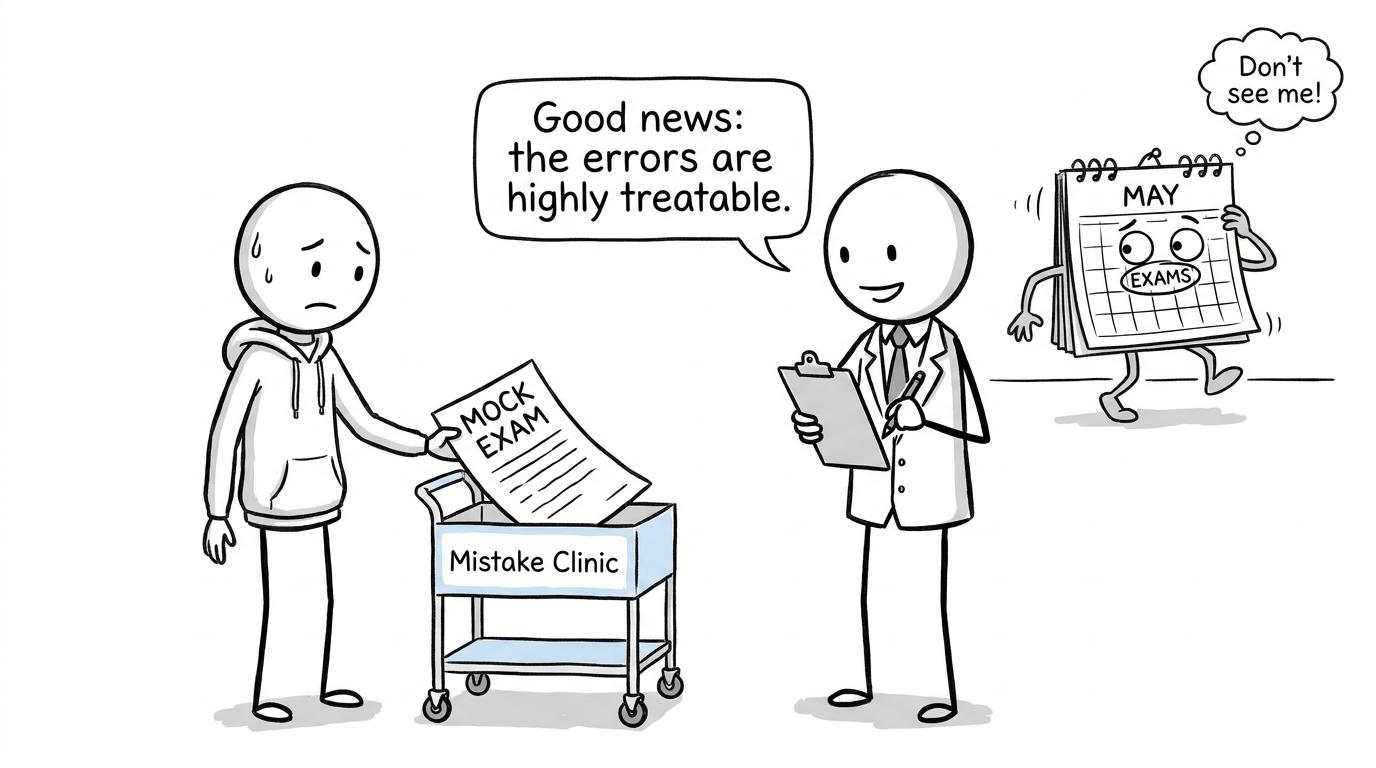 A mock paper arrives at the mistake clinic for highly treatable errors
Why reviewing mock mistakes immediately helps
A mock does more than estimate a grade. It records a series of decisions made under time pressure. Shortly after the paper, you may still remember which questions caused hesitation, which calculation you restarted and where you began guessing.
That memory fades. A week later, an incorrect answer may look merely careless. On the day, however, you might remember that you misunderstood the command word, selected the wrong figure from a source or could not decide which formula applied.
Early review preserves this diagnostic detail. It helps you distinguish between:
- missing subject knowledge;
- weak mathematical fluency;
- misreading data or context;
- poor application to the case study;
- incomplete analysis or evaluation;
- exam timing and question selection;
- a transcription or calculator error.
These causes require different responses. If you did not understand a concept, revisit the lesson. If you understood it but could not recall it, use retrieval practice. If the calculation failed, complete targeted questions. If time ran out, practise making decisions under timed conditions.
For mathematical weaknesses that appear in Economics, MathsGenie’s GCSE maths revision resources provide topic lessons, practice questions and video solutions organised by grade.
Why you should not stop after the immediate review
An immediate correction has one weakness: the correct path is visible.
Once you have read a mark scheme or watched a solution, a question can seem easier than it really is. You may recognise every step yet remain unable to recreate the answer independently. Recognition and recall are not the same skill.
A delayed second attempt removes some of that support. Close the mark scheme, use a clean copy of the question and explain the reasoning from the beginning. For a calculation, write the formula, substitute carefully and interpret the result. For an extended Economics response, rebuild the chain of analysis rather than memorising a model paragraph.
The delay creates useful difficulty. It reveals whether the correction entered long-term memory or only felt convincing while it was on the page.
This principle works just as well in maths. After revising a weak topic, use GCSE maths past papers to check whether you can recognise the same idea when its wording and context change.
What does waiting a few days actually cost?
A short planned gap before the second attempt is useful. An unplanned gap before the first review is not.
The cost cannot honestly be expressed as a fixed number of marks. It depends on the question, the student and the quality of later revision. What delay commonly costs is information and opportunity.
You forget your original reasoning
The answer remains on the paper, but the thought process behind it becomes harder to reconstruct. That makes diagnosis less precise. You may label the error “careless” when it was really caused by uncertainty about a concept or formula.
The wrong method remains unchallenged
An error is not corrected merely because an examiner has crossed it out. Until you identify and replace the faulty reasoning, you may repeat it in homework, another mock or the final exam.
You lose time for targeted practice
Early diagnosis gives you more opportunities to act. A weakness in percentages, averages or interpreting graphs can be improved through several short sessions. Discovering it close to the exam compresses that process into hurried revision.
Feedback becomes emotionally distant
Distance can reduce disappointment, which is sometimes helpful. But too much distance can also reduce urgency. The paper becomes something that happened in the past rather than a practical map of what to do next.
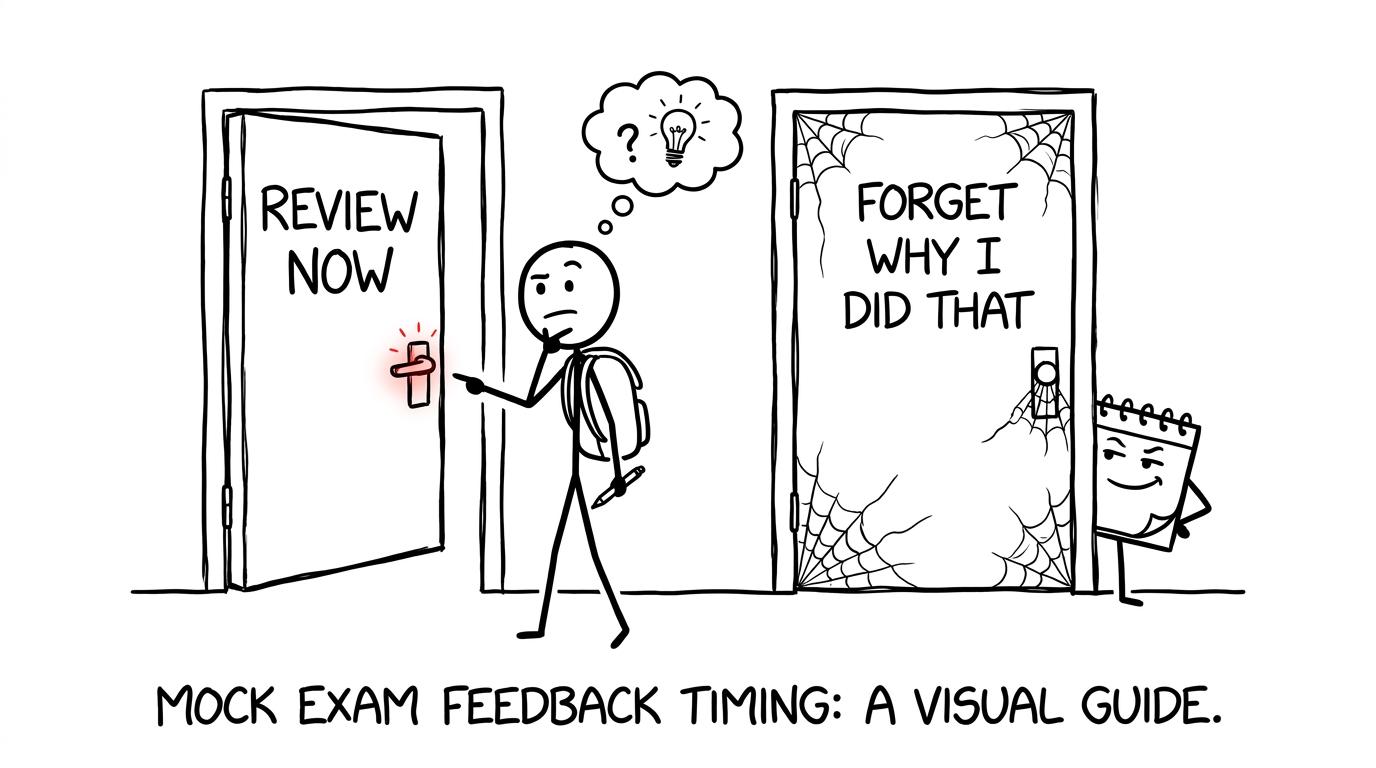 A student chooses review now while the door to forgotten reasoning gathers cobwebs
When waiting until tomorrow is sensible
Immediate review does not mean forcing yourself through every correction while upset, exhausted or angry. Attention matters.
If the result has left you unable to think clearly, spend 555 to 101010 minutes recording your first observations, then return the next day. Write down which sections felt difficult, where time disappeared and which answers surprised you. This preserves useful memory without turning the review into a punishment.
You may also need to wait for teacher feedback. Directly after an unmarked mock, reflect on your decisions, but avoid rewriting answers from unreliable recollections of what other students did. Once the script and mark scheme are available, complete the proper review.
The goal is prompt, thoughtful action, not speed for its own sake.
Build a mock mistake log that leads to action
A useful mistake log should be short enough to maintain and specific enough to change your revision. Record:
- the paper and question;
- the topic or skill;
- the type of mistake;
- why your original reasoning failed;
- the correct principle or method;
- the practice you will complete;
- the date for a delayed retest;
- whether the mistake was fixed independently.
Avoid copying entire mark schemes. The important sentence is not “I got this wrong.” It is “Next time, I will recognise this because…”
For Economics calculations, your log may direct you towards mathematical topics such as percentages, ratio or averages. Data-response questions may expose weaknesses in reading and interpreting scatter graphs.
One frequently used relationship is percentage change:
Percentage change=new value−original valueoriginal value×100\text{Percentage change}=\frac{\text{new value}-\text{original value}}{\text{original value}}\times 100Percentage change=original valuenew value−original value×100The mistake log should not merely say that the formula was forgotten. It should distinguish among selecting the wrong original value, making an arithmetic error, omitting the percentage sign or failing to interpret what the result means in context.
Separate Economics errors from maths errors
A numerical question in GCSE Economics can go wrong even when the arithmetic is accurate. You may calculate correctly but fail to explain the economic significance. Equally, you may understand the economics but lose marks through weak calculation skills.
Sort mistakes into three broad layers:
Mathematical execution
This includes percentages, ratios, averages, graph interpretation, units and calculator use. Practise the underlying operation separately before returning to an Economics context.
Economic understanding
This includes inaccurate definitions, confused relationships and missing knowledge. Return to your specification and class resources, then retrieve the idea without notes.
Exam communication
This includes failing to use the data, ignoring the context, providing an unsupported judgement or not answering the command word. Compare your response carefully with the examiner’s requirements and your teacher’s feedback.
A single question can expose all three layers. Treating every lost mark as “more Economics revision needed” is too vague to improve performance.
Turn the review into a revision cycle
The best mock review ends with work in your calendar, not another highlighted page.
Choose a small number of high-value weaknesses. Relearn each one through a revision lesson, answer focused practice questions and then test it in a mixed paper. MathsGenie’s mini tests and GCSE topic resources make it easier to move from explanation to independent practice.
After rebuilding individual skills, use predicted GCSE maths papers alongside past papers to practise selecting methods across a complete paper. Predicted papers are useful practice, but no prediction can guarantee the content of a live examination. Your exam board’s current specification remains the definitive guide to what may be assessed.
A Level students can use the same review cycle with the A Level maths revision hub: diagnose, relearn, practise, delay and retest.
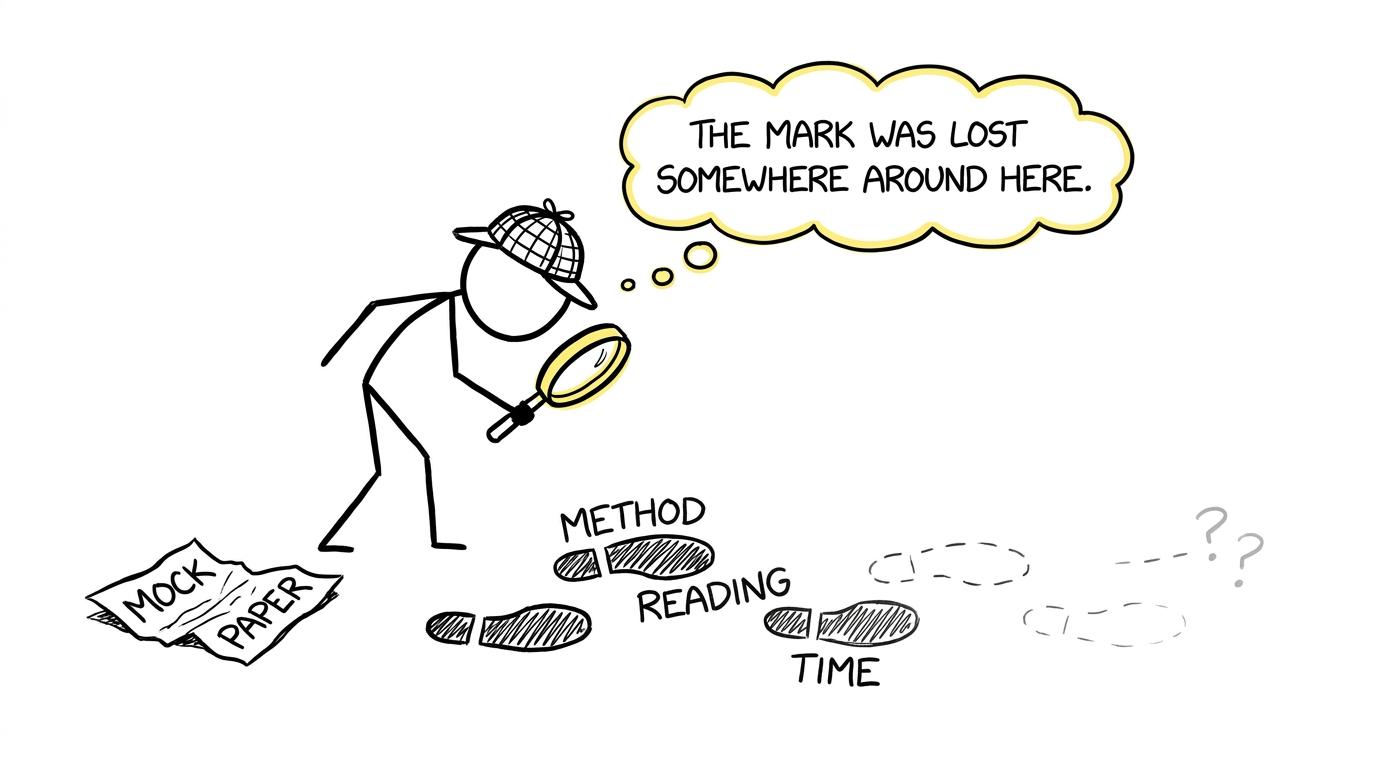 A student detective tracks a lost mark through method, reading and time
Common mistakes when reviewing a mock
Focusing only on the grade
A grade summarises performance across one paper. It does not tell you which actions will improve the next one. Look beneath the total and find patterns.
Calling every error careless
“Careless” is often a label rather than an explanation. Ask what allowed the error to happen: rushed reading, weak checking, uncertain knowledge or an overloaded method.
Copying the correct answer
Copying produces a neat page, but it does not prove that you can retrieve the method. Close the solution and reproduce the reasoning independently.
Reviewing only questions worth many marks
Repeated one-mark errors can reveal important weaknesses in definitions, units, signs or data selection. Review patterns, not just dramatic mistakes.
Correcting without retesting
A correction that is never revisited is an intention, not evidence of learning. Schedule a closed-book attempt after a few days.
Redoing the whole paper immediately
This can waste time on material you already understand. First target the weakest skills; later use a full paper to test whether those improvements survive under exam conditions.
Make the mock useful while the evidence is fresh
You do not need to choose between reviewing immediately and waiting. Use both moments for different purposes.
Review promptly to capture your reasoning, classify each mistake and decide what to practise. Wait a few days, then retest without support. That second attempt tells you whether the lesson lasted.
A mock result is not a verdict. It is information gathered early enough to be useful. Start with the relevant MathsGenie GCSE revision lessons, repair weak skills using practice questions and video solutions, then measure the change with mini tests, past papers and predicted papers. The value of the mock lies not in the grade it gave you, but in what your next revision session does with it.










