Review Exam After Sitting GCSE Art and Design?
Review exam after sitting GCSE Art and Design: learn when reflection helps, when replaying it harms focus, and how to reset for your maths exams.
You leave the art room and immediately begin examining the last ten hours in your head. Was the final composition resolved enough? Should that section have been darker? Did your outcome really connect to your preparatory work?
If you are wondering whether to review exam after sitting GCSE Art and Design, the short answer is: brief reflection can help, but prolonged replaying usually cannot change the submitted work and may drain attention from your remaining exams. Write down one or two lessons that could genuinely help you later, then close the subject and reset. If another supervised art session remains, follow your teacher's instructions carefully rather than changing or adding to controlled materials outside the session.
That distinction matters. Reflection looks forward. Rumination keeps trying to renegotiate a finished moment.
The quick post-exam checklist
Use this decision rule after your GCSE Art and Design assessment:
- Check whether the assessment is actually finished. A scheduled break between supervised sessions is not the same as completing the full task.
- Record only useful lessons. Note one successful decision and one process improvement.
- Do not attempt to alter secured or controlled work. Follow your school and exam board instructions.
- Avoid comparing outcomes in detail with classmates. Their response, media and intentions may be entirely different.
- Redirect your attention. Eat, drink, take a short break and identify the next exam that deserves preparation.
- Ask for support if worry is becoming difficult to manage. A teacher, parent, carer or pastoral lead can help you regain perspective.
The aim is not to pretend the exam never happened. It is to take whatever value remains and leave the rest behind.
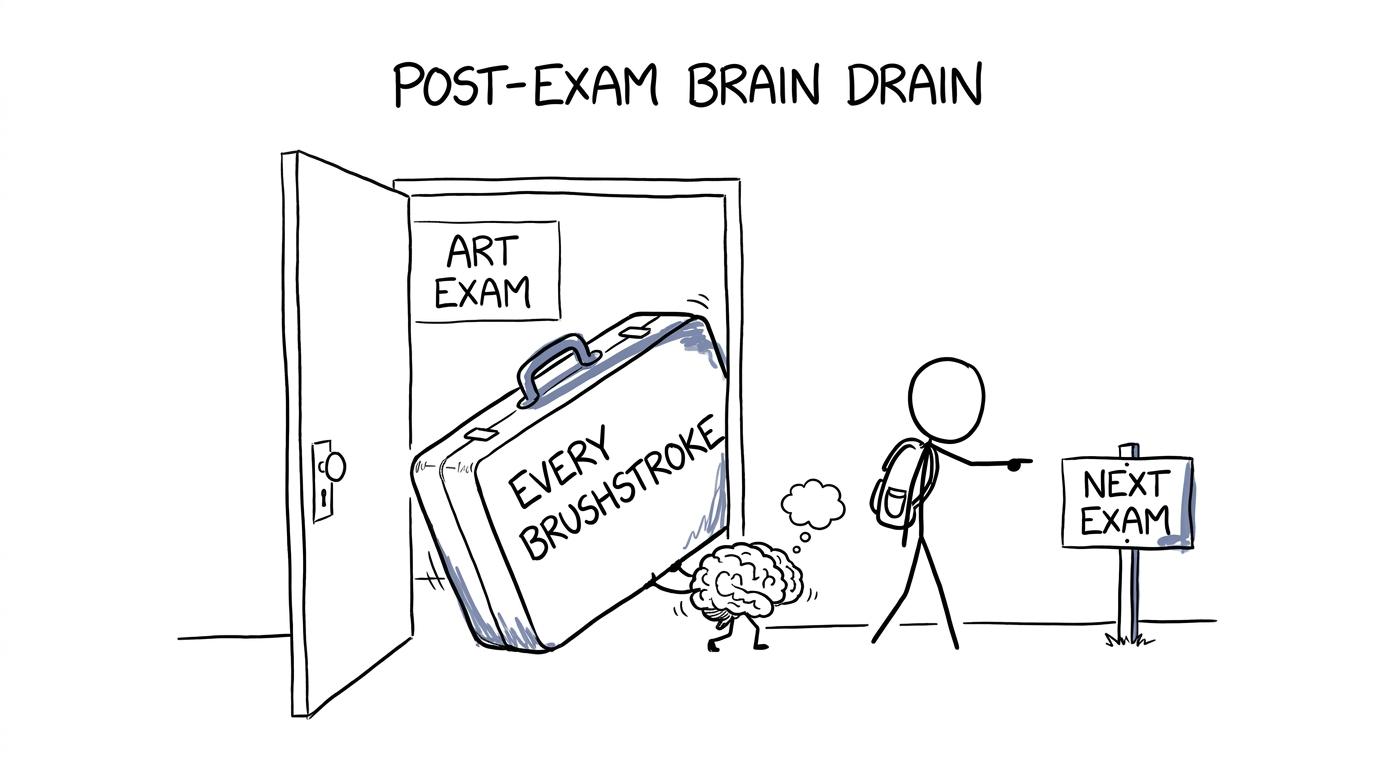 A student leaves the art exam while their brain tries to carry every brushstroke back inside
Why reviewing an art exam is different from reviewing maths
A maths paper leaves you with fairly specific memories: a quadratic you could not factorise, a probability question you misread or a calculation you want to verify. Those memories can identify topics to practise before the next paper.
GCSE Art and Design works differently. Under the regulated assessment structure, the portfolio contributes 60%60\%60% of the qualification and the externally set assessment contributes 40%40\%40%. The externally set component includes preparatory work and a supervised period of 101010 hours. Work is judged across four assessment objectives covering the development, refinement, recording and presentation of ideas. These objectives are equally weighted, although exam boards may use slightly different headings or marking totals.
This broad, holistic assessment means that one detail you dislike does not tell you your mark. A final outcome is considered alongside the journey that produced it. What feels imperfect to you may still provide evidence of thoughtful development, purposeful experimentation or a personal response.
Nor can a corridor conversation reproduce moderation. For AQA, Edexcel, OCR and Eduqas, work is marked internally and externally moderated. Your friend saying, "Mine looked more finished," is not an assessment decision. It is one anxious comparison between two different artistic intentions.
When a short review can genuinely help
A useful review is small, factual and connected to a future action. Five minutes is normally enough.
Capture a transferable process lesson
You might recognise that you allocated too much supervised time to one area, tested an unfamiliar material too late or failed to organise equipment efficiently. Those are process lessons. They may help with future creative work, an A Level course or another timed assessment.
Write the lesson without grading yourself:
- what worked;
- what you would change next time;
- what action follows.
For example, a helpful note might say that your preparatory studies made your starting decisions quicker. An unhelpful note would be a page predicting every possible reason your mark might be lower than hoped.
Notice how you handled sustained concentration
A ten-hour supervised assessment tests more than making skills. It asks you to manage energy, materials, decisions and attention across a long period. That experience can reveal when you concentrate best and what happens when you become tired.
This is relevant to maths preparation. Perhaps you discovered that checking the clock every few minutes disrupted you, or that a simple plan helped you restart after a break. Carry the useful behaviour into your next paper.
MathsGenie's GCSE maths exam-week checklist can help you turn that insight into a calmer routine for upcoming foundation or higher tier papers.
Review concerns that require action
Speak to your teacher or exams officer if something procedural happened that may need reporting, such as illness, a serious disruption or a problem with approved arrangements. Do this promptly and describe the facts rather than trying to decide the outcome yourself.
This is different from asking whether your composition was "good enough". Your teacher must also respect assessment and moderation rules, so they may not be able to offer the immediate judgement you want.
When replaying the exam stops being useful
The mind often disguises worry as analysis. It says that one more replay will finally produce certainty. But a finished assessment rarely offers that certainty, particularly when the full submission has not yet been marked and moderated.
You are trying to calculate an unknowable grade
You do not have the complete marking evidence, internal standardisation or external moderation outcome. Estimating a grade from one remembered section of the final piece is therefore unreliable.
Grade boundaries can also vary between examination series. Do not let an old boundary, an online comment or somebody else's result become a prediction for your work.
Comparison is replacing reflection
Another student's work may be larger, more colourful or apparently more polished. None of those observations proves that it satisfies the assessment objectives more successfully. Art and Design rewards a coherent personal response, not similarity between outcomes.
If the conversation changes from "What did I learn?" to "Whose work looked best?", step away. There is little useful evidence available and plenty of room for unnecessary doubt.
The review is consuming preparation time
Attention is limited during exam season. An hour spent reconstructing an assessment that cannot be changed is an hour unavailable for the next subject.
If maths is next, open the GCSE Maths revision hub and choose one defined task. A short lesson, a focused set of practice questions or a mini test creates evidence you can still act upon. The 20-minute maths revision routine is particularly useful when you are mentally tired after a practical assessment.
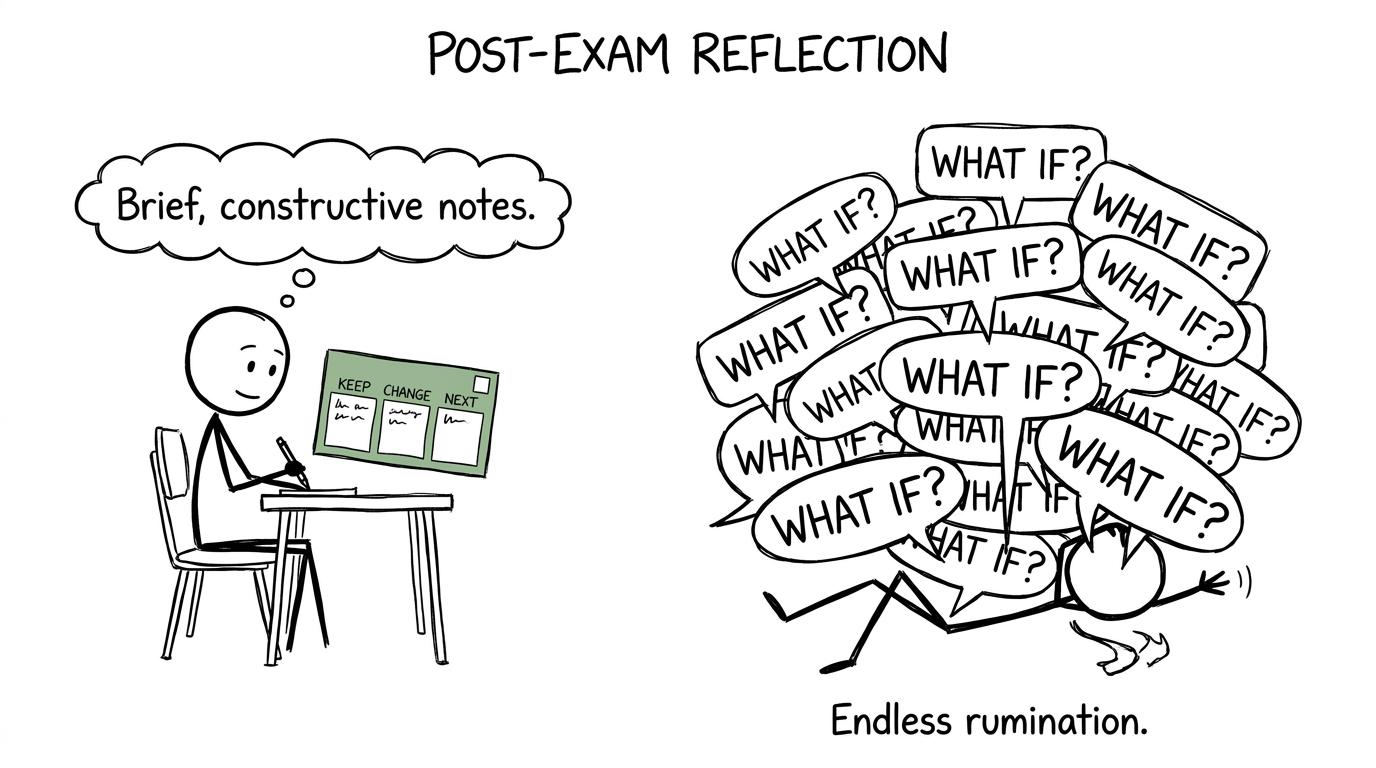 One student writes three useful notes while another disappears beneath a mountain of what-if questions
What to do if more supervised art time remains
Be careful with the word "after". Schools may divide the supervised period into multiple sessions. Leaving the room after one session does not necessarily mean the externally set assessment is complete.
Exam board regulations control how work and preparatory materials are stored and accessed. For example, AQA states that students must not add to or amend preparatory work once supervised time has begun, including between sessions, and supervised work must remain secure. Exact administration should always come from your school and current exam board guidance.
Between sessions:
- do not modify controlled or preparatory materials unless explicitly permitted;
- do not bring in unapproved new material;
- avoid asking others to develop the response for you;
- follow your teacher's instructions about equipment and access;
- use ordinary rest and recovery rather than trying to continue the piece mentally all evening.
You may naturally remember decisions you want to make next. That is not the same as altering controlled evidence. If you are unsure what is allowed, ask your teacher before acting.
A better reset for students with maths still ahead
Once the art assessment is complete, your next move should reduce uncertainty rather than create more of it.
Take a genuine transition break
Put physical distance between yourself and the assessment. Have water and food, move around, and avoid joining an immediate post-exam debate if you know it makes you anxious. A reset is not wasted revision time. It helps separate one performance from the next task.
Choose one maths priority
Do not respond to uncertainty by attempting the whole specification. Use a recent marked paper or mini test to identify one topic that is costing marks. The guide to finding your weakest GCSE topics explains how to turn mistakes into a manageable shortlist.
Then use this sequence:
- learn or refresh the method;
- answer practice questions without looking at the solution;
- mark the work carefully;
- record the reason for each lost mark;
- test the skill again later.
This is productive review because the result can still change your next performance.
Match the resource to your energy
If you are exhausted, use a short topic set rather than forcing a full paper. If you have recovered and need exam practice, sit an appropriate paper under timed conditions.
Edexcel students can use GCSE Maths past papers with mark schemes. Closer to the examination, Edexcel GCSE Maths predicted papers provide fresh specification-matched practice. Students following AQA, OCR or Eduqas can select their board through the main GCSE revision hub.
The principle is the same at foundation and higher tier: review evidence you can use, not memories you cannot verify.
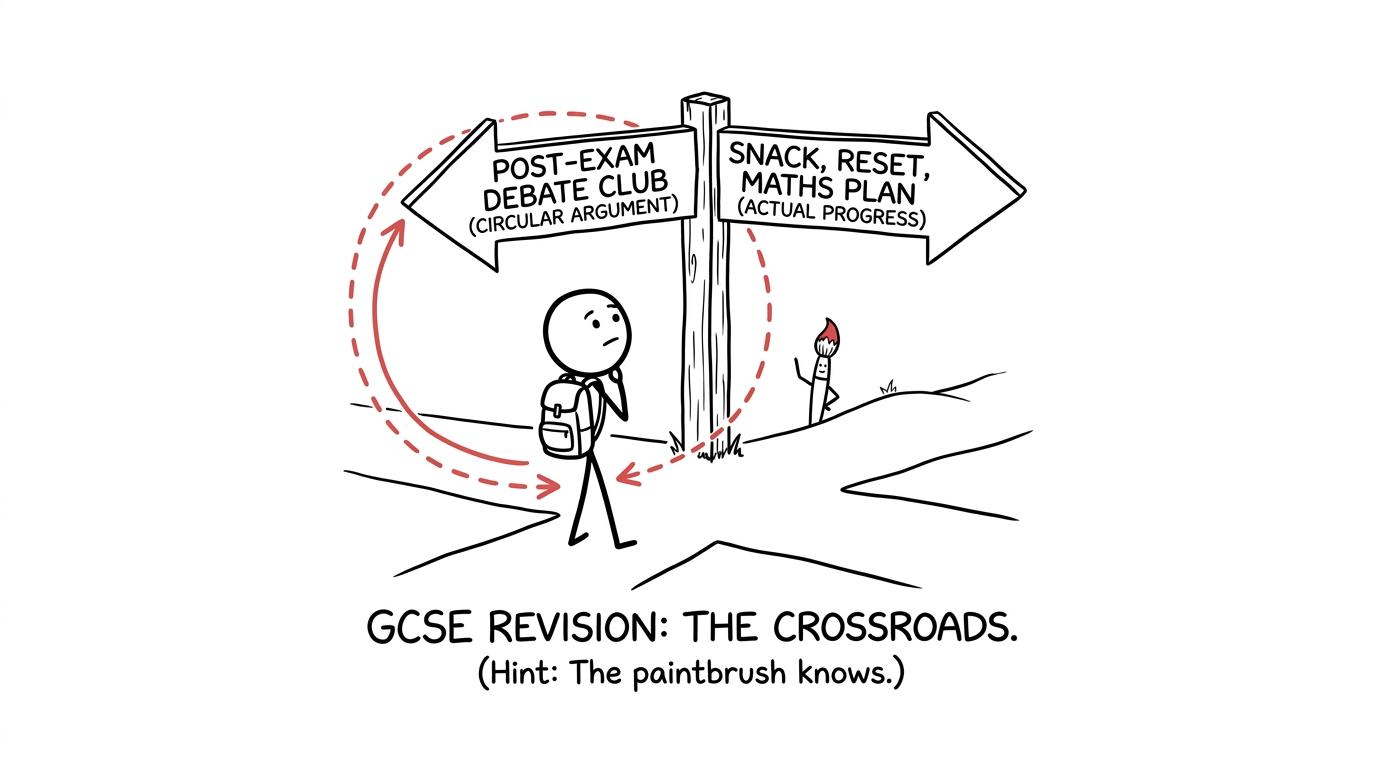 A signpost offers a circular route to the post-exam debate club and a forward route to a snack, reset and maths plan
Common mistakes after GCSE Art and Design
Treating one flaw as the whole submission
Students often fixate on the least satisfying area of an outcome. Assessment considers evidence across the component, including the development and refinement behind the final response. One remembered imperfection is not your complete result.
Seeking an instant grade from a teacher
Teachers may be unable to discuss provisional marks before internal procedures and moderation are complete. A delayed answer does not imply a poor result.
Conducting a detailed class comparison
Different starting points, intentions, media and working methods make visual comparison unreliable. It usually produces emotion rather than useful information.
Breaking controlled-assessment rules unintentionally
If another supervised session remains, do not assume you may edit preparation, access secured work or introduce new resources. Check before doing anything.
Letting the art exam occupy the next revision session
Acknowledge the thought, record any useful lesson and move to an action that can still earn future marks. If forgetting methods is the concern, use MathsGenie's guide to making GCSE maths revision stick and plan repeated retrieval rather than one long session.
Leave the finished work finished
It is worth reviewing your GCSE Art and Design assessment only when the review is brief, factual and useful for the future. It is not worth repeatedly replaying creative decisions in search of a mark that cannot yet be known.
Take the lesson. Leave the verdict to the marking and moderation process. Then give the next exam your full attention.
MathsGenie makes that next step simple. Start with free revision lessons and practice questions, diagnose gaps with mini tests, and build exam confidence using past papers, predicted papers, mark schemes and video solutions. If you are deciding when to begin full-paper practice, read the guide to starting GCSE maths past papers.
Your art submission is now evidence of work already done. Your maths revision is evidence still being written.