Retaking A-Levels Worth It? Your Options
Retaking A-Levels worth it? Compare retake costs, university policies, Clearing and apprenticeships, then create a focused A Level revision plan.

Results day compresses two years of work into a few letters. When those letters are lower than expected, it can feel as though every route has narrowed at once.
But is retaking A-Levels worth it? Sometimes, yes, particularly when improved grades are essential for a specific course or career and you can identify what will change next time. In other cases, Clearing, a foundation year, an apprenticeship or a different course may move you forward without another exam year. The right choice depends on your destination, not your disappointment.
Your main A-Level retake options are:
- resit one or more subjects through your school, college or an exam centre;
- study independently or with tuition before sitting the examinations;
- accept or seek a university place through Clearing;
- apply for a foundation year or a course with different entry requirements;
- pursue an apprenticeship, employment or another qualification.
The first decision on results day is not whether to retake. It is whether to pause long enough to compare those routes properly.
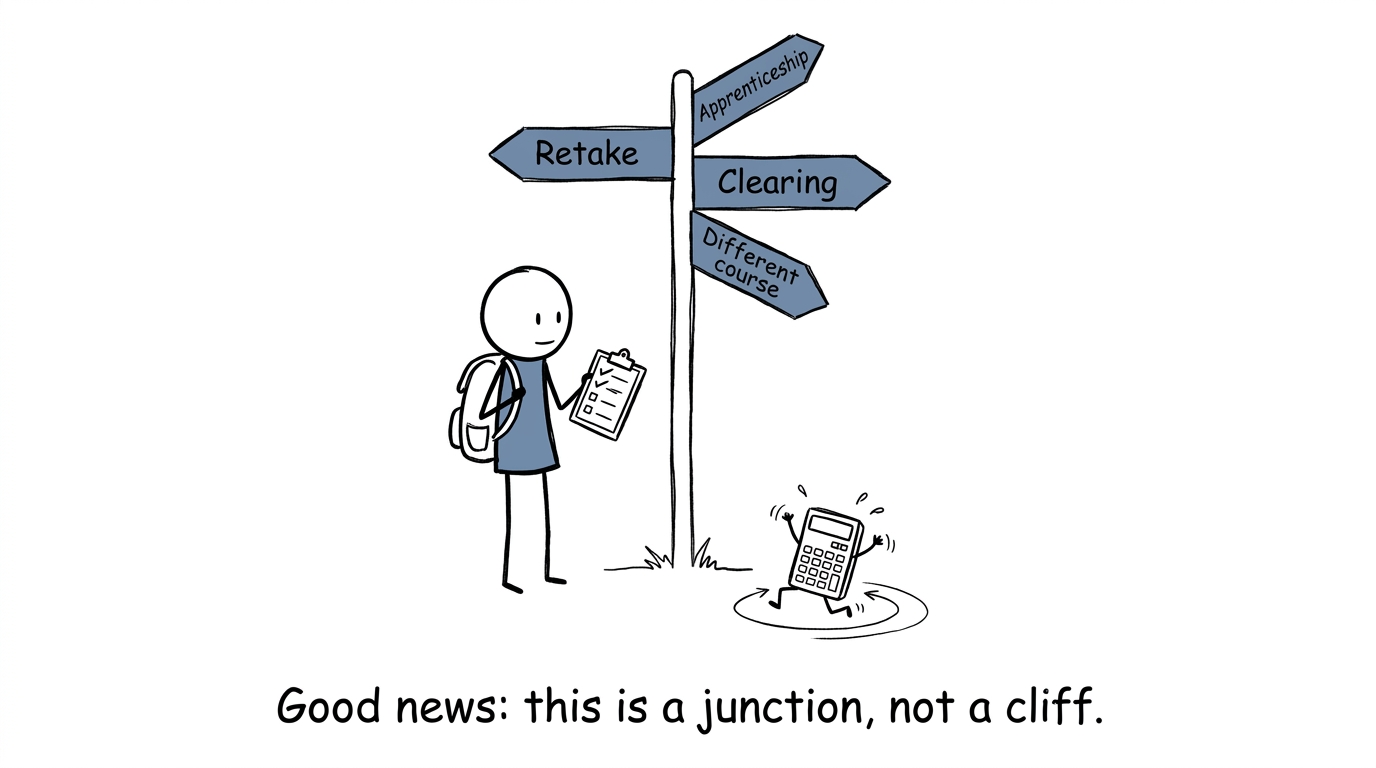 A student choosing between retakes, Clearing, an apprenticeship and a different course
When retaking A-Levels may be worth it
A retake year can be valuable when the missing grades are the main barrier between you and a carefully researched goal.
Your chosen course requires higher grades
Imagine a student who wants a particular engineering course but misses its mathematics requirement. They still want that subject, have compared other courses and know that an improved result would materially strengthen their application. Retaking A Level Maths may be a rational investment rather than a reluctant delay.
Ask the universities directly whether they accept retakes. Policies vary by institution and course, with some highly competitive programmes, particularly certain medicine and dentistry courses, applying stricter conditions. Never assume that one university's policy represents the whole sector.
UCAS applications must include completed and pending qualifications, including previous results and retakes. A better future grade does not erase the first sitting, so build your plan around honest disclosure.
You know why the first attempt went wrong
A useful retake plan names the problem precisely. Perhaps your attendance was disrupted, you began timed papers too late, or you understood individual topics but struggled to select methods under pressure.
"I will work harder" is not yet a strategy. A stronger plan sounds like this:
- diagnose weak areas using a complete paper;
- relearn each method through a concise lesson;
- complete topic questions without notes;
- mark the work and record the cause of each lost mark;
- revisit the same skill after a short delay;
- increase timed practice gradually.
For maths, begin with the free A Level Maths revision hub, then choose the resources matched to your specification.
You can secure appropriate support
Before committing, ask your school or college whether it accepts returning students, provides teaching and will make the examination entries. Independent candidates need an approved centre willing to enter them.
Fees and funding depend on your age, location, centre and programme. In England, institutions cannot generally claim funded teaching hours merely for a student who is only returning to sit examinations, although individual circumstances and full programmes differ. Obtain written details of tuition, entry and administration costs rather than relying on a national estimate.
The drawbacks of taking a retake year
A retake can create opportunities, but it carries real costs.
Improvement is possible, not automatic
More time does not guarantee more marks. If the second year repeats the same passive revision, rereading notes, watching videos without practising and avoiding timed papers; the result may barely move.
The retake becomes worthwhile only when the process changes. Students resitting maths can use the A Level question bank to target precise weaknesses rather than restarting the entire specification indiscriminately.
You may need to retake every examined component
Reformed A Levels in England are linear. To improve the qualification, candidates generally resit all examined components for that subject in the summer examination series, rather than selecting one weak paper.
For subjects containing non-exam assessment, a previous mark may sometimes be carried forward. The conditions vary by awarding body and specification, so confirm them with your centre before entering. A Level Maths is assessed through examinations, making full-paper preparation central to a retake plan.
There are financial and emotional costs
Your budget may include tuition, examination entry, centre administration, travel and materials. A simple comparison is:
total retake cost=tuition+exam fees+centre fees+travel\text{total retake cost}=\text{tuition}+\text{exam fees}+\text{centre fees}+\text{travel}total retake cost=tuition+exam fees+centre fees+travelThere is also an opportunity cost: the time that could have been spent at university, in employment or beginning an apprenticeship. That does not make a retake a poor choice. It means the benefit should be clear enough to justify the cost.
A-Level retake options versus other routes
| Route | Potential advantage | Important question |
|---|---|---|
| Retake one or more A Levels | Can reopen courses with higher grade requirements | What will be different in your preparation? |
| Clearing | May provide a suitable university place this year | Would you genuinely choose the course without results-day pressure? |
| Foundation year | Offers a supported route into some degrees | What are the total duration, cost and progression conditions? |
| Apprenticeship | Combines employment with structured training | Does the role support your intended career? |
| Different course or institution | Keeps you moving without another examination cycle | Are you comfortable changing the route, not merely the entry grades? |
| Planned gap year | Creates time for applications, work and decisions | What specific outcomes will the year produce? |
Clearing is not simply a consolation prize. It is the process universities use to fill remaining places, including for applicants who missed their original conditions. Speak to the institution before accepting anything and compare course content, accreditation, location and cost.
A hypothetical student with grades below one university's offer might find a closely related course elsewhere that still supports the same career. Retaking solely to preserve the original university name may offer less value than starting a suitable course now.
Building a retake plan that can improve your grade
A retake year needs structure before motivation fades.
Start with evidence
Complete one paper under realistic conditions and mark it carefully. Edexcel students can use Edexcel A Level Maths past papers, while equivalent OCR A Level Maths past papers are organised by examination series.
Separate lost marks into four categories: missing knowledge, incorrect method, algebraic accuracy and time or interpretation. Your revision timetable should follow that evidence.
Match revision to your exam board
Specifications overlap, but paper structures and wording differ. Use the dedicated Edexcel A Level Maths resources, AQA A Level Maths resources or OCR A Level Maths resources.
A repeatable weekly cycle is more reliable than occasional marathon sessions: learn, practise, mark, correct and retest. As the examinations approach, add past papers, mini tests and predicted papers to develop timing and method selection.
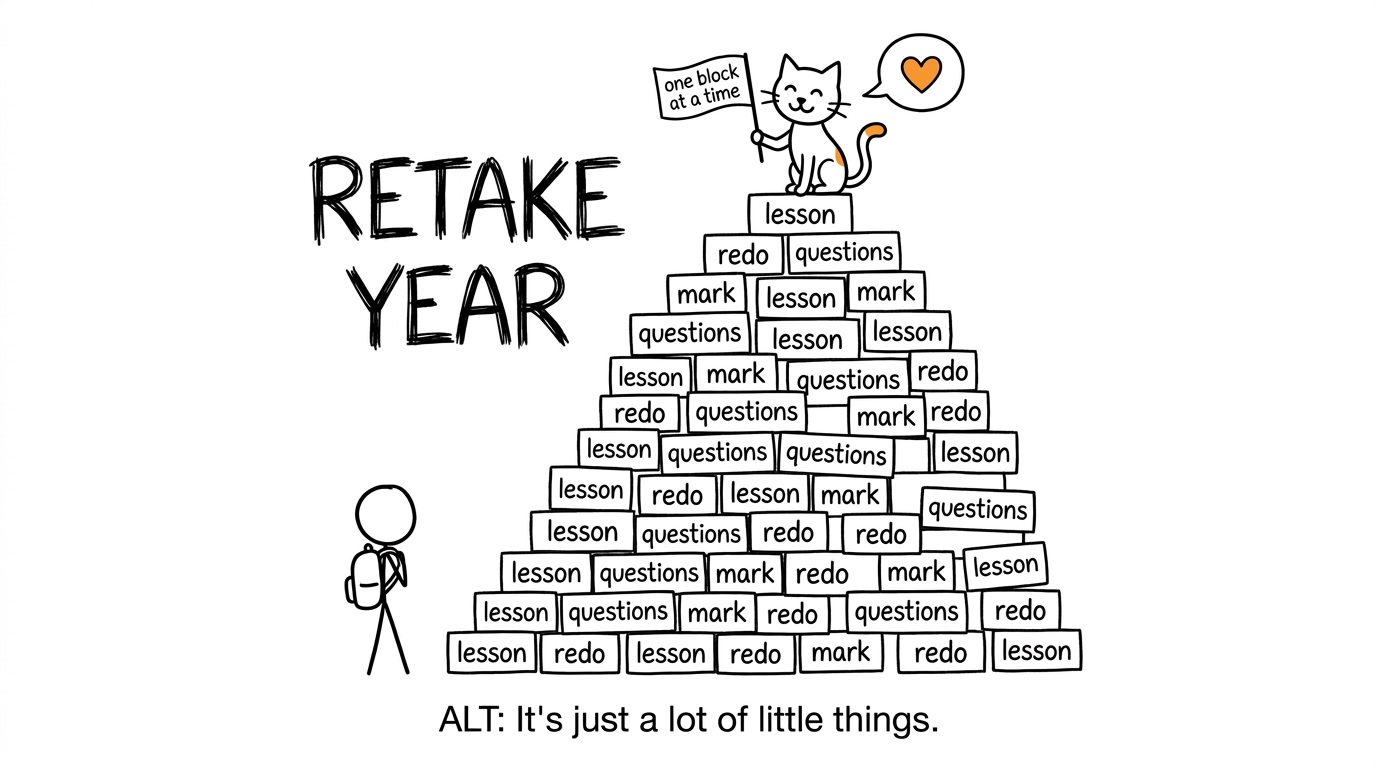 A daunting retake year divided into manageable weekly revision blocks
Common mistakes when choosing an A-Level retake
- Deciding during the first emotional hour: check your confirmed offer status and speak to your school, college and prospective universities first.
- Assuming every university accepts retakes equally: read the current policy for the exact course and request clarification in writing.
- Hiding previous results: UCAS requires applicants to declare completed qualifications and retake attempts.
- Booking tuition before finding an exam centre: confirm the specification, entry arrangements, deadlines and full cost first.
- Repeating the same revision habits: a new calendar produces little without a new feedback process.
- Treating predicted papers as forecasts: use them for additional exam practice, not as a reason to ignore the full specification.
Make the decision about your future, not one morning
Retaking A-Levels is worth it when it serves a defined destination, the relevant institutions accept resits, the practical costs are manageable and your new revision plan corrects the weaknesses of the first attempt. It is less convincing when it is driven mainly by embarrassment, comparison or fear of changing direction.
Talk through every route, confirm the rules and write down what success would require. If maths is part of your retake, use MathsGenie's free A Level revision resources to turn the year into a measurable sequence of revision lessons, practice questions, mark schemes, video solutions, mini tests, past papers and predicted papers. A disappointing result can close one application. It does not get to make every decision that follows.