

Can You Retake GCSE German After Sixth Form?
Retake GCSE German after sixth form with confidence. Learn how colleges, private exam centres, speaking tests, entry deadlines and fees work in the UK.
Leaving sixth form can make qualifications feel strangely final. Your old timetable disappears, teachers move on, and the grade printed on your certificate can seem fixed forever.
It is not. You can retake GCSE German after sixth form, either through a college that accepts external or adult learners or through an approved private exam centre. The difficult part is rarely whether you are allowed to resit. It is finding a centre that offers your exam board, can conduct the speaking assessment and will accept your entry in time.
This guide explains how the process works, what to ask before paying and how to balance German with ongoing maths revision.
GCSE German resit checklist
Before beginning revision, establish the practical details:
- Find your previous exam board and specification code.
- Decide whether to remain with that board or take a current alternative.
- Contact colleges and private exam centres early.
- Confirm that the centre offers every assessment component, including speaking.
- Check whether you must enter at foundation or higher tier.
- Ask for the full price, including entry and administration fees.
- Confirm the examination series and provisional dates.
- Check what identification the centre requires.
- Build a plan covering listening, speaking, reading and writing.
The order matters. Revision is valuable, but it cannot replace an examination entry.
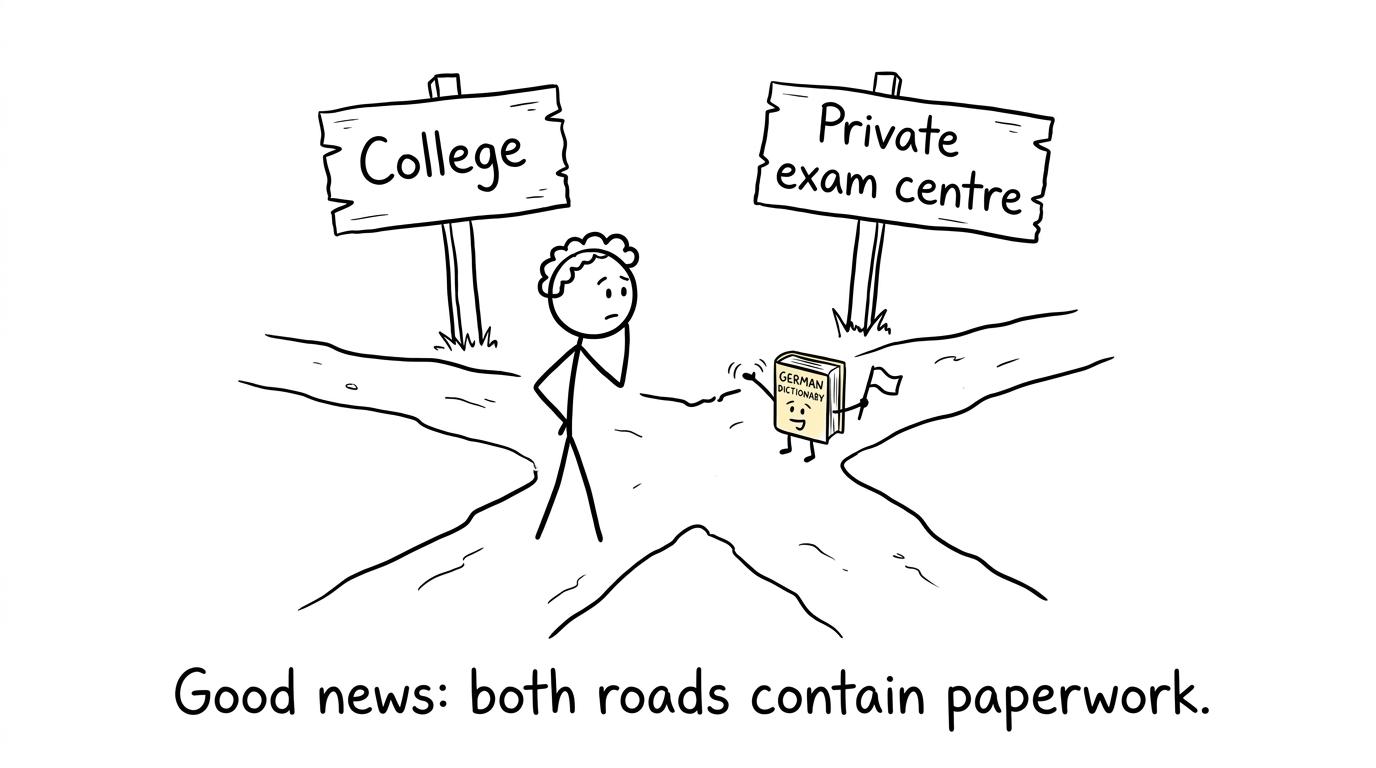 A former student choosing between a college and a private exam centre
Can you retake GCSE German after sixth form?
Yes. GCSEs are not restricted to pupils currently attending school, and leaving sixth form does not prevent you from entering again. You can take GCSE German as a private candidate if an approved centre is willing and able to enter you.
You will usually have two possible routes.
Resitting through a college
Some further education and adult education colleges accept learners who want to improve existing qualifications. A college may provide lessons as well as arranging the examinations, which can be particularly helpful for the speaking component.
However, GCSE German is not available everywhere. Colleges tend to prioritise courses with sufficient local demand, and the widespread funding arrangements that support eligible GCSE English and maths resits do not automatically make a German resit free.
Ask the admissions or examinations team whether the college:
- teaches GCSE German to adult or external learners;
- accepts examination-only candidates;
- offers your chosen exam board and tier;
- provides preparation for the speaking assessment;
- charges tuition, examination or administration fees.
If you are still aged 181818 or 191919, your funding position may depend on your existing qualifications and programme. Adult funding can also vary by course, age and location. The college should confirm your individual eligibility rather than expecting you to assume that the resit will be funded.
Using a private exam centre
A private exam centre enters candidates who are not studying at a school attached to that centre. Some are independent businesses; others are schools or colleges that accept external candidates.
The Joint Council for Qualifications advises private candidates to locate a willing centre and agree arrangements directly with it. Acceptance is not automatic. Each centre decides which qualifications, exam boards and assessment components it can support.
German needs more planning than a written-only subject because the centre must arrange and conduct the speaking assessment correctly. A centre advertising GCSE entries generally may not necessarily accept GCSE German.
Ask for written confirmation that the quoted service includes:
- listening, speaking, reading and writing assessments;
- the correct specification and examination series;
- secure handling of speaking-test materials;
- any required preparation or supervised sessions;
- access arrangements, where approved and applicable;
- certificates and post-results services.
How the GCSE German assessment works
GCSE German normally assesses four language skills: listening, speaking, reading and writing. Current specifications in England use foundation and higher tiers, although the precise paper structure, timings and mark allocations depend on the exam board.
You must normally enter the same tier across the qualification. Foundation tier targets grades 111 to 555, while higher tier targets grades 444 to 999, with the lowest higher-tier grade subject to the exam board's grading rules.
Do not choose higher automatically because it sounds more ambitious. The sensible tier is the one whose vocabulary, listening pace, writing demands and speaking tasks allow you to demonstrate secure knowledge consistently.
Specifications for GCSE French, German and Spanish in England have changed, with reformed courses first taught from 2024 and first assessed in 2026. That makes the specification code especially important. Materials from an older course may still be useful for general language practice, but they may not reflect the exact vocabulary, task structure or assessment rules for your entry.
AQA, Pearson Edexcel and Eduqas arrangements are not interchangeable. Wales may also follow different qualification requirements from England. Before buying resources or booking tuition, check the current specification directly with the exam board and confirm that your centre is entering that exact qualification.
Do you have to resit the whole GCSE?
In most ordinary resit situations, you should expect to complete the full current qualification rather than repeating only the paper on which you performed least well. Your previous listening, speaking, reading and writing results are not usually combined freely with components from a later specification or examination series.
This is important because students sometimes plan around their old component marks. Those marks can identify strengths and weaknesses, but they do not normally remove the need to prepare for all four skills.
Ask the centre to confirm the entry rules for your board and series. This is particularly important during a specification change or if your original GCSE included exceptional assessment arrangements.
When can you retake GCSE German?
GCSE German examinations are generally scheduled in the summer series. Unlike GCSE English language and maths, German does not ordinarily have the same widely available November resit opportunity.
Entries close well before the summer examinations. Centres also set their own internal deadlines, which can be earlier than the exam board deadline. Late entries may cost more, and a speaking assessment requires enough time for staffing and administration.
A sensible sequence is to begin contacting centres during the autumn or early winter before the summer in which you want to sit. Availability varies, so always obtain the current deadline and fee from the centre itself.
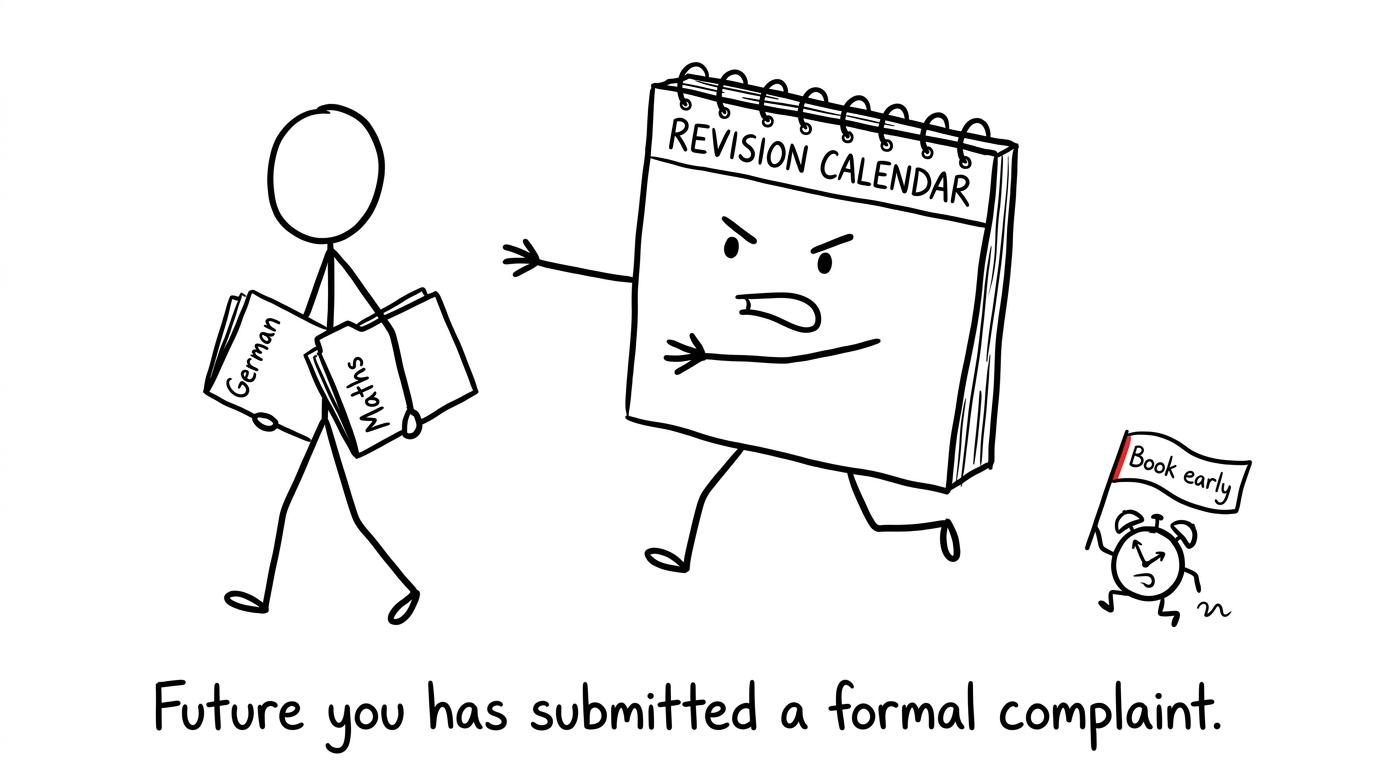 A revision calendar chasing a student who waited to book
How much does a GCSE German resit cost?
There is no single national price for a private GCSE German entry. The exam board charges an entry fee, while the centre may add administration, invigilation, room, speaking-assessment and certificate costs. Tuition is normally separate unless a college offers the resit as a taught course.
Before paying, request an itemised total. Ask whether it covers all four assessments and whether extra charges apply for late entry, timetable changes, access arrangements, results enquiries or certificate postage.
The cheapest advertised entry is not necessarily the cheapest completed qualification. A low initial price is of little value if speaking is excluded or must be arranged elsewhere.
Preparing for German while revising maths
Resitting one subject often happens alongside another goal: an apprenticeship application, university planning, employment or improving GCSE maths. The danger is not a lack of effort. It is allowing whichever subject feels most urgent that evening to consume every available hour.
Use separate, visible plans. German needs regular contact with vocabulary and all four language skills. Maths improves through topic practice, checking errors and returning to weak areas.
For structured maths preparation, begin with the GCSE maths revision topics, where lessons, videos and practice questions are organised by grade. Then use GCSE maths past papers to practise switching between topics under timed conditions.
A balanced weekly plan might contain short German vocabulary sessions, scheduled listening and speaking practice, plus distinct maths topic sessions. Near the examination period, MathsGenie predicted papers can help you rehearse a complete maths paper without pretending to predict the exact questions that will appear.
If you are also taking A Level maths, keep that work separate from GCSE German administration. MathsGenie's A Level maths revision resources and A Level past papers provide a clearer progression than mixing unrelated worksheets into one revision pile.
Give speaking practice a real place in the plan
Speaking can be postponed because it feels less convenient than reading or vocabulary practice. Yet it is also the component most dependent on confidence, retrieval and familiarity with the assessment format.
Practise aloud from the beginning. Record responses, listen back and note recurring problems with tense, pronunciation and word order. A teacher or tutor can provide more precise feedback, but regular independent speaking is still better than leaving spoken German until the final weeks.
 A houseplant acting as an unusually strict German speaking examiner
What to take to the exam centre
Your centre will tell you its exact requirements. Private candidates commonly need photographic identification, their candidate details and confirmation of the examination timetable. Arrive early enough to follow unfamiliar sign-in and security procedures.
Tell the centre about any access needs as early as possible. Previous arrangements do not necessarily transfer automatically from school. Evidence, approval and deadlines may apply, and the centre must be able to implement the arrangement properly.
Keep copies of your entry confirmation, payment receipt, specification code and centre correspondence. A small administrative folder can prevent a large amount of uncertainty later.
Common mistakes when arranging a German resit
Assuming your former school must accept you
Your previous school may help, but it is not obliged to enter every former pupil. Ask politely and early, while preparing alternative options.
Booking a centre without checking speaking
A centre may offer written GCSE examinations but not modern-language speaking assessments. Confirm all four components before paying.
Revising from the wrong specification
Older resources can support language development, but your preparation must follow the vocabulary and task requirements of the specification you will actually sit.
Expecting an automatic November resit
The familiar November resit arrangement applies mainly to GCSE English language and maths. Plan GCSE German around the available summer series unless your centre and exam board explicitly confirm otherwise.
Assuming the course will be free
Funding for German is not the same as the established entitlement for eligible English and maths learners. Ask the provider for a personalised fee and funding assessment.
Waiting until revision feels complete before entering
Entry comes first. You can improve your German after booking, but you cannot sit an examination for which no centre has entered you.
Your next step
A GCSE result can feel permanent because the certificate is permanent. The opportunity to earn a new result is not closed, though. Find your old exam board, contact suitable centres and confirm the speaking arrangements before building your revision timetable.
Then make the rest of your workload easier to see. Use MathsGenie's free maths revision homepage to move between revision lessons, video solutions, practice questions, mini tests, mark schemes, past papers and predicted papers. A clear plan cannot remove every difficult day, but it can make the next useful action obvious, and that is usually how better grades begin.










