Retake GCSE Arabic After Sixth Form: UK Guide
Retake GCSE Arabic after sixth form with this UK guide to colleges, private exam centres, speaking assessments, fees, deadlines and revision planning.
Leaving sixth form can make a simple ambition feel unexpectedly complicated. You know which qualification you want, but there is no teacher making the entry, no exams officer checking the paperwork and no familiar hall waiting in June.
The short answer is yes: you can retake GCSE Arabic after sixth form. You will normally enter through an approved college, school or private exam centre as a private candidate. The important part is finding a centre that offers the correct Pearson Edexcel GCSE Arabic specification and can conduct the compulsory speaking assessment.
Your age does not prevent you from resitting. The real questions are practical: which qualification you need, where you can sit it, what the centre charges and whether it can administer every assessment component.
Your GCSE Arabic retake checklist
Before beginning detailed revision, confirm these essentials:
- Decide whether you need the standard UK GCSE or an International GCSE.
- Ask for Pearson Edexcel GCSE Arabic, specification code 1AA0, if that is the qualification you intend to retake.
- Find an approved centre accepting private candidates.
- Confirm that the centre can arrange the Arabic speaking assessment.
- Ask about the examination series, entry deadline and complete fee.
- Check whether you will enter for foundation or higher tier.
- Discuss any access arrangements immediately.
- Obtain and check your statement of entry.
- Build a revision plan covering listening, speaking, reading and writing.
That order matters. Revision is easier when you know exactly which assessment you are preparing for.
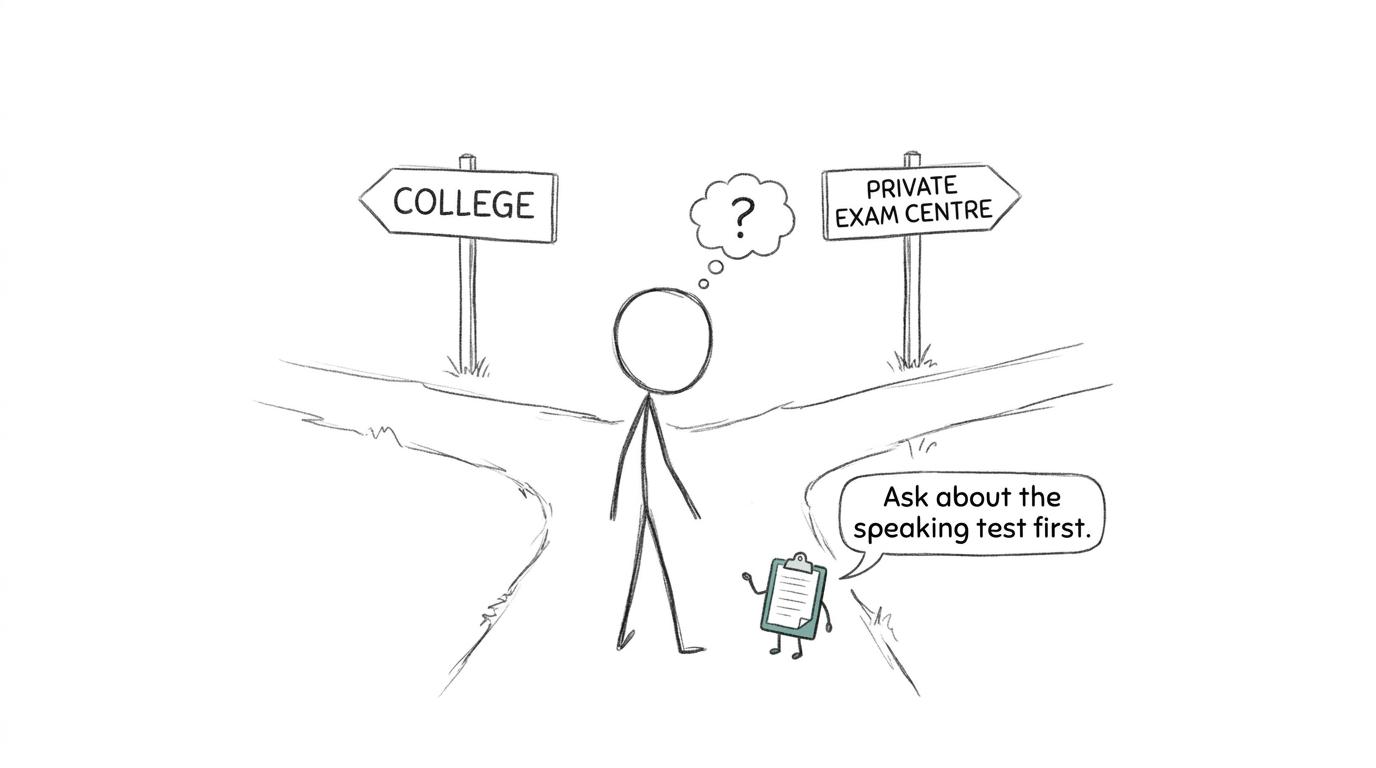 A student choosing between a college and private exam centre for a GCSE Arabic retake
How resitting GCSE Arabic works after leaving school
Once you are no longer enrolled at your old school or sixth form, you will usually be treated as a private candidate. This means you prepare independently or with a tutor, while an approved examination centre makes the formal entry and hosts your assessments.
You cannot enter yourself directly with the exam board. The centre submits your details, collects its fees, issues your examination information and checks your identity. It is also responsible for conducting the examinations under the required conditions.
Pearson Edexcel's GCSE Arabic qualification is graded from 999 to 111 and assesses four language skills:
- listening;
- speaking;
- reading;
- writing.
Foundation and higher tiers are available, and you must be entered for the same tier across the qualification. Do not assume that the tier you sat previously remains the best choice. Compare your earlier result, current ability and target grade before agreeing the entry.
A resit normally requires the relevant assessment components to be taken again. Under Pearson's current administrative rules, an eligible resit candidate may be able to transfer a speaking mark from the previous examination series. This is not something to assume: ask the centre to check your eligibility, previous entry details and the correct transfer entry code with Pearson before booking.
Finding somewhere to sit the examination
There are two realistic routes after sixth form: a college that accepts your entry or a centre specialising in private candidates.
Asking a college
Start with your former sixth form, a local further education college or an adult education provider. Even if it does not teach Arabic, its examinations team may accept external entries. However, many institutions only enter their own learners, while others limit the subjects or exam boards they support.
Send a precise enquiry rather than asking only, “Can I resit Arabic?” Include:
- Pearson Edexcel GCSE Arabic;
- specification code 1AA0;
- your preferred examination series;
- whether you need foundation or higher tier;
- whether you want to transfer a previous speaking mark;
- any access arrangement requirements.
Arabic is more complicated to host than a written-only subject because the centre needs suitable staff, secure speaking materials, a quiet room and recording arrangements.
Using a private exam centre
The Joint Council for Qualifications maintains a private-candidate centre finder. Its list is a starting point, not a guarantee that every listed centre offers Arabic. Contact several centres directly and confirm the exact subject and specification.
A dedicated centre may be more accustomed to external entries, but availability still varies. Some centres offer Pearson qualifications without offering GCSE Arabic, and some can host written papers but cannot provide the speaking assessment.
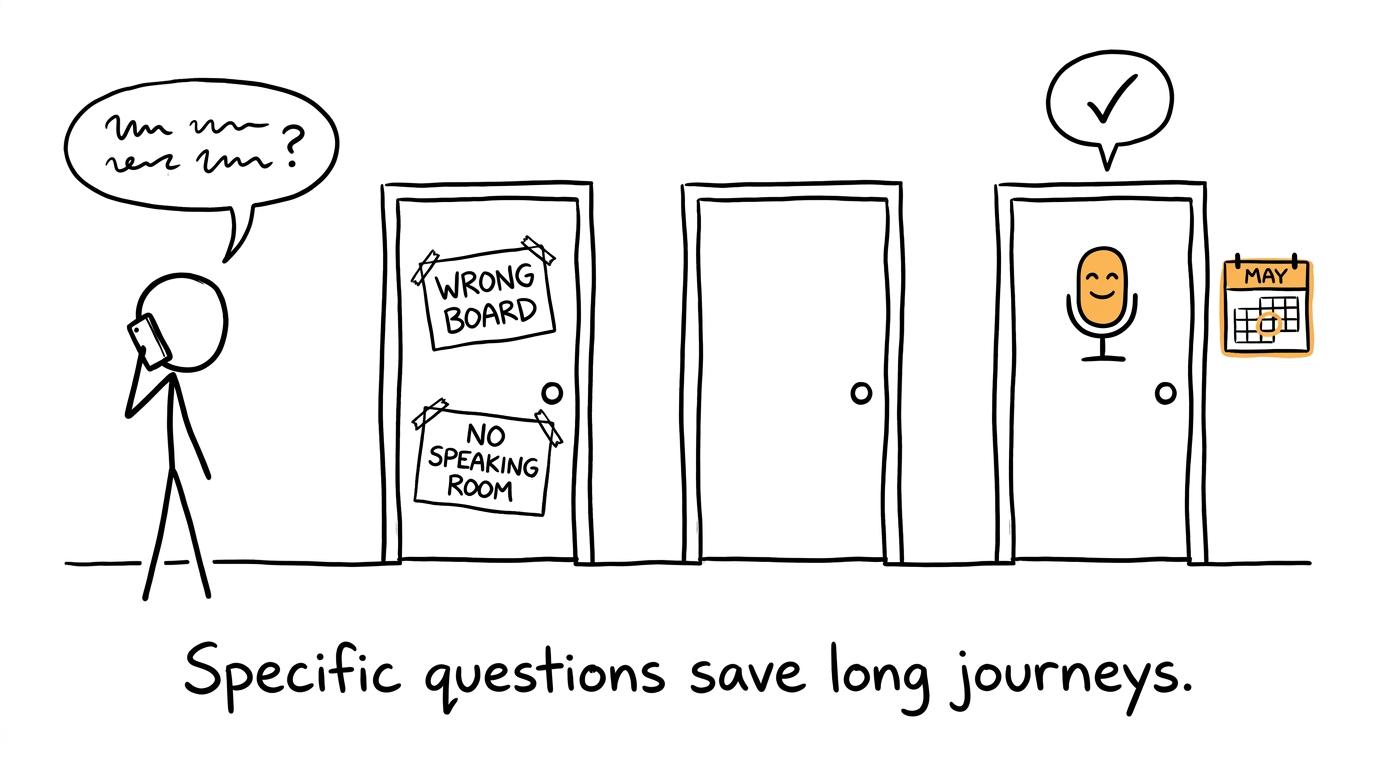 A student asking specific questions while searching for an exam centre
Ask every prospective centre these questions:
- Do you accept private candidates for Pearson Edexcel GCSE Arabic 1AA0?
- Can you conduct and record the speaking assessment?
- Which examination series do you offer?
- What is your internal entry deadline?
- What does the total fee include?
- Are there extra speaking, administration or late-entry charges?
- What identification and previous candidate details do you require?
- Can you process my access arrangements?
- When will I receive my statement of entry?
Centres set their own fees and internal deadlines. Their deadline may be earlier than the awarding body's published entry date, particularly when a speaking assessment must be organised. Enquire during the autumn before the intended summer examination series wherever possible.
Why the speaking assessment changes the process
The speaking component is not an informal conversation that any invigilator can supervise. For the current Pearson Edexcel GCSE Arabic specification, it is conducted face to face by a suitable teacher at the centre, digitally recorded and submitted to Pearson for external assessment.
This is why the nearest private centre is not automatically the right one. A centre must be willing and equipped to manage the complete qualification.
If you are retaking after a long break, speaking may also be the skill that has changed most. Reading can be practised quietly and writing can be corrected on paper. Speaking requires regular production, immediate decisions and familiarity with the assessment format. Build it into your plan from the beginning rather than treating it as a final-week task.
GCSE Arabic or International GCSE Arabic?
These names are sometimes used loosely, but they are not interchangeable. Pearson Edexcel GCSE Arabic 1AA0 is a standard GCSE with listening, speaking, reading and writing components. Pearson also offers International GCSE Arabic qualifications with different specifications and assessment structures.
Before paying, ask the organisation that needs your result, perhaps a college, university or employer, whether it requires a particular qualification. Then obtain the full title, board and specification code from your centre in writing.
A private centre advertising an “Arabic GCSE” may actually be offering an International GCSE. That may be suitable, but it should be a deliberate choice rather than a surprise discovered after registration.
Fees, funding and documents
There is no single national price for a private GCSE Arabic entry. Your payment may combine the awarding-body entry fee with administration, invigilation, room, speaking assessment and recording costs. Late entry or specialist access arrangements can create additional charges.
Unlike the support commonly available for eligible English and maths courses, a GCSE Arabic retake is not automatically free. A college may offer teaching or financial support under its own programme, but you should ask rather than assume. Funding rules also differ according to age, circumstances, provider and UK nation.
A centre may request:
- photographic identification;
- your legal name and date of birth;
- contact and address details;
- your Unique Candidate Identifier, if you have one;
- details of your previous result and exam board;
- evidence supporting access arrangements.
Check your statement of entry carefully. A wrong tier, spelling error or incorrect specification code is easier to resolve before the assessment window begins.
Planning Arabic alongside GCSE maths revision
Many students considering an Arabic resit are also improving GCSE maths for college, an apprenticeship or employment. The two subjects reward different kinds of practice, so one enormous revision session is rarely the answer.
Use separate, repeatable routines. For Arabic, rotate listening, speaking, reading and writing. For maths, identify one weak skill, learn the method, answer questions, mark them and return to the error later.
The GCSE Maths revision hub lets you choose resources for Edexcel, AQA, OCR and Eduqas, including foundation and higher tier material. Short GCSE maths mini tests are useful when Arabic preparation has left limited time.
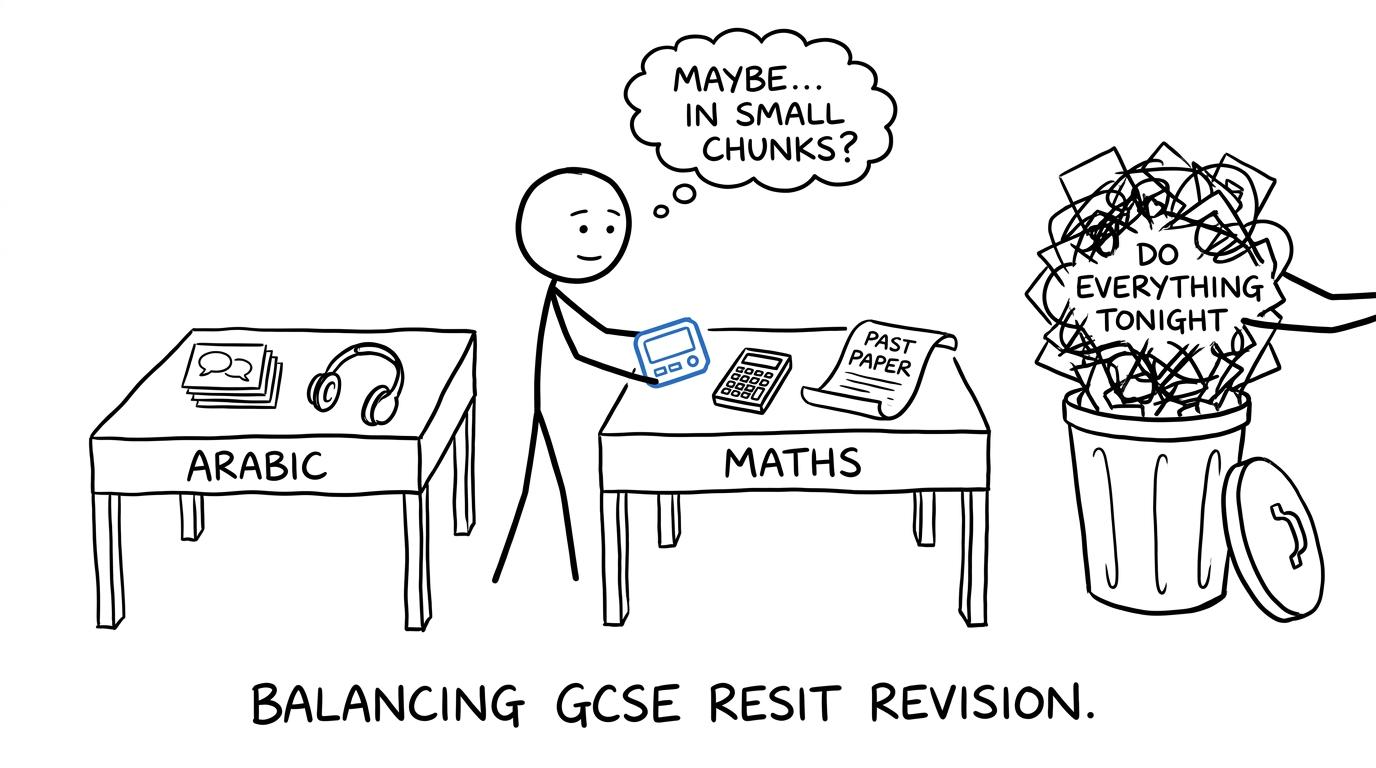 A calm student balancing Arabic and maths revision instead of doing everything at once
A sustainable plan might include short language practice on most days and two or three focused maths sessions each week. The MathsGenie GCSE revision timetable guide can help you build a routine around work, college or other resits. On particularly busy days, use the 20-minute maths revision routine rather than abandoning revision altogether.
As the examination period approaches, move from individual skills to timed assessment. If you take Edexcel maths, use the Edexcel GCSE Maths past papers, then follow the past-paper review method to turn mistakes into specific revision targets. Edexcel predicted papers can provide additional unseen practice, but they should complement official past papers rather than replace them.
Common mistakes when arranging an Arabic resit
Revising before confirming the specification
A centre may offer GCSE Arabic, International GCSE Arabic or neither. Confirm the full qualification title and code before buying materials or following a past-paper syllabus.
Assuming every private centre offers speaking
Accepting private candidates generally does not mean accepting every language qualification. Ask explicitly whether the centre conducts Pearson GCSE Arabic speaking assessments.
Waiting for the exam board's final deadline
A centre can close entries earlier because it has limited capacity or needs time to arrange speaking staff. Contact centres early and keep more than one option open.
Expecting the retake to be free
Automatic support associated with English and maths does not generally extend to Arabic. Request a written breakdown of all charges before committing.
Assuming previous access arrangements will transfer
Tell the new centre about access needs during your first enquiry. It must follow current regulations, review evidence and put arrangements in place; an arrangement at your former school does not simply follow you automatically.
Practising only reading and writing
All four language skills matter. Make listening and speaking part of weekly revision from the start, especially if you no longer use spoken Modern Standard Arabic regularly.
Take the next step calmly
A GCSE retake after sixth form is less about getting permission and more about managing the details. Confirm the qualification, find a centre capable of delivering every component, ask about fees and deadlines, and check the paperwork. Once those pieces are settled, revision becomes a much clearer task.
If maths is part of your next chapter too, begin with the GCSE maths resit revision plan. MathsGenie brings free revision lessons, practice questions, mini tests, past papers, predicted papers, mark schemes and video solutions into one place. Arrange the Arabic entry early, then let a steady MathsGenie routine help you protect and improve the maths marks that matter alongside it.