Resit GCSE as an Adult: Private Candidate Guide
Resit GCSE as an adult with our clear UK guide to private entries, exam centres, fees, deadlines, access arrangements and effective GCSE revision.
A GCSE can become more important years after school has ended. A job application asks for English and maths. A university course has a firm entry requirement. Or perhaps an old result simply feels unfinished.
The practical answer is reassuring: you can resit GCSE as an adult, usually by enrolling on a course or entering through an approved exam centre as a private candidate. There is no upper age limit. If you enter privately, you must choose the qualification, find a centre, pay its fees and manage the deadlines yourself.
That administration can look more intimidating than the exam. Once it is divided into steps, the route becomes much clearer.
Adult GCSE resit checklist
Before beginning revision, establish:
- the subject and grade you need
- whether an employer or course requires a GCSE rather than an alternative qualification
- the awarding organisation and exact specification
- the exam series in which the subject is available
- an approved centre willing to accept private candidates
- foundation or higher tier, where applicable
- the centre's total fees and internal deadline
- any coursework, speaking, practical or non-exam assessment requirements
- any access arrangements you may need
Do not buy a course or spend months revising until a centre confirms that it can enter you for the correct qualification.
What is a private candidate GCSE?
A private candidate takes an examination at an approved school, college or other exam centre without being enrolled there as a regular student. The centre makes the official entry with the awarding organisation, while the candidate is normally responsible for preparation and payment.
You might teach yourself, use an online course or work with a tutor. However, the examination certificate is issued by the awarding organisation, not the revision provider.
You do not book a regulated GCSE directly with Edexcel, AQA, OCR or Eduqas. An approved centre must enter you, so finding one is usually the first practical task.
How to enter as a private candidate
Choose the subject and qualification
Begin with the requirement you are trying to meet. If a university asks for GCSE Mathematics at grade 444 or above, confirm whether it accepts every exam board and whether it has rules about equivalent qualifications. Get the answer in writing where possible.
Next, choose the specification. Exam boards cover similar curriculum content, but paper structures and assessment details vary. The boards supported by your chosen centre may influence your decision.
For maths, also confirm the tier. Foundation and higher papers are not interchangeable, and the available grade ranges differ. Your centre must enter the correct tier before its deadline.
Find an approved exam centre
JCQ maintains a private-candidate centre search for GCSE, AS and A Level entries. Inclusion does not guarantee that a centre will accept your subject, exam board, tier or assessment arrangements.
Search locally and contact several centres. Schools, further education colleges and specialist private exam centres may provide entries, although not every centre accepts external candidates.
Ask each centre:
- Do you accept adult private candidates for this subject?
- Which exam boards and specifications do you support?
- Is the required exam series available?
- Can you enter foundation and higher tier candidates?
- What is your internal booking deadline?
- What is the full cost, including every paper and administration charge?
- Can you support speaking, practical or non-exam assessment components?
- Can you arrange access arrangements?
- What identification must I bring?
Clear communication, support for the correct specification and a complete written quotation matter more than simply choosing the nearest centre.
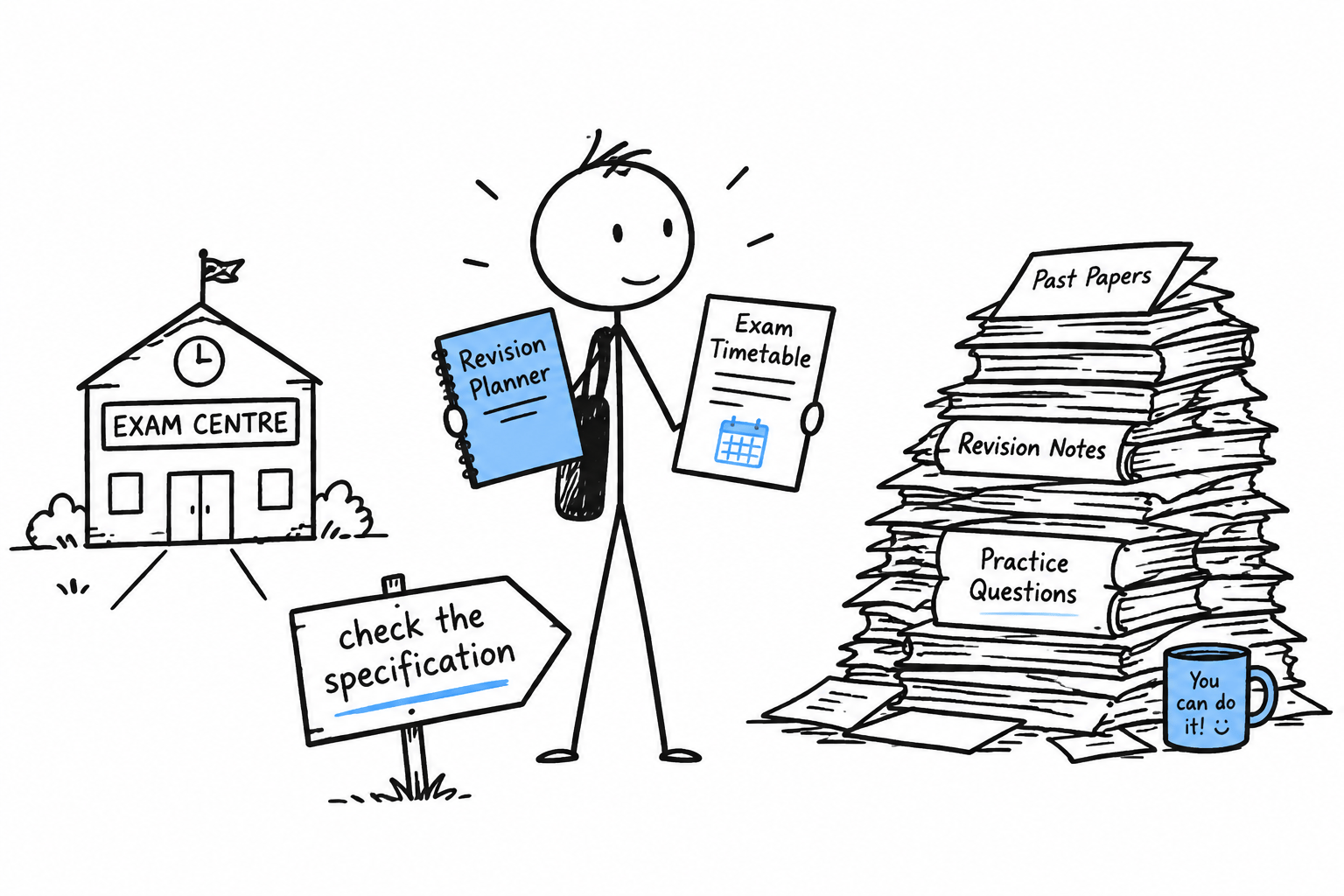 An adult private candidate calmly navigating an exam centre, revision papers and a reminder to check the specification
Register and check your entry
The centre will usually request personal details, identification, qualification information and payment. It may also ask for your Unique Candidate Identifier from earlier examinations, although the centre can explain what to do if you cannot find it.
After registering, check your statement of entry carefully. Confirm your name, subject, specification code, tier and every examination paper. A receipt proves that you paid; the statement confirms what has actually been booked.
When can an adult GCSE resit be taken?
Most GCSE subjects are examined in the main summer series. GCSE Mathematics and English Language are also commonly available in November, although availability depends on the qualification, jurisdiction and awarding organisation. Confirm the current timetable before making plans.
A sensible planning cycle looks like this:
| Stage | What to do |
|---|---|
| Six to twelve months before | Confirm the required grade, choose a specification and contact centres |
| Four to six months before | Register, pay and discuss access arrangements or assessment components |
| Three to four months before | Check your entry and begin timed paper practice |
| Final month | Confirm dates, venue, identification and permitted equipment |
| Results period | Collect results and arrange any review promptly if needed |
Awarding organisations publish national entry deadlines, but centres usually set earlier internal deadlines. Late entry may cost more, and places can fill. Contact centres as early as possible and treat the date they provide as your real deadline.
Summer GCSE results are normally released in August, while results from a November series are usually released in January. Always follow the timetable supplied by your centre.
How much does an adult GCSE resit cost?
There is no single national private candidate GCSE price. A centre's quotation can include:
- the awarding organisation's entry fee
- administration and registration
- room and invigilation costs
- charges for individual papers or examination sessions
- late-entry fees
- speaking, practical or non-exam assessment costs
- administration connected with access arrangements
- certificate or postage services
Prices vary between centres and subjects. Some centres quote for the whole qualification, while others charge for each paper or service. Subjects involving specialist equipment, performances, practical work or centre-assessed components can cost more and may be available at fewer centres.
Ask for a written all-in price before paying and check the cancellation policy. If you enrol on an adult education course, ask whether tuition and examination entry are both included.
Access arrangements and non-exam assessment
Private candidates can be considered for access arrangements, such as extra time, where current rules and evidence support them. The exam centre must manage this process. A previous arrangement does not necessarily transfer automatically, so raise the issue during your first enquiry.
Some subjects contain speaking tests, practical work, performances, portfolios, coursework or other non-exam assessment. A centre that hosts written papers may not be able to supervise or authenticate these components. English, sciences, modern languages, art and performance subjects can therefore require additional planning.
Ask exactly what the centre can provide before beginning your course. If a previous assessment result might be carried forward, obtain confirmation rather than relying on an assumption.
How to prepare for a maths resit around adult life
The goal is not to recreate a school timetable. It is to build a routine that survives work, travel and family commitments.
Start by selecting your board through the GCSE Maths revision hub. If you are taking Edexcel, the GCSE Maths scheme of learning provides an ordered route through lessons, worksheets and tests.
A strong weekly pattern is:
- learn or revisit one topic
- answer exam-style practice questions
- mark the work and record the precise error
- retry missed questions without looking at the solution
- complete a short timed test at the end of the week
Watching a video can explain a method, but independent questions reveal whether you can apply it. MathsGenie's Edexcel mini tests and 45-minute GCSE Maths tests help bridge the gap between individual topics and full papers.
Once the main content is secure, use Edexcel GCSE Maths past papers under timed conditions. Mark schemes and video solutions reveal where method marks were available, not merely whether the final answer was correct.
Closer to the exam, GCSE predicted papers provide additional practice, but they should complement past papers rather than replace them. A personal revision planner can turn the remaining weeks into realistic sessions.
Common mistakes when resitting GCSEs as an adult
Revising before confirming the specification
A familiar textbook is not enough. Check the current exam board, specification code, tier and assessment structure first.
Assuming every centre accepts private candidates
Many schools and colleges do not offer external entries. Contact several centres early and obtain direct confirmation.
Comparing only the headline fee
A low initial price may exclude administration, invigilation, additional papers or assessment components. Compare full written quotations.
Missing the centre's internal deadline
A centre may stop accepting candidates before the awarding organisation's national deadline. Follow the date supplied by the centre.
Leaving access arrangements too late
Centres may need evidence, assessments and administrative time. Discuss your needs when requesting the entry.
Doing full papers too soon
Past papers are diagnostic tools, not substitutes for learning. Use revision lessons and practice questions to repair weak topics, then return to timed papers to measure improvement.
Your next step
An adult GCSE resit is a new decision made with clearer stakes and, often, better judgement.
Write down the subject, required grade and intended exam series. Contact approved centres, confirm the exact entry and build a plan around the time you genuinely have.
For maths, begin with MathsGenie's free GCSE revision resources. Use revision lessons to rebuild understanding, mini tests to make methods dependable, and past papers with mark schemes and video solutions to become exam-ready. The administrative route begins with a centre, but improvement begins with the next question you practise.