

Reset After a Bad Week of GCSE Computer Science
Reset after bad week GCSE Computer Science revision with a calm seven-day plan for rebuilding momentum, testing weak topics and balancing maths.

A revision plan can unravel quietly. One missed evening becomes three, the unfinished tasks accumulate, and opening your Computer Science folder begins to feel like receiving an error message from your own brain.
If you searched for reset after bad week GCSE Computer Science, the practical answer is this: do not try to recover every missed hour. Review what disrupted the week, choose one small task for today, and use a short diagnostic to decide what deserves attention next. Then rebuild a routine you can repeat, including on difficult school days.
The goal is not to create a heroic catch-up weekend. It is to make tomorrow easier to begin.
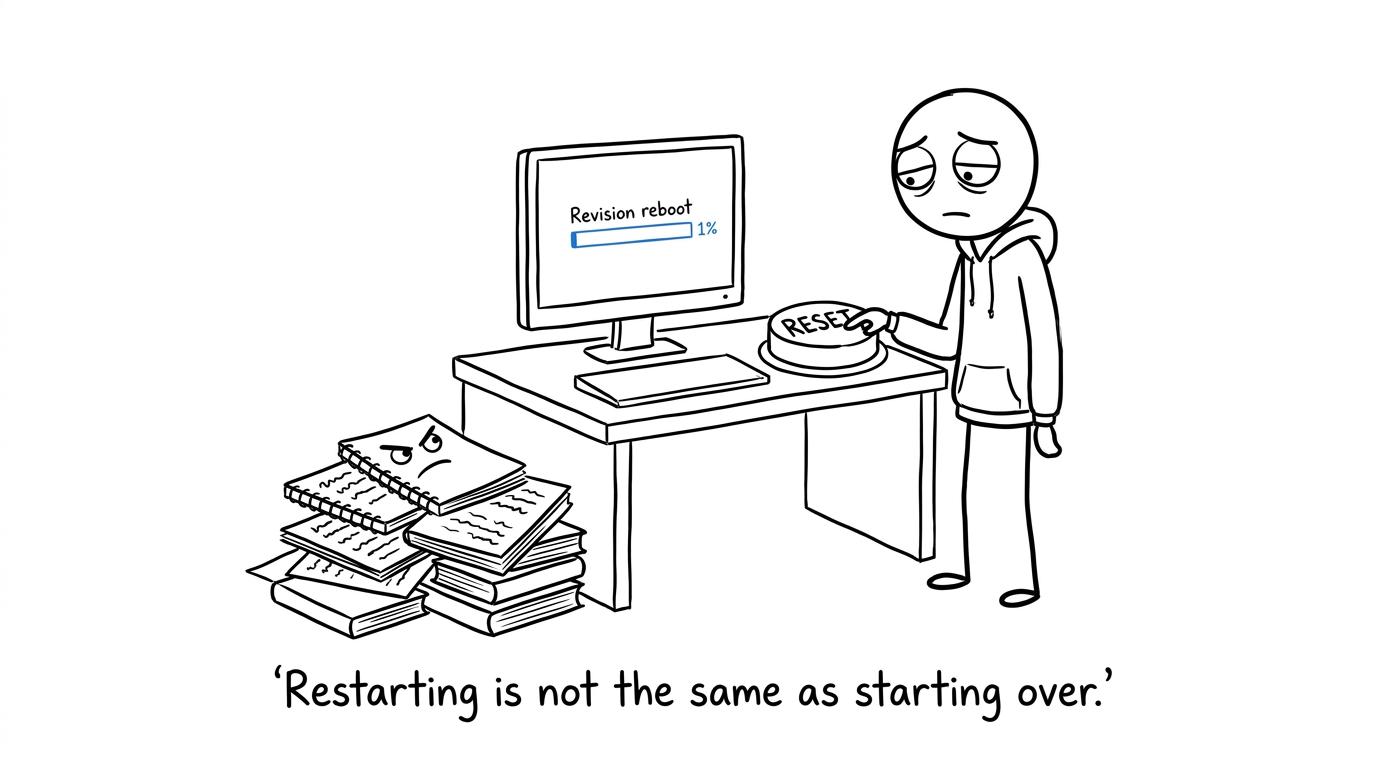 A student pressing a revision reboot button
Your GCSE Computer Science reset checklist
Use this before making another elaborate timetable:
- Accept that the lost week has already happened.
- Identify why revision stopped without turning the answer into self-criticism.
- Check the specification for your exam board and current exam year.
- Choose one weak topic, not the entire course.
- Complete a short, closed-book diagnostic.
- Mark it and classify each mistake.
- Plan a small daily minimum for the next seven days.
- Revisit the same material after a delay.
- Protect time for maths and your other GCSE subjects.
That is enough for a genuine reset. Everything else is refinement.
Start with an honest diagnosis, not a punishment
A bad revision week is usually treated as a time-management failure. Sometimes it is. Often, however, the real problem is hidden underneath the calendar.
Perhaps each task was too vague: “revise programming” gives you no obvious starting point. Perhaps you planned long sessions after tiring school days. You might have avoided a topic because every question exposed a gap, or spent so much time producing attractive notes that the work never reached retrieval or application.
Ask three questions:
- What did I intend to do?
- What actually prevented it?
- What change would make the task easier to start next time?
Keep the answers factual. “I am lazy” cannot improve a plan. “I scheduled ninety minutes when I reliably had twenty” can.
If short sessions fit your week better, MathsGenie’s twenty-minute GCSE revision routine offers a useful structure that can be adapted across subjects: set up, recall, practise, mark and choose the next task.
Check the correct specification before revising
GCSE Computer Science is built around both knowledge and application. Common areas include algorithms, programming, data representation, computer systems, networks, cyber security, Boolean logic and the impacts of digital technology. Students are also expected to analyse problems and design, test, debug and refine solutions.
But the exact content and assessment format depend on your exam board and cohort. AQA has introduced specification changes affecting different examination years, while OCR and Edexcel have their own paper structures and programming requirements. Do not rely on a generic online topic list.
Write your exam board and specification code at the top of your plan. Then use the official specification supplied by AQA, OCR, Edexcel or Eduqas to divide content into three groups:
- Secure: you can recall and apply it without notes.
- Uncertain: you recognise it but struggle to explain or use it.
- Missing: you cannot yet answer a basic question about it.
Begin with one uncertain topic. It is usually easier to restart where some knowledge already exists, while still creating meaningful progress.
Make the first session deliberately small
The first session after a bad week has a special job. It is not there to cover lots of content. It is there to restore trust in your routine.
Choose a task that can be completed in roughly 202020 to 303030 minutes. For example, you could recall the purpose of CPU components, trace a short algorithm, review test-data types or answer several questions on network security. These are task categories, not a substitute for checking your own specification.
Use this sequence:
- Write down everything you can remember without notes.
- Check your recall against trusted course material.
- Answer a few relevant questions.
- Mark your answers immediately.
- Record one specific correction.
Retrieval practice is useful because it makes you bring knowledge to mind rather than merely see it again. Educational evidence also stresses two important conditions: the task needs an appropriate level of difficulty, and feedback matters because uncorrected retrieval can reinforce misconceptions.
One modest, completed session is more valuable than a huge plan left untouched.
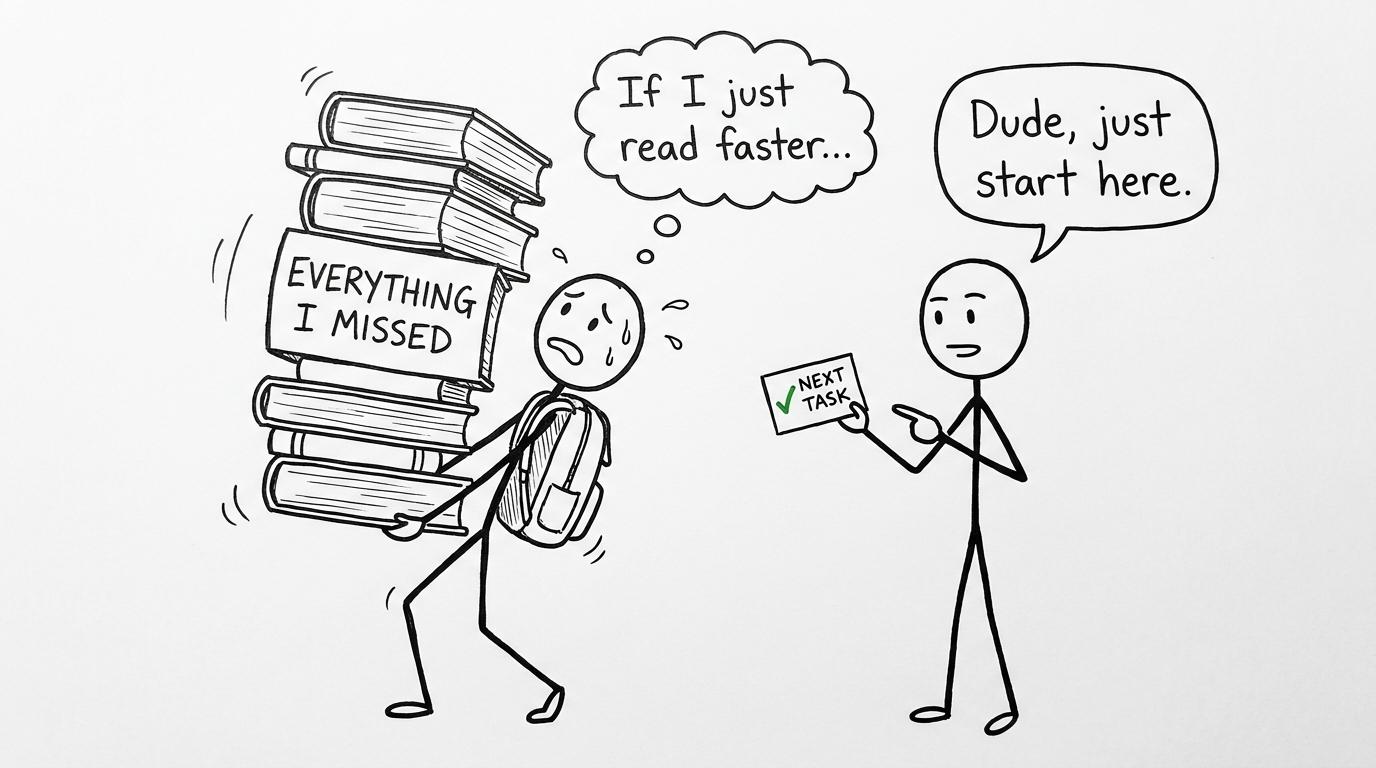 A student choosing one small next task instead of carrying everything missed
Build a seven-day recovery plan
A reset works best when it has a short horizon. Planning every evening until the examination can create more pressure than clarity. Plan the next seven days, review the result, and adjust.
The first two days: restore contact
Use short sessions to reconnect with the subject. Pick one uncertain topic each day and follow the recall-practise-mark loop. Stop at the planned time, even if you feel tempted to compensate for the previous week.
Ending successfully helps tomorrow’s session feel ordinary rather than threatening.
The middle of the week: add application
Computer Science cannot be revised entirely through definitions. Official subject content includes following and writing algorithms, applying computational thinking, using test data, debugging and refining programs.
Include tasks that require you to do something with knowledge:
- trace code or pseudocode;
- identify a logic, syntax or runtime error where your course requires it;
- explain how a security measure addresses a threat;
- compare storage, networking or architecture choices;
- design or refine a short algorithm;
- practise programming in the language used by your school.
The precise balance should match your board. For example, an on-screen programming assessment requires different preparation from a wholly written programming paper.
The end of the week: test, mark and revisit
Complete a short mixed set under quiet, timed conditions. Then use the mark scheme or teacher guidance to classify each lost mark:
- Knowledge gap: you did not know the fact or concept.
- Application gap: you knew it but could not use it in context.
- Expression gap: your explanation lacked precise terminology or development.
- Process gap: you misread the command word, rushed or failed to check.
Revisit the weakest area after a delay rather than repeating it immediately several times. Spaced review is designed to interrupt forgetting, while the effort of retrieval reveals whether learning has lasted.
Use marks as information, not a verdict
A low practice score can feel like proof that the week caused permanent damage. It is better understood as a map.
Mark schemes show the distinction between vaguely understanding an idea and expressing it in a way that earns marks. Pay attention to command words. “State” usually needs a concise fact; “explain” needs a linked reason; “compare” requires relevant similarities or differences; “evaluate” requires a reasoned judgement supported by the context.
Keep an error log with four short fields:
- topic;
- what went wrong;
- what a stronger answer needed;
- when you will test it again.
Avoid copying the whole mark scheme. The log should help you make a decision, not become another revision project.
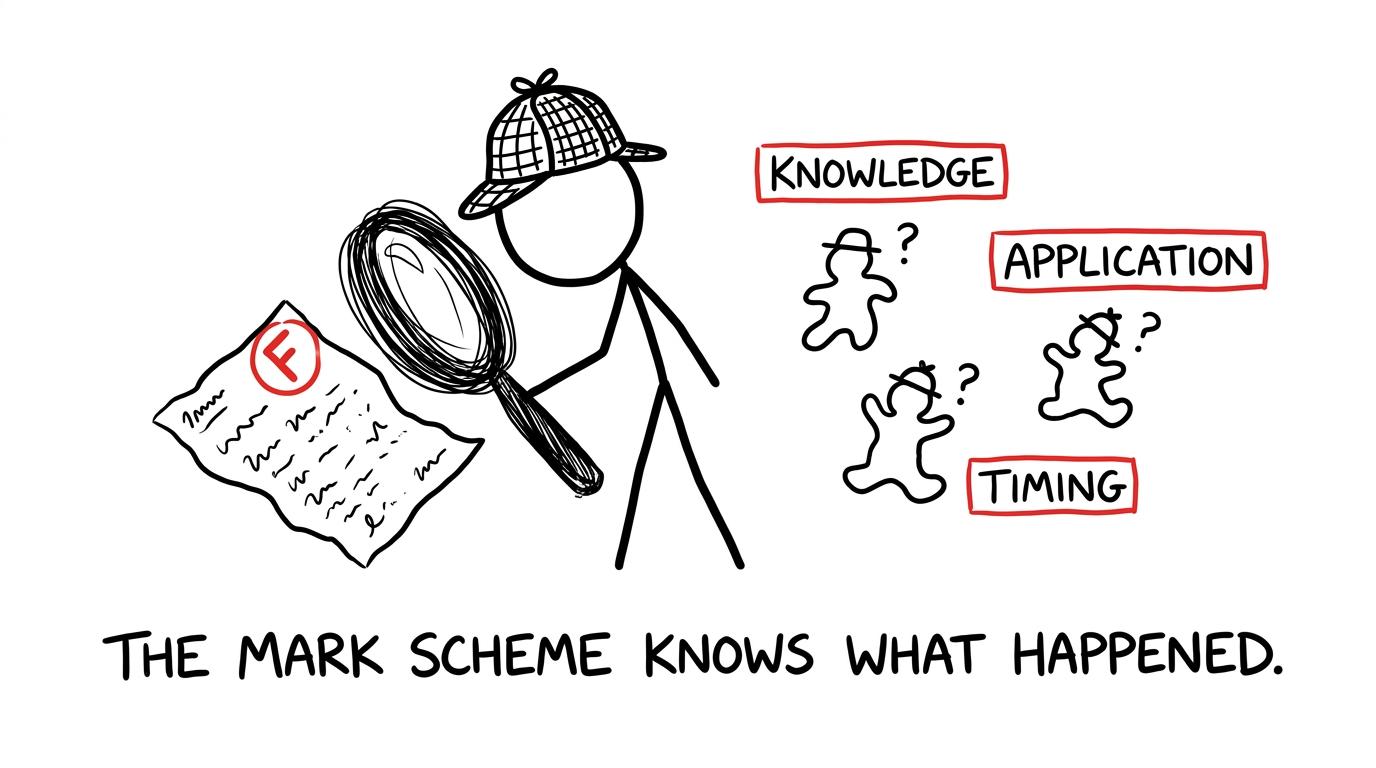 A student detective investigating a marked practice paper
Balance Computer Science with GCSE maths
Computer Science revision often competes with maths because both can demand concentrated problem-solving. Dropping maths for a week to “catch up” rarely solves the wider problem. It simply moves the backlog.
Set a minimum for each subject. On a crowded evening, that might mean one short Computer Science task followed by a focused maths activity. The MathsGenie GCSE Maths revision hub helps you choose revision lessons, exam questions and papers for Edexcel, AQA, OCR and Eduqas rather than losing time searching.
If a full paper feels unrealistic during your reset week, use Edexcel GCSE Maths mini tests or another short topic-based task. Students with more time can use Edexcel GCSE Maths past papers, checking each attempt with the available mark schemes and solutions.
The principle is the same in both subjects: learn, retrieve, apply, mark and revisit. MathsGenie’s guide to starting GCSE past papers in phases explains why shorter diagnostics should usually come before repeated full papers.
Common mistakes when resetting revision
Trying to repay every missed hour
Missed time is not a debt. Adding last week’s unfinished tasks to this week’s full timetable produces an impossible plan. Keep only the tasks that remain important.
Rewriting the whole timetable
Planning can provide relief because it looks like progress without exposing any knowledge gaps. Limit planning, then complete a real question while you still have energy.
Starting with a full paper
A full paper may be useful later, but it can overwhelm a student whose routine has just broken. Begin with a topic set or short mixed diagnostic, then increase the length.
Revising only comfortable theory
Flashcards may help with terminology, but GCSE Computer Science also rewards application, analysis and problem-solving. Include code tracing, algorithm design, testing, debugging and contextual explanations where required by your specification.
Using resources for the wrong board or cohort
Similar topic names do not guarantee identical content or assessment. Check your official specification and ask your teacher if your examination year is affected by a change.
Abandoning every other subject
A reset should stabilise your workload. Maintain a small maths routine using MathsGenie’s one-month GCSE maths plan, or adapt its weekly rhythm if your examinations are further away.
Turn one better week into a repeatable system
At the end of seven days, do not ask whether the week was perfect. Ask whether your system became easier to use.
Keep what worked. Reduce any session that repeatedly failed to start. Turn vague tasks into specific actions and schedule another retrieval attempt for material you nearly forgot. Then let exam questions reveal the next priority.
For maths, MathsGenie can become the dependable part of that system. Begin with free revision lessons, move into practice questions and mini tests, and use mark schemes and video solutions to understand lost marks. As the exams approach, add past papers and Edexcel GCSE Maths predicted papers where they match your course.
A bad week does not require a dramatic comeback. It requires one clear next action, followed by another. Open the correct specification, choose one uncertain Computer Science topic, and complete the first short session today. Then use MathsGenie to keep your GCSE maths revision calm, structured and moving forwards.











