

Reset After a Bad Week of GCSE Astronomy Revision
Reset after bad week GCSE astronomy revision with a calm seven-day plan using retrieval, targeted questions and feedback that rebuilds momentum.
A bad revision week rarely announces itself. One missed evening becomes three, your notes stay closed, and the plan that looked reasonable on Monday feels impossible by Sunday. The practical way to reset after a bad week of GCSE Astronomy revision is not to recover every missed hour. It is to complete one small, useful session today, identify what needs attention and rebuild a rhythm you can repeat.
That distinction matters. You are not trying to repair the past. You are designing a better next week.
Your GCSE Astronomy reset checklist
Start with this short version:
- Drop the idea of paying back every missed session.
- Check the current specification and choose one small topic.
- Complete a closed-book recall task before rereading notes.
- Answer a short set of questions and mark it immediately.
- Record why marks were lost, not just the total.
- Schedule three manageable sessions across the next seven days.
- Review the same material after a gap.
- Ask your teacher about any incomplete observational work.
The Edexcel GCSE Astronomy revision hub gives you a practical starting point, with lessons, questions and past-paper resources gathered together. Open the hub, choose one task and begin before you feel fully ready.
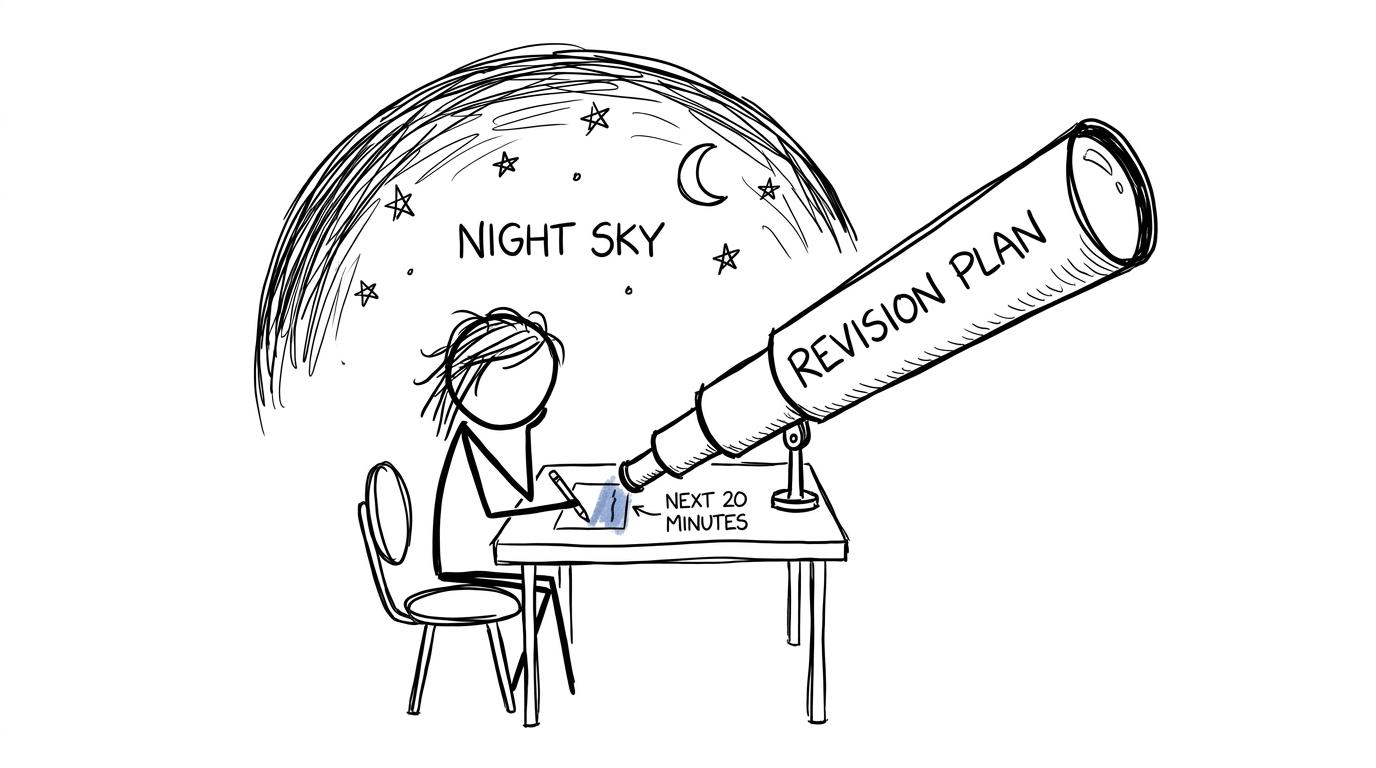 A tired student discovers that the next twenty minutes matter more than an enormous revision plan
Understand what you are resetting for
The current Pearson Edexcel GCSE Astronomy qualification, specification 1AS01\mathrm{AS}01AS0, is assessed through two externally examined papers. Paper 111 covers naked-eye astronomy and Paper 222 covers telescopic astronomy. Each paper lasts 111 hour 454545 minutes, carries 100100100 marks and contributes 50%50\%50% of the qualification.
The papers can include multiple-choice, short-answer, calculation, graphical and extended-open-response questions. The qualification is untiered, so GCSE Astronomy does not have separate foundation and higher papers. That is different from GCSE Maths qualifications offered by Edexcel, AQA, OCR and Eduqas, where tier choices are important.
Students must also complete aided and unaided observational work during the course. If your difficult week affected an observation or its write-up, speak to your teacher rather than trying to improvise a replacement. Weather, equipment, safety and school arrangements all matter, and the current Pearson guidance should be followed.
Knowing this structure stops your reset becoming vague. You need to rebuild four connected abilities:
- accurate recall of astronomical knowledge;
- application of ideas in unfamiliar situations;
- calculations and interpretation of data;
- clear written explanations using appropriate terminology.
A week spent only making attractive notes would neglect most of that list.
Make the first session deliberately small
After a disrupted week, students often create a punishing comeback plan: several chapters, a full paper and every missed flashcard in one evening. It feels responsible. Usually, it creates another reason not to start.
Set a minimum session of approximately 202020 to 303030 minutes. Give it a defined finish line:
- 555 minutes of closed-book recall;
- 101010 minutes checking and correcting knowledge;
- 101010 minutes answering questions;
- 555 minutes recording the next action.
Choose one specification-sized idea rather than a huge label such as “cosmology”. Your focus might be evidence for an expanding Universe, factors affecting astronomical observations or one stage of stellar evolution. The exact choice should come from your course checklist, a recent assessment or teacher feedback.
This is not lowering your ambition. It is reducing the amount of motivation required to begin.
Diagnose the week without judging yourself
A reset works better when it responds to evidence. Spend a few minutes identifying what actually went wrong.
Was the problem time, tiredness, uncertainty about what to revise, an unrealistic plan or avoidance of a difficult topic? Each cause needs a different repair. A student who lacked time needs shorter sessions. A student who did not know where to begin needs a clearer task list. Someone repeatedly avoiding calculations may need to rebuild the underlying maths.
Use a simple error log with four categories:
| Category | What it tells you |
|---|---|
| Knowledge | A fact, process or definition was missing |
| Application | You knew the content but could not use it in context |
| Calculation or graph | The mathematical method, unit or interpretation caused difficulty |
| Exam wording | The command word or required level of detail was missed |
MathsGenie’s guide to finding your weakest GCSE topics explains how to turn lost marks into a focused revision list. The principle applies neatly to Astronomy: revise what the evidence identifies, not simply what feels familiar.
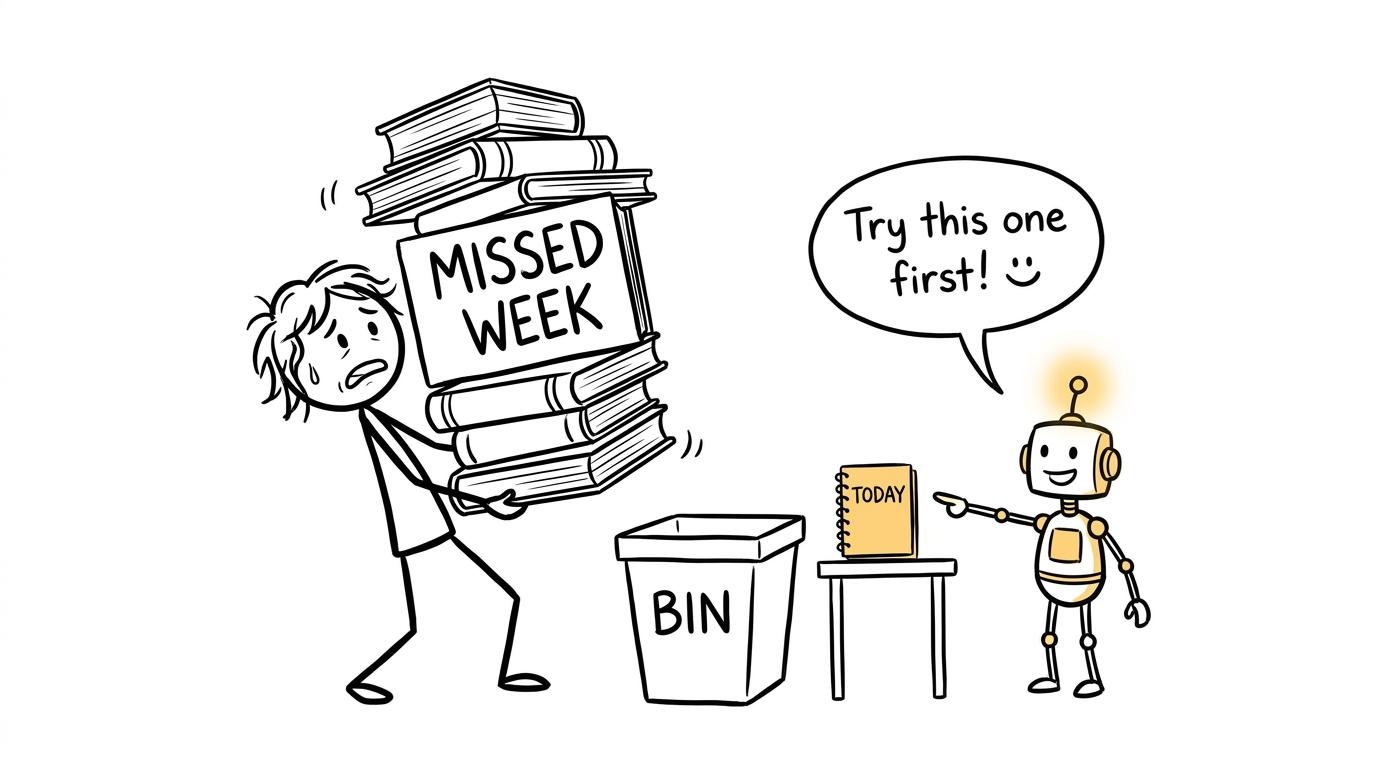 A student abandons an enormous pile of revision debt and carries one manageable notebook instead
Use active recall before reopening your notes
Begin the next session with a blank page. Write everything you can remember about the chosen topic without looking anything up. You might list key terms, sketch a labelled process in words or explain how evidence supports a conclusion.
Only then compare your recall with the lesson material and specification.
Research on retrieval practice supports this active attempt to bring knowledge to mind. Feedback is essential because uncorrected recall can preserve misconceptions. Your sequence should therefore be:
retrieve→check→correct→retrieve again later\text{retrieve} \rightarrow \text{check} \rightarrow \text{correct} \rightarrow \text{retrieve again later}retrieve→check→correct→retrieve again laterRereading can help when knowledge is genuinely missing, but it should not be mistaken for proof that you can recall or apply it. Recognition feels smooth. Exams require retrieval.
Space the second attempt rather than repeating it immediately. For example, revisit the idea after a couple of days and again the following week. The GCSE one-month revision plan shows how retrieval, targeted practice and later review can fit into a sustainable routine.
Repair the maths inside GCSE Astronomy
Astronomy contains substantial quantitative work. A disrupted revision week may expose weaknesses in the maths beneath the science, including standard form, unit conversion, proportional reasoning, graphs and rearranging relationships.
Do not interpret every calculation error as an astronomy knowledge gap. Diagnose the mathematical step that failed.
For very large or small quantities, revisit the standard form revision guide. A number in standard form has the structure
a×10n,1≤a<10,a \times 10^n, \qquad 1 \leq a < 10,a×10n,1≤a<10,where nnn is an integer. Concentrate on choosing the correct operation, handling powers carefully and presenting the final coefficient in the required range.
Units deserve their own check. Write the unit beside each quantity, convert before substituting where necessary and inspect whether the final unit is sensible. MathsGenie’s conversions and units revision guide can help rebuild that foundation.
When reading graphs, check both axes, scales and units before interpreting a trend. In extended astronomical calculations, keep intermediate values in your calculator and round at the end unless the question instructs you otherwise.
These habits also strengthen GCSE Maths preparation. The astronomy context changes, but careful substitution, proportional reasoning and communication remain valuable across exam boards.
Build a realistic seven-day comeback plan
A good reset week contains fewer promises and more completed tasks. Try this pattern:
First session: restart
Choose one small topic. Complete closed-book recall, check it and answer a short question set. Stop at the planned time, even if you could continue. Finishing successfully makes returning easier.
Second session: repair
Review your errors. Relearn only the missing ideas, then answer different questions testing the same knowledge. If calculations caused trouble, use the relevant MathsGenie maths lesson before returning to Astronomy.
Third session: mix
Combine the repaired topic with an older one. Mixing topics helps you practise deciding which knowledge applies instead of being told by a chapter heading.
Weekend session: check progress
Complete a timed section rather than automatically attempting a full paper. Mark it carefully and update your error log. The advice in when to start GCSE past papers is useful here: short diagnostic tasks can come before full papers, while complete timed papers become more valuable as knowledge and stamina improve.
For additional maths practice, Edexcel GCSE Maths mini tests provide shorter tasks with mark schemes and solutions. They are particularly useful when an astronomical question reveals a weakness in an underlying mathematical skill.
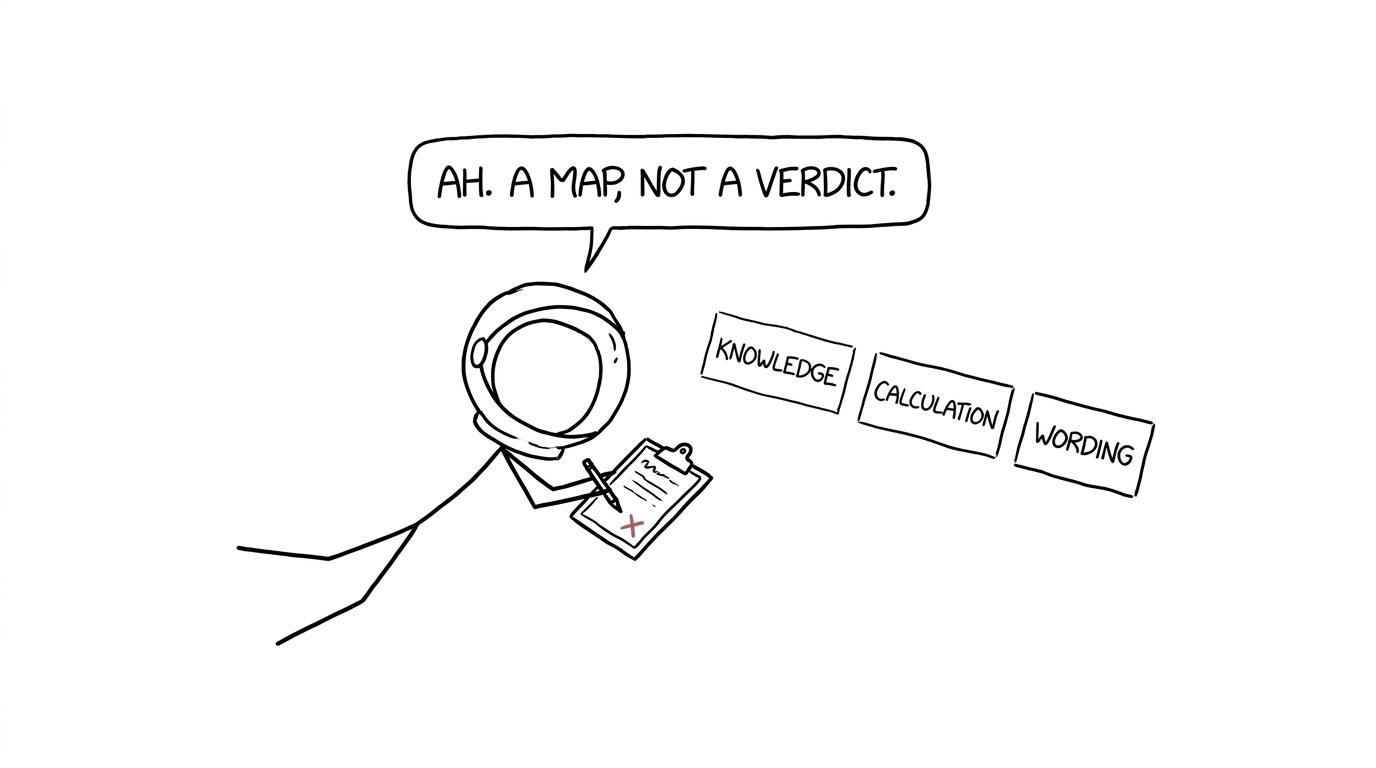 An astronaut student realises that a marked paper is a map rather than a verdict
Treat mark schemes as feedback, not judgement
A score tells you what happened. A marked and analysed response tells you what to do next.
When checking an answer, ask:
- Did I use the correct astronomical term?
- Did I answer the command word?
- Did I connect evidence to the conclusion?
- Did I show enough calculation stages?
- Did I include a unit and appropriate rounding?
- Could another reader follow my reasoning?
For longer responses, compare the structure and scientific content of your answer with the mark scheme. Do not memorise a paragraph without understanding it. Examiners can place familiar ideas in unfamiliar contexts, so adaptable knowledge matters more than a rehearsed script.
Once your topic knowledge is stable, move towards properly timed past-paper sections. MathsGenie’s article on revising GCSE subjects efficiently sets out a useful loop: learn, practise, mark, fix and retest.
Common mistakes when restarting revision
Trying to repay revision debt
Missed sessions are gone. Adding all of them to this week overloads the new plan and makes another collapse more likely. Preserve the important topics, not the old timetable.
Beginning with the hardest possible task
A complete paper may be useful later, but it is often a poor first action after losing momentum. Begin with a task you can finish and mark.
Spending the week reorganising
A new timetable, folder system or set of coloured headings can create the feeling of progress without testing any knowledge. Limit planning, then retrieve and answer questions.
Revising only favourite topics
Familiar material feels reassuring, especially after a bad week. Use assessments, teacher feedback and your error log to choose priorities objectively.
Ignoring observation requirements
Observational work cannot always be reproduced at short notice. Contact your teacher promptly if a planned observation was missed or disrupted.
Treating every error as carelessness
“Careless” is too vague to fix. Identify whether the cause was a missing fact, an incorrect unit, premature rounding, misunderstood wording or weak mathematical technique.
Your next session is the real reset
A bad week is evidence that one version of your plan did not survive real life. It is not evidence that you cannot succeed in GCSE Astronomy.
Make the next task small enough to start and specific enough to finish. Retrieve before rereading. Mark every question. Revisit errors after a gap. Then let completed sessions, rather than guilt, rebuild your confidence.
Start with the free Edexcel GCSE Astronomy revision hub, then use MathsGenie’s revision lessons and practice questions to repair the maths supporting your astronomical calculations. As your exams approach, progress to past papers, mark schemes and appropriate predicted papers across your wider GCSE Maths preparation. Video solutions, mini tests and structured revision plans are there to remove unnecessary decisions.
Open one resource. Choose one topic. Give it the next 202020 minutes.










