Reset After a Bad Week of GCSE Art and Design
Reset after bad week GCSE Art and Design revision with a realistic recovery plan for portfolio work, wellbeing and protected GCSE maths practice.
A bad revision week rarely looks dramatic. It is usually a collection of small disruptions: an unfinished sketchbook page, materials left at school, a maths session postponed, then a weekend spent worrying about all three. By Monday, the backlog feels larger than the work itself.
If you need to reset after bad week GCSE Art and Design revision, the practical answer is this: do not try to recreate the week you lost. Review what is unfinished, choose one high-value Art and Design task, protect a small amount of maths practice, and build the next seven days around work you can genuinely complete.
A reset is not punishment. It is a change of direction.
Your quick reset checklist
Use this before creating another ambitious timetable:
- Stop calculating how many hours you have supposedly lost.
- Check your teacher's instructions, deadlines and exam-board specification.
- Sort Art and Design tasks by assessment objective, not by how guilty they make you feel.
- Ask your teacher which missing evidence would improve your submission most.
- Choose one small task you can finish today.
- Reserve short, specific GCSE maths sessions.
- Prepare materials before each Art and Design block.
- Leave space for sleep, meals, movement and unexpected schoolwork.
The aim is not to have a perfect week. It is to restore a repeatable rhythm.
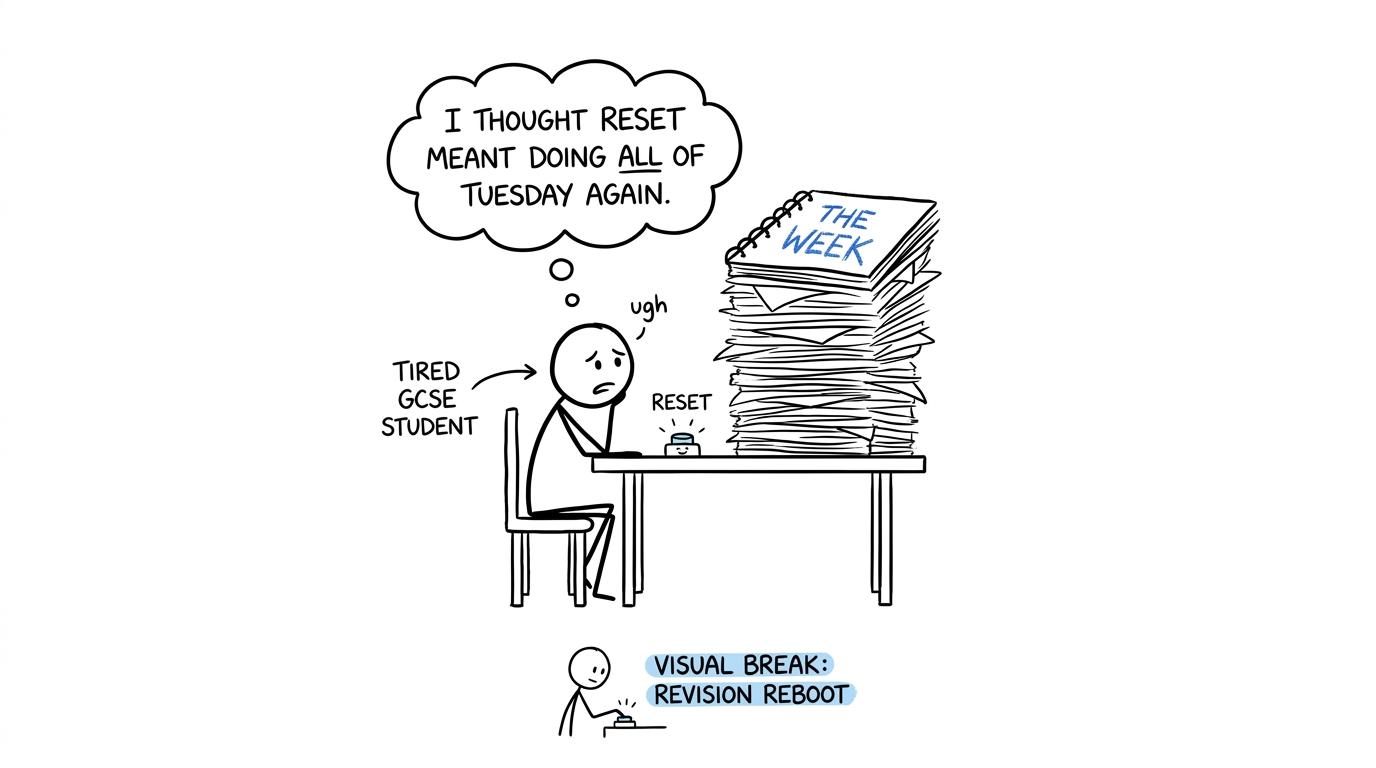 A tired GCSE student discovers that resetting revision does not mean repeating the entire week
Start with evidence, not emotion
After a difficult week, students often describe the problem in broad terms: "I am behind in art" or "I did no revision." Those statements feel true, but they do not tell you what to do next.
Replace them with an evidence check. Open your sketchbook, digital portfolio and task list. Record what is:
- complete and ready to present;
- started but missing development or annotation;
- waiting for materials, printing or teacher feedback;
- not yet started;
- approaching a fixed school deadline.
GCSE Art and Design is assessed through practical evidence. Across England's GCSE specifications, the four common assessment objectives concern developing ideas from sources, refining through experimentation, recording observations and insights, and presenting a personal and meaningful response. Each objective carries 25%25\%25% of the overall assessment weighting.
That matters because a beautiful final piece does not automatically repair weak investigation, experimentation or recording. Equally, another decorative title page may contribute less than thoughtful annotation beside an experiment you have already completed.
Specifications from boards including AQA and Pearson Edexcel generally divide assessment between a portfolio component worth 60%60\%60% and an externally set assignment worth 40%40\%40%. Exact administrative arrangements and deadlines depend on your board and school, so follow your teacher's current guidance rather than an online timetable intended for another course.
Choose the smallest task that moves the project forward
The best first task is neither the easiest task nor the largest. It is the smallest useful action that unlocks what comes next.
That might be:
- photographing completed work in good light;
- annotating why one material was more effective than another;
- making two purposeful variations of an existing idea;
- collecting and analysing a relevant artist or designer source;
- completing an observational study needed for later development;
- writing questions to take to your teacher.
Use verbs that describe visible action. "Do art" is too vague. "Photograph three experiments and annotate the most successful one" gives you a clear finishing point.
Before beginning, place the required materials on the desk. If a task depends on specialist equipment at school, schedule it for a lesson and choose a home task that is actually possible. A plan built around unavailable paint, printing or photography equipment is not a plan. It is another source of delay.
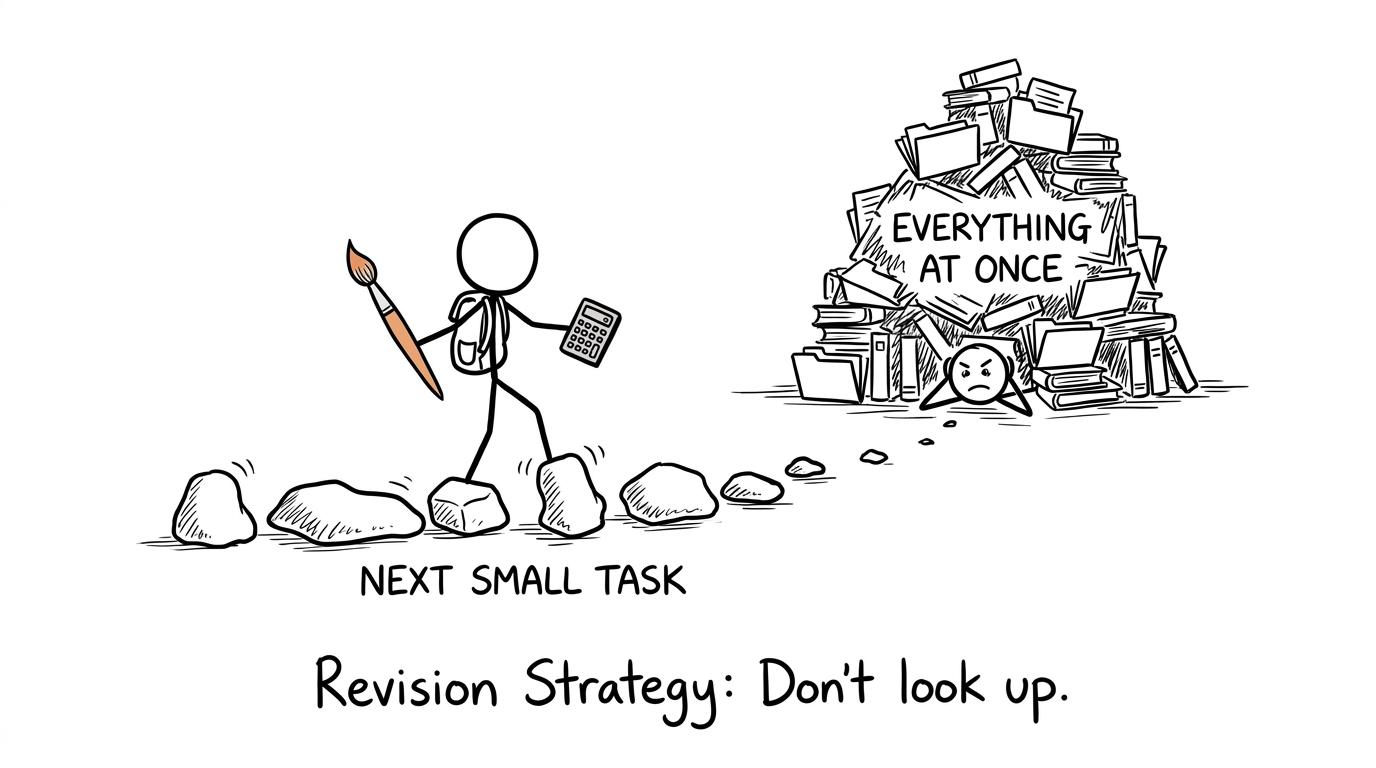 A student chooses one small next task instead of carrying the entire revision backlog
Build a realistic seven-day recovery plan
Do not fill every free hour. A recovery week needs spare capacity because schoolwork, tiredness and practical delays do not disappear simply because you made a new timetable.
The first evening: stabilise
Spend a short block checking your portfolio and identifying missing evidence. Then complete one contained task. Stop at the planned finishing time, prepare tomorrow's materials and get a normal night's sleep.
NHS guidance for young people recommends manageable revision chunks, regular short breaks, realistic schedules and asking for help when stress becomes difficult to manage. It also advises against sacrificing sleep for panicked last-minute work.
The middle of the week: create and refine
Use your longer sessions for work that requires sustained attention, such as drawing, experimentation or developing a composition. Place shorter jobs around them: photography, annotation, organising source material and reviewing feedback.
Try to end each session by writing the next physical action. "Test the darker background on tracing paper" is easier to restart than "continue development."
The end of the week: review rather than cram
Compare your work with the task brief and the four assessment objectives. Do not give yourself an imaginary grade. Instead, ask:
- Can someone see where my ideas came from?
- Have I shown genuine experimentation and refinement?
- Is there relevant visual recording and annotation?
- Does the response connect clearly to my intentions?
Take unresolved questions to your teacher. They can tell you which tasks are required, feasible and most valuable within your course.
Protect your GCSE maths while Art and Design catches up
A practical Art and Design project can expand to occupy every evening. Maths can then disappear because there is no half-finished canvas reminding you it exists.
Protect maths with short appointments rather than waiting for spare time. A small session with a defined outcome is enough to maintain continuity during an Art-heavy week. Start from the GCSE Maths revision hub, select your exam board and tier, and choose one weak topic rather than browsing for the perfect resource.
If your wider schedule has collapsed, adapt the structure in MathsGenie's GCSE maths revision timetable. Keep the sessions modest:
- one revision lesson followed by a few practice questions;
- one short retrieval session without notes;
- one marked mini test or paper section;
- one correction session focused on lost marks.
Foundation and higher-tier students should use material suited to their own course. Edexcel, AQA, OCR and Eduqas papers assess common GCSE maths content, but their paper styles and organisation differ. The GCSE maths topics by exam board and tier guide can help you stay aligned with the right course.
On a low-energy evening, a shorter assessment is more realistic than abandoning maths completely. MathsGenie's GCSE 45-minute tests provide a bridge towards full-paper stamina. Mark the attempt and record one precise weakness to revisit.
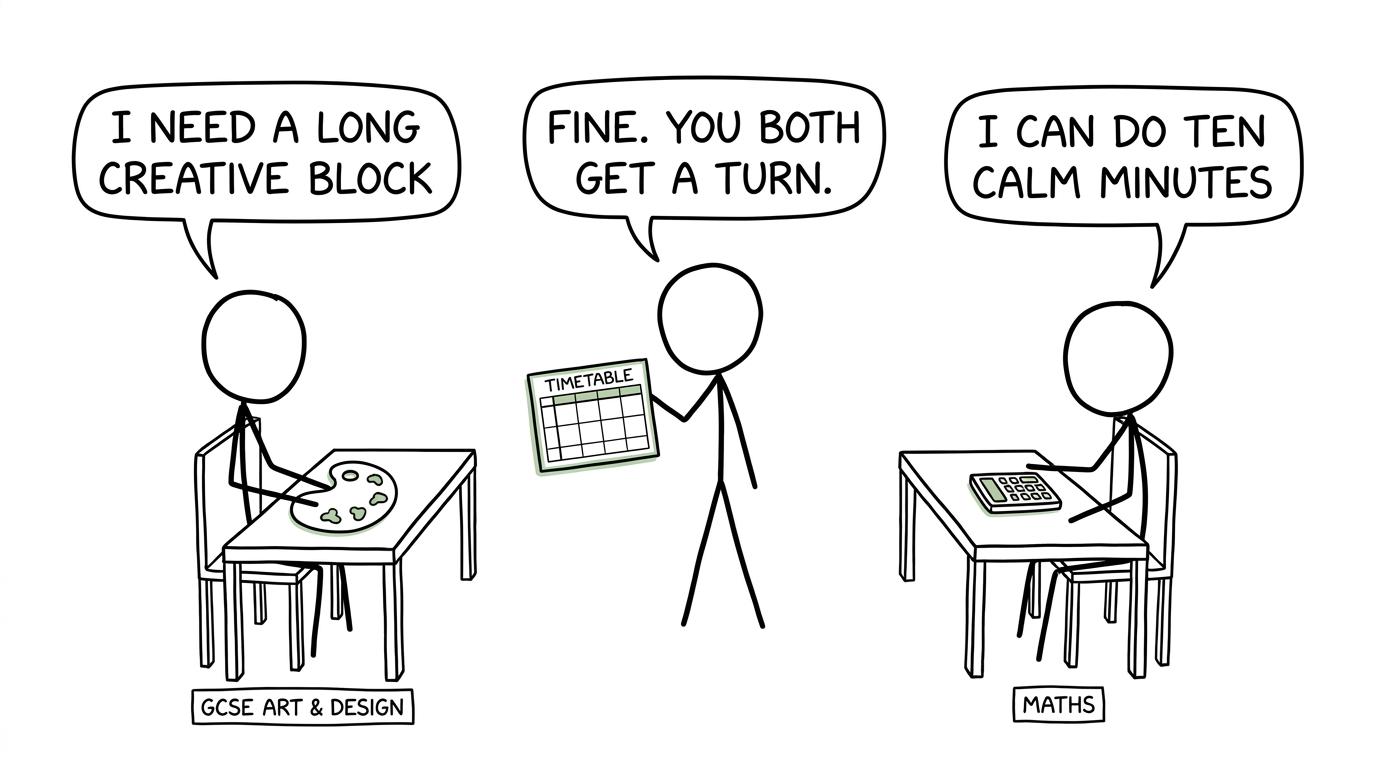 An art palette and calculator negotiate their places on a sensible GCSE revision timetable
Use different revision methods for different subjects
Art and Design and maths both reward evidence of thinking, but the evidence looks different.
For Art and Design, effective revision may involve investigating sources, recording observations, testing materials, refining decisions and explaining how your work developed. Passive rereading cannot replace practical evidence.
In maths, effective revision requires attempting questions, checking methods and correcting errors. Watching a video can clarify a method, but improvement comes from applying it independently. The guide to using GCSE past papers properly explains the useful cycle: attempt, mark, identify the gap, relearn and retest.
Do not force both subjects into identical session lengths. Art may need a longer block because setting up and clearing materials takes time. Maths can fit into a shorter, concentrated block using practice questions, mini tests or video solutions. Fair does not mean identical. It means giving each subject the conditions it needs.
What to do when motivation still does not return
You do not need to feel motivated before starting. Reduce the task until beginning feels ordinary:
- open the correct sketchbook page;
- put one material on the desk;
- write one annotation sentence;
- answer one maths question;
- mark one previous attempt.
Then decide whether to continue. Starting creates information: perhaps the task is manageable, perhaps you need help, or perhaps you are too tired to work accurately. All three outcomes are more useful than sitting beside a closed folder and predicting failure.
If stress, low mood or anxiety is persistent or interfering with everyday life, speak to a parent, carer, teacher, pastoral lead or another trusted adult. Asking for support is not a revision failure. It is part of responding sensibly to a problem.
Common mistakes when restarting revision
Trying to repay every missed hour
Lost time is not a debt that must be repaid overnight. Overloading the recovery week often produces another collapse. Plan from the time and energy now available.
Polishing instead of developing
Neat presentation has value, but it should not replace missing investigation, recording or experimentation. Ask what evidence the project needs before decorating pages.
Starting a full maths paper when exhausted
Full papers are valuable when you can attempt and review them properly. During a difficult week, use a targeted topic set or shorter test. Save GCSE predicted papers for purposeful timed practice, not as a punishment for falling behind.
Ignoring feedback because it feels uncomfortable
Teacher feedback reduces guesswork. Convert each comment into a visible action and clarify anything you do not understand.
Making a timetable with no recovery space
A schedule that assumes perfect energy and no interruptions will break quickly. Leave some evenings lighter and protect sleep. The one-week GCSE maths revision plan can be scaled down when Art and Design deadlines are taking priority.
Your next move matters more than last week
A bad week does not require a heroic comeback. It requires an honest inventory, one worthwhile Art and Design task and a small protected space for maths. Once those actions are complete, plan the next ones from evidence rather than panic.
For maths, let MathsGenie remove unnecessary decisions. Use free revision lessons to rebuild a method, practice questions and mini tests to check it, then move to past papers, predicted papers, mark schemes and video solutions when you are ready for exam conditions.
Open the MathsGenie GCSE revision hub, choose one suitable task and begin. Your week does not need to be rescued all at once. It only needs a better next step.