

Rereading and Highlighting: Why They Don't Work
Rereading and highlighting: why they don't work, what to do instead, and how to build an effective GCSE or A Level revision plan using active practice.
A textbook is open and the highlighter is moving. Revision looks productive. Yet when the book closes, explaining the method or answering a question can feel surprisingly difficult.
That gap explains rereading and highlighting: why they don't work as a complete revision strategy. Both can support understanding, but familiarity with a page does not prove you can recall its ideas or apply them independently.
The practical answer is to keep rereading brief, highlight selectively, and spend most revision time recalling information, answering questions, checking mistakes and returning to weaker topics later.
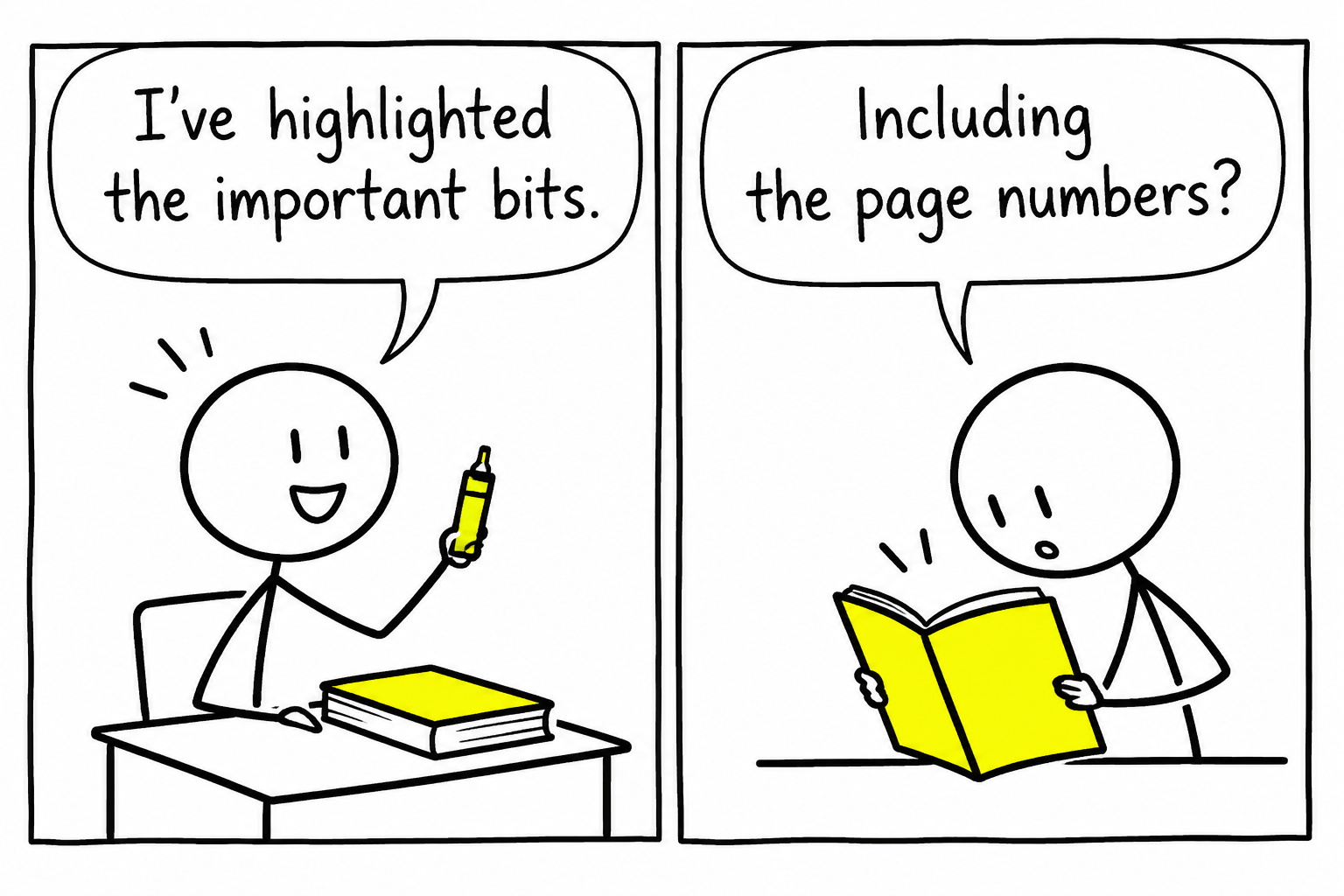 A student discovers that highlighting everything is not the same as identifying what matters
The short revision checklist
A useful session should include these actions:
- Recall something without looking at your notes.
- Answer questions independently.
- Check your answers against a mark scheme or solution.
- Identify and repair mistakes.
- Schedule another attempt after a gap.
These activities leave evidence of learning. A colourful page shows where your attention went; a completed question shows what you can currently do.
Why rereading feels effective
Imagine a GCSE student rereading a revision page. By the third reading, the sentences seem obvious. That feeling is reassuring, but the page is still supplying prompts. Recognising an explanation is easier than producing it from memory.
Rereading can help when you first encounter material or need to resolve a particular misunderstanding. The problem begins when repeated reading becomes the whole session, leaving independent performance untested.
In maths, following a solution can make a method appear straightforward. The more revealing moment comes when you face a blank page and must choose the method yourself. Use GCSE maths revision lessons and questions to move from explanation into independent practice.
Why highlighting needs a next step
Highlighting helps you select information: a definition, formula or condition you may need later. It does not automatically establish whether you understand or remember that information.
Its usefulness falls when most of the page is marked, when you select passages before understanding them, or when colouring replaces answering questions.
Give each highlight a purpose. Turn a definition into a recall prompt. Use a marked formula to decide which questions to practise. Revisit a highlighted condition when checking why a method applies.
The useful question is: what will this highlight make me do next? If there is no answer, another colour is unlikely to improve the session.
Build an active revision session
You do not need to discard your notes. Change how you use them, placing independent attempts before checking.
Retrieve
Close the resource and recall the relevant facts, formulae or steps. You might explain when a method applies or write down what you remember about a topic.
Allow yourself time to think before checking. If you cannot start, consult a small prompt, then try again without it. The aim is to discover what you can produce independently.
Practise
Answer questions without copying an example. Choose a manageable set of topic questions, a GCSE maths mini test or a 45-minute maths test.
As revision develops, mix topics using GCSE past papers and predicted papers. Mixed questions test whether you can select a method without a topic heading giving it away. Choose resources appropriate to your exam board and tier.
Check and repair
Mark your answers honestly. Use mark schemes and video solutions to locate the gap: forgotten knowledge, an unsuitable method, a misread question or an arithmetic error.
Now reread the explanation that addresses that gap. Then close it and attempt the question again. Copying a correction records the answer; solving independently checks whether the correction has helped.
Return later
Schedule another attempt after a gap. Begin with a question before reopening your notes. If you succeed independently, leave a longer gap next time. If the difficulty remains, revisit the explanation and arrange another attempt sooner.
The MathsGenie Revision Planner can help organise these return sessions alongside other revision tasks.
Plan around tasks and evidence
Hours matter, but a timetable also needs to describe what happens inside them. “Revise maths” leaves too many decisions until the session begins.
Specify the topic, opening recall task, question set, marking stage and return date. This gives the session a clear purpose and makes progress easier to review.
Use the GCSE revision hours guide to consider a sustainable commitment, and the GCSE maths revision timetable guide to distribute sessions across the week. Adjust the plan when completed work reveals a weakness.
For A Level maths, the same structure applies: recall relevant knowledge, select and apply methods, check reasoning and revisit difficulties. Longer questions make independent practice particularly important.
Parents can support this process without teaching the content. Ask what was answered without notes, which mistake needs another attempt, and when that attempt will happen. These questions make the conversation about learning rather than desk time.
Common mistakes to avoid
Checking too quickly. Reading the first line of a solution can supply the method you were meant to select. Make an independent attempt before looking.
Practising without marking. An incorrect method can persist if nobody checks it. Review answers while your reasoning is still fresh.
Treating mistakes as failure. A mistake identifies something worth revising. Record the cause and test it again later.
Abandoning reading completely. Reading remains useful for understanding new material and repairing gaps. Follow it with an independent check.
Keeping the timetable unchanged. If practice reveals a weak topic, give it attention in the next plan.
Make your next session count
Start with one topic. Recall what you know, complete questions, mark them and set a return date. MathsGenie's free revision lessons, practice questions, mark schemes and video solutions give each stage a resource. Open the MathsGenie Revision Planner and turn that sequence into your next revision session.















