

Remote Learning GCSE Spanish Results: What Changed?
Remote learning GCSE Spanish results explained through official data, grading changes and school closures, with practical lessons for smarter maths revision.
A strange thing happened after schools closed. Language learning became harder, yet GCSE grades rose. At first glance, those facts seem to contradict each other.
If you searched for remote learning GCSE Spanish results, the short answer is this: school closures disrupted Spanish learning, particularly participation and speaking practice, but the unusually high grades awarded in 2020 and 2021 cannot be treated as evidence that attainment improved. Exams were cancelled, assessment changed, and grading was more generous than before the pandemic.
For students preparing for GCSE maths, this story matters beyond Spanish. It shows why data needs context, and why consistent practice, feedback and exam conditions remain so important.
What the evidence says at a glance
- Remote education reduced the quantity and quality of learning for many pupils.
- Language subjects faced a particular challenge because speaking and listening depend on regular interaction.
- GCSE exams were cancelled in 2020 and 2021, so those results are not directly comparable with normal examination years.
- Exams returned in 2022 with transitional grading.
- England returned broadly to pre-pandemic grading standards in 2023.
- A revised GCSE Spanish specification was first taught from September 2024, with its first award in summer 2026.
- Higher grades during school closures do not prove that remote learning improved Spanish knowledge.
That last distinction is the heart of the issue. Results describe what was awarded. They do not always measure learning under identical conditions.
How remote learning affected GCSE Spanish
Spanish is not simply a collection of vocabulary lists. Students need to recognise speech, retrieve words quickly, construct sentences and respond to another person. Those abilities strengthen through repeated use.
Ofqual's review of learning during the pandemic concluded that the quality and quantity of learning generally declined during periods of disruption. It also reported evidence that pupils had fallen behind particularly in modern foreign languages.
The British Council's Language Trends 2021 research adds useful subject context. Teachers in state secondary schools reported that two in five Key Stage 3 pupils did not engage with language learning during the first national lockdown. Access was unequal: schools serving more deprived communities reported a greater negative effect than more affluent schools.
These findings do not isolate GCSE Spanish results or prove that every pupil lost the same amount of learning. They do, however, identify credible ways in which school closures affected later performance:
- fewer live conversations with teachers and classmates;
- reduced immediate correction of pronunciation and grammar;
- inconsistent access to devices or reliable internet;
- lower engagement with independent language work;
- less exposure to international activities and language assistants;
- disrupted routines during an important stage of the course.
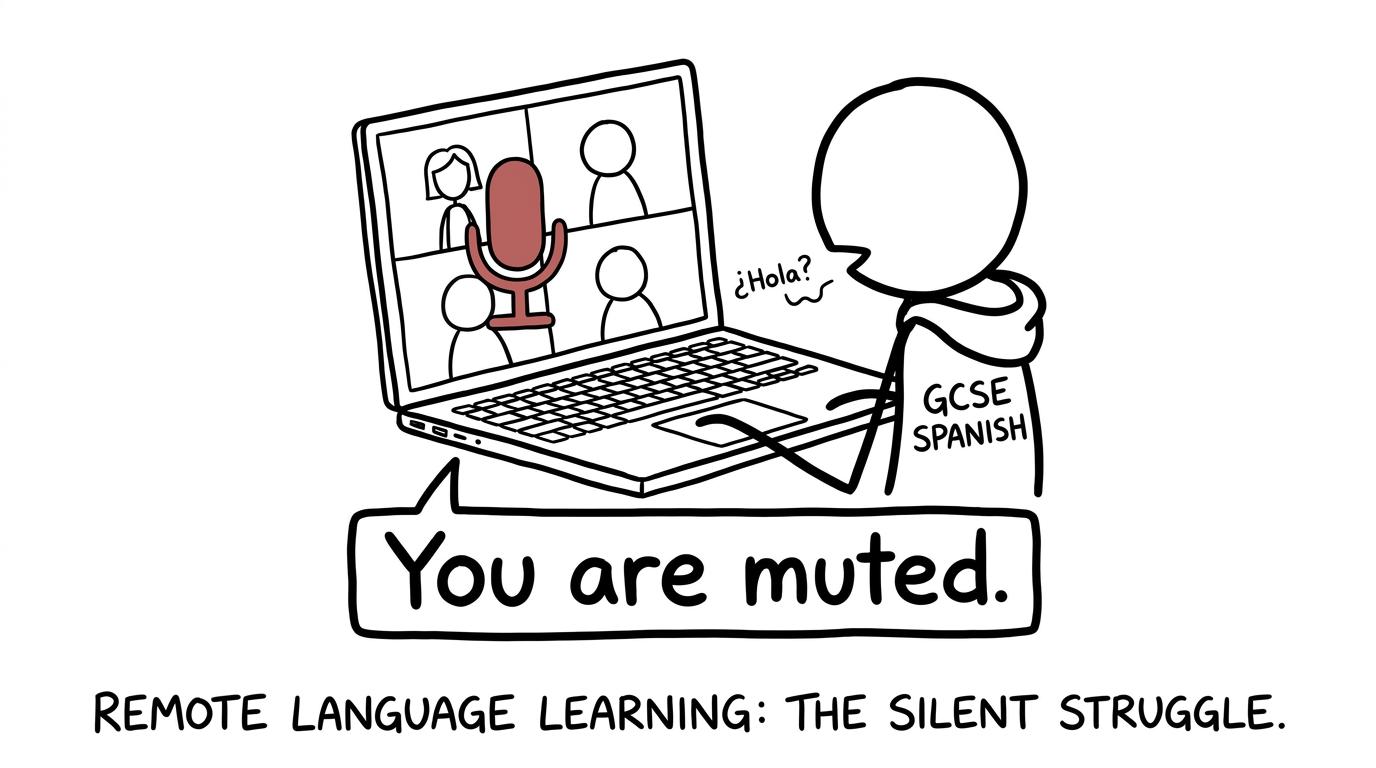 A remote Spanish lesson meets the mute button
Why speaking was especially difficult online
A worksheet can be uploaded. A vocabulary list can be emailed. Conversation is harder to reproduce.
Video delays, muted microphones and reluctance to speak in front of a digital class can reduce spontaneous practice. Some pupils received strong live teaching; others mainly completed independent tasks. The phrase “remote learning” therefore describes many different experiences rather than one standard intervention.
That variation matters when interpreting national results. An overall percentage can conceal very different experiences between schools, households and individual students.
Why GCSE Spanish grades initially rose
The most important statistical warning is that assessment changed at the same time as teaching changed.
| Exam year | How grades were awarded in England | How to interpret the results |
|---|---|---|
| 2019 | Normal summer examinations | The clearest pre-pandemic comparison point |
| 2020 | Exams cancelled; centre assessment formed the basis of final awards | Not directly comparable with an examined year |
| 2021 | Teacher Assessed Grades based on available evidence | Not directly comparable with an examined year |
| 2022 | Exams returned with transitional grading | More generous than 2019 by design |
| 2023 onwards | Broad return to pre-pandemic grading standards | Better suited to long-term comparison, though cohorts still differ |
Across GCSE subjects, the proportion of results at grade 444 or above increased from 67.0%67.0\%67.0% in 2019 to 75.9%75.9\%75.9% in 2020 and 76.9%76.9\%76.9% in 2021. It then fell to 73.0%73.0\%73.0% in 2022 and 67.8%67.8\%67.8% in 2023 as normal examinations and pre-pandemic grading standards returned.
Those figures cover all GCSE subjects, not Spanish alone. They are useful because they reveal the system-wide grading pattern, but they should not be presented as subject-specific Spanish outcomes.
In statistical language, assessment method is a confounding variable. Both learning conditions and grading arrangements changed. Consequently, a rise in awarded grades cannot be attributed to remote teaching.
What the Spanish results can and cannot tell us
A careful conclusion has three layers.
The evidence supports disruption to learning
Authoritative reviews found reduced learning time, weaker engagement and particular difficulty in modern foreign languages. Speaking and listening were vulnerable because they depend heavily on interaction.
The results do not measure that disruption cleanly
The 2020 and 2021 cohorts did not sit the usual summer exams. Teacher evidence, mock assessments, classwork and other available information contributed to grades. The resulting outcomes answered a different question from a standard examination series.
Falling grades after 2021 do not prove learning suddenly worsened
Ofqual deliberately moved grading back towards the pre-pandemic standard. In 2022, outcomes were intended to sit between 2019 and 2021 overall. From 2023, grading returned broadly to the pre-pandemic approach, with protection against disruption built into the process.
So the most defensible reading is not “remote learning raised Spanish grades” or “remote learning caused a precise fall”. It is that school closures damaged important learning opportunities, while temporary assessment arrangements made headline grades a poor direct measure of that damage.
What has changed since school closures?
Normal summer examination series resumed in 2022. Full subject content and familiar assessment arrangements returned, while schools continued addressing gaps left by disrupted teaching.
There has also been a more permanent curriculum change. Revised GCSEs in French, German and Spanish began teaching in September 2024, with first assessment in summer 2026. The new subject content places clearer emphasis on frequently occurring vocabulary, grammar and pronunciation.
Students are expected to know 1,2001,2001,200 lexical items at foundation tier and a further 500500500 at higher tier, giving 1,7001,7001,700 in total for higher. At least 85%85\%85% of the specified vocabulary is drawn from the 2,0002,0002,000 most frequent words in the language. Exact paper structures vary between AQA, Edexcel and other awarding organisations, so students should follow their own specification.
This reform is not simply a pandemic recovery measure. It is a new qualification design. Results under the revised specification must therefore be interpreted with care when compared with earlier Spanish GCSEs.
What maths students can learn from the Spanish data
There is a practical lesson hiding inside the statistics: activity is not the same as learning.
A pupil may attend every online lesson yet receive little corrective feedback. In maths, a student may watch several videos yet never attempt a question without help. Both can feel productive while leaving understanding fragile.
A stronger revision cycle is:
- learn or review one method;
- answer questions independently;
- mark the work immediately;
- identify the exact reason for each lost mark;
- practise that weakness again;
- retest it later under timed conditions.
Start with the GCSE Maths revision hub, where resources are organised by exam board. If you are unsure what to revise first, use the MathsGenie revision planner or follow the process in finding your weakest GCSE topics.
The aim is not to spend the maximum number of hours at a desk. It is to create evidence that your performance is improving.
Treat feedback as part of the task
Remote learning often weakened the feedback loop. You can avoid repeating that problem in independent maths revision.
Use revision lessons to rebuild a method, then complete practice questions without looking at the solution. Move into GCSE maths past papers once individual topics become secure. Edexcel students can use the dedicated Edexcel GCSE Maths past papers, including mark schemes and solutions where available.
A mark is useful only if it changes what you do next. The total tells you where you are. The errors tell you how to move.
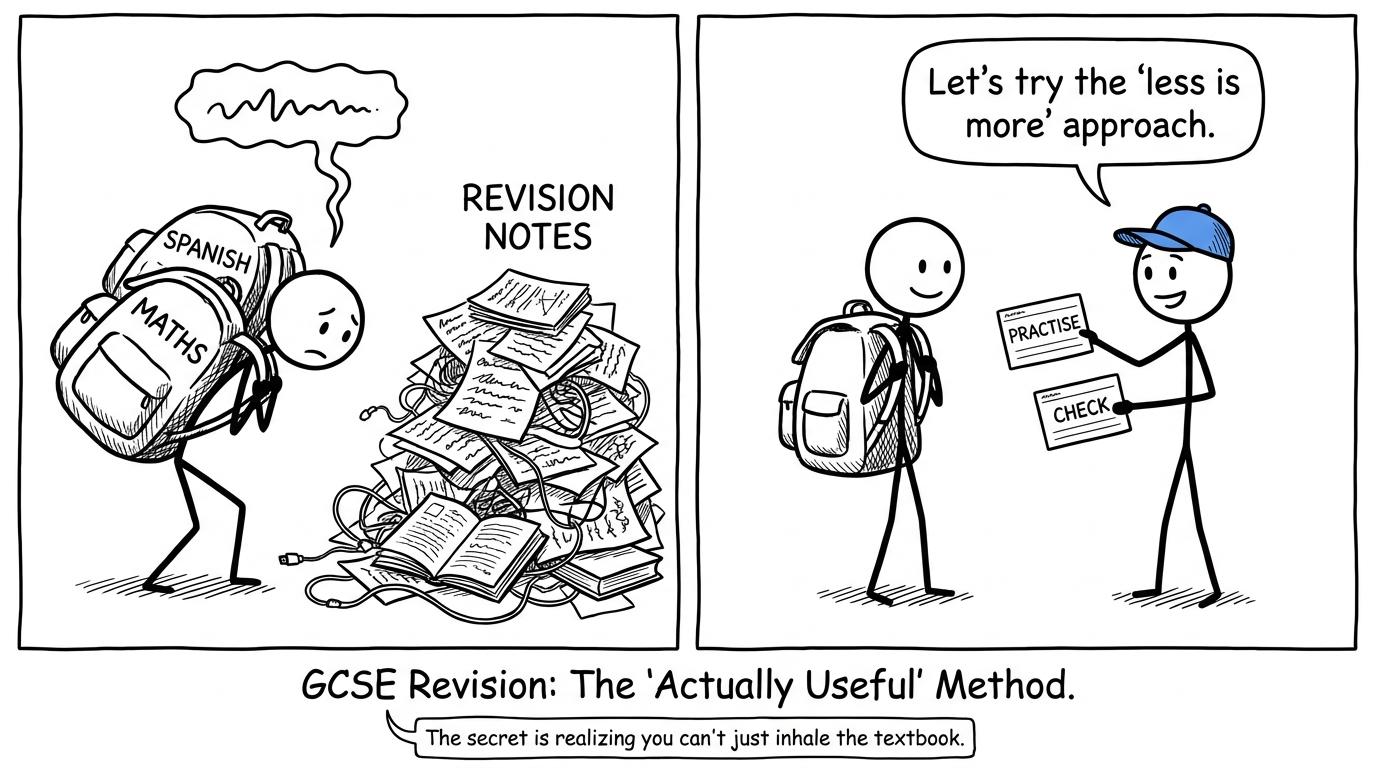 A student replaces two enormous revision piles with a simple practise-and-check routine
Build a routine that survives disruption
The pandemic exposed how vulnerable learning can be when it depends entirely on one place, one lesson or one burst of motivation. A small repeatable system is more resilient.
The GCSE maths revision timetable guide can help you combine topic sessions with timed practice. As exams approach, the GCSE maths exam-week checklist provides a calmer structure for foundation and higher tier students across Edexcel, AQA, OCR and Eduqas.
Predicted papers can provide fresh exam-style practice, but they should supplement official past papers rather than replace them. Their value lies in revealing gaps, not predicting every question.
Common mistakes when interpreting the evidence
Comparing 2021 directly with 2019
The cohorts were assessed differently. Any comparison must acknowledge that 2019 used normal exams, while 2021 used Teacher Assessed Grades.
Assuming higher grades mean better learning
Awarded outcomes rose across GCSEs during the non-exam years, even though research found substantial disruption. Both facts can be true because grading arrangements changed.
Treating all remote education as identical
Some pupils received live lessons, regular feedback and speaking practice. Others had limited technology or mainly independent work. A national average cannot describe every experience.
Using overall GCSE figures as Spanish-only statistics
Whole-cohort GCSE percentages provide context, not a precise measurement of Spanish performance. Subject claims should rely on subject-level data.
Confusing correlation with causation
Remote learning, assessment policy, pupil entry patterns, school resources and prior attainment can all influence observed results. One trend does not identify one cause.
Results need context, but revision needs action
The story of remote learning and GCSE Spanish is not a neat tale of grades rising or falling. School closures disrupted language practice, especially interaction and engagement. At the same time, exams were cancelled and grading changed, making 2020 and 2021 outcomes unsuitable for simple comparison with normal exam years.
That is the honest conclusion. Data becomes useful when we understand how it was produced.
For your own GCSE maths preparation, keep the lesson practical. Build a routine around active questions, immediate marking and repeated testing. Use MathsGenie's free revision lessons and practice questions to repair individual topics, mini tests to check progress, and past papers, predicted papers, mark schemes and video solutions to prepare for the real examination. Start with the GCSE Maths topics by exam board and tier, choose one weakness, and turn today's evidence into tomorrow's marks.










