

Regret Picking GCSE German? What to Check First
Regret picking GCSE German? Explore common concerns, check the course demands, and plan language and maths revision confidently before committing.

Choosing a GCSE option can feel strangely permanent. A subject that looked interesting in Year 9 may feel very different when vocabulary tests, speaking practice and maths revision all begin competing for the same evening.
If you already regret picking GCSE German, the short answer is this: the feeling often comes from the course being more cumulative, exposed and time-consuming than expected. That does not automatically mean you chose the wrong subject. Before trying to switch, identify whether the problem is German itself, your revision method, the assessment format or an overloaded timetable.
This guide explains the concerns students commonly have, what the course actually demands and what to check before committing, or deciding that a change is sensible.
A quick GCSE German decision checklist
Before choosing or changing the subject, ask:
- Do I enjoy communicating in German, not just completing familiar classroom exercises?
- Am I prepared to learn vocabulary consistently rather than before one test?
- How do I feel about speaking under controlled assessment conditions?
- Which exam board and specification does my school use?
- Will I take foundation or higher tier, where tiering applies?
- What support, conversation practice and revision resources are available?
- Can I balance German with maths, English and my other options?
- What subject would replace German, and would it genuinely suit me better?
- What is my school's deadline and process for changing options?
The last two questions matter. Dropping one demanding subject for another demanding subject is not necessarily progress.
Why students may regret picking GCSE German
Vocabulary becomes a long-term commitment
German is cumulative. Words learnt in one topic may return months later in a listening task, speaking conversation or writing question. This can surprise students who previously succeeded by revising the night before an end-of-topic test.
The difficulty is not simply the number of words. You need to recognise vocabulary quickly when listening, recall it independently when speaking and use it accurately in writing. Passive recognition is not the same as active command.
A student may therefore conclude that they are "bad at German" when the real issue is irregular retrieval practice. Short, frequent sessions generally fit this kind of learning better than occasional, exhausting blocks.
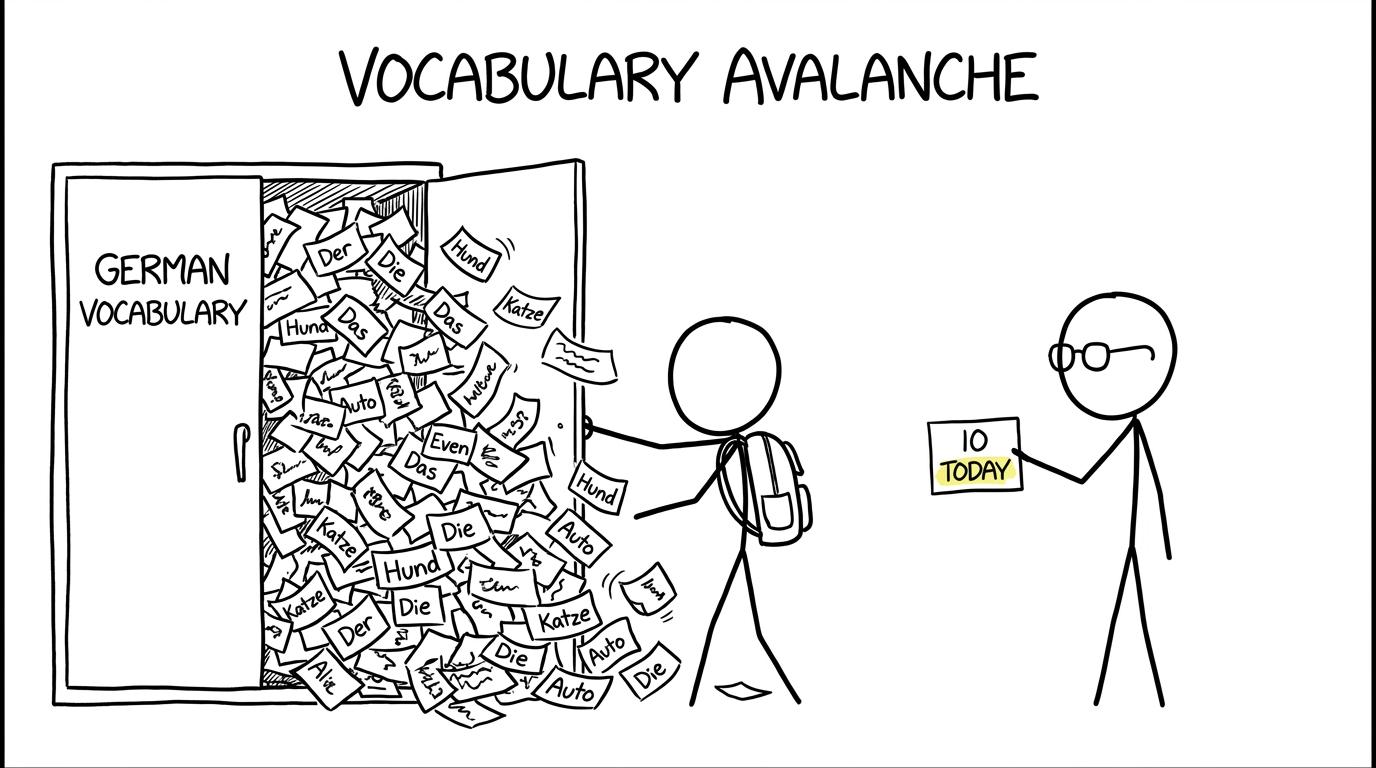 A GCSE student discovers an avalanche of German vocabulary flashcards
Speaking can feel unusually exposed
In many subjects, you can pause privately before writing an answer. Speaking feels different. You must understand, recall and pronounce language while another person is listening.
That pressure can make a manageable task feel much larger. It is also why students should investigate the speaking assessment before choosing German. Ask how lessons prepare you for it, how often you will practise and what the examination involves under your specification.
Nervousness alone does not mean German is unsuitable. Speaking becomes less mysterious through regular rehearsal, recording yourself and practising responses without reading a complete script. But if spoken assessment causes serious concern, discuss it early with your teacher rather than hoping it will disappear.
Listening may feel less controllable than reading
A difficult reading passage stays on the page. Spoken German keeps moving.
Students can lose the thread because of an unfamiliar word, a change of tense, a distractor or the speed of delivery. They may understand the general topic but miss the precise detail required for the mark.
This is one reason GCSE German can feel unpredictable. Improvement requires regular contact with spoken language, not merely memorising written vocabulary lists. Your school's resources and the specification's assessment guidance should make clear what kinds of listening task you will face.
Grammar demands attention to small details
German rewards precision. Word order, verb forms, cases, genders and adjective endings can all affect accuracy. Students who enjoy patterns may find this satisfying; others may find that small details create a disproportionate amount of frustration.
The important distinction is between complexity and impossibility. Grammar becomes more manageable when it is divided into recurring patterns. Trying to repair every weakness simultaneously usually makes progress harder to see.
This is similar to maths revision. A student does not improve algebra by rereading every page of a textbook. They identify a specific gap, practise it and check the answer. MathsGenie's GCSE maths revision lessons are organised around that principle, with focused explanations and questions rather than one indistinct block called "maths".
The workload was underestimated
German is not necessarily more difficult than every other option, but it asks for a particular kind of consistency. Vocabulary, grammar, listening, reading, speaking and writing all need attention.
That workload becomes noticeable when combined with compulsory subjects. If maths is already taking longer than expected, German may appear to be the problem simply because it is the next task on the list.
Look at the whole week. Are you genuinely spending too much time on German, or are unplanned sessions expanding to fill every evening? MathsGenie's revision planner can help turn a vague sense of overload into a visible schedule.
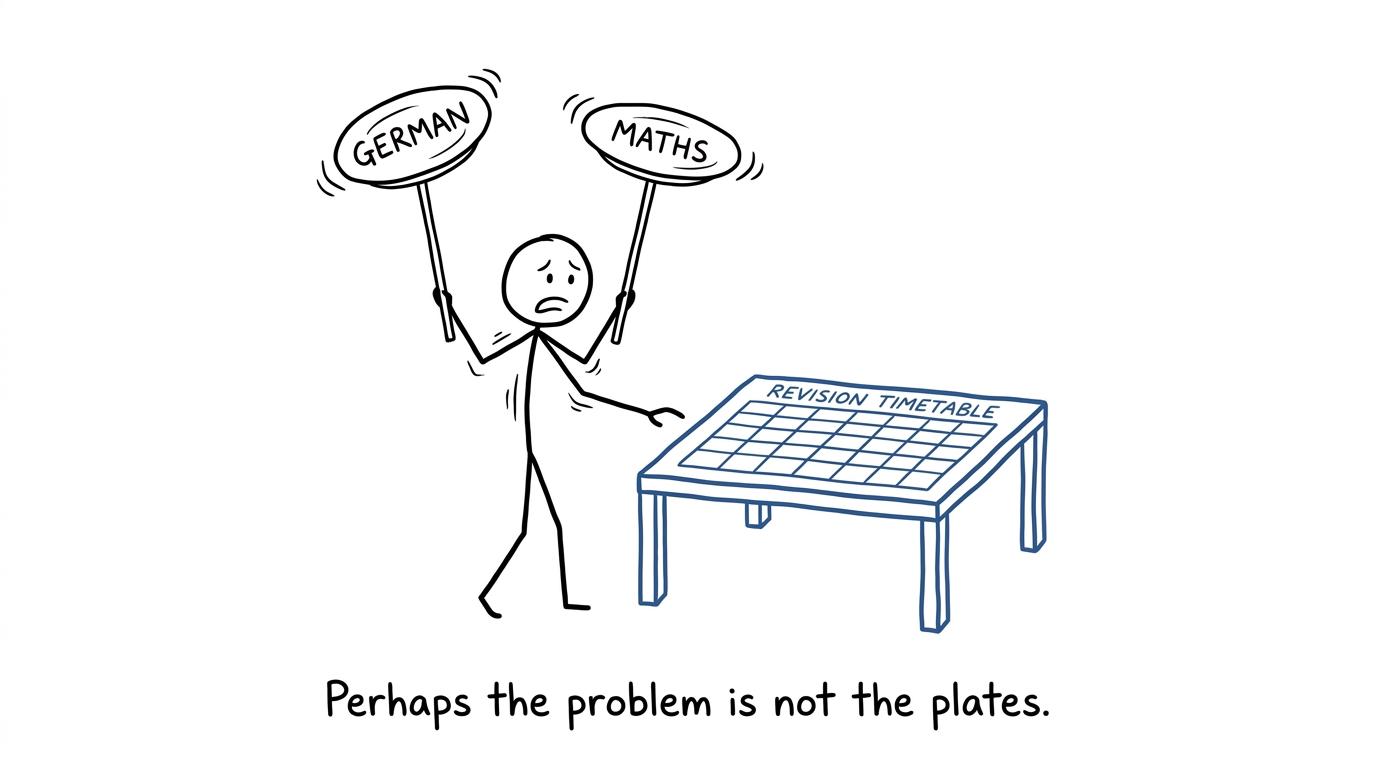 A student balancing German and maths revision discovers a timetable
The subject was chosen for the wrong reason
A friend choosing German can make the classroom feel safer. A teacher's encouragement can make the option feel sensible. Neither is a reliable substitute for personal interest and a realistic view of the course.
Friendship groups change, classes may be arranged differently and the teacher you expect may not take your group. Choose the content and assessment, not an imagined seating plan.
Some schools also encourage a language as part of an English Baccalaureate pathway. The EBacc is a school performance measure in England rather than a separate qualification. Ask your school how its options policy applies to you instead of relying on playground explanations.
What GCSE German actually involves
GCSE German assesses four language skills:
- listening;
- speaking;
- reading;
- writing.
Your exact papers, task types, timings, tier arrangements and permitted preparation depend on the specification used by your school. AQA, Pearson Edexcel and Eduqas specifications should not be treated as interchangeable, and arrangements can also differ across UK nations and examination years.
Check the current specification and assessment materials supplied by your school. Do not base a decision on an older sibling's course, an outdated video or a paper from a different exam board.
Questions to ask your German department
A short conversation can prevent months of uncertainty. Ask:
- Which specification and examination year apply to my class?
- How are the four skills assessed?
- Does the school enter students for foundation or higher tier?
- How frequently will we complete speaking and listening practice?
- What vocabulary and grammar are expected?
- Are catch-up sessions available if I fall behind?
- When is the final deadline for changing an option?
These questions turn "German seems hard" into information you can use.
How to decide whether to stay or switch
Separate discomfort from a poor fit
Every worthwhile subject eventually becomes uncomfortable. The useful question is whether your discomfort is responding to growth or revealing a lasting mismatch.
A temporary problem may be caused by one weak topic, limited practice or anxiety about an unfamiliar assessment. A poor fit is broader: sustained lack of interest, serious difficulty across all four skills or a workload that remains unmanageable after support and better planning.
Give the problem a name before giving it a solution.
Compare the replacement honestly
If switching is possible, investigate the alternative with the same care. Look at its content, assessment structure, coursework or practical demands, timetable and likely catch-up work.
Do not compare the hardest week of German with the most attractive description of another subject. Compare both complete courses.
Protect maths revision without abandoning everything else
When options become stressful, maths revision often gets squeezed because its next examination can feel far away. Yet maths is cumulative too. Losing several weeks can create a larger recovery job later.
Use a simple cycle: choose one maths topic, complete focused practice, check the mark scheme and record the next gap. The GCSE mini tests are useful when time is limited, while GCSE past papers help you assess broader exam readiness.
Closer to the examination, MathsGenie predicted papers can add structured practice. They should complement specification coverage and past papers, not replace them.
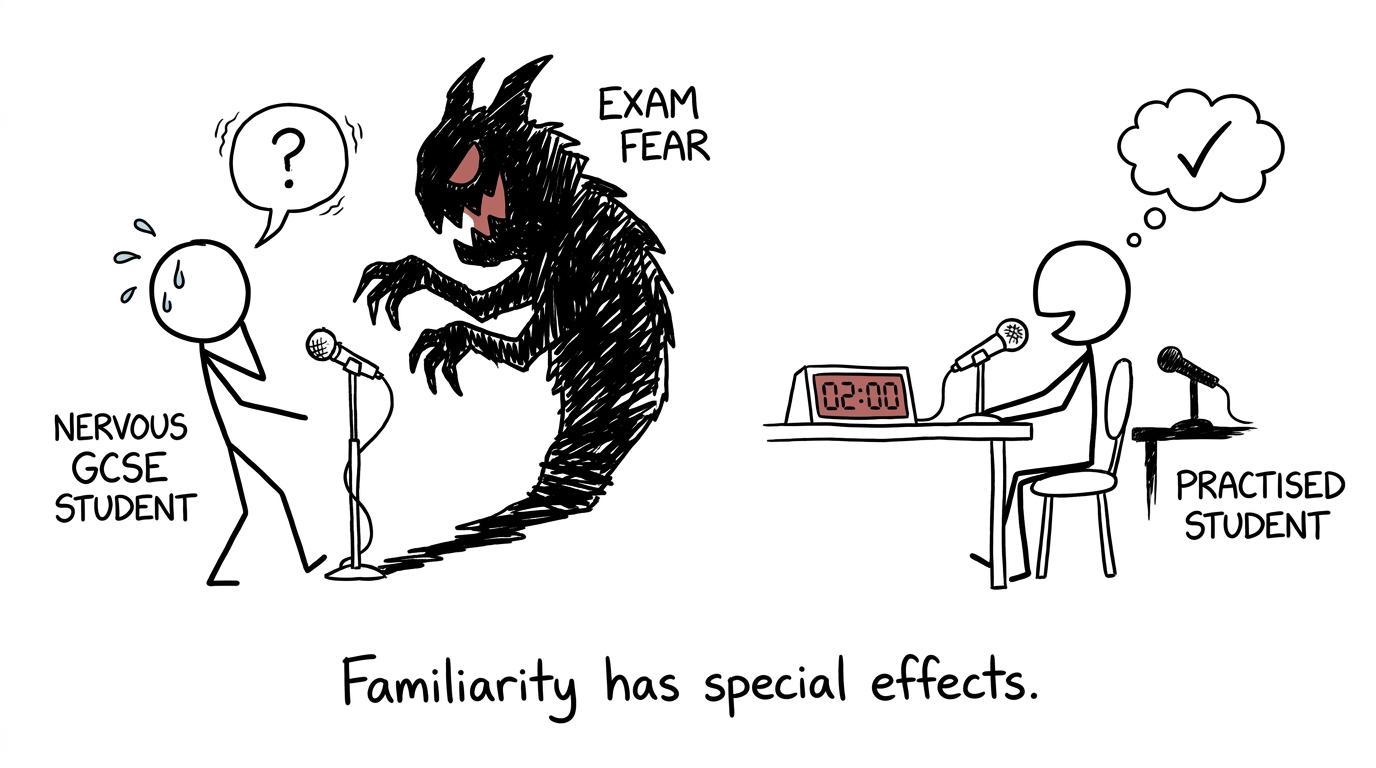 A speaking microphone loses its giant shadow after regular practice
If you have already chosen German
Start by speaking to your German teacher, form tutor or options lead. Explain the specific issue rather than saying only that you dislike the subject. Mention whether vocabulary, listening, speaking, grammar, workload or motivation is causing the concern.
If you stay, create a small routine:
- retrieve vocabulary from memory several times each week;
- listen to short German recordings regularly;
- practise speaking aloud before you feel fully ready;
- correct one recurring grammar weakness at a time;
- keep maths sessions protected in your timetable;
- use assessment feedback to choose the next task.
For maths, begin with the main MathsGenie GCSE revision hub, then move from revision videos to practice questions and mark schemes. If you are already thinking beyond GCSE, the A Level maths revision resources show how the same habits of focused practice continue later.
Common mistakes when judging GCSE German
Deciding after one poor result
One vocabulary test or difficult listening exercise is evidence about a topic, not a verdict on the entire qualification. Look for a pattern across time and across all four skills.
Ignoring the official specification
Course names are not enough. Assessment arrangements change, and exam boards use different tasks. Check the specification that applies to your cohort.
Memorising complete scripts without flexibility
A memorised response may feel secure until the question changes. Learn reusable vocabulary, structures and opinions so that you can adapt what you know.
Waiting too long to ask about switching
Schools have their own option-change procedures and deadlines. Waiting can create substantial catch-up work in the replacement subject. Ask early, even if you have not made a final decision.
Treating revision time as an all-or-nothing choice
German and maths do not need to compete for an entire evening. Focused sessions can keep both moving. The aim is not to feel busy; it is to know what improved.
Make the decision using evidence
It is understandable to regret picking GCSE German when the course feels different from what you expected. But regret is a signal to investigate, not an instruction to panic.
Check the specification. Speak to your teachers. Identify the precise difficulty. Compare any replacement fairly and protect your compulsory subjects while the decision is being made.
Then give maths the same clarity. Visit MathsGenie for free revision lessons, video solutions, practice questions, mini tests, mark schemes, past papers, predicted papers and a structured revision planner. A good revision plan cannot choose your options for you, but it can make the decision feel much less crowded.











