

Regret Picking GCSE Drama? What to Check First
Regret picking GCSE Drama? Explore why writing, group rehearsals and assessment can surprise students, plus what to check before choosing your options.
Choosing GCSE options can feel strangely permanent. A subject that sounds creative in Year 9 may feel very different once rehearsals, written analysis and deadlines arrive alongside maths, English and science. If you already regret picking GCSE Drama, the feeling often comes from a mismatch between the course you imagined and the course you are actually taking, not from a lack of ability.
GCSE Drama is not simply acting. It combines devising, performance or design, collaboration, evaluation, theatre knowledge and a written examination. For some students, that mixture is exactly what makes the subject worthwhile. For others, it creates pressures they did not expect.
This guide explains the most common sources of regret, what to investigate before committing, and how to protect your maths revision time if Drama is already on your timetable.
GCSE Drama reality check
Before choosing the subject, find out:
- which exam board your school uses;
- how the written examination and non-exam assessment are divided;
- whether you can follow a design route as an alternative to performing;
- how often rehearsals happen outside normal lessons;
- which set texts and theatre productions you will study;
- how individual marks are awarded within group work;
- what written portfolio, log or evaluation work is required;
- whether the course fits your confidence, interests and wider GCSE workload.
The exact arrangements vary between AQA, Edexcel, OCR and Eduqas, so your school's specification and course plan matter more than a general subject description.
Why some students regret picking GCSE Drama
Regret usually begins with an expectation gap. Students may expect a relaxed practical subject that provides relief from written work. The official course is broader and more rigorous.
GCSE Drama qualifications regulated in England allocate 40%40\%40% of the marks to examination and 60%60\%60% to non-exam assessment. Across the course, students create and develop ideas, apply theatrical skills, demonstrate knowledge and understanding, and analyse and evaluate theatre.
In other words, enjoying school productions is useful, but it is not the whole qualification.
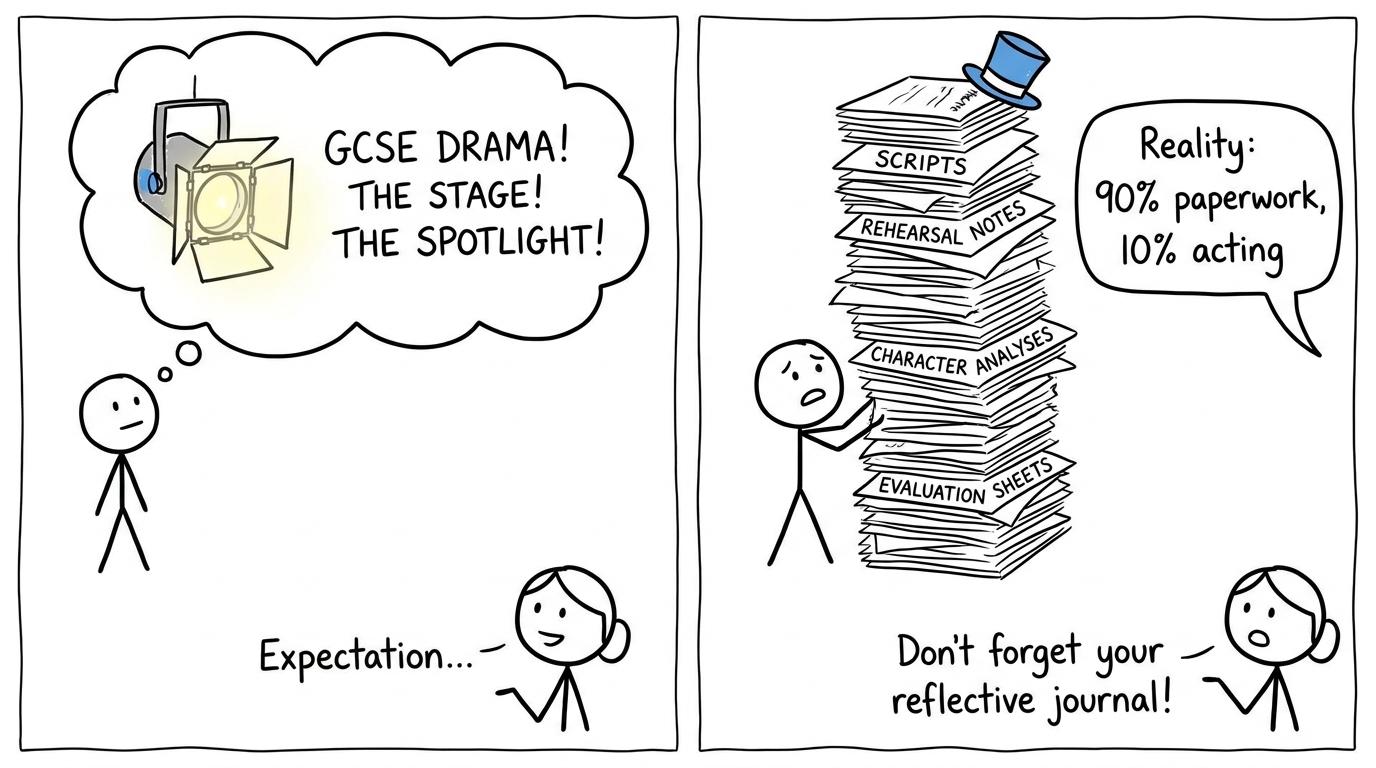 A student discovers that GCSE Drama includes scripts and evaluation sheets as well as a spotlight
There is more writing than expected
One of the largest surprises is the amount of explanation and evaluation involved. Depending on the exam board, students may produce a portfolio, devising log or supporting evidence. They must describe artistic intentions, explain how ideas developed and evaluate whether particular decisions communicated meaning.
The written examination also requires precise theatre vocabulary and developed analysis. You may need to discuss acting choices, direction, staging, lighting, sound, costume or the effect of a live production on an audience.
This is not necessarily a reason to avoid Drama. It is a reason to avoid choosing it solely because you hope to escape extended writing.
Group work affects the experience
Drama develops collaboration because theatre is collaborative. Yet that strength can also become a source of frustration.
A devised performance may depend on several people agreeing on an idea, attending rehearsals, learning material and responding constructively to feedback. You still have an individual responsibility, but the working process can feel uncertain when another member is absent or the group cannot settle on a direction.
Ask your teacher how groups are formed, how individual contributions are documented and what happens when attendance becomes a problem. Good assessment procedures can distinguish individual achievement, but they cannot remove every practical inconvenience of working with other people.
 A GCSE Drama group enters the difficult scheduling phase of rehearsal
Rehearsals can compete with revision
The lesson timetable rarely tells the whole story. Some departments arrange lunchtime, after-school or additional rehearsals, particularly near assessed performances. The precise commitment depends on your school, production and role, so it should be checked rather than assumed.
This becomes important when rehearsals overlap with preparation for compulsory subjects. A busy week can contain a Drama deadline, science assessment and maths paper at once. The problem is not that Drama is uniquely demanding. It is that practical deadlines can be less flexible than independent revision.
If you are balancing both, use a realistic GCSE maths revision timetable rather than hoping spare time will appear. Reserve short, repeatable maths sessions before rehearsal weeks become crowded.
Performing can feel more exposed than expected
Classroom Drama can feel informal. An assessed performance feels different because choices must be controlled, repeatable and purposeful. Students may be filmed or perform for an examiner, depending on the component and exam board.
Nervousness does not mean you cannot succeed. Rehearsal can make performance more secure. However, you should think honestly about whether you are willing to perform under assessment conditions, or whether your school offers and supports a suitable design route.
A design route is not an easy substitute. Lighting, sound, costume, set or puppetry requires clear artistic intentions and technical understanding. It simply uses a different collection of strengths.
Devising is creative but not completely free
Creating original theatre sounds like unlimited freedom. In practice, devised work must respond to a stimulus, communicate meaning and generate assessable evidence of development.
Ideas are researched, tested, refined and evaluated. An entertaining scene is not automatically effective if its purpose is unclear. Some students love this disciplined creative process. Others find the uncertainty harder than learning a script with an established structure.
Live theatre analysis requires detailed observation
GCSE Drama includes responding to theatre, not only making it. Students need to recognise what performers, directors and designers do and explain how their decisions shape meaning.
That demands more than saying a production was convincing. Strong analysis identifies a specific choice, describes it accurately and evaluates its effect. If you enjoy noticing how voice, movement, space, lighting and sound work together, this can be one of the richest parts of the course.
What to check before choosing GCSE Drama
Start with the actual course offered by your school. Request the exam board, specification, component weightings and a rough calendar of major assessments. An open evening description cannot tell you how your department organises rehearsals or which options it supports.
Then ask yourself four honest questions.
Do I enjoy improving work through repetition?
Drama is not constant novelty. Scenes are rehearsed repeatedly because small changes matter. You need enough patience to receive feedback, adjust a decision and try again.
Can I explain creative decisions in writing?
You do not need to arrive as a perfect essay writer. You do need to accept that written analysis is part of the subject and be prepared to improve it.
Am I comfortable depending on a group?
You cannot control every classmate. You can control your preparation, communication and evidence of contribution. Consider whether that responsibility energises or drains you.
What else will be competing for my time?
Look at your full option combination. A collection of subjects with practical work, portfolios or performances may create clustered deadlines. Ask when major Drama assessments usually happen and compare them with your likely revision periods.
For maths, identify your board and tier through the GCSE Maths revision hub, then review the GCSE topics by exam board and tier. Knowing the scale of your compulsory-subject revision makes an option decision more realistic.
What to do if you already regret the choice
First, identify the precise problem. “I hate Drama” is difficult to solve. “I struggle to evaluate my acting choices” or “rehearsals are replacing maths practice” gives you somewhere to begin.
Speak to your Drama teacher before assuming the situation is fixed. Ask what the next assessed component requires, where you are losing marks and whether extra support or a different permitted role is available. If you are considering changing subjects, speak promptly to your school. Timetables, completed content and entry arrangements may limit what is possible.
If the main issue is workload, create boundaries rather than abandoning revision whenever Drama becomes busy. The GCSE twenty-minute maths routine is designed for crowded school days. A short focused session can preserve continuity when a full paper is unrealistic.
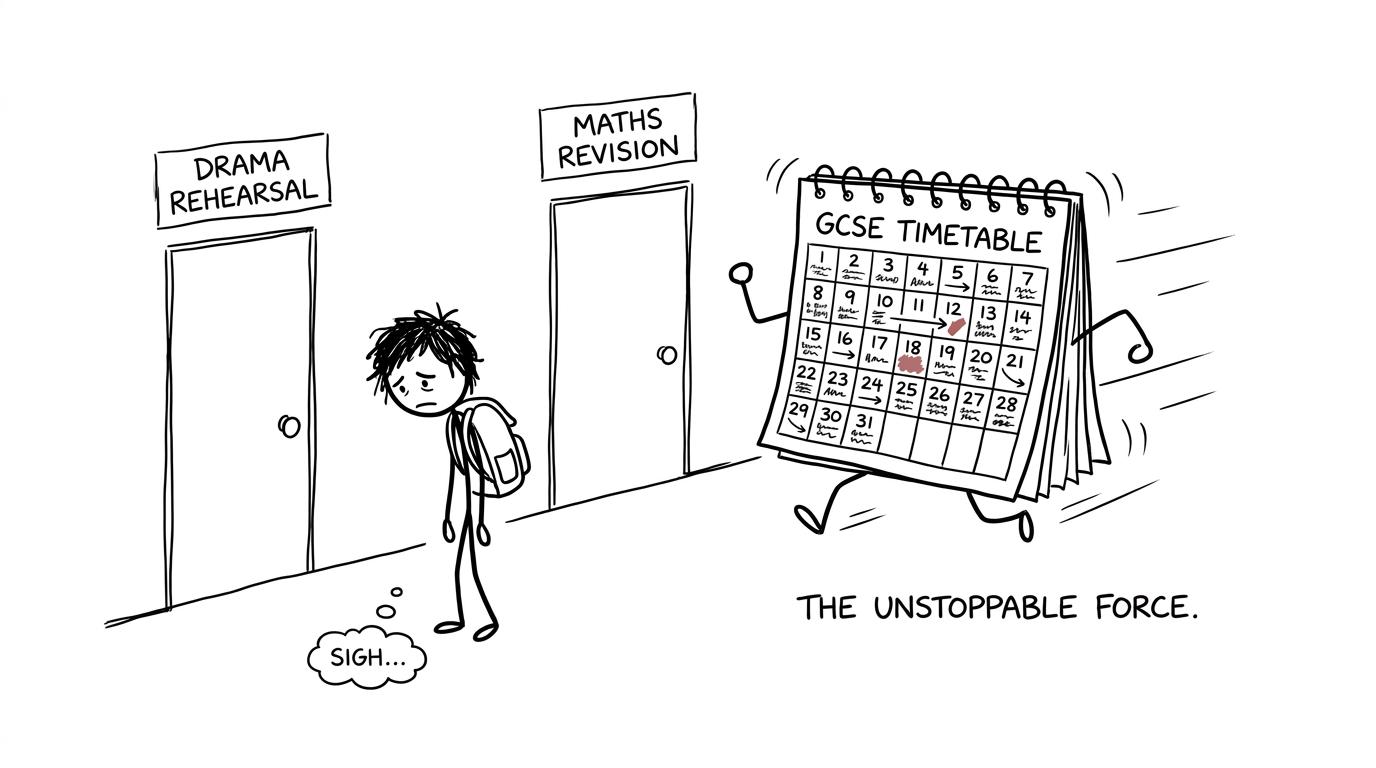 A GCSE student is chased by an overbooked calendar between Drama rehearsal and maths revision
Use evidence to choose the content of those sessions. The guide to finding your weakest GCSE topics explains how to turn lost marks into a manageable priority list. Nearer the examination, build towards papers gradually; MathsGenie's guide to when to start GCSE past papers can help you plan the transition.
Common mistakes when judging GCSE Drama
Choosing it because friends are choosing it
Friends can make lessons enjoyable, but groups and classes may change. The specification, workload and assessment remain. Choose the course you are willing to complete independently.
Assuming practical means easy
Practical assessment still demands preparation, precision and reflection. Creative subjects are not effortless subjects.
Ignoring the written examination
The written paper is a substantial part of the qualification. Check a specimen paper and mark scheme before choosing, even if performance is your main interest.
Treating every rehearsal as equally urgent
Some rehearsals are fixed and essential; others can be planned around. Keep one calendar for performances, coursework, mocks and maths revision so that urgency is visible rather than emotional.
Letting one difficult component define the course
Disliking devising does not automatically mean you will dislike text performance, design or live theatre analysis. Get specific feedback before deciding that the entire subject was a mistake.
Make the option decision with open eyes
GCSE Drama can be demanding because it asks students to create, collaborate, perform or design, write analytically and respond to theatre. Those are also the reasons many students value it. Regret is more likely when only the spotlight is visible and the rehearsal process remains hidden.
Check your school's course, speak to current teachers and pupils, inspect the assessment materials and consider your complete workload. If you have already committed, focus on the exact difficulty and ask for help early.
Meanwhile, keep compulsory maths revision steady. Start with MathsGenie's free GCSE maths revision resources, use revision lessons and practice questions to repair weak topics, and add mini tests, mark schemes and video solutions as you progress. When you are ready for timed practice, use the Edexcel GCSE Maths predicted papers or the equivalent past-paper resources for your board.
A good option choice is not the subject that looks easiest from a distance. It is the one whose real work you are prepared to do.











