

Redo GCSE Dance Mock Timed: Is It Worth It?
Redo GCSE Dance mock timed or review it first? Use this practical guide to fix knowledge gaps, improve pacing and plan your next revision session.
A disappointing mock creates a strong urge to wipe the slate clean. Set the timer, reopen the paper and prove that the first result was not the real you. But if you are wondering whether to redo GCSE Dance mock timed, the useful answer is usually: review and repair your first attempt before sitting the whole paper again.
A full timed resit becomes worthwhile when timing, concentration or question selection caused a significant share of the lost marks. If missing knowledge or weak analysis caused the problem, repeating the paper immediately can simply reproduce it under greater pressure.
This distinction matters beyond Dance. GCSE maths students face the same choice: another complete paper, or careful work on the questions that exposed a weakness? The best revision is not always the activity that feels most serious. It is the activity that changes what you can do next time.
The quick decision checklist
Review the original attempt first if:
- you could not recall key Dance terminology or details from the set works;
- your extended answers lacked analysis, interpretation or evaluation;
- you misunderstood command words;
- you repeated general comments without linking them to the question;
- you have not yet used the mark scheme or teacher feedback;
- the mock exposed several specific knowledge gaps.
Redo the full mock under timed conditions if:
- you knew substantially more than you managed to write;
- you left questions unfinished because of pacing;
- you spent too long on low-mark questions;
- concentration fell sharply during the paper;
- you have already repaired the weaknesses revealed by the first attempt;
- enough time has passed for the second sitting to test retrieval rather than short-term memory of your answers.
In many cases, the strongest plan combines both approaches: mark, diagnose, repair, retest selected questions, then complete a fresh timed paper.
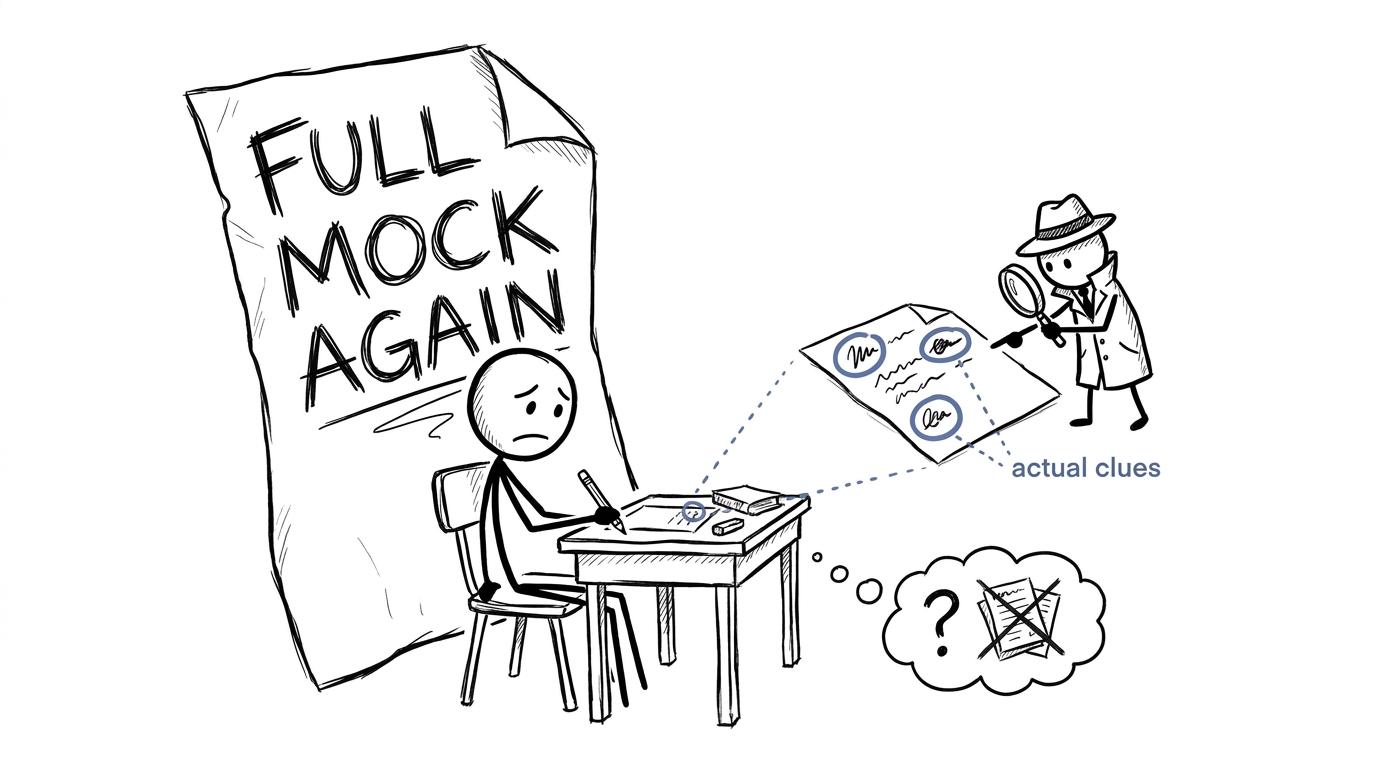 A student choosing useful clues over repeating an enormous mock
What a full GCSE Dance mock actually tests
For the current AQA GCSE Dance specification, Dance Appreciation is a written examination lasting 909090 minutes and carrying 808080 raw marks. It accounts for 40%40\%40% of the qualification. The paper has three sections covering choreographic processes and performing skills, critical appreciation of your own work, and critical appreciation of professional works.
The written component assesses AO3 and AO4. In practical terms, that means demonstrating knowledge and understanding, then using evidence to analyse, interpret and evaluate dance. Students must answer every section, so pacing and stamina genuinely matter.
A timed mock therefore tests several things at once:
- subject knowledge;
- recall without notes;
- understanding of command words;
- construction of concise and extended responses;
- selection of relevant evidence;
- pacing across the complete paper;
- concentration over 909090 minutes.
That makes a complete resit useful as an assessment. It does not automatically make it the best way to learn. A full paper can tell you that a problem exists, while focused review is often what allows you to solve it.
Why reviewing the first attempt usually comes first
A marked mock is not merely a score. It is a map of decisions made under pressure.
Begin by comparing every response with the mark scheme and any teacher comments. Do not stop at whether an answer was right or wrong. Identify why each mark disappeared.
Separate knowledge gaps from performance gaps
Use four categories:
- Knowledge gap: you did not know the required term, feature, process or set-work detail.
- Application gap: you knew relevant content but could not connect it to the precise question.
- Communication gap: your point was vague, unsupported or insufficiently developed.
- Timing gap: you could have answered but ran out of time or rushed unnecessarily.
The category determines the next action. Knowledge gaps need retrieval and relearning. Application gaps need carefully selected practice questions. Communication gaps need comparison with the mark scheme and stronger answer planning. Timing gaps need timed sections and, eventually, a complete paper.
This is the same diagnostic habit encouraged in MathsGenie's guide to finding your weakest GCSE topics. Whether the subject is Dance or maths, a total mark is less useful than knowing where and why the marks leaked away.
Make feedback produce an action
Research guidance from the Education Endowment Foundation emphasises planning, monitoring and evaluating learning. Its retrieval-practice guidance also stresses that active recall should be followed by feedback, because uncorrected retrieval can leave misconceptions in place.
That gives you a simple rule: never let a mock end at the mark.
For every important error, write one specific action. For example, you might need to revise a named set work, distinguish analysis from description, practise a particular command word or impose a time limit on an extended response. The action should be small enough to complete in one revision session.
Maths students can apply precisely the same loop through the GCSE Maths revision hub: use a revision lesson to rebuild understanding, answer practice questions, check the mark scheme and revisit the skill later.
When redoing the entire mock is worth it
A complete resit earns its place when it tests something that shorter practice cannot test properly.
Your main problem was pacing
If several answers were blank despite secure knowledge, the paper has revealed an exam-management problem. A timed resit can test whether you now move on appropriately, allocate attention according to the available marks and preserve enough time for later questions.
Before repeating the whole paper, try one or two timed sections. This reduces the cost of practice while isolating the weakness. MathsGenie's GCSE mini tests serve a similar purpose for maths: they create manageable pressure without demanding a complete examination every time.
You have repaired the original weaknesses
Sitting the same paper again immediately can create false confidence. You may remember the wording, the mark-scheme phrases or the answers you discussed, rather than independently retrieving the underlying knowledge.
A resit is more informative after you have:
- corrected the original responses;
- revised the relevant content;
- answered different questions on the same skills;
- left a gap before returning to the paper;
- removed notes, prompts and interruptions.
At that point, the second attempt becomes a check on whether the repair survives pressure.
You need to build full-paper stamina
Short questions cannot fully reproduce the experience of maintaining judgement across 909090 minutes. Nearer the examination, a complete timed paper can help you practise concentration, question selection and recovery after a difficult prompt.
But stamina should be built progressively. You would not sensibly begin physical training with the heaviest possible session every day. Exam practice works similarly: secure the component skills, introduce timed sections, then combine them in a full paper.
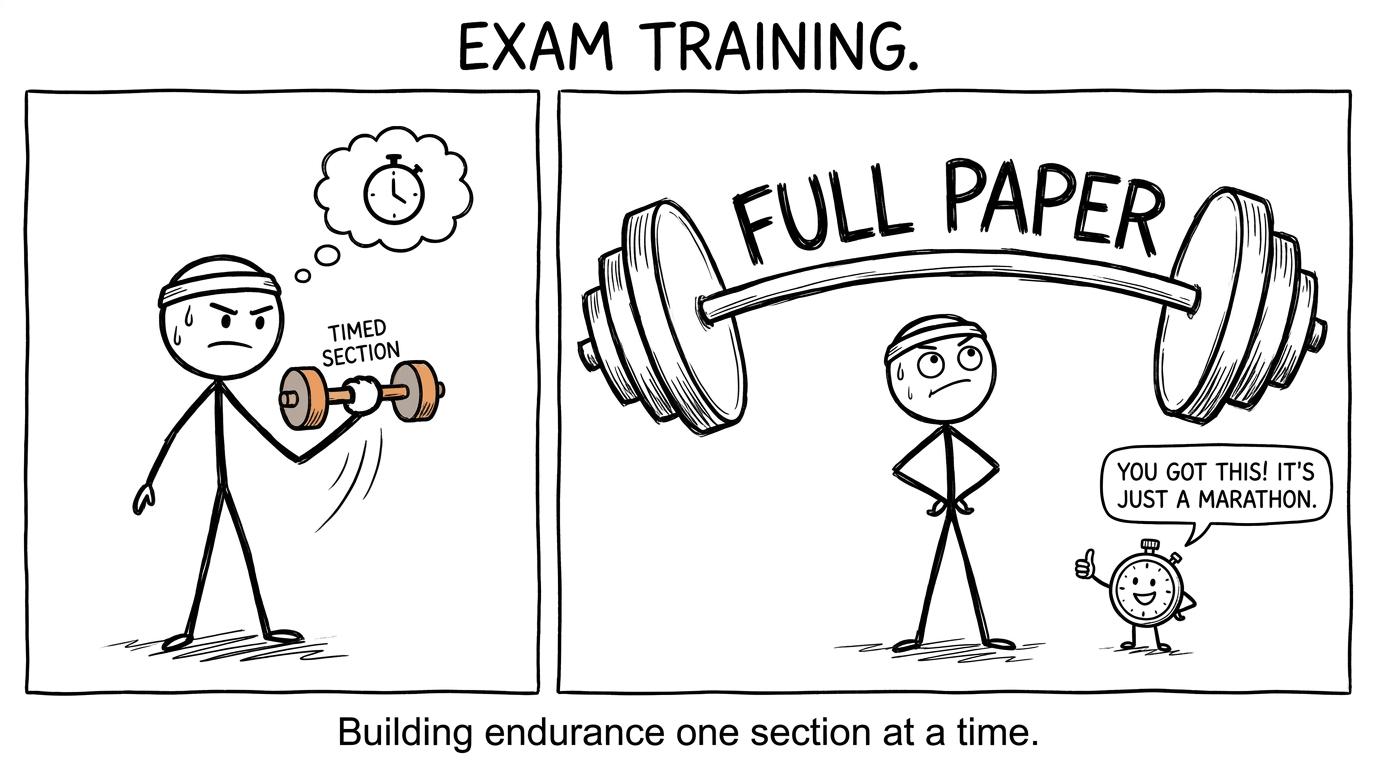 A student progressing from a timed section to a full paper
A more efficient revision sequence
If you have one full mock and limited revision time, use the following sequence.
Diagnose the original paper
Mark it carefully and classify every significant loss as knowledge, application, communication or timing. Select the three areas that cost the most marks or appeared repeatedly.
Repair the smallest useful skill
Avoid broad tasks such as “revise Dance”. Choose something observable: recall accurate evidence for a set work, plan an analytical paragraph, distinguish two command words or produce a concise explanation within a fixed time.
Maths revision becomes more manageable for the same reason. Instead of “revise algebra”, students can choose one lesson and its questions from MathsGenie's structured free GCSE maths resources.
Retest with different material
Use fresh questions where possible. This checks whether you understand the content rather than remember the original response. Mark promptly and make another correction if necessary.
For maths, GCSE predicted papers and board-specific past papers provide mixed practice once individual topics have been repaired. Predicted papers should be treated as additional practice, not as a guarantee of what will appear.
Add controlled timing
Time a section before committing to another full mock. Your target is not simply to write faster. It is to make quicker decisions about relevance, depth and when to move on.
Sit a fresh full paper where possible
A fresh paper gives cleaner evidence than an immediate repeat. If no unused mock is available, redo the original after a delay and recognise that familiarity may improve the result. Recreate sensible exam conditions: uninterrupted time, permitted equipment, no notes and strict adherence to the paper's limit.
Then mark it. The revision loop is still incomplete until the second attempt has produced its own next steps.
How this decision applies to GCSE maths
Although Dance Appreciation and GCSE maths assess different knowledge, the revision decision is remarkably similar.
A complete maths paper is valuable for testing mixed-topic recognition, calculator or non-calculator technique, method under pressure and pacing. Yet if the first paper shows that fractions, algebraic manipulation or circle theorems are insecure, immediately repeating every question is inefficient. Targeted teaching and practice should come first.
MathsGenie's one-month GCSE revision plan builds towards exam conditions rather than relying on full papers alone. The GCSE maths revision timetable guide likewise combines focused learning, immediate marking and timed practice.
The broad sequence is:
- diagnose with a paper or mock;
- learn the missing content;
- practise the weak skill;
- check solutions and mark schemes;
- retest after a delay;
- return to complete timed papers.
If you use an Edexcel paper, the guide to using GCSE maths past papers properly explains how to sit, mark and diagnose it rather than treating the final score as the whole story. Students following AQA, OCR or Eduqas can use the same underlying method with papers matching their own board, specification and foundation or higher tier.
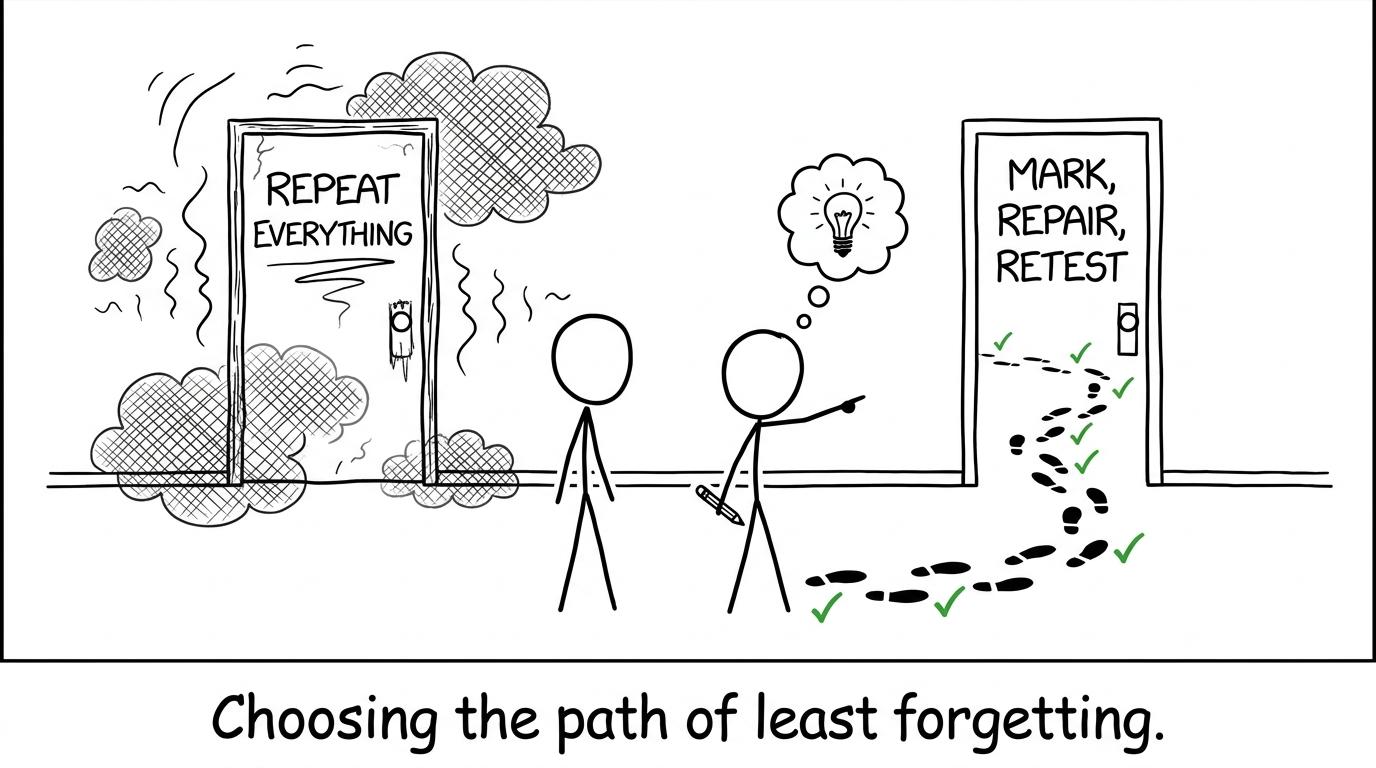 A student choosing the mark, repair and retest route
Common mistakes when repeating a GCSE mock
Redoing it before checking the mark scheme
This wastes the most valuable evidence from the first attempt. Review first so that the second sitting tests a deliberate improvement.
Treating a higher score as complete proof
Familiarity matters. On a repeated paper, you may remember prompts or corrections. Confirm improvement with different questions or a fresh paper.
Timing every revision activity
Pressure is useful only when the underlying knowledge is sufficiently secure. Untimed practice allows you to think carefully, while timed practice checks whether that thinking remains available in the exam.
Revising only what felt difficult
Feelings are imperfect evidence. A response may have felt fluent while remaining too descriptive or imprecise. Use the mark scheme, teacher feedback and marks lost to set priorities.
Completing papers without repairing errors
Paper after paper can become a measurement routine rather than a learning routine. The productive cycle is attempt, mark, repair and retest.
Make the next attempt different
It is worth redoing an entire GCSE Dance mock under timed conditions, but usually not as your first response to the original result. Start by discovering what the paper exposed. Repair missing knowledge and weak analysis, test those changes on selected questions, then use a full timed paper to check pacing and stamina.
The same principle can shape your maths revision. Start with the MathsGenie GCSE Maths hub, choose your exam board and tier, and turn each lost mark into a clear next step. Use free revision lessons and practice questions to rebuild individual skills, mini tests to check recall, and past papers or predicted papers with mark schemes and video solutions when you are ready for exam conditions.
Do not repeat a mock merely to replace an uncomfortable score. Repeat it when you have given the second attempt something new to reveal.











