Redo GCSE Art and Design Mock Timed: Worth It?
Redo GCSE Art and Design mock timed or review it instead? Learn when a full resit helps, when it wastes revision time, and how to decide calmly.
A disappointing mock creates a powerful urge: start again, work harder and prove the first result was not the real you. But if you are wondering whether to redo GCSE Art and Design mock timed, the short answer is usually not immediately. Review the original attempt first, identify what actually limited it, then rehearse the weakest parts. A complete timed rerun is worthwhile only when timing, stamina or executing your prepared intentions was the main problem.
That distinction matters when you are also preparing for GCSE maths. A full art mock can consume many hours. Those hours should buy you useful evidence, not simply the feeling of having worked hard.
The quick decision checklist
Redo the entire mock under timed conditions only if most of these statements are true:
- Your teacher agrees that a full rerun would address a genuine weakness.
- You had suitable preparatory work but struggled to use it under pressure.
- Your main difficulty was pacing, stamina, organisation or completing the outcome.
- You can reproduce realistic conditions without breaching your school’s assessment rules.
- You have enough time left for the review that must follow the rerun.
- The session will not displace more urgent revision in maths or another subject.
Choose a review plus shorter rehearsal if:
- Your ideas or preparatory studies were underdeveloped.
- You had not tested the materials or techniques sufficiently.
- You are unclear about the feedback or assessment objectives.
- Only one stage of the process went wrong.
- You would repeat the mock without changing your plan.
- You are considering it mainly because the first attempt felt disappointing.
The principle is simple: diagnose before you repeat.
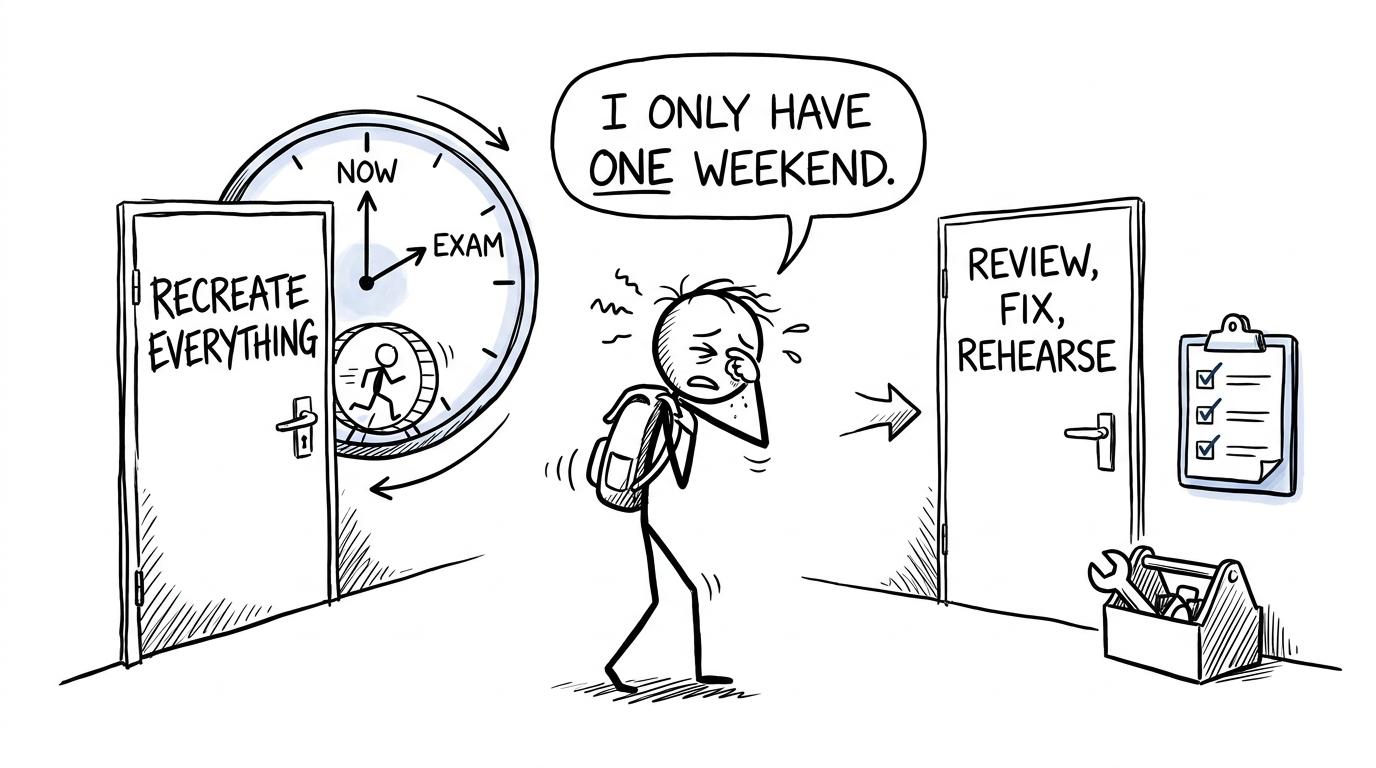 A student choosing between recreating everything and reviewing strategically
What a GCSE Art and Design mock is testing
A school mock is practice, so its exact format may vary. It is usually designed to prepare you for the externally set assignment and its period of supervised work. Check the instructions from your teacher rather than assuming that every mock follows identical arrangements.
Across the current AQA, Pearson Edexcel, OCR and Eduqas specifications, GCSE Art and Design assessment is organised around four common assessment objectives:
- AO1, develop: investigate sources and develop ideas with critical understanding.
- AO2, refine: explore, select and experiment with suitable materials, techniques and processes.
- AO3, record: record relevant ideas, observations and insights as the work progresses.
- AO4, present: produce a personal and meaningful response that realises your intentions.
The externally set component normally contributes 40%40\%40% of the qualification, while the portfolio contributes 60%60\%60%. The externally set assignment includes preparatory work followed by 101010 hours of supervised work, although the rules for arranging sessions differ between exam boards.
This explains why simply remaking the final outcome may have limited value. The assessment considers a journey: investigation, experimentation, recording, refinement and presentation. If the weakness began in the preparatory stages, another long final session cannot fully repair the cause.
Review the first attempt before deciding
A mock becomes useful when you stop seeing it as one finished object and start seeing it as evidence.
Ask your teacher for feedback connected to the assessment objectives. Then divide your findings into three categories.
Preparation problems
These include an unclear intention, limited source investigation, weak links between experiments and the final response, or insufficient testing of materials. The best response is usually to strengthen the preparatory process, not repeat the whole timed session.
You might revisit how your ideas developed, test a difficult technique on a smaller scale or make the relationship between your sources and personal response clearer. Follow your teacher’s guidance about what may be changed, particularly if any work relates to a live assessed component.
Execution problems
Perhaps the plan was strong, but the final piece became rushed. You may have spent too long on an early section, chosen a process that could not be completed reliably or lost time arranging materials.
This is where timed rehearsal can help. Yet even here, you may not need the entire mock. Rehearsing the opening stage, a complex transition or the final finishing period can reveal whether your revised plan works.
Decision-making problems
Some students lose time because every choice is reopened during the session: which material to use, where to begin, whether to change the composition or how polished each section should become.
The solution is not necessarily faster hands. It is fewer unresolved decisions. A clearer sequence, prepared workspace and tested technique can remove more pressure than another full attempt.
This is the same logic behind effective maths revision. Using GCSE past papers properly means marking, classifying errors, fixing weaknesses and retesting. Repeating a paper without that middle stage often reproduces the same habits.
When a complete timed redo is worth it
A full rerun becomes valuable when it answers a question that shorter practice cannot answer.
For example, you may need to know whether your amended plan remains realistic across a sustained session, whether your concentration holds, or whether the stages fit together within the available time. A realistic rerun can also expose practical issues such as drying time, equipment changes and an over-ambitious scale.
Before starting, write down what the second attempt is testing. Keep the list narrow:
- a planned sequence of stages;
- sensible checkpoints;
- reliable use of materials;
- sustained concentration;
- enough time to resolve the response rather than merely stop working.
Do not judge the rerun only by whether the final piece looks better. Ask whether the process became more controlled and whether your decisions became more deliberate.
You should also confirm the arrangements with your art teacher. The rules for an informal practice exercise are not the same as the controls applied to live assessed work. Official supervised work and preparatory materials are subject to exam-board and centre rules, including restrictions on access and alteration.
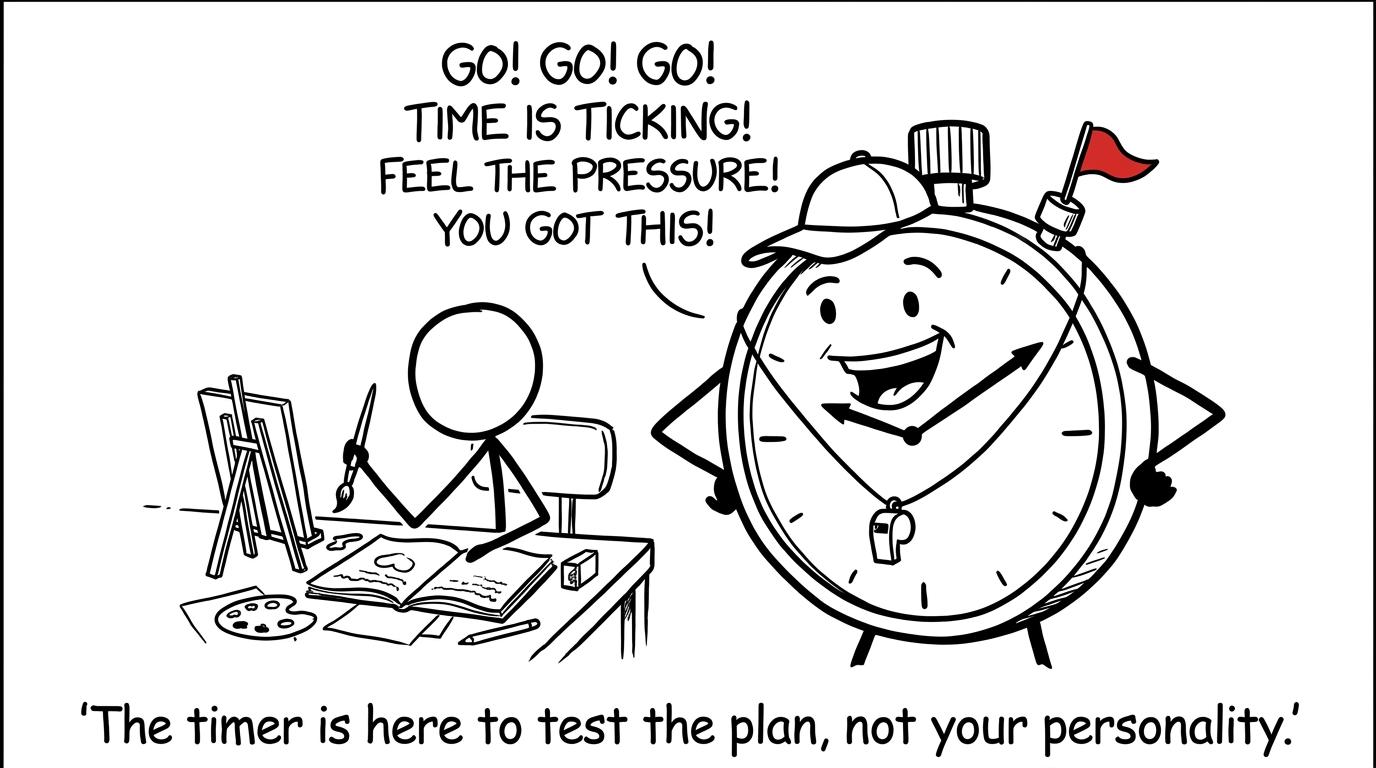 An overenthusiastic stopwatch coaching a student during an art mock
Why reviewing is often the better investment
A full redo feels complete. Review can feel smaller and less dramatic. But revision is not rewarded for drama.
Suppose the original mock revealed one unreliable technique, poor pacing near the end and a weak connection between the preparatory work and outcome. A better sequence would be:
- clarify the intention and teacher feedback;
- rehearse the unreliable technique separately;
- create checkpoints for the supervised session;
- complete one shorter timed trial;
- evaluate whether a full rerun is still needed.
Each action tests something specific. If the shorter trial solves the problem, the remaining hours can be used elsewhere.
That matters for a student balancing art with foundation or higher tier maths. The MathsGenie GCSE maths revision hub brings together exam-board resources, topic practice and papers for Edexcel, AQA, OCR and Eduqas. A short diagnostic can show whether your next available session should go towards art timing, algebra, geometry or another weakness.
If you need a manageable maths task alongside an intensive art week, Edexcel GCSE maths mini tests provide focused timed practice. Students with limited time can also use the structure in the 20-minute GCSE maths revision routine.
The aim is not to treat every subject equally every evening. It is to prevent one emotionally difficult mock from taking over the entire revision plan.
A better alternative to an immediate full rerun
Use a staged response.
Mark and annotate the evidence
Gather the mock, preparatory studies, teacher comments and any assessment grid provided by your school. For each assessment objective, note what is secure, what is inconsistent and what is missing.
Keep observations specific. “The mock was bad” cannot guide practice. “The final process took longer than the test piece suggested” can.
Rehearse the weakest process
Practise the particular stage that caused difficulty. Use the same materials and equipment where possible, but work on a manageable scale. Record practical information such as setup time, drying time or the order in which tools are required.
Run a timed section
Choose a section long enough to create genuine pressure but short enough to review carefully afterwards. Use realistic access to references and materials, following your teacher’s instructions.
Decide whether full practice adds new evidence
If the section now works and your overall sequence is clear, a complete redo may add little. If the separate stages work but you still do not know whether they can be sustained and combined, the full mock has a clear purpose.
The same staged approach helps with maths. Start with a short assessment, repair the topic and only then invest in a complete paper. MathsGenie’s guide to finding your weakest Edexcel maths topics explains how to turn mistakes into targeted revision rather than vague extra practice.
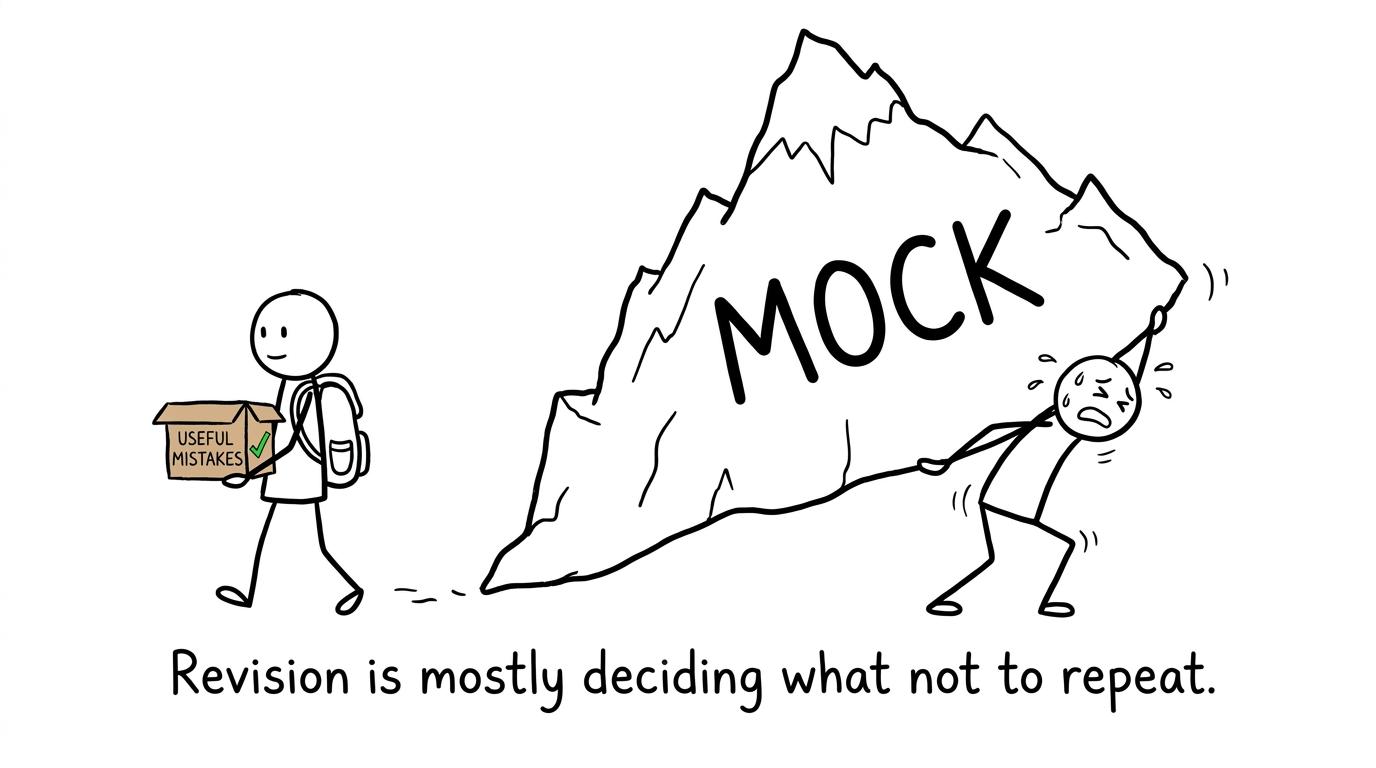 One student carrying useful mistakes while another tries to carry the whole mock
Common mistakes when repeating an art mock
Repeating before understanding the feedback
A second attempt is not automatically a better attempt. Translate each comment into a change you can observe in your planning or process.
Treating the final outcome as the whole assessment
The assessment objectives cover development, refinement, recording and presentation. A visually polished final response cannot substitute for an unexplained or poorly evidenced journey.
Making the second plan more ambitious
Students sometimes react to disappointment by adding detail, scale or another technique. Under timed conditions, simplification is often the more intelligent response. Ambition should be supported by preparation.
Creating unrealistic practice conditions
Pausing the timer, seeking help midway or using resources that would not be available in the mock weakens the evidence. If you are testing timing, keep conditions honest.
Finishing without reviewing
The value of a timed attempt lies partly in what happens afterwards. Compare checkpoints with reality, identify decisions that slowed you down and agree the next step with your teacher.
Sacrificing the wider revision plan
One poor result can become mentally larger than every other subject. Before committing to a long rerun, check upcoming deadlines and maths needs. The guide on when to start GCSE past papers can help you place full papers within a broader revision schedule rather than using them impulsively.
Make the next attempt earn its time
So, is it worth redoing an entire GCSE Art and Design mock under timed conditions? Sometimes, but only after review shows that sustained timed performance is the skill you need to test. If the real weakness was preparation, experimentation or clarity of intention, targeted repair is likely to be more useful and far less expensive in revision time.
Treat the first mock as information, not a verdict. Ask what failed, change the plan, rehearse the fragile part and use a complete rerun only when it can reveal something new.
Then protect the rest of your GCSE preparation. Visit MathsGenie’s free revision website to continue with revision lessons, practice questions, mini tests, past papers, predicted papers, mark schemes and video solutions. The strongest revision plan is rarely the one that repeats the most work. It is the one that learns the most from each attempt.